Jev AI Explained: The Decision-Making Model Built for Software Automation
TypeSafe AI just launched Jev, and it highlights a major flaw in how we currently build AI agents: we are wasting massive computing power forcing LLMs to output paragraphs when all our code needs is a simple yes or no.
That's the idea behind Jev: a model designed to turn application state into structured, actionable decisions instead of generating traditional text.
AI applications do not always need another paragraph of generated text.
Sometimes, the application simply needs an answer to a small but important question:
- Which support team should handle this ticket?
- Should an AI agent call a particular tool?
- Is this request urgent?
- Should this workflow continue or stop?
- Does this response pass a specific quality check?
- Should this action require human approval?
Traditionally, developers often use a general-purpose large language model (LLM) for these decisions. The application sends a prompt, asks the model to return structured JSON, parses the response, validates it, and then decides what to do.
Jev takes a different approach.
Jev is TypeSafe AI's first public System One Model, designed specifically for making fast, structured decisions inside software. Instead of generating open-ended text, Jev evaluates application state against predefined questions and returns typed decisions with probabilities and confidence information.
Read the official announcement on TypeSafe AI's website .
The result is a different way of thinking about AI architecture:
Instead of asking an AI to explain a decision, ask it to make the decision your software actually needs.
What Is Jev?
Jev is a probabilistic decision model created by TypeSafe AI.
The model was introduced on September 15, 2026, as the company's first public System One Model. TypeSafe describes System One models as a new class of models designed for decisions inside software rather than traditional human-facing chat.
Jev System One Model
The simplest way to understand Jev is:
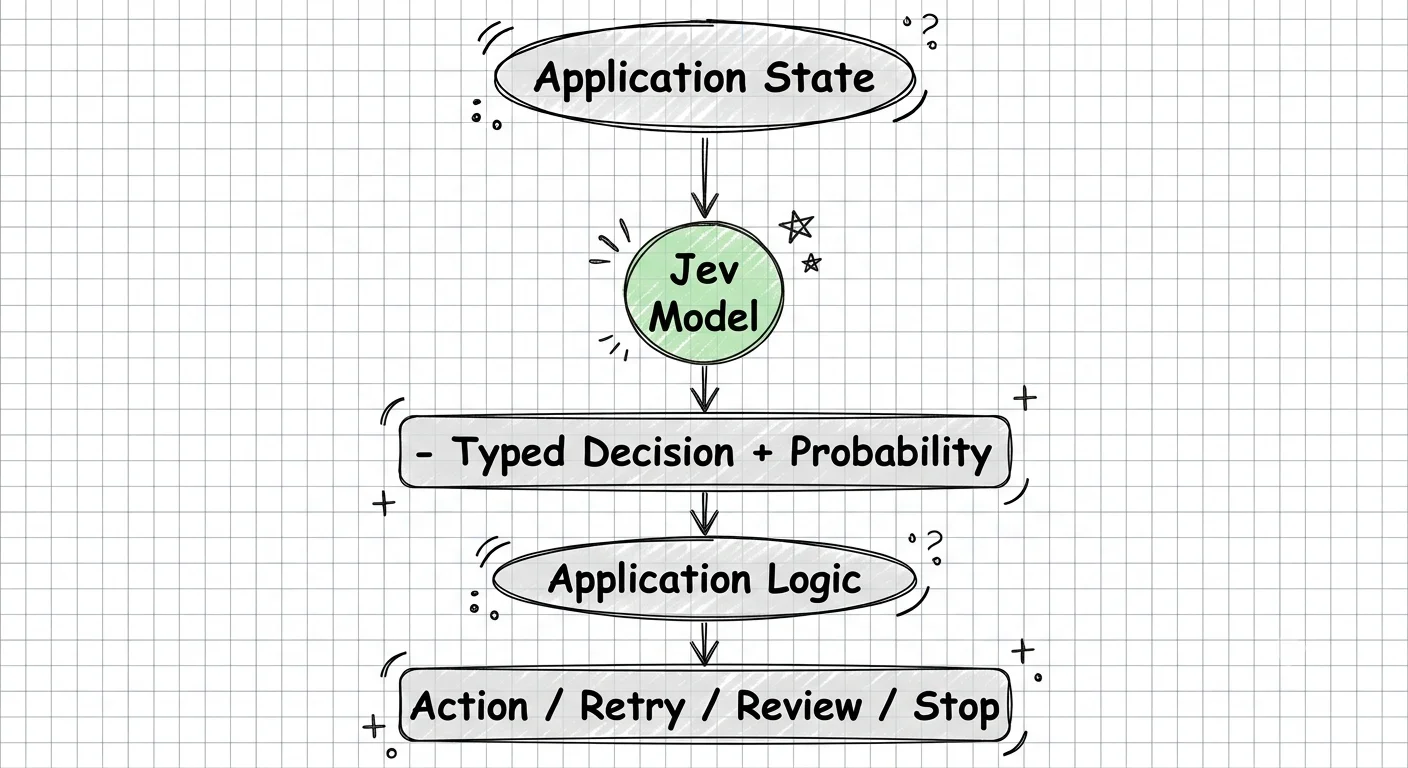
Unlike a normal LLM, Jev does not try to generate a paragraph explaining what it thinks.
Instead, your application defines the possible decision space beforehand.
For example:
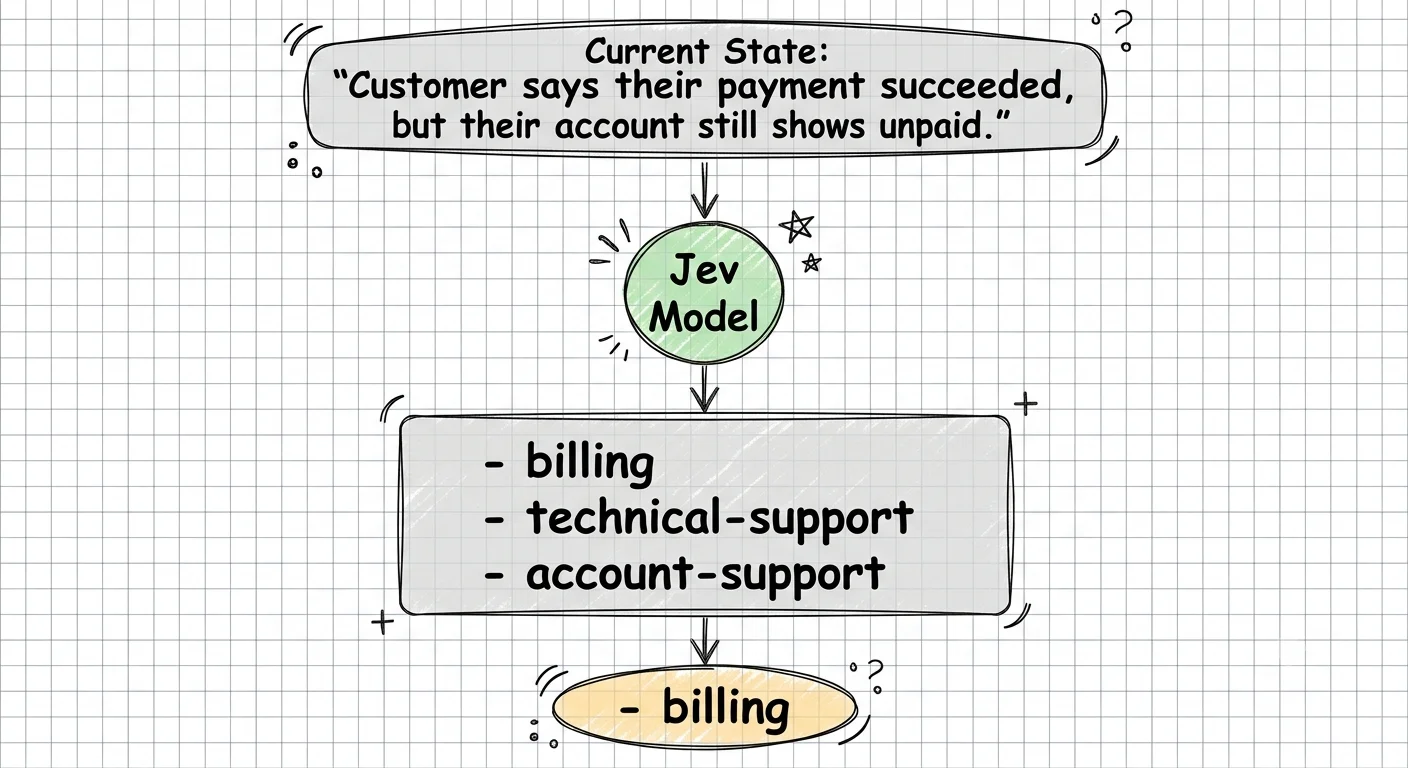 Jev can select one of those choices and provide probability information that your application can use when deciding whether to automate the next step or request human review.
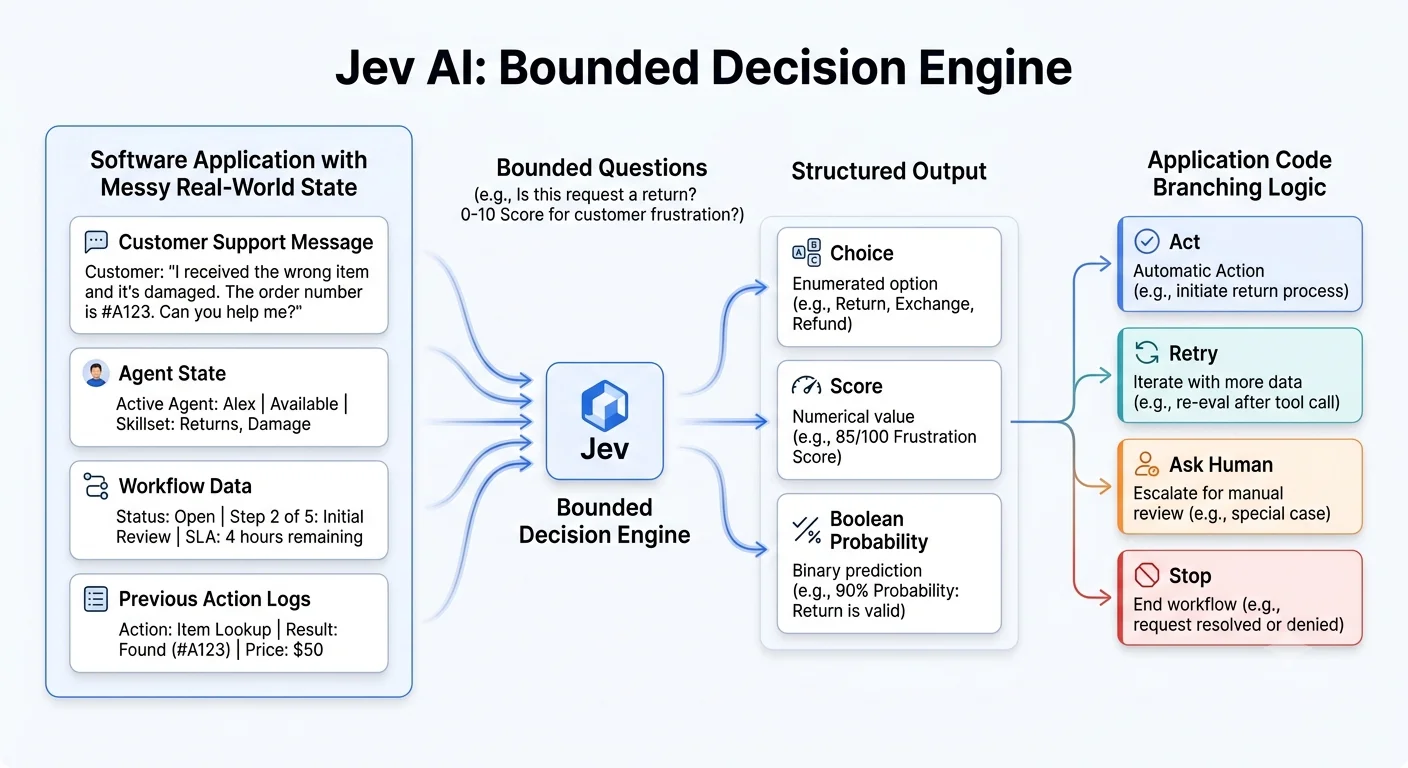
Jev in One Picture
Why Do We Need a Decision Model?
Large language models are extremely capable.
But many software workflows do not actually require text generation.
Imagine an AI agent that receives a user request.
The agent has five possible tools:
- Search documentation
- Search database
- Call payment API
- Send email
- Ask the user
The agent may need an intelligent decision about which tool to use next.
A traditional approach might ask an LLM:
"Based on the current state, decide which tool should be called next and return your answer as JSON."
That introduces an unnecessary generation step.
The model generates text.
The application parses the text.
The application validates the JSON.
Then the application extracts the actual decision.
Jev is designed around the decision itself.
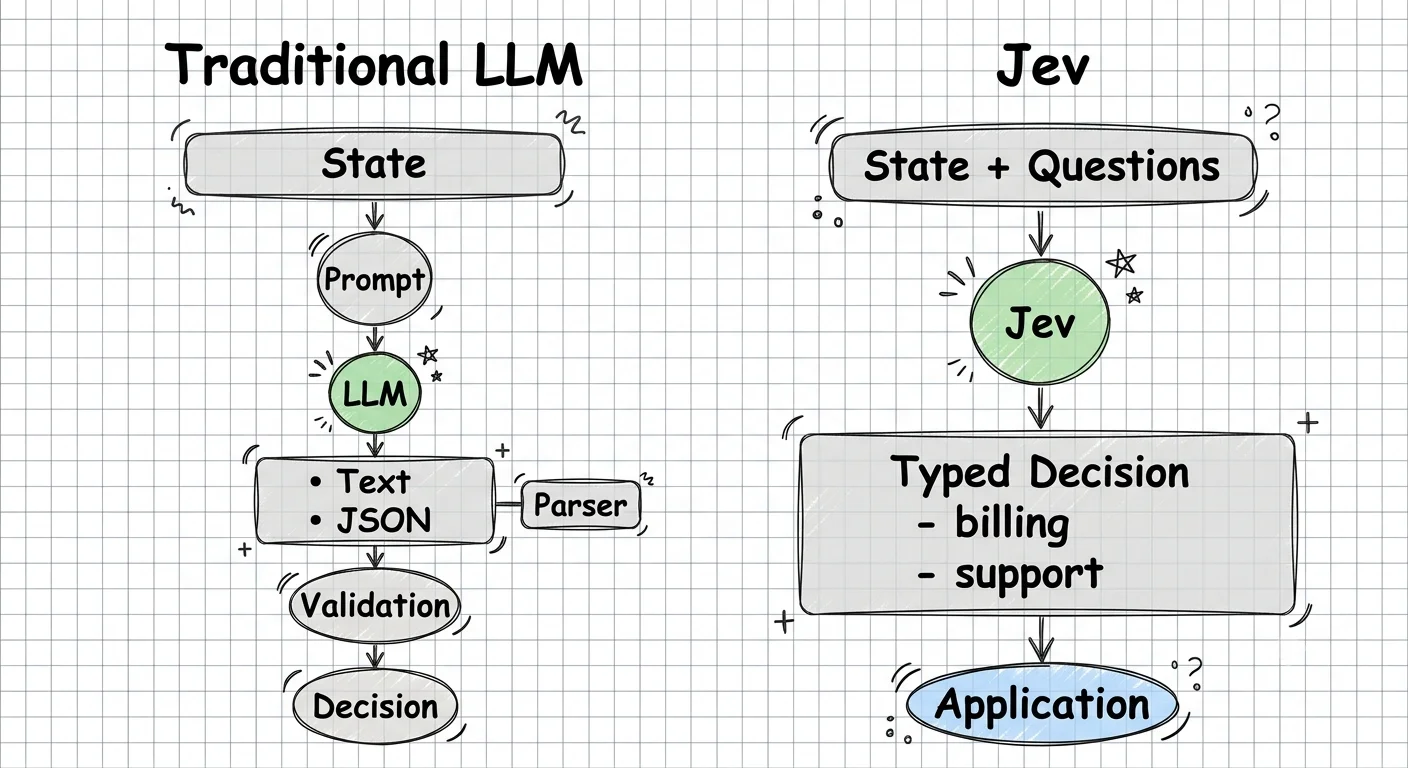
Vercel's AI Gateway describes the same distinction: regular language models generate text that applications then parse and validate, while Jev evaluates declared questions and returns typed answers directly.
The Three Core Decision Types in Jev
Jev's current interface revolves around three fundamental types of decisions:
- Choice
- Score
- Boolean probability
These cover different kinds of bounded decisions.
1. Choice
A Choice question asks Jev to select one option from a predefined set.
For example:
Question: Which department should handle this ticket?
Options:
- Billing
- Technical Support
- Account Support
- Human Review
Jev does not need to invent another category.
It chooses from the options supplied by the application.
This makes Choice useful for:
- Ticket routing
- Agent selection
- Tool selection
- Model selection
- Intent classification
- Workflow routing
For example:
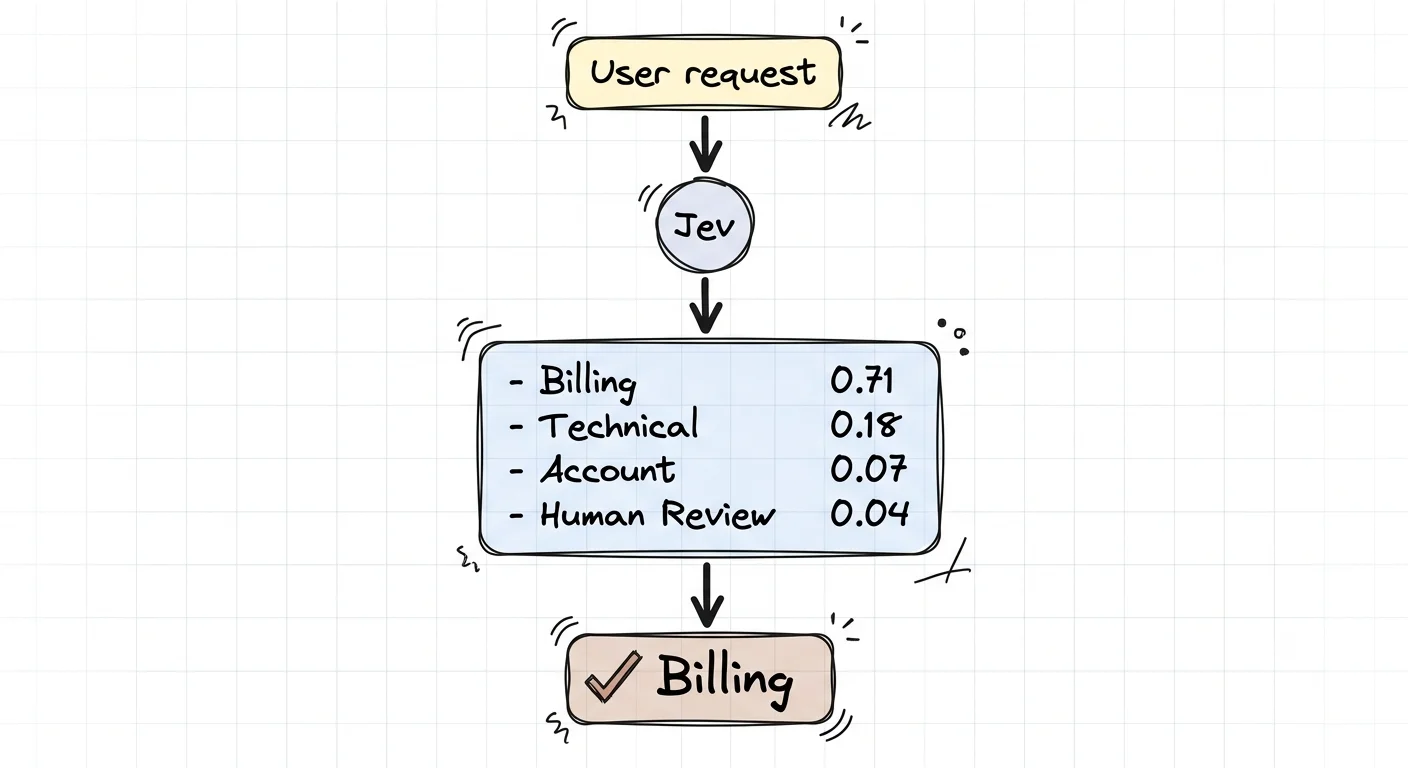
The exact output structure and probability interpretation should be tested against your own workflow and labeled examples before using it for autonomous actions. Vercel specifically recommends calibrating probabilities and confidence against known examples.
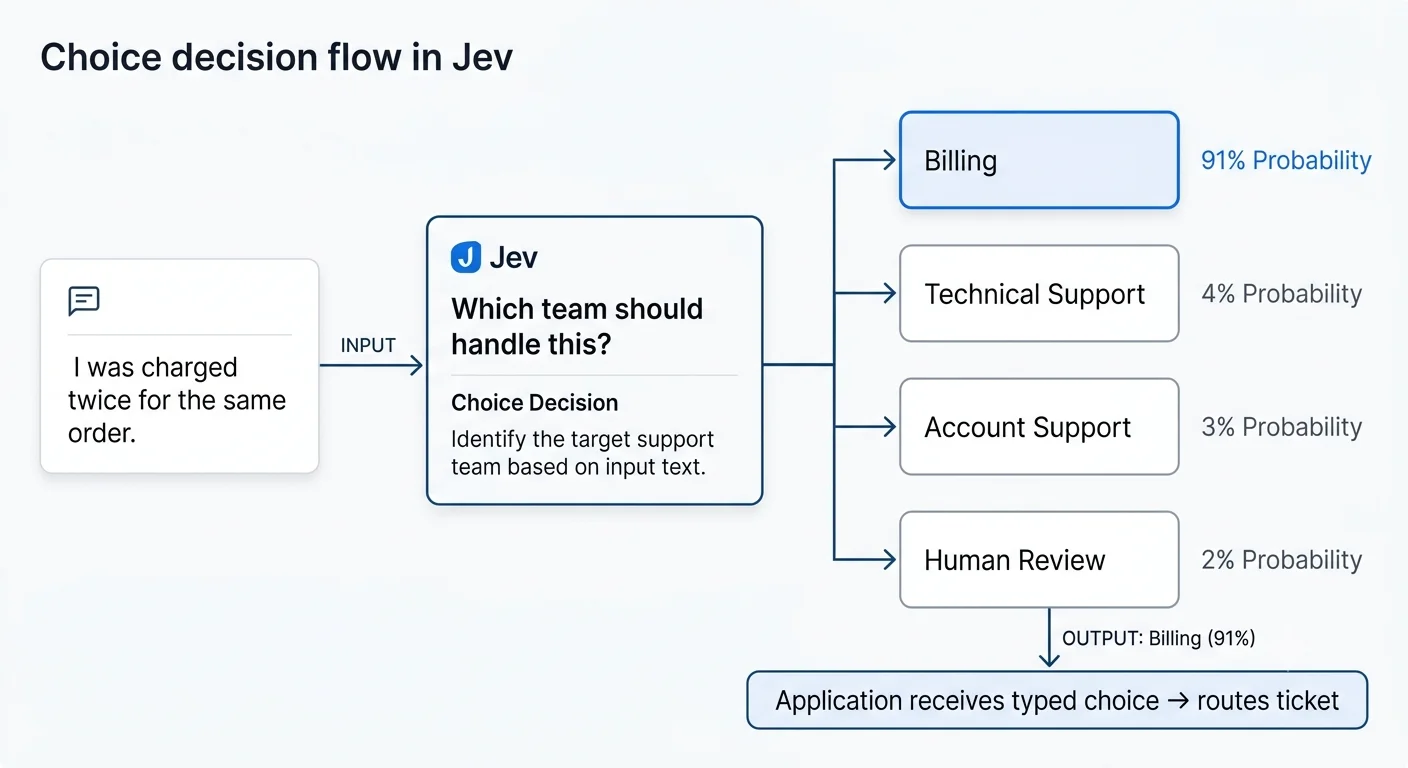
Choice Decision
2. Score
Some decisions are not about choosing a category.
Instead, software may need to determine how strongly something satisfies a defined criterion.
That is where a Score question can be useful.
For example:
Question: How urgent is this support request?
Scale:
1 → Very Low
2 → Low
3 → Moderate
4 → High
5 → Critical
A support system could then use the score in its workflow:
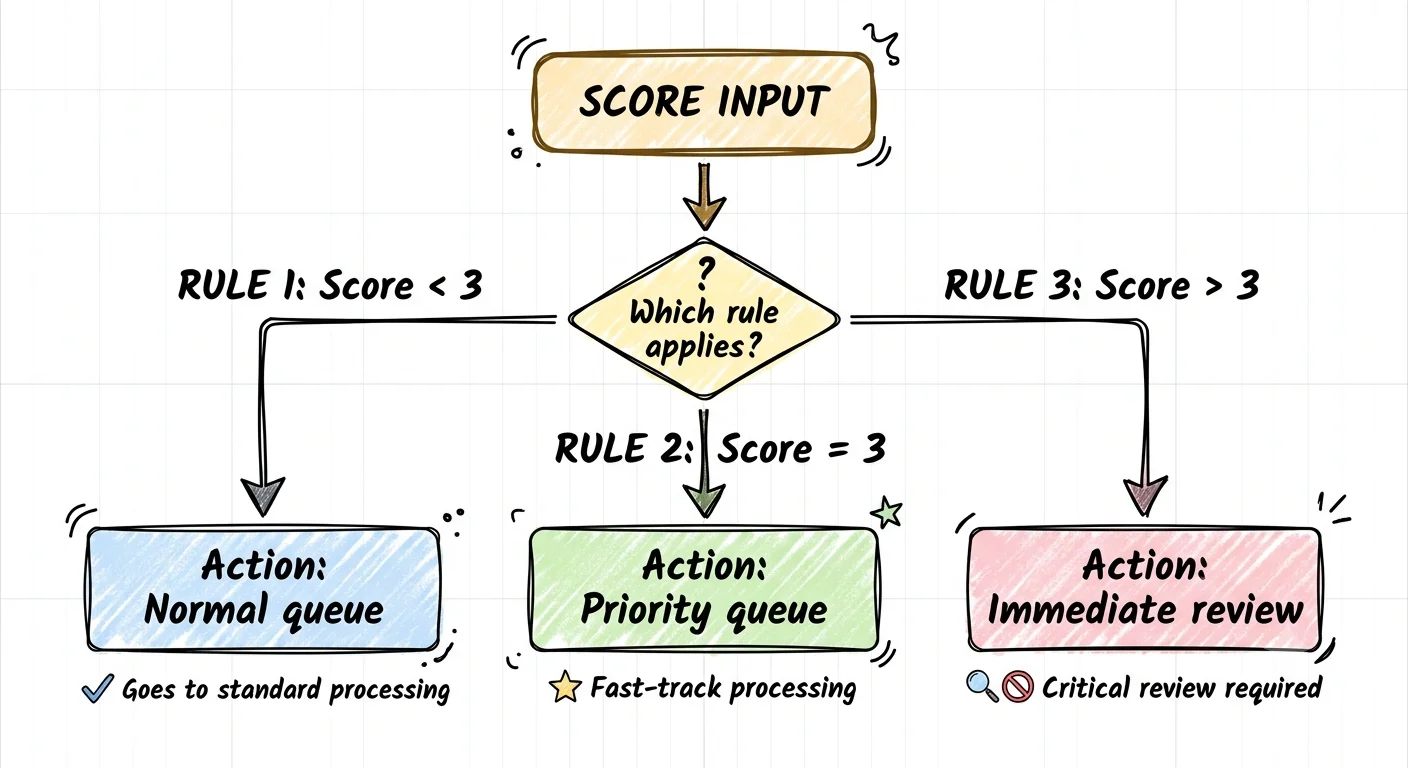
This is particularly useful when the application has a predefined rubric.
Potential examples include:
- Urgency scoring
- Risk assessment
- Quality evaluation
- Relevance scoring
- Priority classification
- Response evaluation
The important point is that the application defines what the scale means.
Jev is not being asked to write an explanation such as:
"I think this request is fairly urgent because..."
Instead, the software asks for a structured judgment against a known scale.
3. Boolean Probability
The third primitive handles questions that essentially have a yes/no outcome.
For example:
Question: "Does this request ask for a refund?"
Instead of producing:
Yes, the customer is asking for a refund.
Jev can provide a probability associated with the Boolean decision.
Conceptually:
P(True) = 0.94
The application can then define its own threshold.
For example:
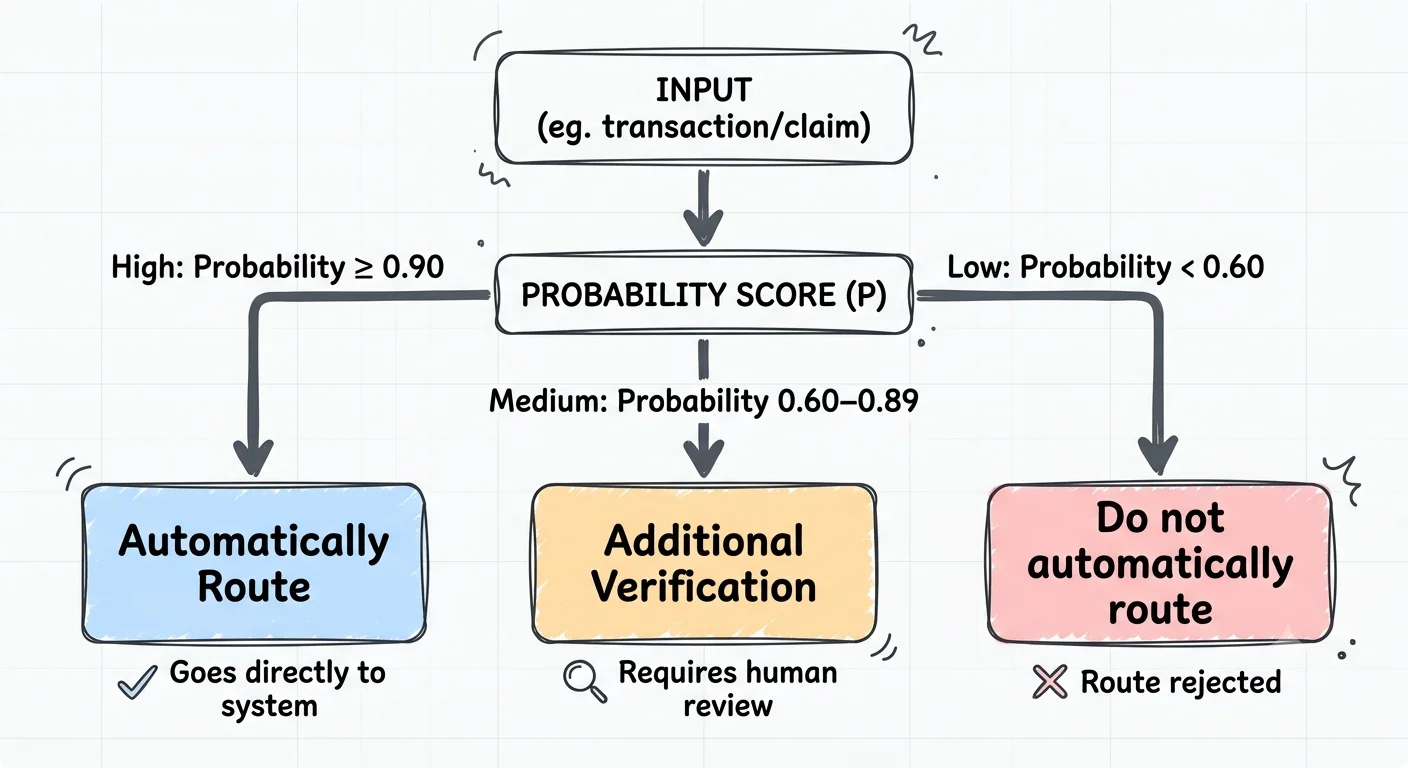
This is one of the important architectural ideas behind Jev.
The model supplies the judgment and uncertainty; your application decides what threshold should trigger an action.
Jev vs Traditional LLMs
The biggest difference becomes easier to understand through a side-by-side comparison.
| Traditional LLM | Jev |
| Generates text | Produces structured decisions |
| Open-ended output | Bounded output |
| Application parses generated output | Application receives typed answers |
| Often used for reasoning + writing | Designed for focused decisions |
| Can generate explanations | Does not generate prose |
| Useful for open-ended tasks | Useful for bounded decisions |
| Output must often be validated | Decision schema is defined beforehand |
This does not mean Jev replaces LLMs.
In many applications, the two can work together.
A generative model can handle:
- Understanding
- Writing
- Reasoning
- Code generation
- Conversation
while Jev can handle:
- Routing
- Classification
- Scoring
- Verification
- Tool selection
- Workflow decisions
Vercel similarly describes Jev as something that can sit at a decision point inside an agent loop while a generative model handles responses or other open-ended work.
The Most Important Architectural Difference
Consider an AI customer-support agent.
A user sends:
"My payment was successful but my order still says pending. Can you fix it?"
A traditional architecture might look like this:
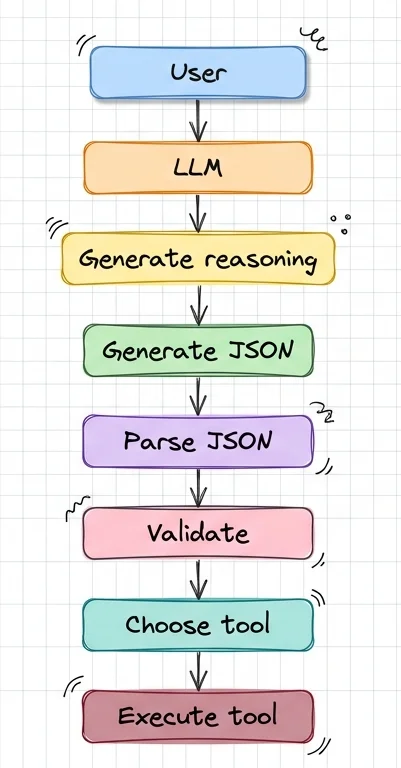
A Jev-based architecture can separate the decision from the generation:
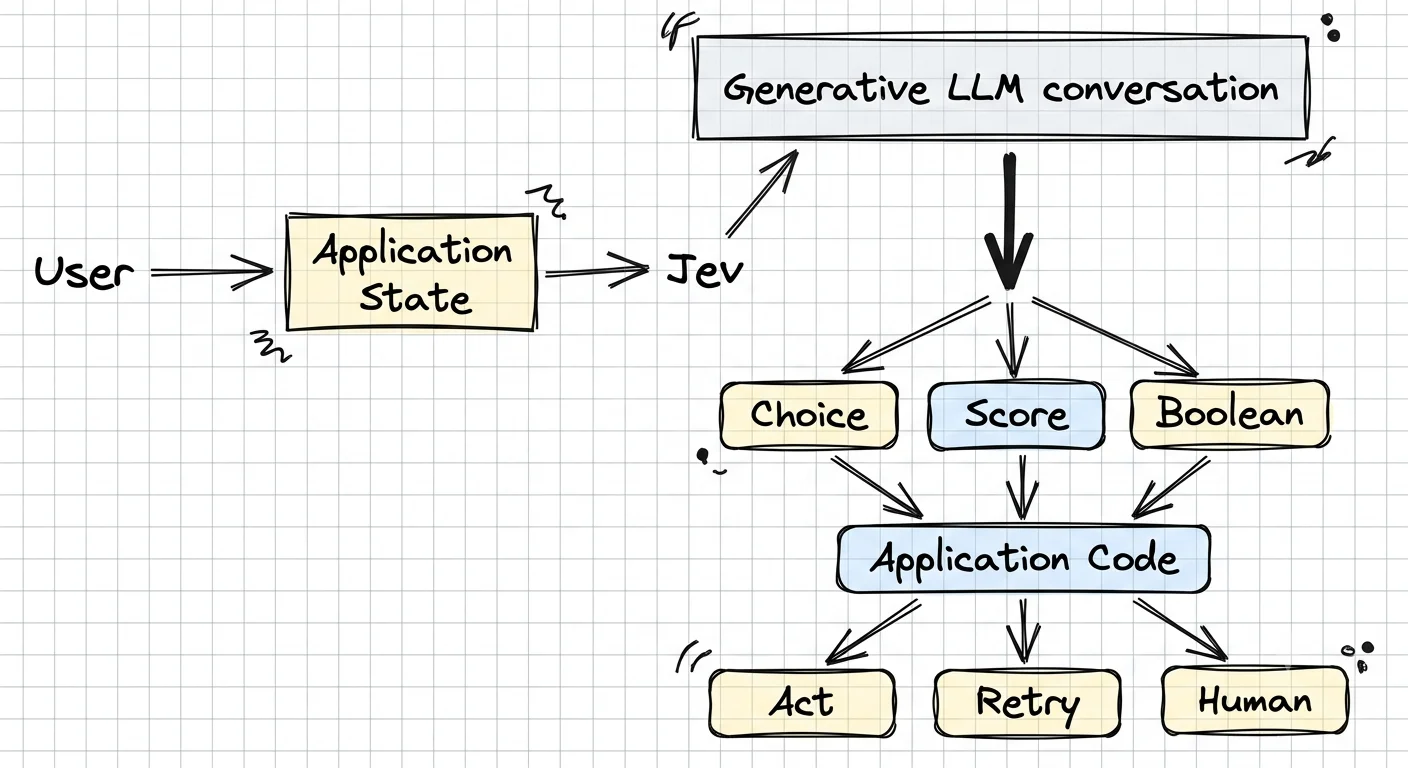
This is the architectural role Jev is trying to occupy: a decision layer between application state and application action.
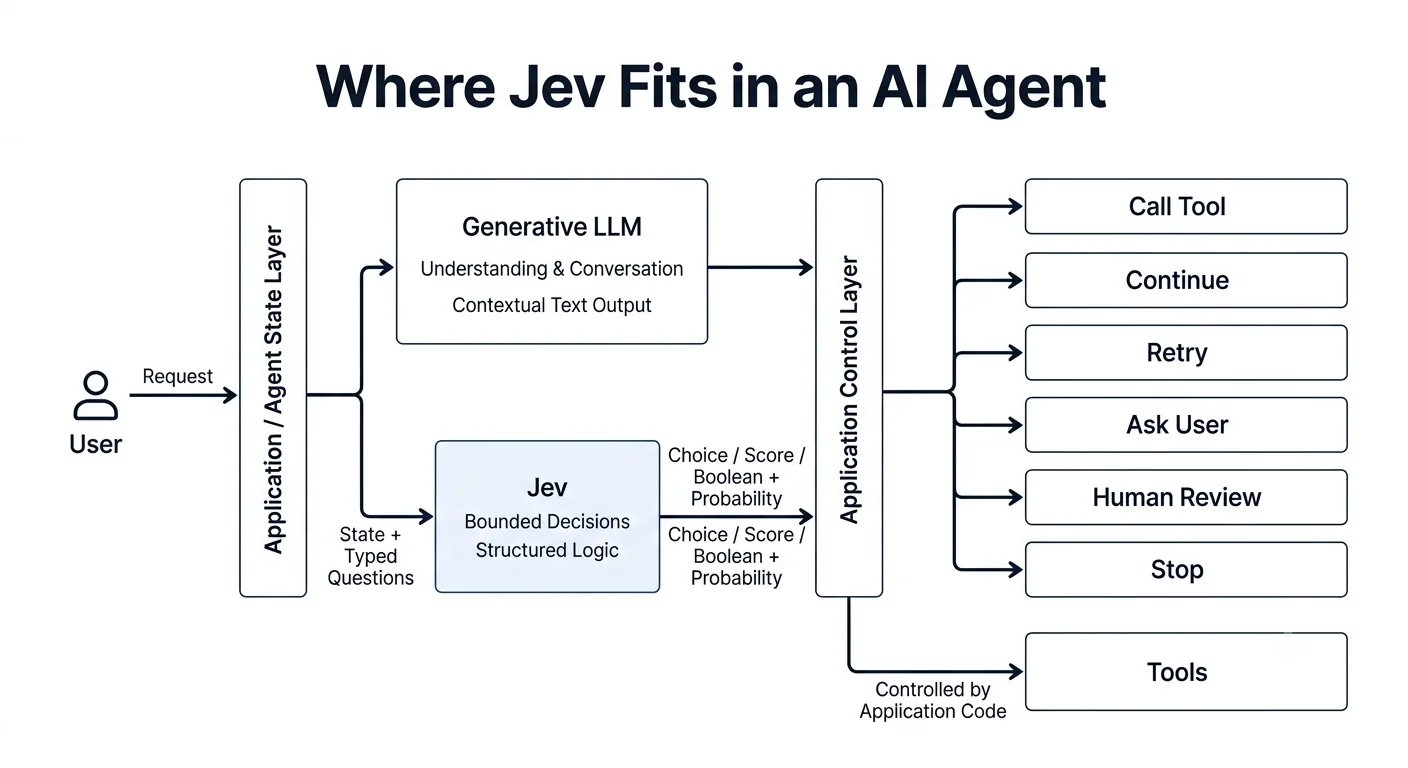
Full AI Agent Architecture
Jev in an AI Agent Loop
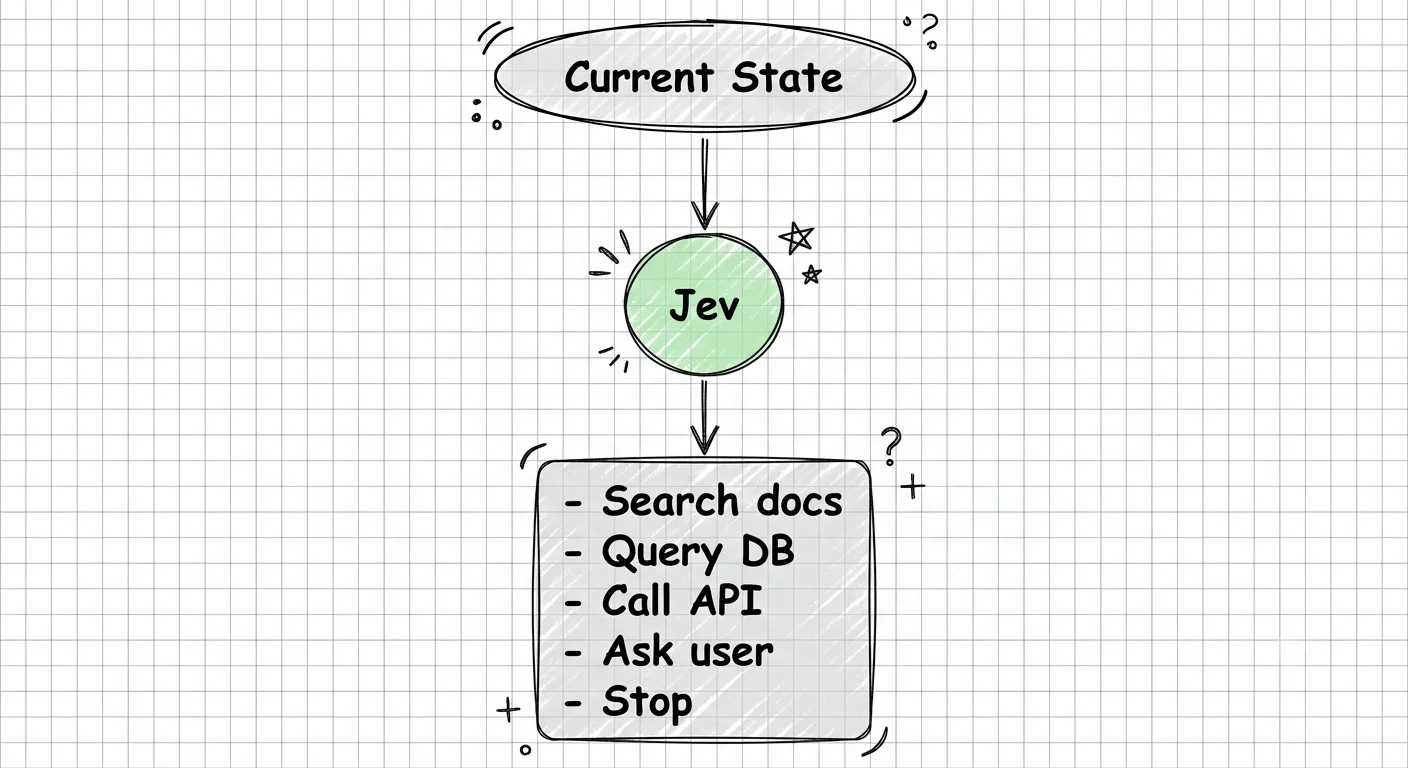
AI agents repeatedly make small decisions.
For example:
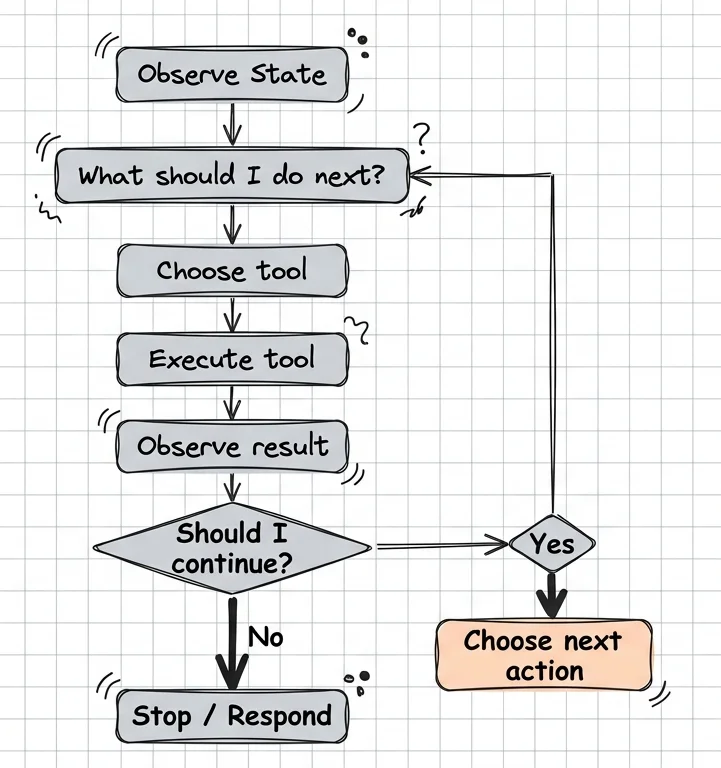
Jev can participate at these decision points.
For example, after an agent runs a search:
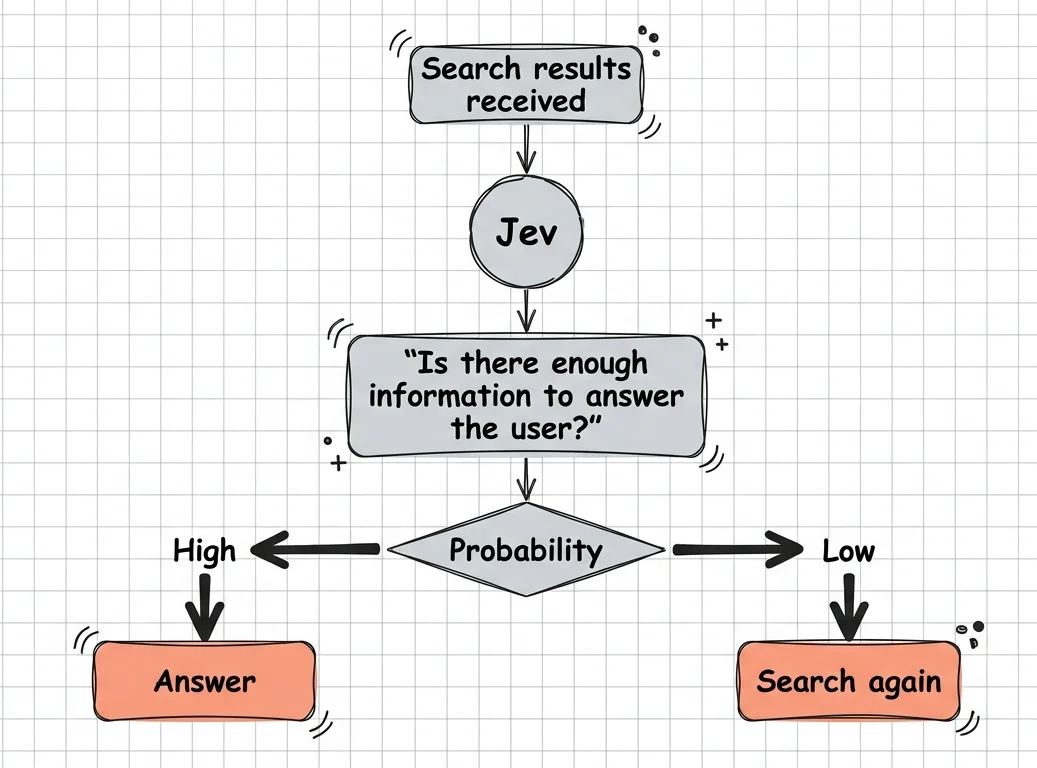
Another possible decision is:
"Should this tool call be allowed?"
or:
"Should the agent ask the user for clarification?"
or:
"Should the workflow stop?"
These are all bounded decisions that can be expressed using predefined answers.
Vercel's documentation specifically describes Jev being used inside agent loops for selecting next steps, deciding whether to continue/retry/ask/stop, scoring risk, and checking proposed actions.
A Practical Example: Support Ticket Routing
Let's build a simple conceptual system.
Suppose your application receives:
"I was charged for my subscription but my account is still showing the free plan."
The application sends the state to Jev.
It defines three questions:
Question 1: Which team should handle this?
Options:
- Billing
- Account
- Technical Support
Question 2: How urgent is the request?
Scale:
1–5
Question 3: Does the request require human review?
Boolean
Jev evaluates the questions.
The application might receive something conceptually like:
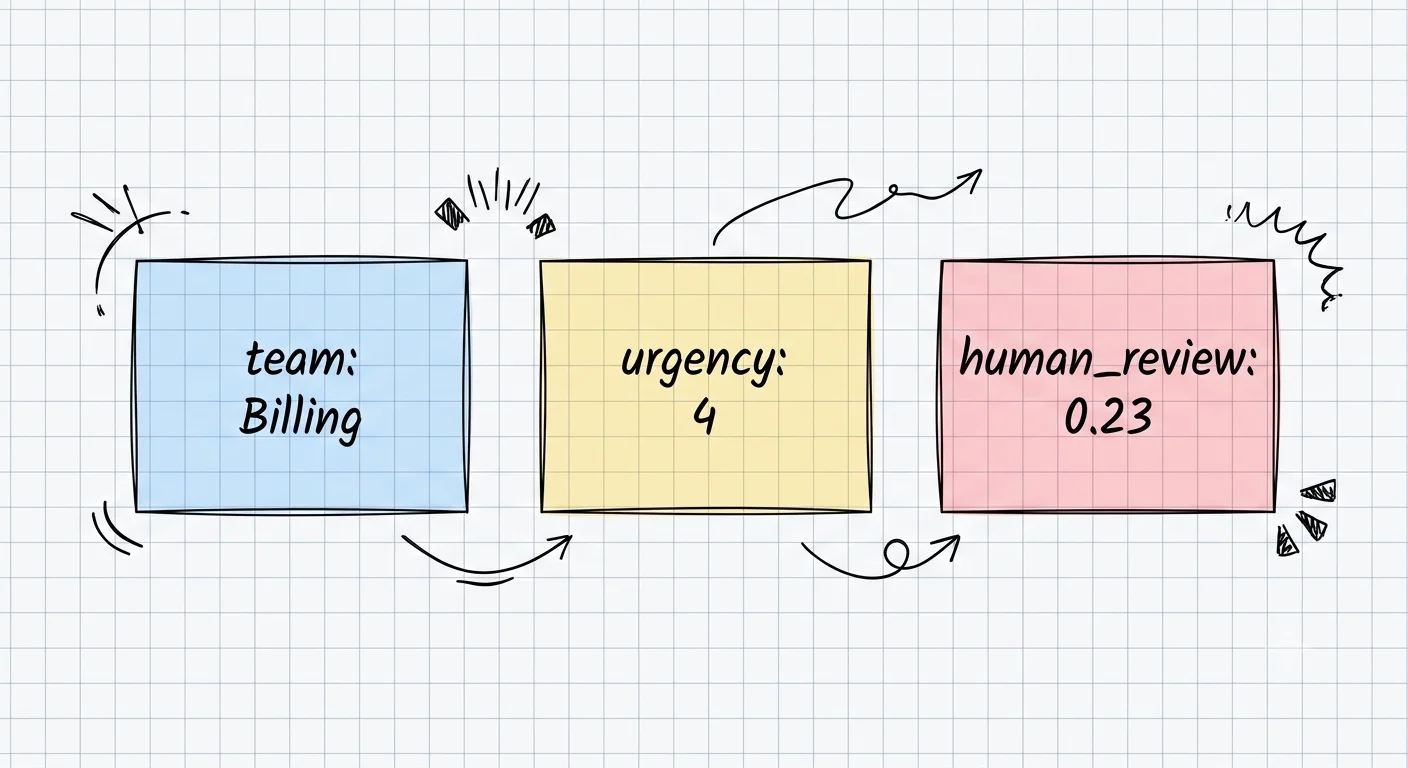
The application can then implement its own logic:
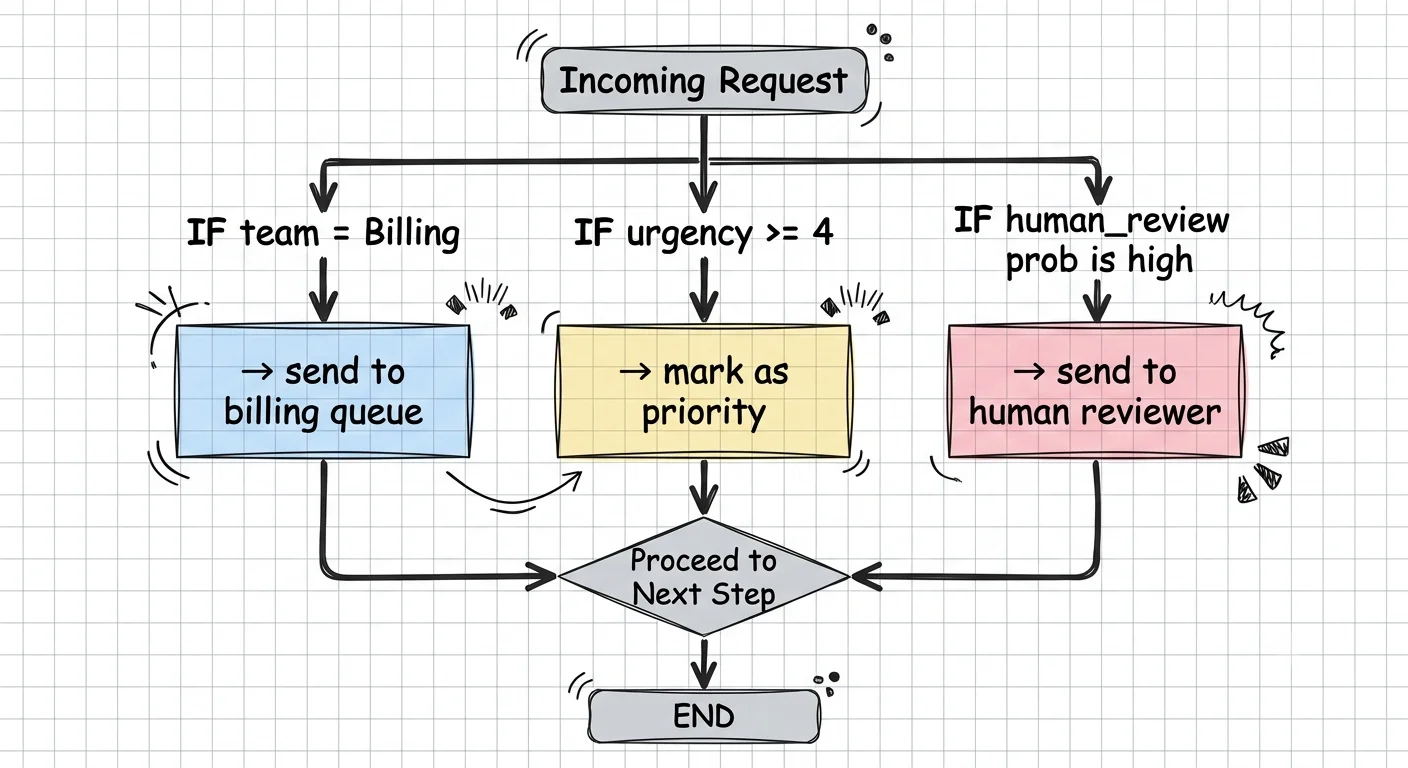
Notice something important:
Jev did not perform the action.
The application did.
That separation is important for production systems.
Jev provides a decision.
Your software controls permissions, thresholds, tool execution, and business rules.
Why Typed Decisions Matter
One of the fundamental ideas behind Jev is that the software should know the possible output space before the model answers.
Imagine asking an LLM:
Which tool should I use?
Return JSON.
The model could theoretically return:
But production software still needs to validate:
- Is
search_databasevalid? - Did the model use the correct field?
- Is the value spelled correctly?
- Did it return extra information?
- Is the JSON valid?
- Does the selected tool actually exist?
With a bounded decision interface, the possible choices are defined by the application.
Conceptually:
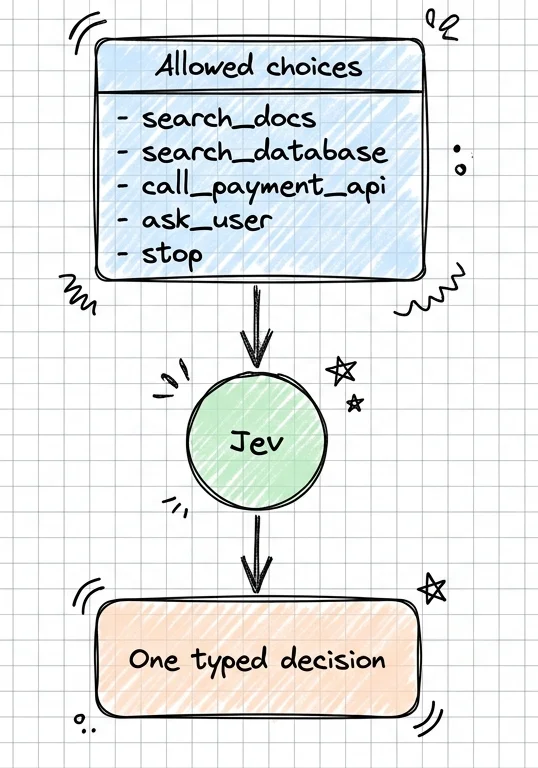
The model does not need to invent a new tool name.
But Jev Can Still Be Wrong
This distinction is extremely important.
A structured answer is not automatically a correct answer.
Suppose the application provides:
Choices:
- Billing
- Technical Support
- Account Support
Jev must select one of them.
Even if the output is perfectly typed, it could still select the wrong team.
That means Jev changes one problem:
Unstructured generation
into:
Structured decision
It does not magically eliminate model error.
Vercel explicitly notes that a typed answer can still misinterpret the evidence, and recommends testing decisions against known outcomes before allowing them to trigger automated actions.
This is why probabilities and confidence information matter.
A production system can create different paths:
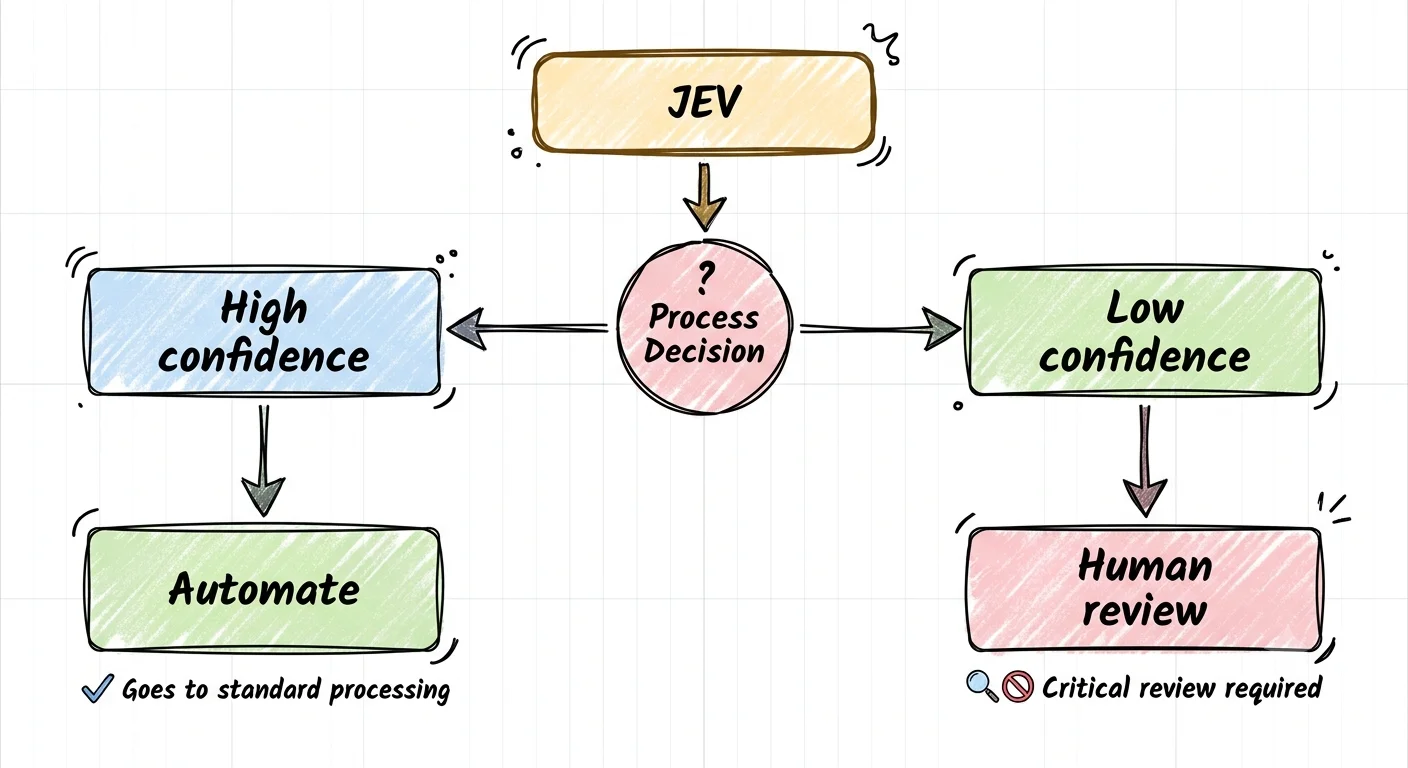
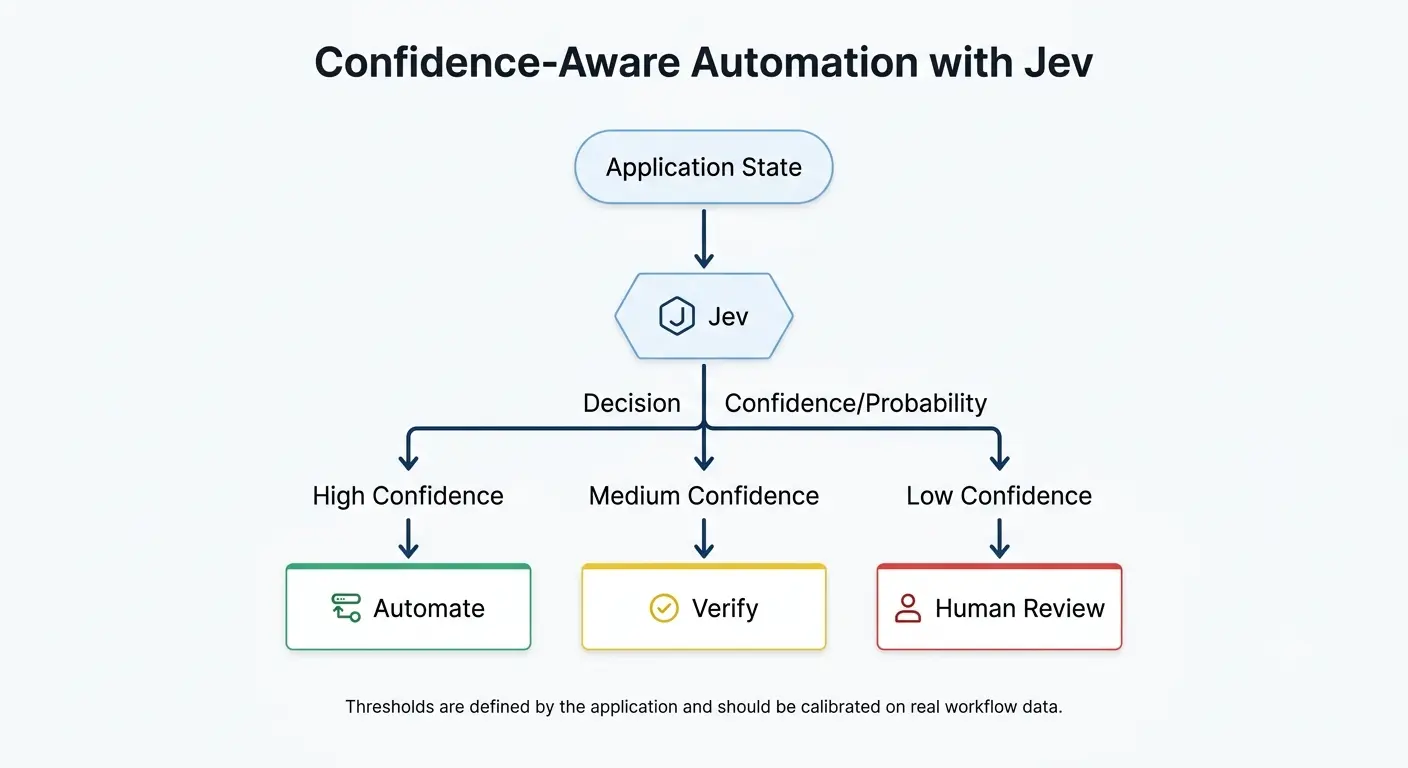
Confidence-Based Automation
Jev Does Not Replace Generative AI
It is tempting to describe Jev as a replacement for LLMs.
That would be misleading.
Jev and generative models are optimized for different interfaces.
A generative model is useful when the application needs something like:
"Explain why the deployment failed and write a response for the developer."
That requires open-ended text generation.
Jev is better suited to a question such as:
"Should the agent inspect the deployment logs?"
with answers like:
Yes / No
or:
"Which diagnostic tool should the agent call?"
with a predefined list of tools.
A realistic AI system could therefore look like:
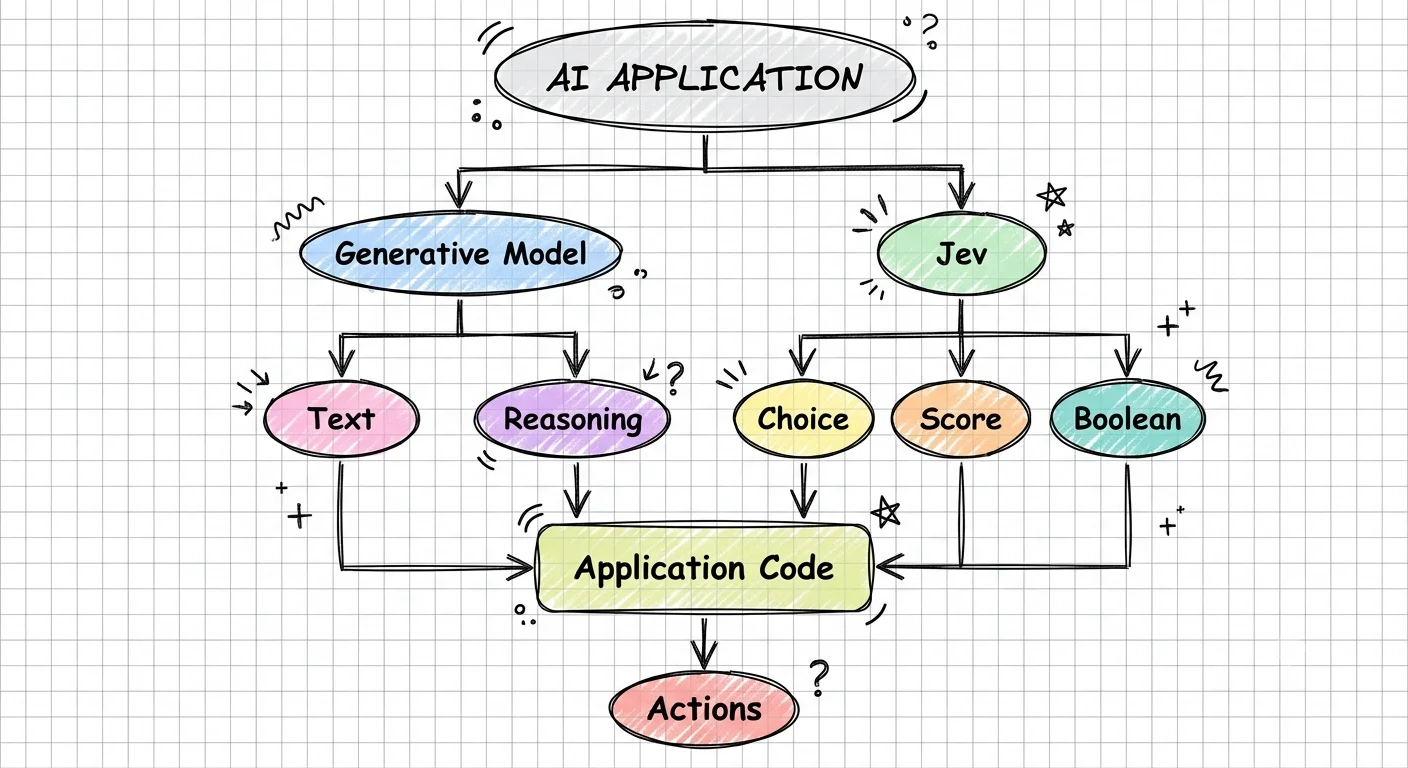 The interesting architecture is therefore not:
Jev vs LLM
but:
Jev + LLM + application code
Where Can Jev Be Used?
Jev's design makes it applicable to many software workflows involving bounded decisions.
1. AI Agent Routing
An agent may have several possible next actions.
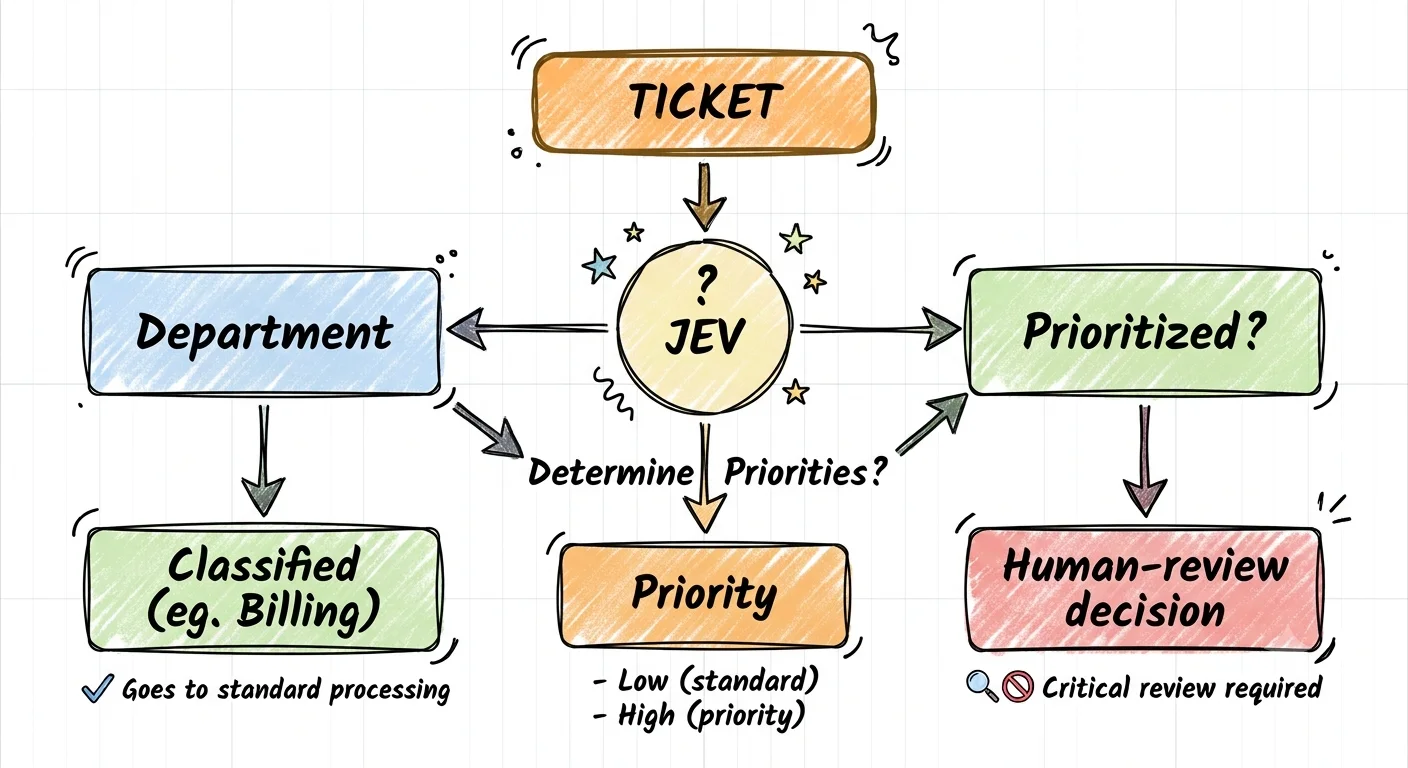
2. Customer Support
Jev can help classify and route incoming tickets.
3. Tool Approval
Before an agent executes an important tool:
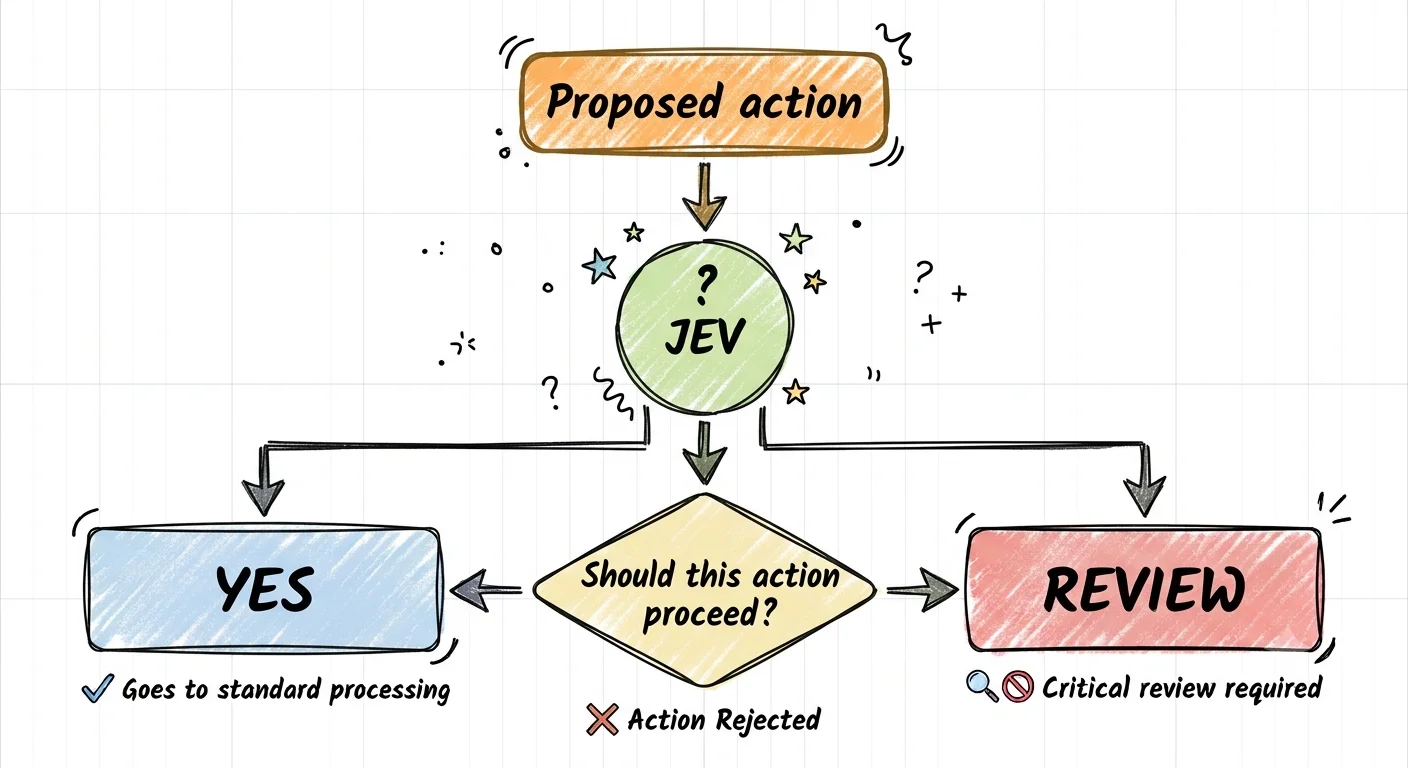
The actual permission and execution should remain under application control.
4. Model Routing
An application might have several AI models:
- Cheap Model
- Fast Model
- Reasoning Model
- Specialized Model
- Human
Jev can make a bounded routing decision based on the current request and application state.
5. Response Evaluation
Suppose a generative model produces an answer.
Another component can evaluate:
- Is the answer relevant?
- Is it safe?
- Does it follow the requested format?
- Should it be shown to the user?
Jev can provide structured judgments for these types of bounded questions.
6. Workflow Control
A multi-step automation system frequently needs decisions such as:
- Continue?
- Retry?
- Ask user?
- Escalate?
- Stop?
These are small decisions, but they occur repeatedly.
That makes them natural candidates for a specialized decision model.
Jev's Place in the AI Stack
A useful way to visualize modern AI software is as multiple layers.
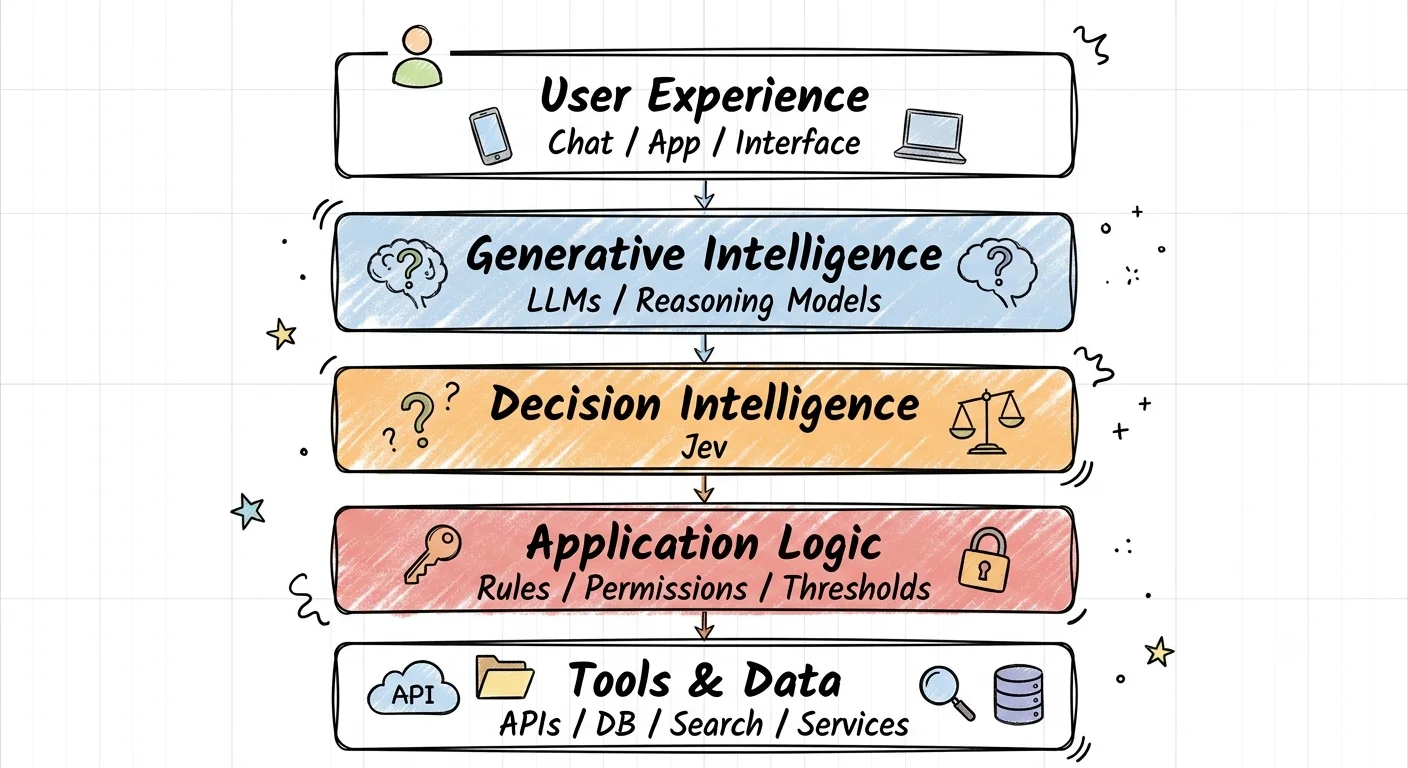
This separation is useful because different components can have different responsibilities.
The LLM can generate.
Jev can decide.
Application code can enforce.
Tools can execute.
Humans can review uncertain or high-risk cases.
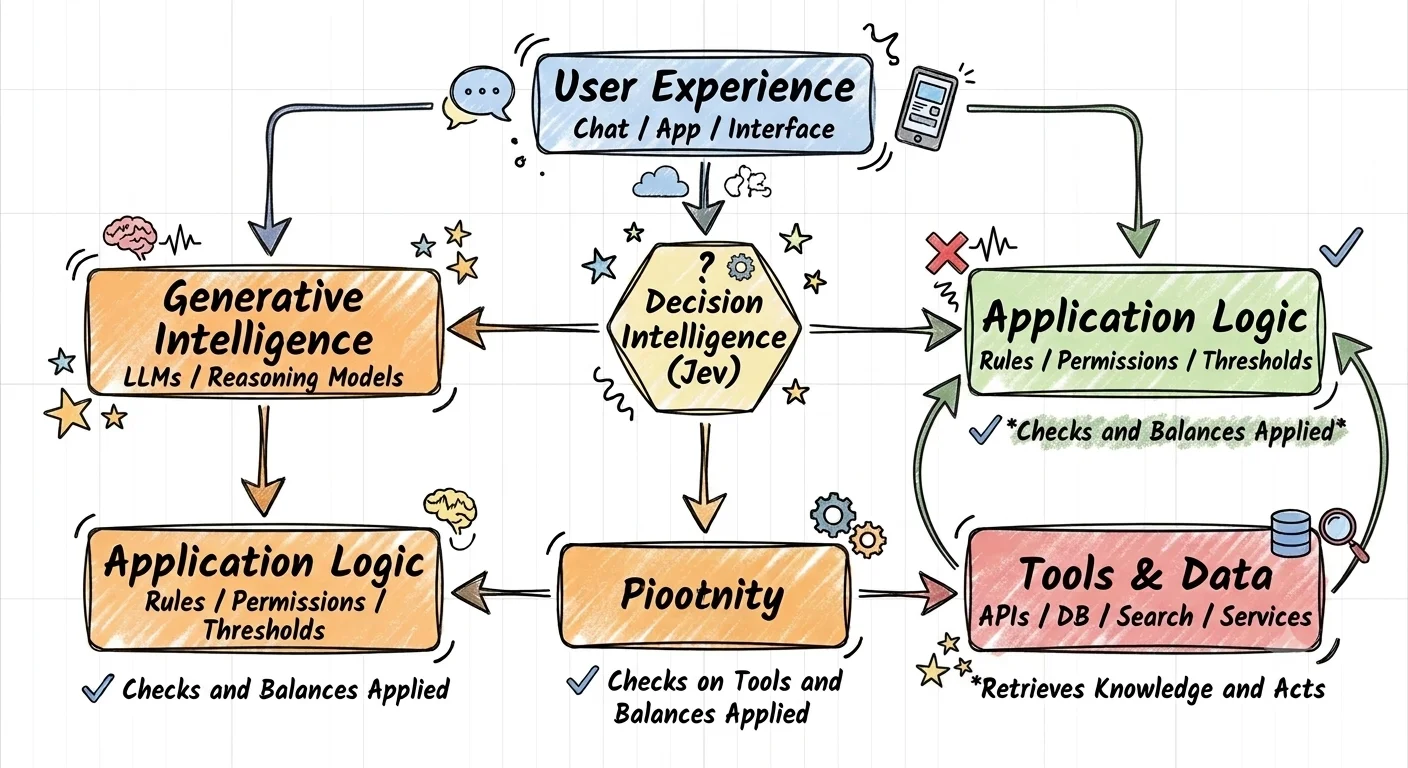
AI Stack
How Fast Is Jev?
TypeSafe reports that Jev can be significantly faster and cheaper than general-purpose LLM workflows on the company's System One workflow evaluations.
Its website currently reports up to 193.6× faster and 444.6× cheaper on those workflows. These are TypeSafe's reported results, not a universal guarantee for every workload.
Vercel has also published the same broad comparison, reporting up to approximately 194× faster and 445× cheaper in TypeSafe's workflow evaluations.
The reason for the difference in architecture is straightforward.
A traditional LLM is designed to produce tokens.
Jev is designed around structured decisions.
For a workload that only needs:
- Which option?
- What score?
- Yes or no?
generating a long natural-language response can be unnecessary overhead.
How Jev Fits Into a Real Production Workflow
A sensible production architecture might look like this:
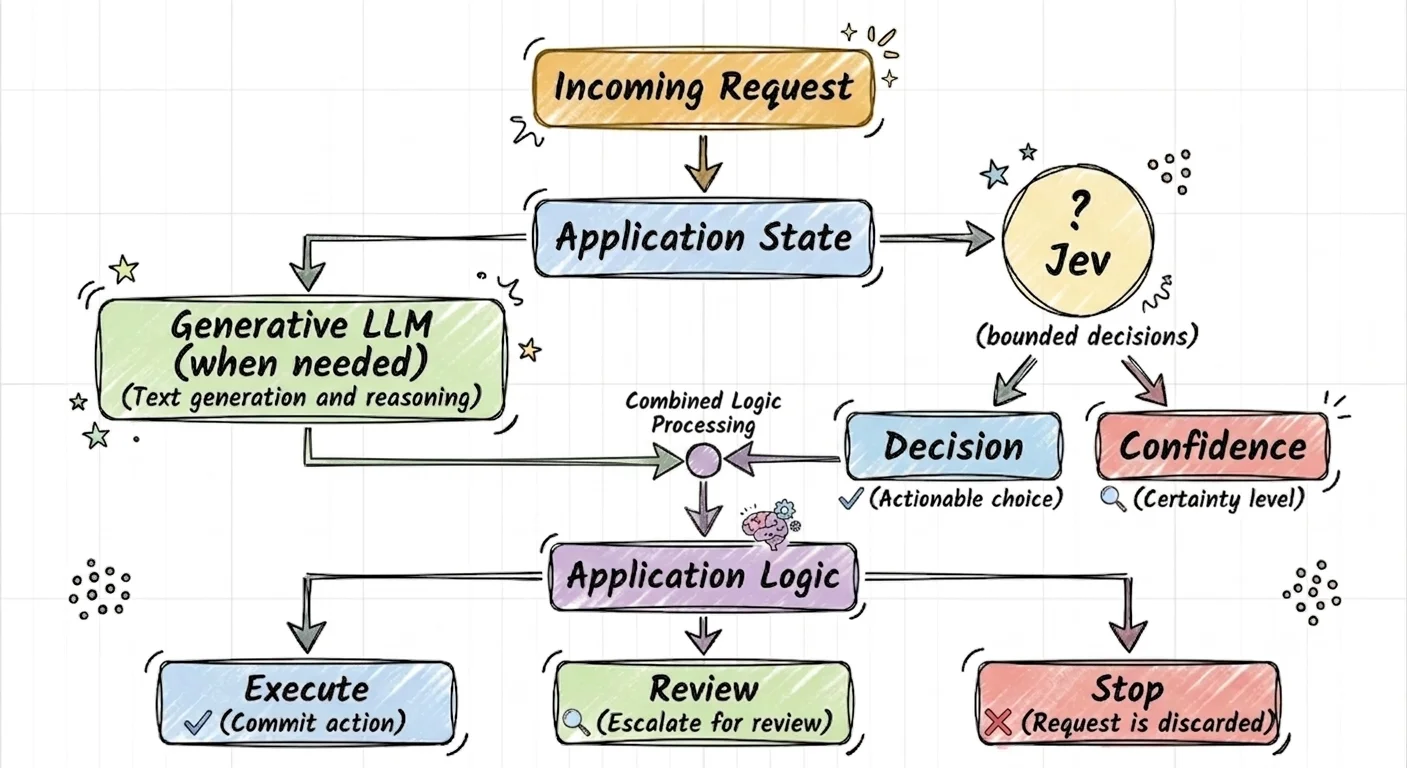
The application should remain responsible for:
- Authentication
- Permissions
- Business rules
- Tool arguments
- Side effects
- Thresholds
- Human escalation
- Logging
- Error handling
Jev should not be treated as a replacement for those controls.
Vercel's guidance similarly recommends keeping tool execution and policy enforcement in application code even when Jev supplies the decision.
When Should You Use Jev?
Jev makes the most sense when the problem has a bounded decision space.
Ask yourself:
Can I clearly define the possible answers?
If yes, Jev may be a candidate.
For example:
Which queue?
→ Billing / Technical / Account
Should we continue?
→ Yes / No
How urgent is this?
→ 1–5
But:
Write a detailed explanation
is not a bounded decision.
Use a generative model instead.
Likewise:
Generate a Java implementation
is not what Jev is designed for.
The easiest mental model is:
If your software needs a paragraph, think generative model. If your software needs a bounded judgment, think decision model.
Jev Through Vercel AI Gateway
Jev is also available through Vercel AI Gateway, which makes it possible to access Jev alongside other models through Vercel's AI infrastructure.
Vercel's integration exposes Jev as:
typesafe-ai/jev
and supports evaluation questions such as Boolean, Choice, and Score. Multiple questions can be evaluated within the same request.
As of September 21, 2026, Vercel also supports calling Jev through the TypeSafe client and a native HTTP API in addition to the AI SDK.
This makes Jev accessible from different application architectures rather than limiting it to one specific framework.
The Bigger Idea Behind Jev
The most interesting part of Jev may not be its speed.
It is the idea of treating decision-making itself as an AI primitive.
For years, AI software has largely been built around:
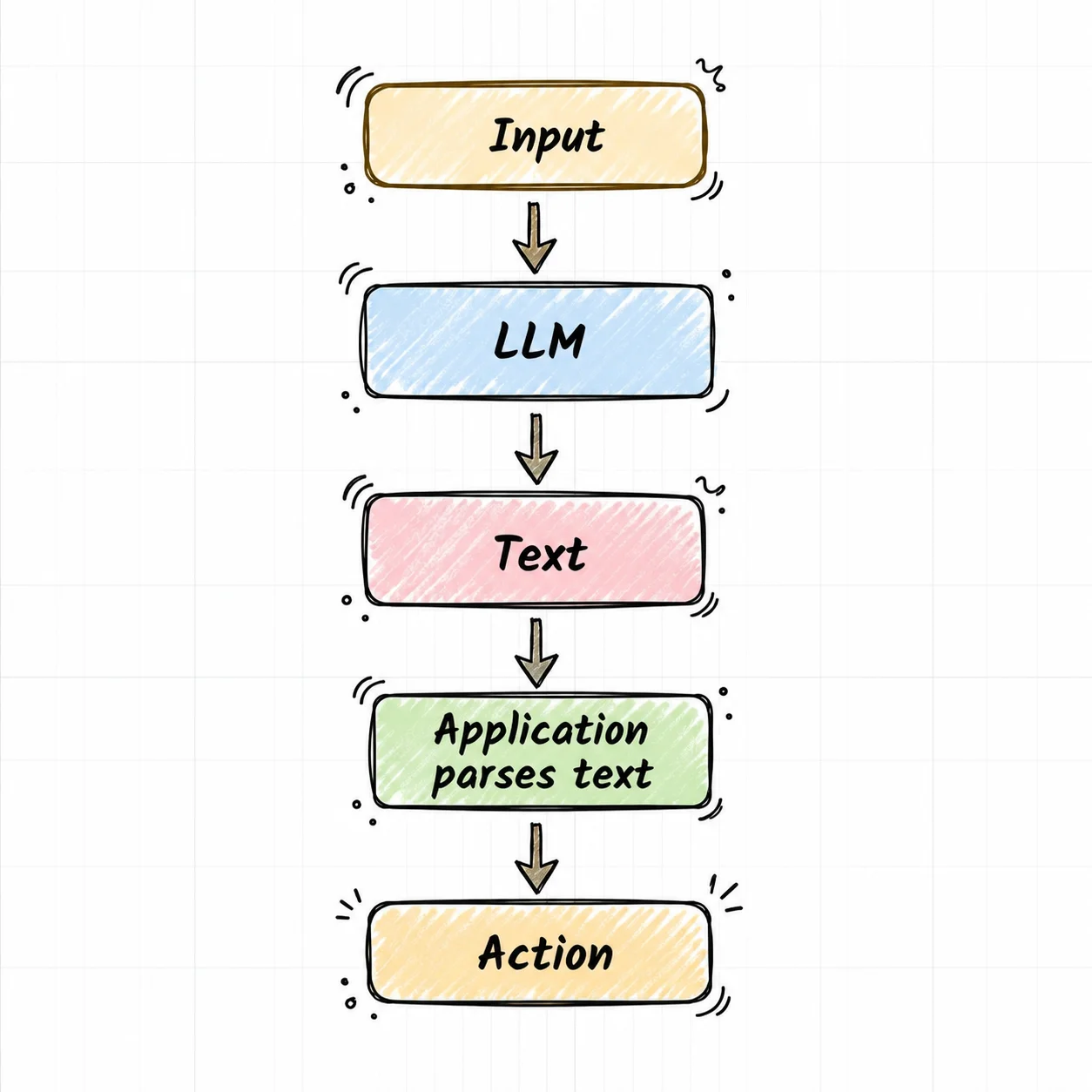
Jev suggests another abstraction:
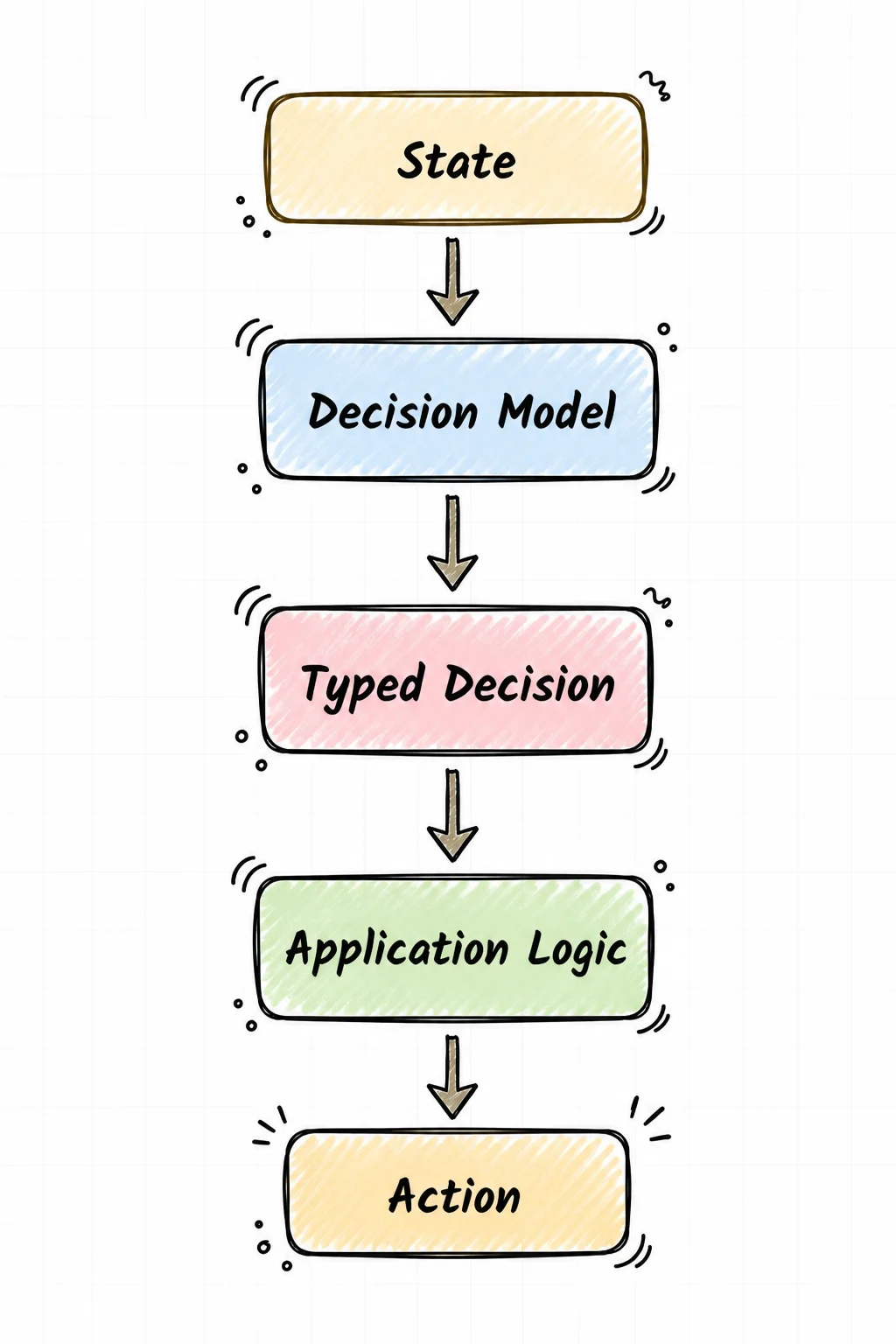
That is a meaningful architectural difference.
Software does not always need an AI that talks.
Sometimes it needs an AI that answers one narrow question reliably enough for the software to decide what happens next.
Final Takeaway
Jev is not another chatbot and it is not simply a smaller version of a traditional LLM.
It is designed around a different interface:
state in → bounded questions → typed decisions out.
Its three central decision primitives are:
- Choice
- Score
- Boolean probability
That makes it particularly interesting for:
- AI agent routing
- Tool selection
- Customer-support classification
- Workflow control
- Risk and urgency scoring
- Model routing
- Response evaluation
- Automated verification
The most important thing to remember is that structured does not mean infallible.
Jev can constrain the shape of a decision, provide probability information, and remove the need for applications to parse generated prose. But the application still needs sensible question design, thresholds, evaluation data, permissions, and human-review paths for uncertain or high-risk cases.
The broader architectural lesson is simple:
Not every AI problem needs text generation. Some software problems need a decision.
And that is the space Jev is designed to occupy.
Quick Mental Model
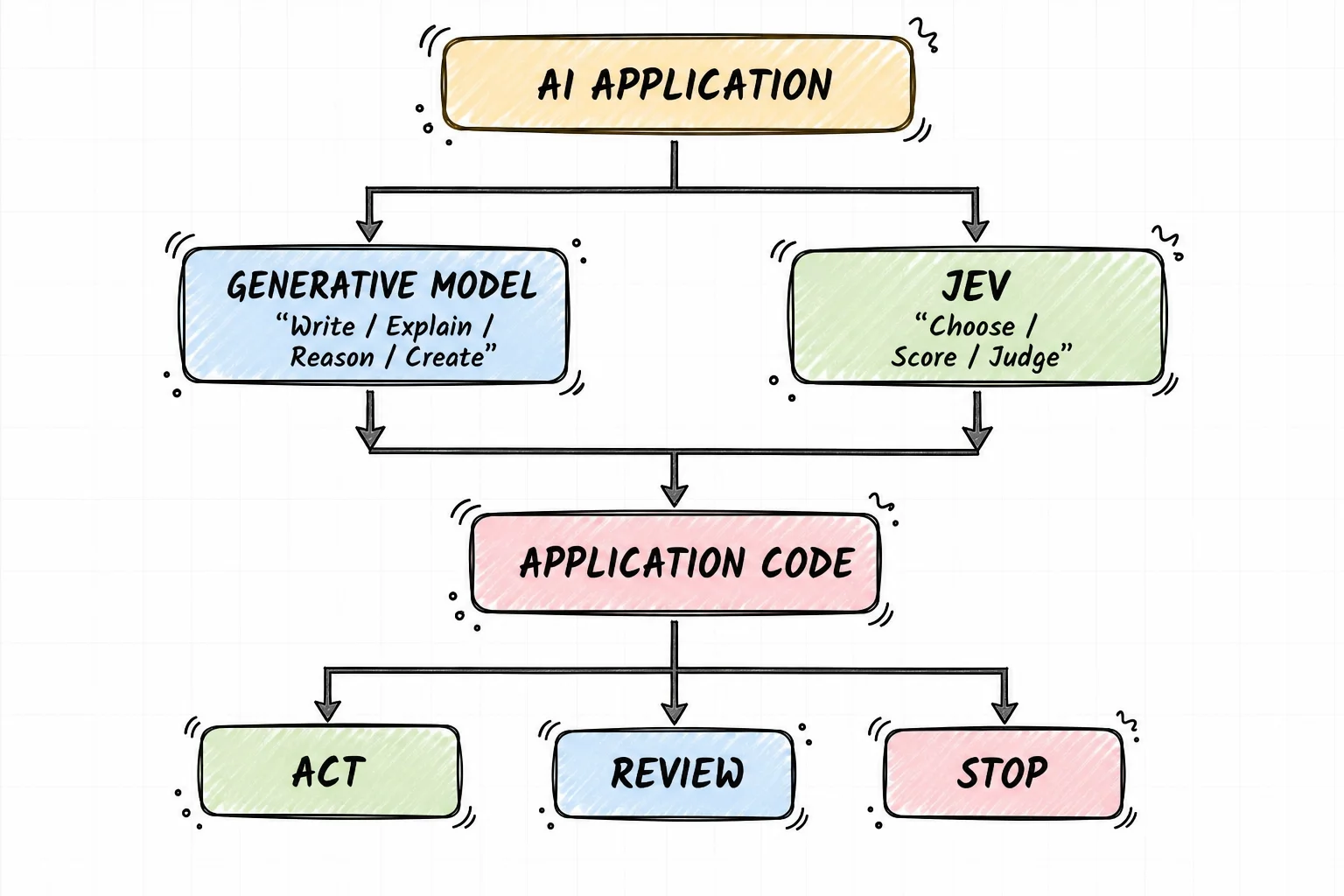
Jev does not try to replace generative AI. It adds a decision-making layer that software can use directly.
Resources & Links
- Official Website: TypeSafe AI / Jev
- Developer Documentation: Vercel AI Gateway Integration