The First Question I Asked Myself: Do We Really Need a Complicated Path?
Problem link: LeetCode 3963 — Create Grid With Exactly One Path
When I first looked at this problem, I saw a grid with two types of cells:
.means we can move through the cell.#means the cell is blocked.
We have to construct a grid in which exactly one valid path exists from the top-left corner to the bottom-right corner.
My first instinct was to think about movement. We can move right or down, so I started wondering how to arrange the cells to control these movements.
But then I realized something important: the problem doesn't ask us to find a path in a given grid. It asks us to create the grid ourselves.
That changes the problem completely.
We are not trapped inside a grid someone else has designed. We are the ones deciding which cells are free and which cells are blocked.
So instead of asking, "How do I search for exactly one path?", I started asking a simpler question:
What is the easiest possible path I can create, and how can I prevent every other path?
That question leads to a much simpler solution.
Step 1: Stop Thinking That We Must Alternate Right and Down
Suppose we have a grid with three rows and four columns.
We need to travel from the top-left cell to the bottom-right cell.
A valid path can move right or down. But there is no rule saying we must alternate between these movements.
We can move right three times and then down twice. We can also move down twice first and then right three times.
Both movement patterns are allowed, provided the cells we enter are free.
This was the observation that made the problem easier for me.
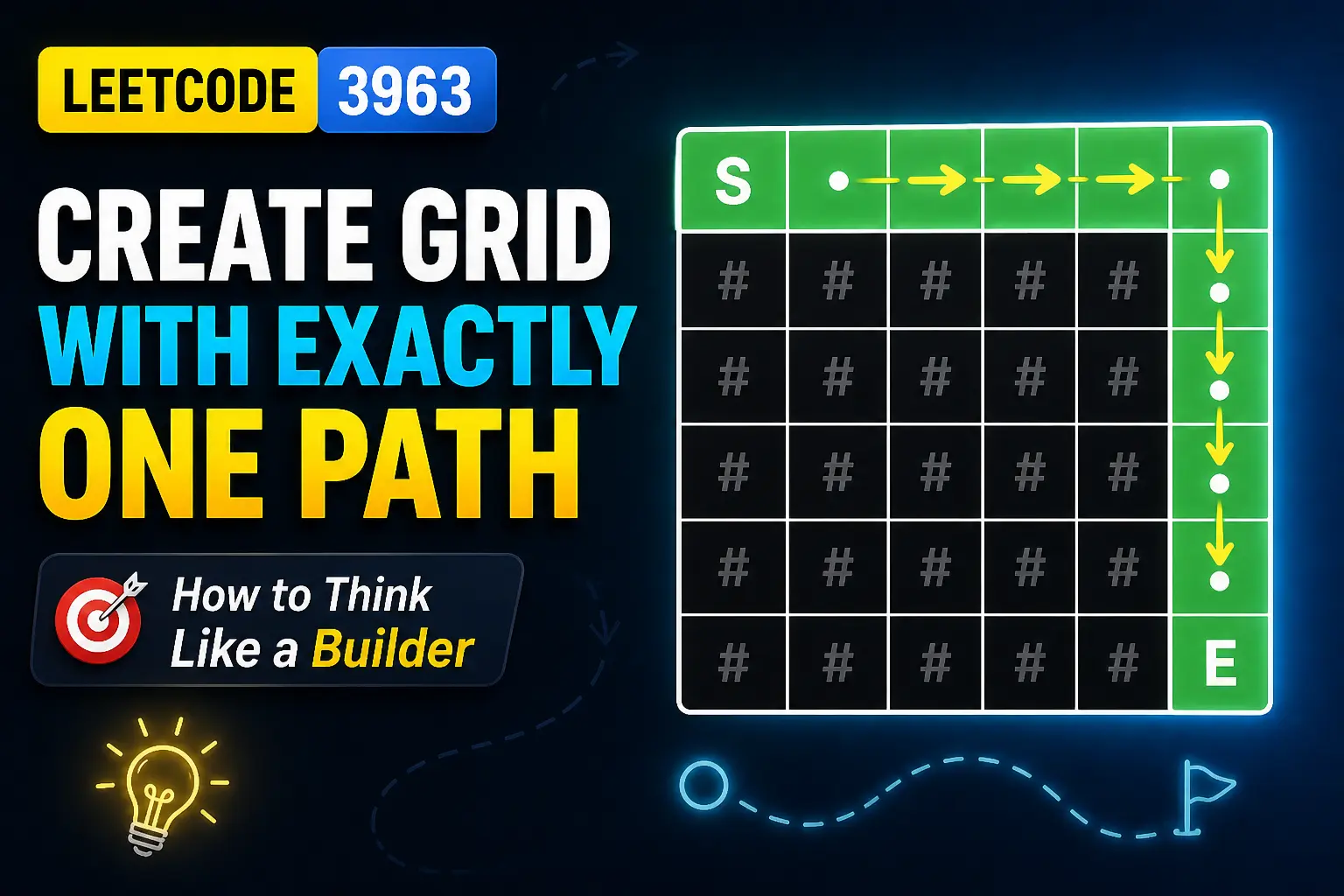
Instead of creating a complicated zigzag path, why not move right along the first row and then down along the last column?
For example, with m = 3 and n = 4, we can create this grid:
Let's trace the intended path:
The first row is free until the final column, and the last column is free all the way to the bottom.
Every other cell is blocked.
There is only one way to reach the destination: move right across the top row, then move down along the last column.
We don't need recursion, DFS, BFS, or dynamic programming. We only need to construct a grid that forces the movement we want.
Step 2: Why Does This Grid Have Exactly One Path?
Let's look at the structure rather than just the example.
Our grid has three important parts:
- The top row is free, allowing movement to the right.
- The last column is free, allowing movement downward.
- Every other cell is blocked.
Consider the starting cell (0,0).
Since moving down immediately would enter a blocked cell, the only possible move is right.
The same reasoning applies as we continue along the top row. Moving down is blocked until we reach the last column.
Once we reach the last column, moving right is impossible because we are already at the rightmost boundary. The only available movement is down.
We keep moving down until we reach the bottom-right cell.
Therefore, every step is forced. There is no point along the path where we can choose between two valid directions.
If every step has only one possible next move, there can be only one valid path.
This is the central idea behind the construction.
Step 3: Translate the Idea Into Java
Now that the pattern is clear, the code becomes straightforward.
We create an array of strings, where each string represents one row of the grid.
For every cell, we ask two questions:
- Is this cell in the first row?
- Is this cell in the last column?
If either condition is true, we place a .. Otherwise, we place a #.
In other words:
This creates the top-row-and-last-column corridor.
Notice that we do not need to calculate all possible paths or count them. The construction itself guarantees that there is exactly one.
Java Solution
Here is the complete implementation using the same constructive approach:
What is different from my original code?
My original solution already had the right core idea: create free cells along the first column and the bottom row, blocking the other cells.
That approach is also valid. It creates a path that moves down first and then right.
The revised implementation uses the alternative pattern discussed above: move right along the top row, then down along the last column.
Both constructions work because they create one continuous corridor and block all competing routes.
I also used StringBuilder instead of repeatedly concatenating strings with ro += "." or ro += "#". This makes row construction clearer and avoids repeatedly creating intermediate strings.
Step 4: Dry Run
Let's use the example m = 3, n = 3.
Initially, we have three rows and three columns.
For each cell, we check whether it belongs to the first row or the last column.
Row 0
Every cell is in the first row, so every cell becomes free.
Row 1
The first two cells are neither in the first row nor in the last column, so they become obstacles. The last cell is in the last column, so it remains free.
Row 2
The same rule applies.
The final grid is:
The only valid path is:
The answer is a valid grid because the path starts at (0,0), ends at (m - 1, n - 1), and contains no alternative route.
Step 5: What About a Grid With Only One Row or One Column?
This is where I initially added special cases to my code.
For example, if m = 1, the grid contains only one row. We can make every cell free:
There is exactly one path: keep moving right.
If n = 1, the grid contains only one column. We can make every cell free vertically:
There is exactly one path: keep moving down.
The useful discovery is that our new construction already handles both cases. When m = 1, the first-row condition makes every cell free. When n = 1, the last-column condition makes every cell free.
That means we don't need separate if (m == 1) or if (n == 1) blocks.
Removing unnecessary special cases makes the code shorter and easier to reason about.
Complexity Analysis
Let m be the number of rows and n be the number of columns.
Time complexity: O(m × n)
We visit every cell exactly once and decide whether it should be a free cell or an obstacle.
Space complexity: O(m × n)
The returned grid contains m × n characters, so the output itself requires O(m × n) space. The temporary StringBuilder for constructing a row uses O(n) space.
What I Learned From This Problem
The biggest lesson was that I was thinking too much about finding paths instead of designing one.
When I saw the words "exactly one valid path," I could easily have started thinking about graph algorithms, counting paths, or checking every possible route.
But we control the grid. That means we can make every decision along the route for the person moving through it.
The moment I realized that we could move right as many times as needed before moving down, the problem became much simpler. I could create a straight corridor and block everything else.
My original solution used the same principle in the opposite direction: move down first, then right. Both ideas are correct.
This is a useful lesson for constructive problems in general: before reaching for a complicated algorithm, ask whether you can build an answer whose structure makes the required property inevitable.
Final Takeaway
LeetCode 3963 is not really about searching a grid. It is about constructing one that forces a unique route.
- Choose a simple path.
- Keep the cells along that path free.
- Block cells that could create alternative routes.
- Check that the construction still works for a single row or column.
Sometimes the best solution isn't to explore every possibility. It's to design the situation so that only one possibility exists.
That is the intuition worth carrying into the next constructive algorithm problem.