Search Blogs

Showing results for "DFS"

Found 17 results

LeetCode 1306: Jump Game III – Java DFS & Graph Traversal Solution Explained

LeetCode 1306: Jump Game III – Java DFS & Graph Traversal Solution Explained

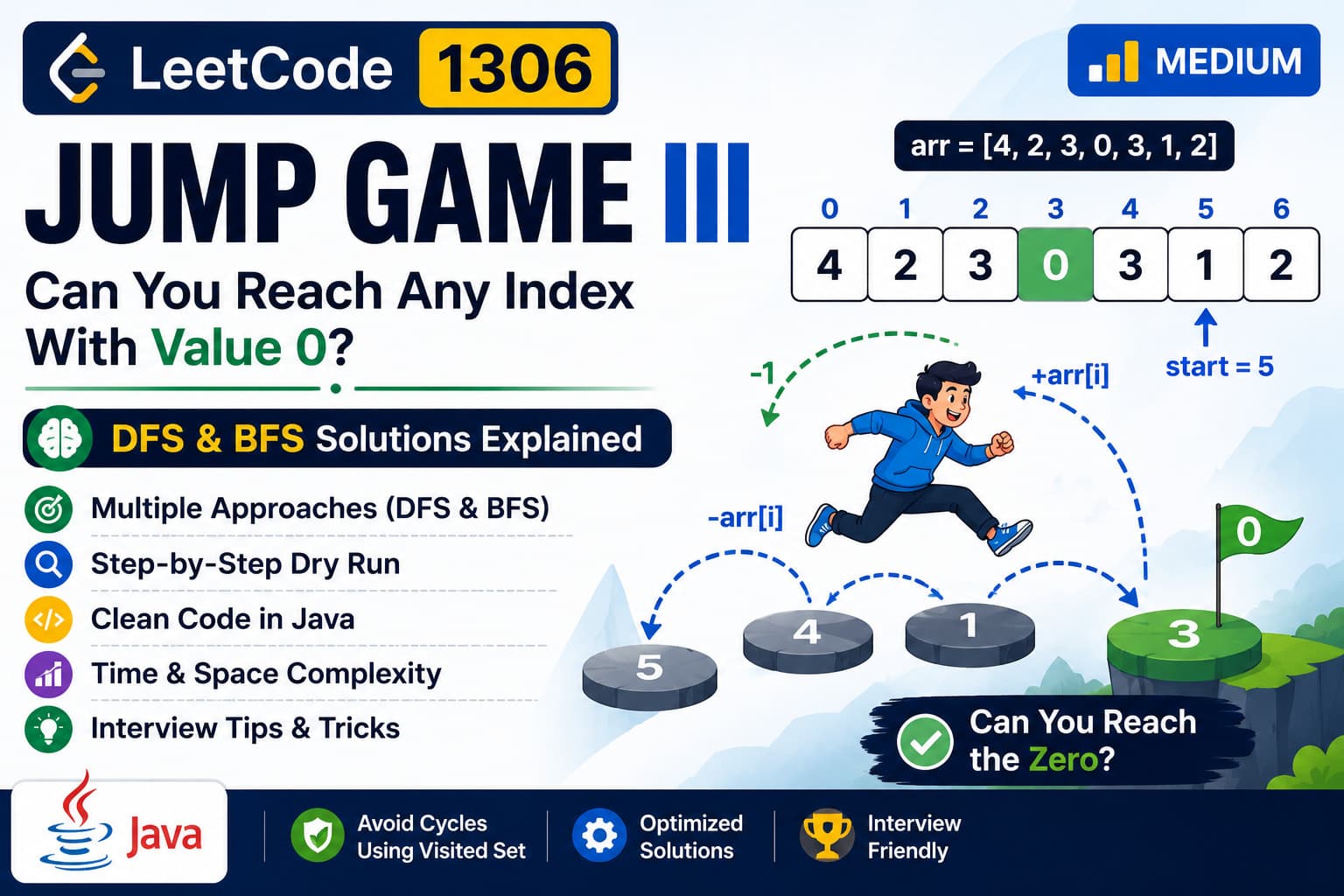
IntroductionLeetCode 1306 – Jump Game III is an interesting graph traversal problem that combines:Depth First Search (DFS)Breadth First Search (BFS)RecursionVisited trackingCycle detectionAt first glance, this problem looks like an array problem.But internally, it behaves exactly like a graph traversal problem where:Each index acts like a nodeEach jump acts like an edgeThis problem is commonly asked in coding interviews because it tests:Recursive thinkingGraph traversal intuitionAvoiding infinite loopsState trackingProblem LinkπŸ”— https://leetcode.com/problems/jump-game-iii/Problem StatementYou are given:An array arrA starting index startFrom index i, you can jump:i + arr[i]ori - arr[i]Your goal is to determine whether you can reach any index having value:0ExampleInputarr = [4,2,3,0,3,1,2]start = 5OutputtrueExplanationPossible path:5 β†’ 4 β†’ 1 β†’ 3At index:3Value becomes:0So answer is:trueUnderstanding the ProblemThink of every index as a graph node.From each node:index iwe have two possible edges:i + arr[i]andi - arr[i]The goal is simply:Can we reach any node containing value 0?Brute Force IntuitionA naive recursive solution would:Try both forward and backward jumpsContinue recursivelyStop when we find zeroWhy Brute Force FailsWithout tracking visited indices, recursion may enter infinite loops.Example:1 β†’ 3 β†’ 1 β†’ 3 β†’ 1...This creates cycles.So we must track visited nodes.DFS IntuitionWe perform DFS traversal from the starting index.At every index:Check boundariesCheck if already visitedCheck if value is zeroExplore both possible jumpsKey DFS ObservationEach index should only be visited once.Why?Because revisiting creates cycles and unnecessary computation.So we use:HashSet<Integer> visitedorboolean[] visitedRecursive DFS ApproachSteps1. Boundary CheckIf index goes outside array:return false2. Visited CheckIf already visited:return false3. Found ZeroIf current index contains:0Return:true4. Explore Both DirectionsTry:start + arr[start]andstart - arr[start]Java DFS Solutionclass Solution { public boolean solve(HashSet<Integer> zeroIndexes, HashSet<Integer> visited, int start, int[] arr) { if(start >= arr.length || start < 0) return false; if(visited.contains(start)) return false; visited.add(start); if(zeroIndexes.contains(start)) return true; return solve(zeroIndexes, visited, start + arr[start], arr) || solve(zeroIndexes, visited, start - arr[start], arr); } public boolean canReach(int[] arr, int start) { HashSet<Integer> visited = new HashSet<>(); HashSet<Integer> zeroIndexes = new HashSet<>(); for(int i = 0; i < arr.length; i++) { if(arr[i] == 0) { zeroIndexes.add(i); } } return solve(zeroIndexes, visited, start, arr); }}Simpler Optimized DFS SolutionWe actually do not need a separate set for zero indexes.We can directly check:arr[start] == 0Cleaner Java DFS Solutionclass Solution { public boolean dfs(int[] arr, boolean[] visited, int start) { if(start < 0 || start >= arr.length) return false; if(visited[start]) return false; if(arr[start] == 0) return true; visited[start] = true; return dfs(arr, visited, start + arr[start]) || dfs(arr, visited, start - arr[start]); } public boolean canReach(int[] arr, int start) { return dfs(arr, new boolean[arr.length], start); }}Dry RunInputarr = [4,2,3,0,3,1,2]start = 5Step 1Current index:5Value:1Possible jumps:5 + 1 = 65 - 1 = 4Step 2Visit index:4Value:3Possible jumps:4 + 3 = 7 (invalid)4 - 3 = 1Step 3Visit index:1Value:2Possible jumps:1 + 2 = 31 - 2 = -1 (invalid)Step 4Visit index:3Value:0Return:trueBFS ApproachThis problem can also be solved using BFS.Instead of recursion:Use queueExplore neighbors level by levelJava BFS Solutionclass Solution { public boolean canReach(int[] arr, int start) { Queue<Integer> queue = new LinkedList<>(); boolean[] visited = new boolean[arr.length]; queue.offer(start); while(!queue.isEmpty()) { int index = queue.poll(); if(index < 0 || index >= arr.length) continue; if(visited[index]) continue; if(arr[index] == 0) return true; visited[index] = true; queue.offer(index + arr[index]); queue.offer(index - arr[index]); } return false; }}Time Complexity AnalysisDFS ComplexityTime ComplexityO(N)Each index is visited at most once.Space ComplexityO(N)Due to recursion stack and visited array.BFS ComplexityTime ComplexityO(N)Space ComplexityO(N)DFS vs BFSApproachAdvantagesDisadvantagesDFSSimple recursive logicRecursion stackBFSIterative solutionQueue managementInterview ExplanationIn interviews, explain:This problem behaves like graph traversal where each index acts as a node and jumps act as edges. We use DFS or BFS with visited tracking to avoid infinite cycles.This demonstrates strong graph intuition.Common Mistakes1. Forgetting Visited TrackingThis causes infinite recursion.2. Missing Boundary ChecksAlways check:start < 0 || start >= arr.length3. Revisiting NodesAvoid processing already visited indices.FAQsQ1. Is this an array problem or graph problem?Internally it is a graph traversal problem.Q2. Which is better: DFS or BFS?Both are valid.DFS is usually simpler for this problem.Q3. Why do we need visited tracking?To avoid infinite loops caused by cycles.Q4. Can this be solved greedily?No.Because multiple paths must be explored.ConclusionLeetCode 1306 is an excellent beginner-friendly graph traversal problem.It teaches:DFS traversalBFS traversalCycle detectionRecursive thinkingVisited state managementThe most important insight is:Treat every index as a graph node.Once you understand this idea, many graph and traversal interview problems become much easier.
LeetCodeMediumDFSBFSGraph TraversalJavaRecursion
LeetCode 2265: Count Nodes Equal to Average of Subtree – Java DFS Solution

LeetCode 2265: Count Nodes Equal to Average of Subtree – Java DFS Solution

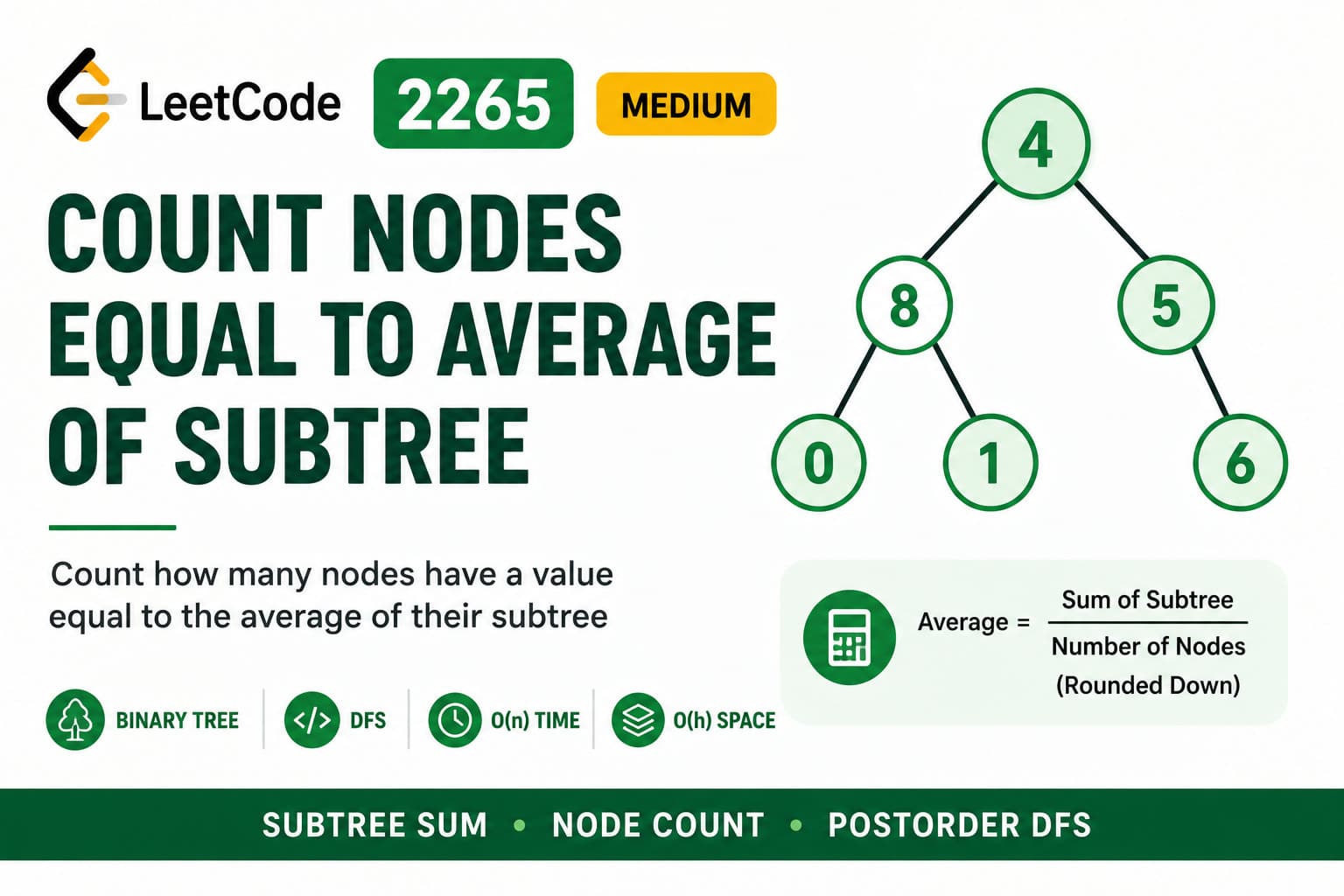
IntroductionBinary tree problems often become interesting when the answer for a node depends on everything below that node.This problem is exactly that.For every node, the task is to calculate the average of all values in its subtree and check whether that average is equal to the value of the node itself.At first, this looks like a simple DFS problem. But there is an important optimization opportunity hidden inside it.To calculate the average of a subtree, two things are required:The sum of all nodes in the subtreeThe number of nodes in the subtreeThe first approach calculates these values directly. Then, by looking at the repeated work, the solution can be improved further.Question LinkLeetCode 2265 – Count Nodes Equal to Average of SubtreeUnderstanding the ProblemFor every node:Average = Subtree Sum / Number of NodesThe average is rounded down.If the calculated average is equal to the current node's value, that node is counted.Consider this tree: 4 / \ 8 5 / \ \ 0 1 6For node 5:Subtree = [5, 6]Sum = 5 + 6 = 11Count = 2Average = 11 / 2 = 5Since the average is 5, node 5 contributes to the answer.The same calculation has to be performed for every node.The Core ObservationFor each node, the required information is:Subtree Sum+Subtree Node CountOnce these two values are available, calculating the average is straightforward.The natural question is:How can the sum and count of every subtree be calculated efficiently?A recursive DFS is a natural fit because the information of a subtree can be obtained by processing its children first.Approach 1: Calculate Subtree Sum and Count SeparatelyThe first approach is the most direct way to think about the problem.For every node:Calculate the sum of its entire subtree.Calculate the number of nodes in that subtree.Calculate the average.Compare it with the current node.Repeat for the left and right children.A separate count() function can be used to count the nodes.This approach follows the problem statement very closely, which makes it a good starting point for understanding the solution.CodeHere is the complete approach, including the separate count() idea:class Solution { int co = 0; // Calculates the sum of all nodes in the subtree public int sumdfs(TreeNode roo) { if (roo == null) { return 0; } // Leaf node contributes its value to the sum if (roo.left == null && roo.right == null) { co++; return roo.val; } int left = sumdfs(roo.left); int right = sumdfs(roo.right); // Current node is also part of its subtree co++; return roo.val + left + right; } // Separate function to count the number of nodes // in the subtree. // // This was the initial idea, but it is commented out // because the sumdfs() traversal can already count nodes. // // public int count(TreeNode roo){ // if(roo == null){ // return 0; // } // if(roo.left == null && roo.right == null){ // return 1; // } // int left = count(roo.left); // int right = count(roo.right); // return 1 + left + right; // } int am = 0; public void solve(TreeNode root) { if (root == null) { return; } // Reset count for the current subtree co = 0; // Calculate the sum of the current subtree // and count its nodes at the same time. int tot = sumdfs(root); int cot = co; // The problem requires the average to be rounded down. if (Math.floor(tot / cot) == root.val) { am++; } // Check the left subtree solve(root.left); // Check the right subtree solve(root.right); } public int averageOfSubtree(TreeNode root) { solve(root); return am; }}How This Approach WorksThe interesting part is sumdfs().Initially, a separate count() function can be used:int cot = count(root);At the same time, another traversal calculates the sum.But there is no need to traverse the same subtree again just to count its nodes.The sumdfs() function is already visiting every node, so the counter can be increased during the same traversal.That is why the following idea works:co++;Whenever a node is visited, co increases by one.After sumdfs(root) finishes:int tot = sumdfs(root);int cot = co;Now:tot = sum of subtreecot = number of nodes in subtreeand the average can be calculated.Dry RunConsider: 4 / \ 8 5 / \ \ 0 1 6Start from node 4.Node 0sum = 0count = 1average = 0 / 1 = 0So node 0 is counted.Node 1sum = 1count = 1average = 1 / 1 = 1Node 1 is counted.Node 8Its subtree is: 8 / \ 0 1Therefore:sum = 8 + 0 + 1 = 9count = 3average = 9 / 3 = 3Since:8 != 3node 8 is not counted.Node 6sum = 6count = 1average = 6Node 6 is counted.Node 5Its subtree is: 5 \ 6So:sum = 5 + 6 = 11count = 2average = 11 / 2 = 5Node 5 is counted.Node 4The complete subtree is: 4 / \ 8 5 / \ \ 0 1 6Therefore:sum = 4 + 8 + 5 + 0 + 1 + 6 = 24count = 6average = 24 / 6 = 4Node 4 is counted.The final answer is:5An Important Complexity ObservationThe co variable removes the need for a separate count() traversal.However, there is still a bigger issue.Look at what happens when solve() processes the root.It calls:sumdfs(root);which visits the entire tree.Then solve() moves to the left child and calls:sumdfs(root.left);which visits that subtree again.Then the same thing happens for the right subtree.So the same nodes can be visited many times.For example, in a skewed tree:1 \ 2 \ 3 \ 4 \ 5The first call processes:1 β†’ 2 β†’ 3 β†’ 4 β†’ 5The second processes:2 β†’ 3 β†’ 4 β†’ 5The third:3 β†’ 4 β†’ 5and so on.Therefore, although the co optimization is cleaner than using a separate count() traversal, the overall worst-case complexity can still reach:O(nΒ²)This observation leads directly to the optimal solution.Approach 2: Calculate Everything During One Postorder TraversalInstead of recalculating every subtree, the better idea is:Calculate the subtree information once and return it to the parent.For every node, the DFS can return two values:sumcountSuppose a node has:left subtree β†’ (leftSum, leftCount)right subtree β†’ (rightSum, rightCount)Then the current node can calculate:sum = root.val + leftSum + rightSumand:count = 1 + leftCount + rightCountNow the average is immediately available.After checking the current node, the pair:(sum, count)is returned to its parent.This means every node is processed exactly once.Why Postorder Traversal?The traversal order is:Left β†’ Right β†’ RootThis is called postorder traversal.It fits perfectly because the parent needs information from its children before it can calculate its own subtree information.For example: 4 / \ 8 5The algorithm first calculates information for:85and then combines them at:4This is a very common pattern in tree problems.Optimal Java SolutionA small Pair class can be used to return both the subtree sum and node count together.class Solution { int ans = 0; class Pair { int sum; int count; Pair(int sum, int count) { this.sum = sum; this.count = count; } } public Pair dfs(TreeNode root) { // Empty subtree if (root == null) { return new Pair(0, 0); } // Get sum and count from left subtree Pair left = dfs(root.left); // Get sum and count from right subtree Pair right = dfs(root.right); // Calculate information for current subtree int sum = root.val + left.sum + right.sum; int count = 1 + left.count + right.count; // Calculate subtree average int average = sum / count; // Check if current node equals its subtree average if (average == root.val) { ans++; } // Return current subtree information to parent return new Pair(sum, count); } public int averageOfSubtree(TreeNode root) { dfs(root); return ans; }}Why This Solution Is OptimalConsider node 4.Instead of recalculating its subtree from scratch, the algorithm receives:From 8:sum = 9count = 3and:From 5:sum = 11count = 2Then:sum = 4 + 9 + 11 = 24and:count = 1 + 3 + 2 = 6Therefore:average = 24 / 6 = 4The information is calculated once and passed upward.No subtree needs to be recalculated.Complexity AnalysisApproach 1The sumdfs() traversal can be repeated for every node.Time ComplexityO(nΒ²)in the worst case.Space ComplexityThe recursion stack depends on the height of the tree:O(h)Approach 2: One Postorder DFSEvery node is visited exactly once.At each node, only constant-time operations are performed.Time ComplexityO(n)Space ComplexityO(h)where h is the height of the tree.For a balanced tree:O(log n)For a skewed tree:O(n)A Small Java ImprovementThere is also a small simplification in the original code.The following expression:Math.floor(tot / cot)is unnecessary here.Because tot and cot are integers:tot / cotalready performs integer division.For example:11 / 2 = 5which is exactly the required rounded-down result because all node values are non-negative.Therefore, the comparison can simply be:if (tot / cot == root.val)The optimal solution uses:int average = sum / count;which is cleaner and easier to read.Approach ComparisonApproachMain IdeaTimeSpaceSeparate sum + countCalculate subtree information directlyO(nΒ²) worst caseO(h)Global co counterCount nodes during sum traversalO(nΒ²) worst caseO(h)One postorder DFSReturn sum + count to parentO(n)O(h)The second approach is a useful improvement over the first, but the third approach is the real optimization.What Can Be Learned From This Problem?This problem teaches an important binary-tree pattern:If a parent needs information about its entire subtree, calculate that information from the results returned by its children.Instead of repeatedly asking:"What is the sum of this subtree?""What is the count of this subtree?"the children calculate their information once and return it.The parent simply combines the results.This pattern appears in many tree problems involving:Subtree sumsSubtree sizesTree heightDiameterBalanced tree checkingMaximum path calculationsCounting nodes satisfying a conditionTree dynamic programmingA useful mental template is:Result dfs(Node root) { if (root == null) { return baseResult; } Result left = dfs(root.left); Result right = dfs(root.right); // Combine left + right + current node return result;}Once this pattern becomes familiar, many seemingly complicated tree problems become much easier to approach.Interview TipIf an interviewer asks for the straightforward solution first, it is perfectly reasonable to start with the direct recursive approach.But after getting it working, look for repeated subtree calculations.A strong follow-up thought process is:Am I visiting the same subtree multiple times? ↓Can I calculate its information once? ↓Can I return that information to the parent? ↓Postorder DFSThis is often the difference between an acceptable recursive solution and an optimal tree solution.ConclusionThe straightforward approach is a natural way to solve this problem: for each node, calculate the sum and number of nodes in its subtree, find the average, and check whether it matches the node's value.The first improvement is to notice that the same DFS used for calculating the sum can also maintain the node count using a shared counter instead of running a separate count() traversal.However, the bigger optimization comes from noticing that subtrees are still being recalculated.The optimal solution solves this by using one postorder DFS. Each node receives the sum and count from its children, calculates its own subtree information, checks the average, and passes the result to its parent.This changes the worst-case time complexity from:O(nΒ²)to:O(n)The most valuable takeaway is the pattern behind the solution:When a tree problem asks for information about a subtree, try to calculate that information once and return it upward through postorder DFS.

LeetCodeJavaBinary TreeDFSRecursionPostorder TraversalMedium
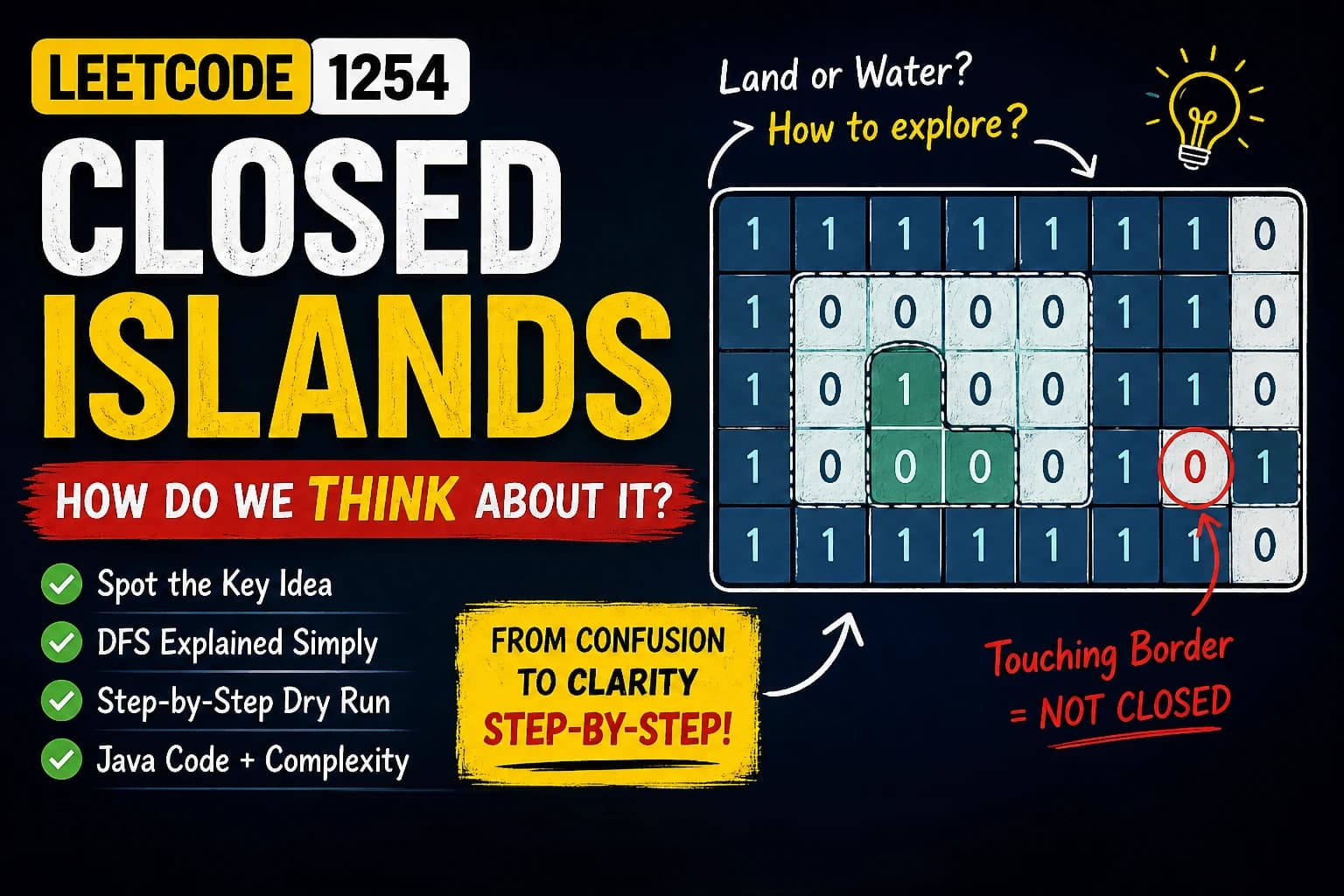
LeetCode 1254: Number of Closed Islands β€” Finding the Idea Before Writing the Code (Java)

LeetCode 1254: Number of Closed Islands β€” Finding the Idea Before Writing the Code (Java)

The Honest Beginning: I Understood the Question, but I Didn't Know How to Solve ItProblem: LeetCode 1254 β€” Number of Closed IslandsWhen I first read this question, I understood the basic meaning of the input. We have a grid containing 0s and 1s. Zero represents land, and one represents water.But understanding the input and knowing how to solve the problem are two completely different things.The question asks us to count closed islands. What exactly is an island here? How do we decide whether several zeroes belong to the same island? And how can we tell whether an island is closed?I didn't immediately think of DFS, recursion, or connected components. Honestly, I didn't even know which direction to take.So instead of jumping straight into a solution, let's start with something familiar and build the intuition from there.Step 1: Imagine Looking for Land on a MapImagine that you are looking at a small map made up of land and water.0 means land.1 means water.Suppose several pieces of land are touching each other horizontally or vertically. Even if that land occupies many grid cells, we consider it one connected island.For example, look at this grid:1 1 1 1 11 0 0 1 11 1 0 1 11 1 1 1 1There are three land cells, but they are not three separate islands.The two zeroes in the second row are connected. The zero directly below the second zero is also connected to them.Therefore, all three cells form one island.This gives us our first important observation:We should not count every zero individually. We need to discover groups of zeroes connected in four directions: up, down, left, and right.Notice that diagonal contact does not count. Two land cells touching only at their corners are not connected under this problem's rules.But we still haven't answered the most important question: how do we discover an entire group?Step 2: How Do We Explore All the Connected Land?Suppose we find a zero at position (1, 1).What should we do next?We can inspect its four neighboring cells:Left: (1, 0)Right: (1, 2)Up: (0, 1)Down: (2, 1)If a neighboring cell contains land, we should explore that cell too. Then we should inspect its neighbors, and continue until there is no more unvisited land connected to our starting point.Think about exploring a maze. You enter a room, check the available paths, enter another room, and continue exploring. Whenever you reach a dead end or a path you have already visited, you return and try another direction.That is very close to what recursion does.We can write a function that explores a cell and calls itself for the four neighboring cells. This technique is commonly called Depth-First Search (DFS).I initially found the recursive calls confusing because it felt as if the function would keep calling itself forever. The missing piece is that we need a way to remember which cells have already been explored.In this problem, we can use the grid itself.Whenever we visit a land cell, we change its value from 0 to 1. Since we have finished treating that cell as unvisited land, we won't explore it again.This prevents us from repeatedly visiting the same cells and getting stuck in an infinite recursive loop.Step 3: Exploring an Island Is Not Enough β€” Is It Closed?At this point, we can discover an island. But the problem doesn't ask us to count every island. It asks us to count only closed islands.Imagine two pieces of land.In the first case, land is surrounded by water on every side. It is completely enclosed.In the second case, some land reaches the edge of the map. This island is open because it is not completely surrounded by water.The important distinction is that an island touching the boundary of the grid cannot be closed.For example:1 1 1 1 11 0 0 1 11 1 0 1 11 1 1 1 1The island is surrounded by water, so it is closed.Now consider:0 0 1 1 11 0 0 1 11 1 1 1 1The land group touches the top edge of the grid. It is not closed, even though some of its cells have water around them.This gives us the second important observation:An island is closed only if none of its connected land cells touches the boundary of the grid.We now have the complete plan:Find an unvisited land cell.Explore every land cell connected to it.Determine whether that entire island touches the boundary.Count it only if it is closed.Continue looking for other unvisited islands.The remaining challenge is implementing this logic without losing information about whether the island is open or closed.Step 4: Translating the Idea into RecursionLet's design a recursive function called sol().It receives the grid and the current row and column. It returns a boolean:true means the explored land group is closed.false means the group touches the grid boundary and is not closed.The function needs to handle three situations.Case 1: We reach waterIf the current cell contains 1, we have reached water. This direction does not lead to additional land outside the island.We return true because this particular direction does not make the island open.Case 2: We reach the grid boundaryIf the current cell is land and lies on the outermost row or column, the island touches the boundary.That means the island is not closed, so this exploration must eventually return false.However, there is a subtle implementation detail here: we must still mark and explore the boundary-connected land correctly. If we stop immediately at the first boundary cell without exploring the rest of that connected group, some of the island's cells may remain unvisited. A later scan could then mistake part of that same open island for a separate closed island.We will address this in the final implementation.Case 3: We reach unvisited interior landThis is where recursion does the real work.We mark the current cell as visited by changing it to 1. Then we explore all four directions.The island is closed only if every direction confirms that it does not connect to the outside boundary.In boolean terms, the results must be combined using logical AND (&&).If even one path reaches boundary-connected land, the whole island is open.Step 5: Connecting the Recursive Function to the Main LoopWe need a way to start exploring islands.The simplest approach is to scan the grid using two nested loops.The outer loop moves through the rows, and the inner loop moves through the columns. Whenever we find an unvisited land cell, we call our recursive function.If the function confirms that the island is closed, we increment our answer.Why can we modify the grid instead of creating a separate visited matrix?Because the original problem only requires us to return the count. We don't need to preserve the original grid, so changing visited land into water is a convenient way to remember our progress.We also need to avoid counting the same island twice. Once an entire connected island has been explored and marked, its cells will no longer trigger another DFS call from the main loop.Java SolutionHere is the complete implementation. It follows the recursive DFS approach described above and handles boundary-connected islands correctly.class Solution {public boolean sol(int[][] grid, int row, int col) {// Reaching outside the grid means this island is open.if (row < 0 || row >= grid.length ||col < 0 || col >= grid[0].length) {return false;}// Water does not make the island open.if (grid[row][col] == 1) {return true;}// Mark this land cell as visited.grid[row][col] = 1;// Explore all four directions.boolean left = sol(grid, row, col - 1);boolean right = sol(grid, row, col + 1);boolean top = sol(grid, row - 1, col);boolean bottom = sol(grid, row + 1, col);return left && right && top && bottom;}public int closedIsland(int[][] grid) {int rows = grid.length;int cols = grid[0].length;int ans = 0;for (int i = 0; i < rows; i++) {for (int j = 0; j < cols; j++) {if (grid[i][j] == 0) {if (sol(grid, i, j)) {ans++;}}}}return ans;}}What changed from my first attempt?My original code checked whether the current cell was water before checking whether it was on the boundary. It also returned immediately when isperim() detected a boundary land cell.That creates a subtle problem: the boundary cell remains unvisited, and the DFS does not continue through it to explore the rest of the connected island. Consequently, land connected through the boundary can be left behind and potentially counted incorrectly later.The revised code uses a different strategy:It checks whether the coordinates are outside the grid before accessing grid[row][col].It treats water as a successful direction.It marks every visited land cell, including boundary land.It explores all four directions before combining their results.This ensures that the whole connected island is visited, even when it is open.One more detail matters: we store the results of all four recursive calls in separate variables. This is intentional. Writing a short-circuit expression that skips later calls after the first false could leave some cells unexplored.Step 6: Dry RunConsider this grid:1 1 1 1 11 0 0 1 11 1 0 1 11 1 1 1 1The main loop scans the grid until it finds the first zero at (1, 1).First, we start DFS at (1, 1).The cell is land, so we mark it as visited. The function explores its left, right, top, and bottom neighbors.The right neighbor (1, 2) is also land. The DFS visits it and explores its neighbors.The cell (2, 2) is land as well, so the exploration continues there.Eventually, every connected land cell has been visited.Next, we check the four directions.All paths eventually reach water or the outside of the grid through no unvisited land. Because no connected land cell reaches the boundary, the recursive result is true.We increment the answer:ans = 1The main loop continues scanning. Since the three land cells have already been changed to 1, they are not counted again.There are no other land cells, so the final answer is:1This small example demonstrates the entire mechanism: one DFS call discovers the complete island, marks it visited, and returns whether it is closed.A More Important Edge Case: One Island Touching the BoundaryConsider this grid:0 0 1 1 11 0 0 1 11 1 1 1 1The connected land group touches the top boundary.When DFS starts from one of its land cells, it will eventually reach a coordinate outside the grid. That recursive call returns false.The false result propagates through the recursive calls, so the complete island is classified as open and is not counted.Because the DFS still explores all four directions and marks every land cell, the main loop cannot later count another portion of this same island as a closed island.The answer is 0.This is why visiting the complete connected group matters just as much as deciding whether it is closed.Complexity AnalysisLet m be the number of rows and n be the number of columns.Time complexity: O(m Γ— n)Each cell is visited at most once because every visited land cell is changed from 0 to 1. The grid scan also examines every cell. Therefore, the total time complexity is O(m Γ— n).Auxiliary space complexity: O(m Γ— n) in the worst case.The recursive DFS can reach a depth proportional to the number of cells if a large island is connected throughout the grid. The recursion call stack can therefore use O(m Γ— n) space in the worst case.The algorithm modifies the input grid directly and does not require a separate visited matrix.What I Learned from This ProblemThe biggest lesson was that I didn't need to know the term β€œconnected component” before starting. I needed to understand what the problem was asking me to discover.First, I noticed that individual zeroes were not the answer; groups of connected zeroes were. That led to the idea of exploring neighbors.Then I realized that exploring one neighbor should lead to exploring its neighbors too. Recursion gave me a way to express that repeated process.Finally, I understood that a closed island was not just a group of land cells. It was a group that never reached the boundary.The difficult part was not writing four recursive calls. It was making sure the function explored the entire island and correctly communicated whether any part of it touched the boundary.That distinction is worth remembering in future DFS problems: discovering a connected group and evaluating a property of that group are two related, but separate, tasks.Final TakeawayLeetCode 1254 becomes easier to reason about once we stop thinking of it as a mysterious graph problem and start thinking of it as exploring connected land on a map.Use DFS to explore the entire island.Mark visited land so it cannot be counted twice.Treat a path that reaches outside the grid as evidence that the island is open.Count an island only when every explored direction confirms that it is closed.If you struggled to find this approach on your first attempt, that is a normal part of learning DSA. The goal is not to recognize every pattern immediately. It is to learn how to turn an unfamiliar problem into a sequence of smaller, understandable decisions.

LeetCodeJavaRecursionBacktrackingMatrixDFSMedium
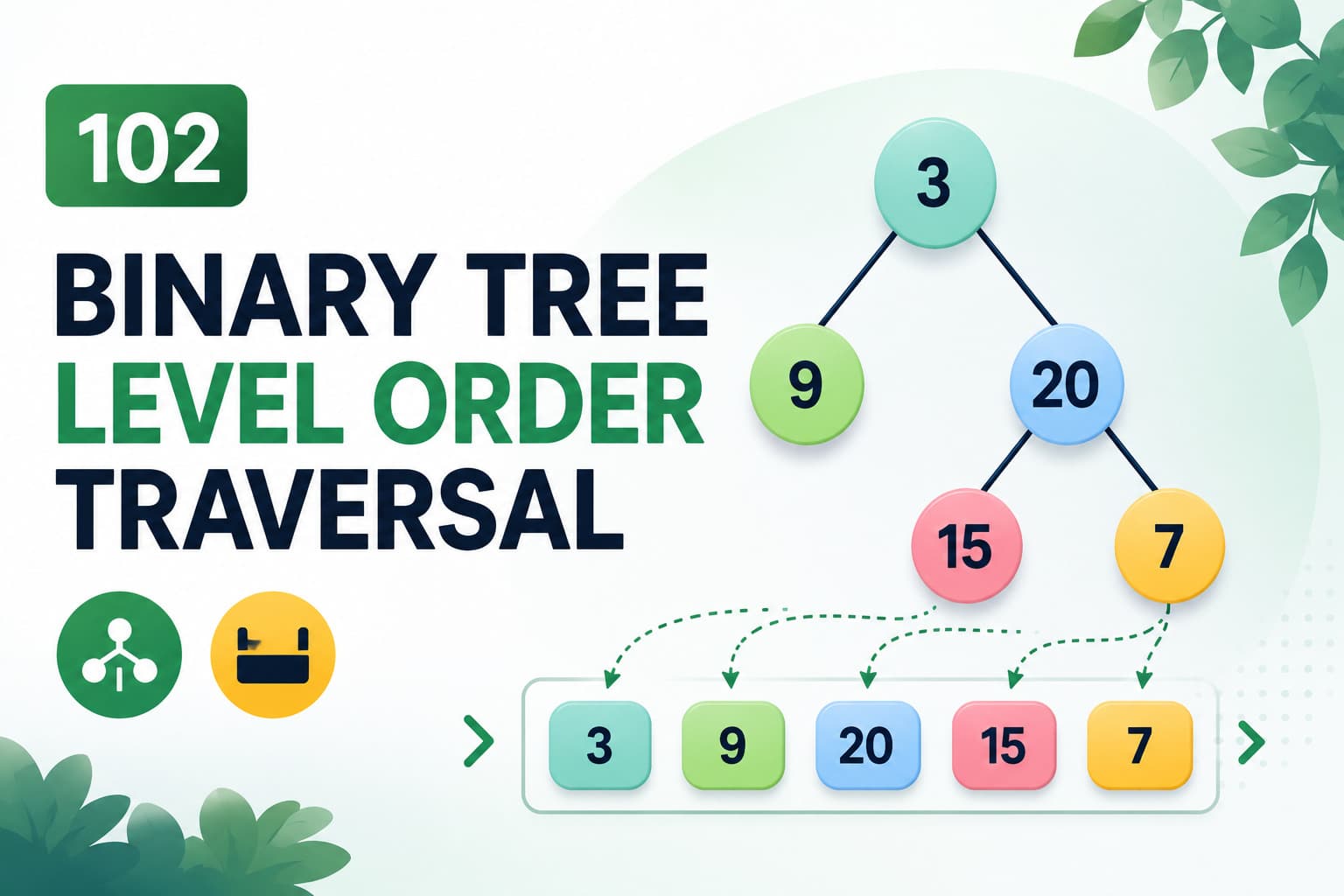
LeetCode 102: Binary Tree Level Order Traversal – Java BFS Solution Explained

LeetCode 102: Binary Tree Level Order Traversal – Java BFS Solution Explained

IntroductionLeetCode 102 – Binary Tree Level Order Traversal is one of the most important Binary Tree traversal problems for coding interviews.This problem introduces:Breadth First Search (BFS)Queue data structureLevel-by-level traversalTree traversal patternsInterview-level BFS thinkingUnlike DFS traversals like preorder, inorder, and postorder, this problem explores the tree level by level.This traversal is widely used in:Graph traversalShortest path problemsTree serializationZigzag traversalBFS-based interview questionsProblem LinkπŸ”— https://leetcode.com/problems/binary-tree-level-order-traversal/Problem StatementGiven the root of a binary tree, return the level order traversal of its nodes' values.Traversal should happen:Level by levelLeft to rightExampleInputroot = [3,9,20,null,null,15,7]Tree Structure: 3 / \ 9 20 / \ 15 7Level Order TraversalLevel 1:[3]Level 2:[9,20]Level 3:[15,7]Final Output:[[3],[9,20],[15,7]]Understanding the ProblemThe main challenge is:Process nodes level by level.This is exactly what:Breadth First Search (BFS)is designed for.Why Queue is Used?A queue follows:First In First Out (FIFO)This ensures:Nodes are processed in insertion orderParent nodes are processed before child nodesLevels are traversed correctlyBrute Force IntuitionOne brute force idea is:Calculate height of treeTraverse each level separatelyStore nodes level by levelBrute Force ComplexityThis approach becomes inefficient because:Each level traversal may revisit nodesComplexity may become:O(NΒ²)for skewed trees.Optimal BFS IntuitionInstead of traversing each level separately:Use a queueProcess nodes level by level naturallyAt every level:Store queue sizeProcess exactly those many nodesAdd children into queueMove to next levelKey BFS ObservationBefore processing a level:int size = queue.size();This tells us:How many nodes belong to the current level.BFS AlgorithmSteps1. Initialize QueueInsert root node.2. Process Until Queue Becomes EmptyWhile queue is not empty:Find current level sizeTraverse current levelStore valuesPush child nodes3. Store Current LevelAfter processing one level:ans.add(levelList);Java BFS Solution/** * Definition for a binary tree node. * public class TreeNode { * int val; * TreeNode left; * TreeNode right; * } */class Solution { public List<List<Integer>> levelOrder(TreeNode root) { List<List<Integer>> ans = new ArrayList<>(); Queue<TreeNode> queue = new LinkedList<>(); if(root == null) return ans; queue.offer(root); while(!queue.isEmpty()) { int size = queue.size(); List<Integer> level = new ArrayList<>(); for(int i = 0; i < size; i++) { root = queue.poll(); level.add(root.val); if(root.left != null) queue.offer(root.left); if(root.right != null) queue.offer(root.right); } ans.add(level); } return ans; }}Dry RunInputroot = [3,9,20,null,null,15,7]Tree: 3 / \ 9 20 / \ 15 7Initial Queue[3]Level 1Queue size:1Process:3Add children:9, 20Level result:[3]Queue now:[9,20]Level 2Queue size:2Process:9, 20Add children:15, 7Level result:[9,20]Queue now:[15,7]Level 3Queue size:2Process:15, 7Level result:[15,7]Queue becomes empty.Final Answer[[3],[9,20],[15,7]]Time Complexity AnalysisTime ComplexityO(N)Every node is visited exactly once.Space ComplexityO(N)Queue may store an entire level of nodes.DFS Alternative ApproachThis problem can also be solved using DFS recursion.Idea:Pass current level during recursionCreate new list when level appears first timeAdd node into correct level listJava DFS Solutionclass Solution { public void dfs(TreeNode root, int level, List<List<Integer>> ans) { if(root == null) return; if(level == ans.size()) { ans.add(new ArrayList<>()); } ans.get(level).add(root.val); dfs(root.left, level + 1, ans); dfs(root.right, level + 1, ans); } public List<List<Integer>> levelOrder(TreeNode root) { List<List<Integer>> ans = new ArrayList<>(); dfs(root, 0, ans); return ans; }}BFS vs DFS for Level Order TraversalApproachAdvantagesDisadvantagesBFSNatural level traversalUses queueDFSRecursive solutionSlightly harder intuitionInterview ExplanationIn interviews, explain:Level order traversal is a BFS problem because we process nodes level by level. A queue naturally supports this traversal order.This demonstrates strong BFS understanding.Common Mistakes1. Forgetting Queue SizeWithout storing:int size = queue.size();levels cannot be separated correctly.2. Using DFS IncorrectlySimple DFS alone does not guarantee level ordering.3. Forgetting Null CheckAlways handle:if(root == null)FAQsQ1. Why is BFS preferred here?Because BFS naturally processes nodes level by level.Q2. Can this problem be solved recursively?Yes.Using DFS with level tracking.Q3. What data structure is mainly used?Queue.Q4. Is Level Order Traversal important?Yes.It is one of the most frequently asked BFS tree problems.Related ProblemsAfter mastering this problem, practice:Binary Tree Zigzag Level Order TraversalAverage of Levels in Binary TreeRight Side View of Binary TreeBinary Tree Vertical Order TraversalMaximum Depth of Binary TreeConclusionLeetCode 102 is one of the most important BFS tree traversal problems.It teaches:BFS traversalQueue usageLevel-by-level processingTree traversal fundamentalsThe key idea is:Use queue size to separate levels.Once this intuition becomes clear, many BFS-based tree interview problems become much easier.
LeetCodeBinary Tree Level Order TraversalBFSQueueBinary TreeJavaTree TraversalMedium
LeetCode 110: Balanced Binary Tree – Java Optimized DFS Solution Explained

LeetCode 110: Balanced Binary Tree – Java Optimized DFS Solution Explained

IntroductionLeetCode 110 – Balanced Binary Tree is one of the most important binary tree interview problems.This problem teaches:Tree recursionHeight calculationDepth First Search (DFS)Bottom-up recursionOptimization techniquesIt is frequently asked in coding interviews because it checks whether you can:Traverse trees efficientlyAvoid repeated calculationsCombine recursion with conditionsOptimize brute force tree solutionsThis problem is also a foundation for advanced tree problems like:AVL TreesHeight-balanced treesDiameter of Binary TreeTree DP problemsProblem LinkπŸ”— https://leetcode.com/problems/balanced-binary-tree/Problem StatementGiven the root of a binary tree:Return:trueif the tree is:height-balancedOtherwise return:falseWhat is a Balanced Binary Tree?A binary tree is balanced if:For every node,|height(left subtree) - height(right subtree)| <= 1Meaning:Left and right subtree heights should not differ by more than:1Example 1Inputroot = [3,9,20,null,null,15,7]Tree:3/ \9 20/ \15 7OutputtrueExplanation:Every node satisfies:height difference <= 1Example 2Inputroot = [1,2,2,3,3,null,null,4,4]Tree:1/ \2 2/ \3 3/ \4 4OutputfalseExplanation:Left subtree becomes much deeper than right subtree.Difference becomes greater than:1Key ObservationTo determine if tree is balanced:At every node we need:Height of left subtreeHeight of right subtreeCompare differenceThis naturally becomes a recursive DFS problem.Brute Force ApproachIntuitionFor every node:Calculate left heightCalculate right heightCompare differenceRecursively check childrenBrute Force Java Solutionclass Solution {public int height(TreeNode root) {if(root == null)return 0;return 1 + Math.max(height(root.left), height(root.right));}public boolean isBalanced(TreeNode root) {if(root == null)return true;int left = height(root.left);int right = height(root.right);if(Math.abs(left - right) > 1)return false;return isBalanced(root.left) && isBalanced(root.right);}}Problem with Brute ForceThe height function gets called repeatedly.For every node:Heights are recalculated again and again.This increases complexity significantly.Brute Force ComplexityTime ComplexityO(NΒ²)because height calculation repeats.Space ComplexityO(H)for recursion stack.Optimized DFS ApproachInstead of:Calculating heights separatelyWe can:Calculate height and balance together.Core Optimization IdeaWhile calculating height:If subtree becomes unbalanced:Return negative value immediatelyThis avoids unnecessary computation.Optimized Java Solutionclass Solution {public int solve(TreeNode roo) {if(roo == null)return 0;int left = solve(roo.left);if(left < 0) {return -1;}int right = solve(roo.right);if(right < 0) {return -1;}if(Math.abs(left - right) > 1) {return -1000;}return 1 + Math.max(left, right);}public boolean isBalanced(TreeNode root) {int ans = solve(root);return ans < 0 ? false : true;}}Cleaner Optimized VersionWe can simplify negative returns using:-1consistently.Cleaner Java Solutionclass Solution {public int height(TreeNode root) {if(root == null)return 0;int left = height(root.left);if(left == -1)return -1;int right = height(root.right);if(right == -1)return -1;if(Math.abs(left - right) > 1)return -1;return 1 + Math.max(left, right);}public boolean isBalanced(TreeNode root) {return height(root) != -1;}}Why This WorksAt every node:Recursively calculate left heightRecursively calculate right heightIf difference > 1:Tree is unbalancedPropagate failure upward immediately.Dry RunInput1/ \2 2/ \3 3/ \4 4Step 1Start from leaf nodes:4 β†’ height = 1Step 2Node:3gets:left = 1right = 1Difference:0Balanced.Height:2Step 3At node:2Left height:2Right height:0Difference:2Unbalanced.Return:-1Final ResultTree is:Not balancedReturn:falseTime Complexity AnalysisOptimized DFS SolutionTime ComplexityO(N)because every node is visited once.Space ComplexityO(H)where:H = height of treeWorst case:O(N)for skewed tree.Brute Force vs OptimizedApproachTime ComplexitySpace ComplexityBrute ForceO(NΒ²)O(H)Optimized DFSO(N)O(H)Interview ExplanationIn interviews, explain:Instead of recalculating heights repeatedly, we combine height calculation and balance checking into a single DFS traversal.This demonstrates:Optimization skillsRecursive DFS understandingBottom-up tree processingCommon Mistakes1. Recalculating Heights RepeatedlyThis causes:O(NΒ²)complexity.2. Forgetting Absolute DifferenceAlways use:Math.abs(left - right)3. Not Handling Null NodesBase case:if(root == null)return 0;is necessary.FAQsQ1. What is a balanced binary tree?A tree where left and right subtree heights differ by at most:1for every node.Q2. Why use DFS?Because height calculation naturally follows recursive depth traversal.Q3. Why return -1?It acts as a signal:Subtree already unbalancedQ4. Is this problem important for interviews?Very important.It is one of the most common tree optimization questions.ConclusionLeetCode 110 is an excellent binary tree optimization problem.It teaches:DFS traversalHeight calculationBottom-up recursionOptimization techniquesThe key insight is:Combine balance checking and height calculation in one DFS traversal.Once you understand this optimization pattern, many advanced tree problems become much easier.

LeetCodeBalanced Binary TreeJavaBinary TreeDFSTree HeightRecursionTree
LeetCode 543: Diameter of Binary Tree – Java DFS Solution Explained

LeetCode 543: Diameter of Binary Tree – Java DFS Solution Explained

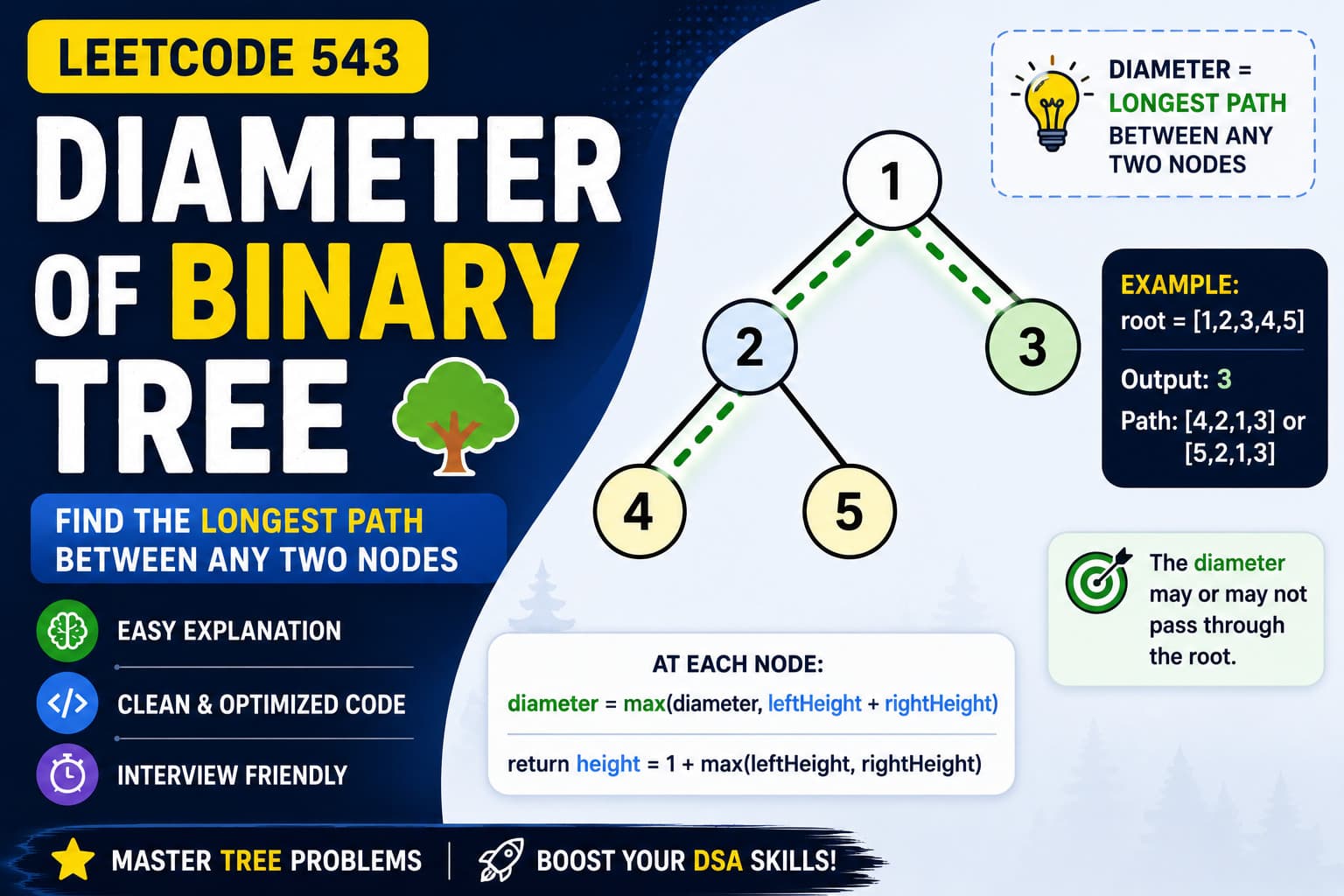
IntroductionLeetCode 543 – Diameter of Binary Tree is one of the most popular binary tree interview problems.This problem teaches:Depth First Search (DFS)Tree height calculationRecursive traversalBottom-up recursionTree optimization techniquesIt is extremely important because it introduces a very common pattern in tree problems:Use recursion to calculate subtree heights while simultaneously updating a global answer.This same idea is used in:Balanced Binary TreeMaximum Path SumLongest ZigZag PathTree DP problemsProblem LinkπŸ”— https://leetcode.com/problems/diameter-of-binary-tree/Problem StatementGiven the root of a binary tree:Return:Length of the diameter of the treeThe diameter is:The length of the longest path between any two nodes in the tree.This path:May pass through the rootMay not pass through the rootImportant NoteThe diameter is measured in:EDGESnot nodes.Example 1Inputroot = [1,2,3,4,5]Tree: 1 / \ 2 3 / \ 4 5Output3Explanation:Longest path:4 β†’ 2 β†’ 1 β†’ 3Edges count:3Example 2Inputroot = [1,2]Tree: 1 / 2Output:1Understanding DiameterAt every node:Possible longest path through that node is:left subtree height + right subtree heightWhy?Because:One side contributes left edgesOther side contributes right edgesTogether they form a path.Key ObservationFor every node:Diameter through node=leftHeight + rightHeightWe compute this for all nodes.Maximum among them becomes answer.Brute Force ApproachIntuitionFor every node:Calculate left subtree heightCalculate right subtree heightCompute diameterRecursively repeat for childrenBrute Force ComplexityHeight gets recalculated repeatedly.Time ComplexityO(NΒ²)Space ComplexityO(H)where:H = tree heightOptimized DFS ApproachInstead of separately calculating:HeightDiameterWe calculate both in one DFS traversal.Core IdeaWhile calculating subtree height:We also update:max diameterThis avoids repeated traversal.Java Solutionclass Solution { int max = Integer.MIN_VALUE; public int solve(TreeNode roo) { if(roo == null) return 0; int left = solve(roo.left); int right = solve(roo.right); max = Math.max(max, left + right); return 1 + Math.max(left, right); } public int diameterOfBinaryTree(TreeNode root) { solve(root); return max; }}Cleaner Optimized Versionclass Solution { int diameter = 0; public int height(TreeNode root) { if(root == null) return 0; int left = height(root.left); int right = height(root.right); diameter = Math.max(diameter, left + right); return 1 + Math.max(left, right); } public int diameterOfBinaryTree(TreeNode root) { height(root); return diameter; }}Why This WorksAt every node:Find left subtree heightFind right subtree heightCompute:left + rightUpdate global maximum diameterReturn current subtree height upwardDry RunInput 1 / \ 2 3 / \ 4 5Step 1Leaf nodes:4 β†’ height = 15 β†’ height = 13 β†’ height = 1Step 2At node:2Left height:1Right height:1Diameter through node:1 + 1 = 2Update:max = 2Height of node 2:2Step 3At root:1Left height:2Right height:1Diameter:2 + 1 = 3Update:max = 3Final Answer3Recursive Visualizationheight(1) β”œβ”€β”€ height(2) β”‚ β”œβ”€β”€ height(4) β”‚ └── height(5) β”‚ └── height(3)Diameter gets updated during return phase.Time Complexity AnalysisOptimized DFS SolutionTime ComplexityO(N)because every node is visited once.Space ComplexityO(H)where:H = tree heightWorst case:O(N)for skewed tree.Brute Force vs OptimizedApproachTime ComplexitySpace ComplexityBrute ForceO(NΒ²)O(H)Optimized DFSO(N)O(H)Interview ExplanationIn interviews, explain:While recursively calculating subtree heights, we simultaneously compute the maximum possible path passing through every node.This demonstrates:DFS understandingBottom-up recursionOptimization skillsTree DP thinkingCommon Mistakes1. Counting Nodes Instead of EdgesDiameter measures:edgesnot nodes.2. Forgetting Global VariableDiameter must be updated across all nodes.3. Returning Diameter Instead of HeightRecursive function should return:heightnot diameter.FAQsQ1. Does diameter always pass through root?No.It can exist completely inside a subtree.Q2. Why use DFS?Because height calculation naturally follows recursive depth traversal.Q3. Why update diameter globally?Because longest path may occur at any node.Q4. Is this problem important for interviews?Very important.It is one of the most common recursive tree questions.ConclusionLeetCode 543 is one of the best problems for learning recursive tree optimization.It teaches:DFS traversalHeight calculationBottom-up recursionGlobal answer trackingThe key insight is:Diameter through a node equals left subtree height + right subtree height.Once you understand this pattern, many advanced binary tree problems become much easier.

LeetCodeDiameter of Binary TreeJavaBinary TreeDFSTreeRecursionEasy
LeetCode 104: Maximum Depth of Binary Tree – Java Recursive Solution Explained

LeetCode 104: Maximum Depth of Binary Tree – Java Recursive Solution Explained

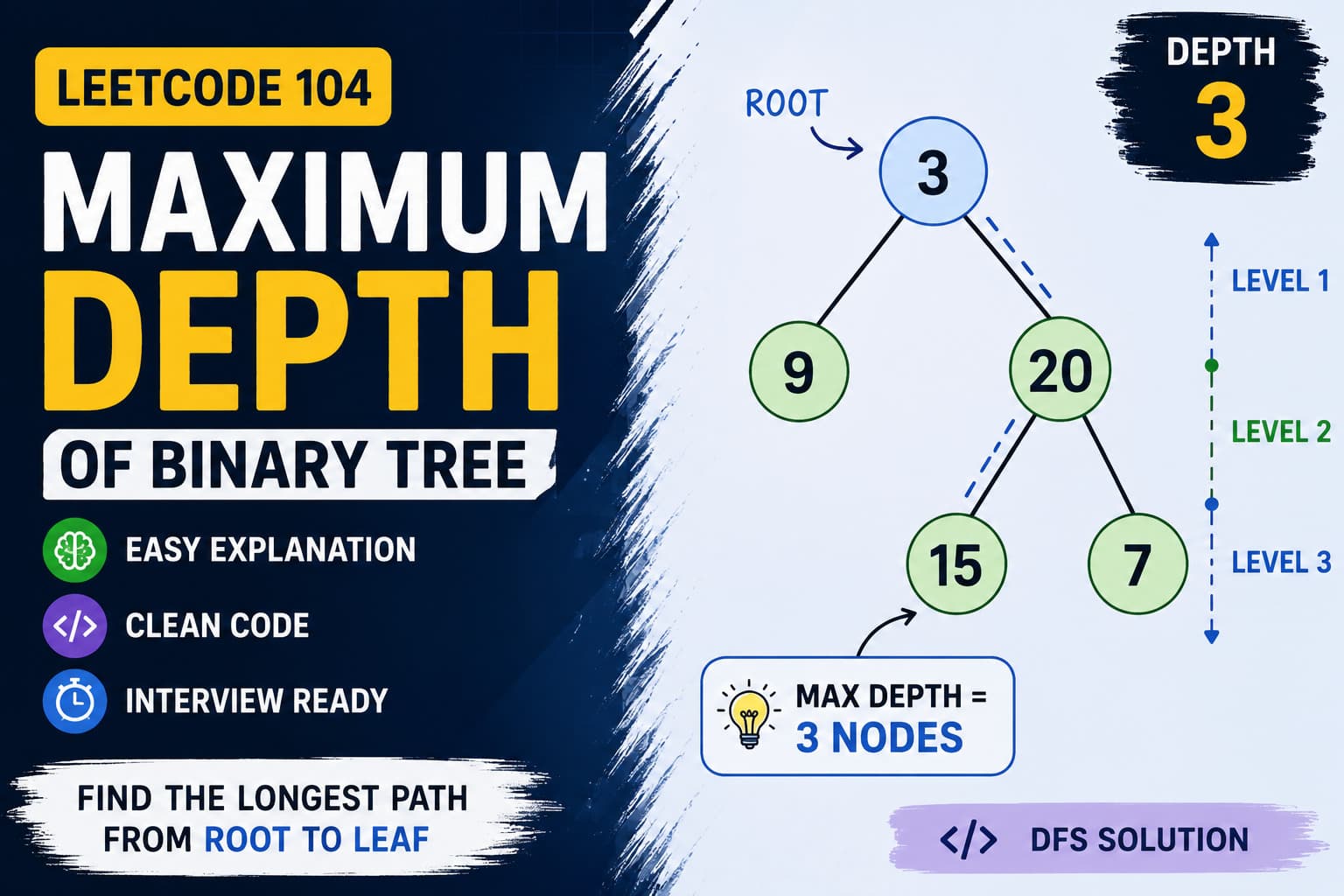
IntroductionLeetCode 104 – Maximum Depth of Binary Tree is one of the most important beginner tree problems in Data Structures and Algorithms.This problem teaches:Binary Tree TraversalDepth First Search (DFS)RecursionTree Height CalculationDivide and ConquerIt is one of the most frequently asked tree questions in coding interviews because it builds the foundation for:Tree recursionHeight problemsBalanced tree problemsDiameter problemsDFS traversalIf you are starting binary trees, this is one of the best problems to master first.Problem LinkπŸ”— https://leetcode.com/problems/maximum-depth-of-binary-tree/Problem StatementGiven the root of a binary tree:Return:Maximum depth of the treeMaximum depth means:Number of nodes along the longest path from root to the farthest leaf node.Example 1Inputroot = [3,9,20,null,null,15,7]Tree: 3 / \ 9 20 / \ 15 7Output3Explanation:Longest path:3 β†’ 20 β†’ 15contains:3 nodesExample 2Inputroot = [1,null,2]Tree:1 \ 2Output:2Understanding Maximum DepthDepth means:How many levels exist in the treeFor example: 1 / \ 2 3 / 4Levels:Level 1 β†’ 1Level 2 β†’ 2,3Level 3 β†’ 4Maximum depth:3Key ObservationThe depth of a tree depends on:Maximum depth of left subtreeandMaximum depth of right subtreeSo:Depth(root)=1 + max(leftDepth, rightDepth)This is the core recursive formula.Recursive IntuitionAt every node:Find depth of left subtreeFind depth of right subtreeTake maximumAdd current nodeThis naturally becomes a recursive DFS problem.Java Recursive Solutionclass Solution { public int maxDepth(TreeNode root) { if(root == null) return 0; int left = maxDepth(root.left); int right = maxDepth(root.right); return 1 + Math.max(left, right); }}Why This WorksAt every node:Recursively calculate left depthRecursively calculate right depthChoose bigger depthAdd:1for current node.This continues until leaf nodes.Dry RunInput 3 / \ 9 20 / \ 15 7Step 1Start from root:3Step 2Left subtree:9Depth:1Step 3Right subtree:20Its children:15 and 7Depth becomes:2Step 4At root:1 + max(1,2)Result:3Recursive Call FlowmaxDepth(3) β”œβ”€β”€ maxDepth(9) β”‚ β”œβ”€β”€ 0 β”‚ └── 0 β”‚ └── maxDepth(20) β”œβ”€β”€ maxDepth(15) └── maxDepth(7)Then values return upward.Alternative BFS ApproachWe can also solve this using:Level Order Traversalusing a queue.Every level increases depth by:1BFS Java Solutionclass Solution { public int maxDepth(TreeNode root) { if(root == null) return 0; Queue<TreeNode> queue = new LinkedList<>(); queue.offer(root); int depth = 0; while(!queue.isEmpty()) { int size = queue.size(); for(int i = 0; i < size; i++) { TreeNode node = queue.poll(); if(node.left != null) queue.offer(node.left); if(node.right != null) queue.offer(node.right); } depth++; } return depth; }}DFS vs BFSApproachTechniqueSpaceDFSRecursionO(H)BFSQueueO(N)Time Complexity AnalysisRecursive DFS SolutionTime ComplexityO(N)because every node is visited once.Space ComplexityO(H)where:H = tree heightWorst case:O(N)for skewed tree.BFS SolutionTime ComplexityO(N)Space ComplexityO(N)queue may contain full level.Interview ExplanationIn interviews, explain:The depth of a node depends on the maximum depth between its left and right subtree. This naturally forms a recursive divide-and-conquer problem.This demonstrates:Tree recursion understandingDFS traversal knowledgeDivide and conquer thinkingCommon Mistakes1. Forgetting Base CaseAlways handle:if(root == null) return 0;2. Using Min Instead of MaxWe need:Longest pathnot shortest.3. Incorrect Depth CountingRemember to add:1for current node.FAQsQ1. What is maximum depth?It is the number of nodes in the longest root-to-leaf path.Q2. Why is recursion preferred?Tree problems naturally fit recursive structures.Q3. Can this be solved iteratively?Yes.Using BFS with queue.Q4. Is this problem important for interviews?Very important.It is one of the most fundamental tree recursion problems.Related ProblemsAfter mastering this problem, practice:Minimum Depth of Binary TreeBalanced Binary TreeDiameter of Binary TreeBinary Tree Level Order TraversalPath SumConclusionLeetCode 104 is one of the most important beginner binary tree problems.It teaches:Recursive DFSTree height calculationDivide and conquerBinary tree traversalThe key insight is:Maximum depth equals 1 + maximum depth of left and right subtree.Once this recursive pattern becomes clear, many advanced tree problems become easier to solve.

LeetCodeDepth of Binary TreeJavaBinary TreeDFSBFSRecursionTreeEasy
LeetCode 144: Binary Tree Preorder Traversal – Java Recursive & Iterative Solution Explained

LeetCode 144: Binary Tree Preorder Traversal – Java Recursive & Iterative Solution Explained

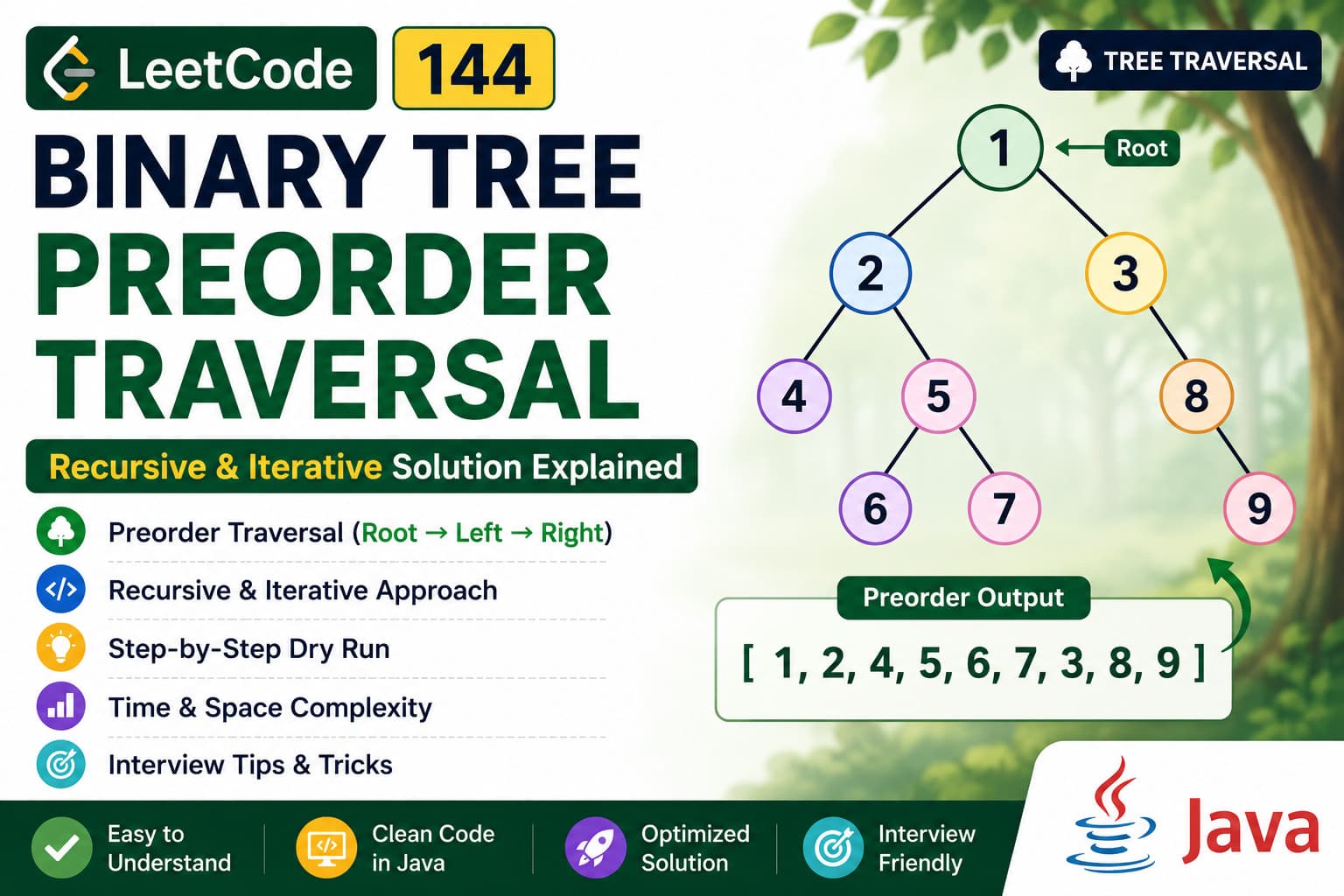
IntroductionLeetCode 144 – Binary Tree Preorder Traversal is one of the most important beginner-friendly tree traversal problems in Data Structures and Algorithms.This problem helps you understand:Binary Tree TraversalDepth First Search (DFS)RecursionStack-based traversalTree traversal patternsPreorder traversal is widely used in:Tree copyingSerializationExpression treesDFS-based problemsHierarchical data processingIt is also one of the most commonly asked tree problems in coding interviews.Problem LinkπŸ”— ProblemLeetCode 144: Binary Tree Preorder TraversalOfficial Problem:LeetCode Problem LinkProblem StatementGiven the root of a binary tree, return the preorder traversal of its nodes' values.What is Preorder Traversal?In preorder traversal, nodes are visited in this order:Root β†’ Left β†’ RightThe root node is processed first before traversing subtrees.ExampleInputroot = [1,null,2,3]Tree Structure:1\2/3Preorder TraversalTraversal order:1 β†’ 2 β†’ 3Output:[1,2,3]Recursive Approach (Most Common)IntuitionIn preorder traversal:Visit current nodeTraverse left subtreeTraverse right subtreeThis naturally fits recursion because trees themselves are recursive structures.Recursive DFS VisualizationTraversal pattern:Root β†’ Left β†’ RightRecursive function:visit(node)preorder(node.left)preorder(node.right)Java Recursive Solution/*** Definition for a binary tree node.* public class TreeNode {* int val;* TreeNode left;* TreeNode right;* }*/class Solution {public void solve(List<Integer> list, TreeNode root) {if(root == null) return;list.add(root.val);solve(list, root.left);solve(list, root.right);}public List<Integer> preorderTraversal(TreeNode root) {List<Integer> list = new ArrayList<>();solve(list, root);return list;}}Dry Run – Recursive ApproachTree:1\2/3Step 1Start at:1Add:1Move right to:2Step 2Add:2Move left to:3Step 3Add:3Final Answer[1,2,3]Time Complexity – RecursiveTime ComplexityO(N)Every node is visited once.Space ComplexityO(H)Where:H = height of treeRecursive call stack uses extra spaceWorst case:O(N)for skewed trees.Iterative Approach (Interview Follow-Up)The follow-up asks:Can you solve it iteratively?Yes.We use a stack to simulate recursion.Iterative Preorder IntuitionPreorder traversal order is:Root β†’ Left β†’ RightUsing a stack:Process current node immediatelyPush right child firstPush left child secondWhy?Because stacks follow:Last In First Out (LIFO)So left subtree gets processed first.Stack-Based Iterative LogicAlgorithmPush root into stack.Pop node.Add node value.Push right child.Push left child.Repeat until stack becomes empty.Java Iterative Solutionclass Solution {public List<Integer> preorderTraversal(TreeNode root) {List<Integer> ans = new ArrayList<>();if(root == null) return ans;Stack<TreeNode> stack = new Stack<>();stack.push(root);while(!stack.isEmpty()) {TreeNode node = stack.pop();ans.add(node.val);if(node.right != null) {stack.push(node.right);}if(node.left != null) {stack.push(node.left);}}return ans;}}Dry Run – Iterative ApproachTree:1\2/3Step 1Push:1Step 2Pop:1Add:[1]Push right child:2Step 3Pop:2Add:[1,2]Push left child:3Step 4Pop:3Add:[1,2,3]Final Answer[1,2,3]Comparison of ApproachesApproachAdvantagesDisadvantagesRecursiveEasy to understandUses recursion stackIterativeBetter interview practiceSlightly harder logicInterview ExplanationIn interviews, explain:Preorder traversal processes nodes in Root β†’ Left β†’ Right order. Recursion naturally handles this traversal. Iteratively, we use a stack and push the right child before the left child so the left subtree gets processed first.This demonstrates strong DFS and stack understanding.Common Mistakes1. Wrong Traversal OrderIncorrect:Left β†’ Root β†’ RightThat is inorder traversal.Correct preorder:Root β†’ Left β†’ Right2. Forgetting Null Base CaseAlways check:if(root == null) return;3. Wrong Stack Push OrderFor iterative traversal:Push right firstPush left secondOtherwise traversal order becomes incorrect.FAQsQ1. Why is preorder traversal useful?It is heavily used in:Tree cloningSerializationDFS traversalExpression treesQ2. Which approach is preferred in interviews?Recursive is simpler.Iterative is often asked as a follow-up.Q3. Can preorder traversal be done without stack or recursion?Yes.Using Morris Traversal.Q4. What is the difference between preorder, inorder, and postorder?TraversalOrderPreorderRoot β†’ Left β†’ RightInorderLeft β†’ Root β†’ RightPostorderLeft β†’ Right β†’ RootBonus: Morris Preorder TraversalMorris traversal performs preorder traversal using:O(1)extra space.This is considered an advanced interview topic.ConclusionLeetCode 144 is one of the most fundamental binary tree traversal problems.It teaches:DFS traversalRecursionStack simulationBinary tree fundamentalsThe key preorder pattern is:Root β†’ Left β†’ RightMastering this traversal builds a strong foundation for advanced tree problems such as:Tree serializationDFS-based problemsTree reconstructionExpression treesMorris traversal

LeetCodeBinary Tree Preorder TraversalBinary TreeTree TraversalJavaDFSStackRecursionEasy
LeetCode 124: Binary Tree Maximum Path Sum – Java DFS Solution Explained

LeetCode 124: Binary Tree Maximum Path Sum – Java DFS Solution Explained

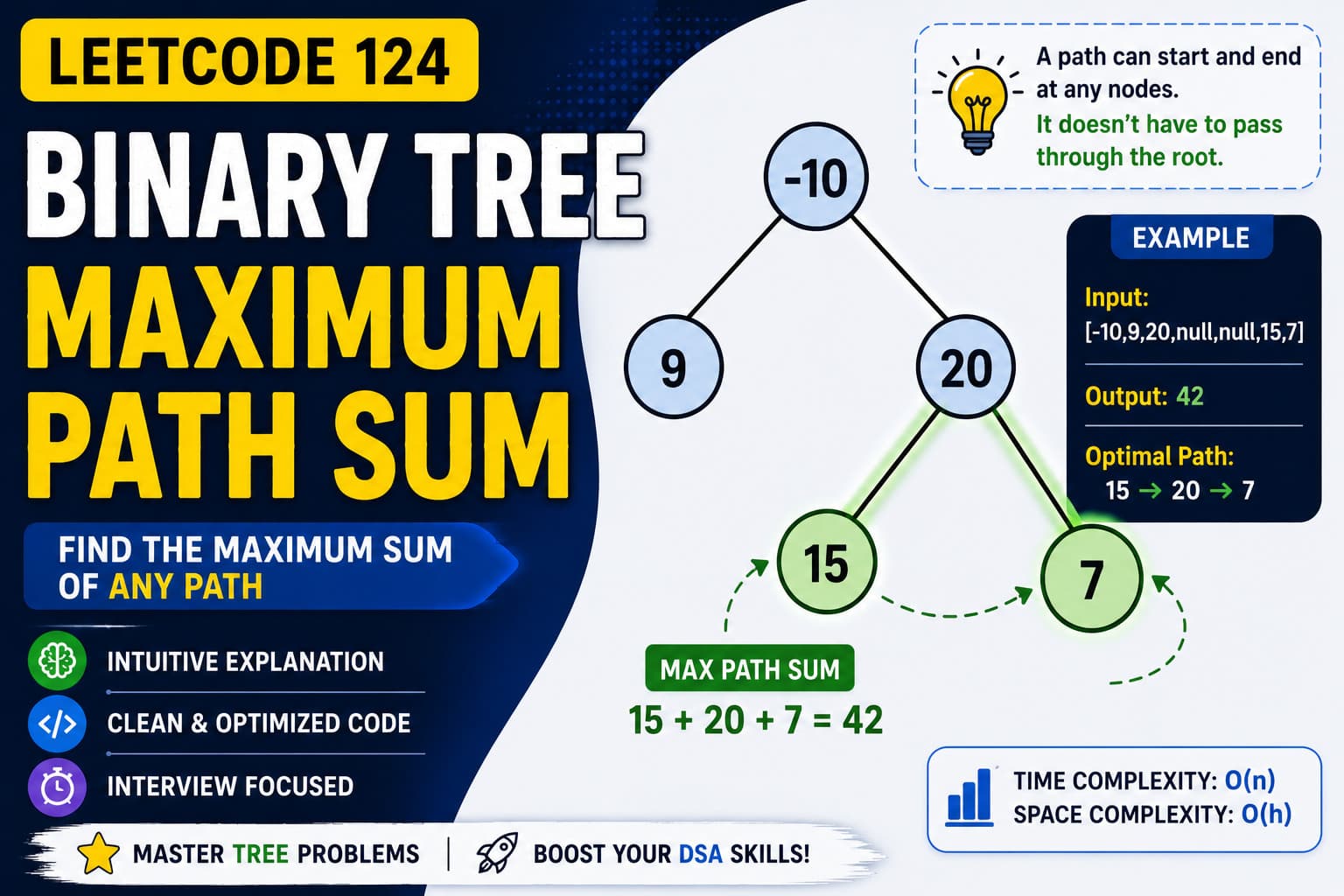
IntroductionLeetCode 124 – Binary Tree Maximum Path Sum is one of the most important and frequently asked hard-level binary tree interview problems.This problem teaches:Depth First Search (DFS)Bottom-up recursionTree Dynamic ProgrammingRecursive optimizationGlobal answer trackingIt is considered a classic interview problem because it combines:Tree traversalRecursive decision makingPath optimizationNegative value handlingMastering this problem helps in understanding advanced binary tree patterns used in:Diameter problemsTree DPMaximum path problemsGraph recursion problemsProblem LinkπŸ”— https://leetcode.com/problems/binary-tree-maximum-path-sum/Problem StatementGiven the root of a binary tree:Return:Maximum path sum of any non-empty pathA path:Can start from any nodeCan end at any nodeMust follow parent-child connectionsCannot visit a node more than onceImportant:Path does NOT need to pass through rootExample 1Inputroot = [1,2,3]Tree: 1 / \ 2 3Output6Explanation:Best path:2 β†’ 1 β†’ 3Path sum:2 + 1 + 3 = 6Example 2Inputroot = [-10,9,20,null,null,15,7]Tree: -10 / \ 9 20 / \ 15 7Output42Explanation:Best path:15 β†’ 20 β†’ 7Sum:15 + 20 + 7 = 42Key ObservationAt every node:We have two important possibilities.Possibility 1Path continues upward to parent.In this case:We can choose only:ONE sidebecause path cannot split upward.Return value becomes:node + max(left, right)Possibility 2Current node becomes:Highest point of pathThen we can use:left + node + rightThis candidate updates global maximum answer.Core Recursive IdeaAt every node:Calculate left maximum contributionCalculate right maximum contributionIgnore negative pathsUpdate global answerReturn best single-side path upwardWhy Ignore Negative Paths?Negative paths reduce total sum.So:Math.max(path, 0)ensures:Negative contribution is discardedOnly profitable paths are consideredThis is the most important optimization.Your Java Solutionclass Solution { int max = Integer.MIN_VALUE; public int solve(TreeNode roo) { if(roo == null) return 0; int left = Math.max(solve(roo.left), 0); int right = Math.max(solve(roo.right), 0); max = Math.max(max, roo.val + left + right); return roo.val + Math.max(left, right); } public int maxPathSum(TreeNode root) { solve(root); return max; }}Why This WorksFor every node:We calculate:Best path passing through current nodewhich is:left + node + rightThis path may become global maximum.But while returning upward:We can only choose:one directionbecause paths cannot split.Dry RunInput -10 / \ 9 20 / \ 15 7Step 1Leaf nodes:9 β†’ return 915 β†’ return 157 β†’ return 7Step 2At node:20Left:15Right:7Current best path:15 + 20 + 7 = 42Update:max = 42Return upward:20 + max(15,7)= 35Step 3At node:-10Left:9Right:35Candidate:9 + (-10) + 35 = 34Global maximum remains:42Final Answer42Recursive Visualizationsolve(-10) β”œβ”€β”€ solve(9) β”‚ └── solve(20) β”œβ”€β”€ solve(15) └── solve(7)Global maximum gets updated during return phase.Brute Force ApproachA brute force approach would:Generate all possible pathsCalculate sumsTrack maximumBut number of paths becomes extremely large.This is inefficient.Brute Force ComplexityTime ComplexityCan become:O(NΒ²)or worse depending on implementation.Optimized DFS ComplexityTime ComplexityO(N)because every node is visited once.Space ComplexityO(H)where:H = height of treeWorst case:O(N)for skewed tree.Important InsightTwo values exist at every node.1. Value Returned UpwardOnly one side allowed:node + max(left, right)2. Value Used for Global MaximumBoth sides allowed:left + node + rightThis distinction is the heart of the problem.Interview ExplanationIn interviews, explain:Every node acts as a potential highest point of a path. We compute the best path through that node while recursively returning the best single-side contribution upward.This demonstrates:Advanced DFS understandingTree DP conceptsRecursive optimizationHandling negative pathsCommon Mistakes1. Returning Both Sides UpwardIncorrect:left + node + rightA path cannot branch upward.2. Forgetting Negative Path HandlingAlways use:Math.max(value, 0)3. Assuming Path Must Pass RootThe path can exist entirely inside a subtree.4. Not Using Global VariableMaximum path may occur anywhere.FAQsQ1. Does path need to start from root?No.It can start and end anywhere.Q2. Why ignore negative sums?Negative paths reduce overall answer.Q3. Why can we return only one side?Because a path moving upward cannot split into two directions.Q4. Is this problem important for interviews?Extremely important.It is one of the most famous hard-level tree problems.Related ProblemsAfter mastering this problem, practice:Diameter of Binary TreeBalanced Binary TreeMaximum Depth of Binary TreeConclusionLeetCode 124 is one of the best problems for learning advanced binary tree recursion.It teaches:DFS optimizationTree dynamic programmingRecursive decision makingNegative path handlingGlobal answer trackingThe key insight is:Every node can become the highest point of a maximum path.Once this recursive pattern becomes clear, many advanced tree and graph problems become much easier to solve.

LeetCodeBinary Tree Maximum Path SumJavaBinary TreeDFSTreeRecursionDynamic Programming on TreesHard
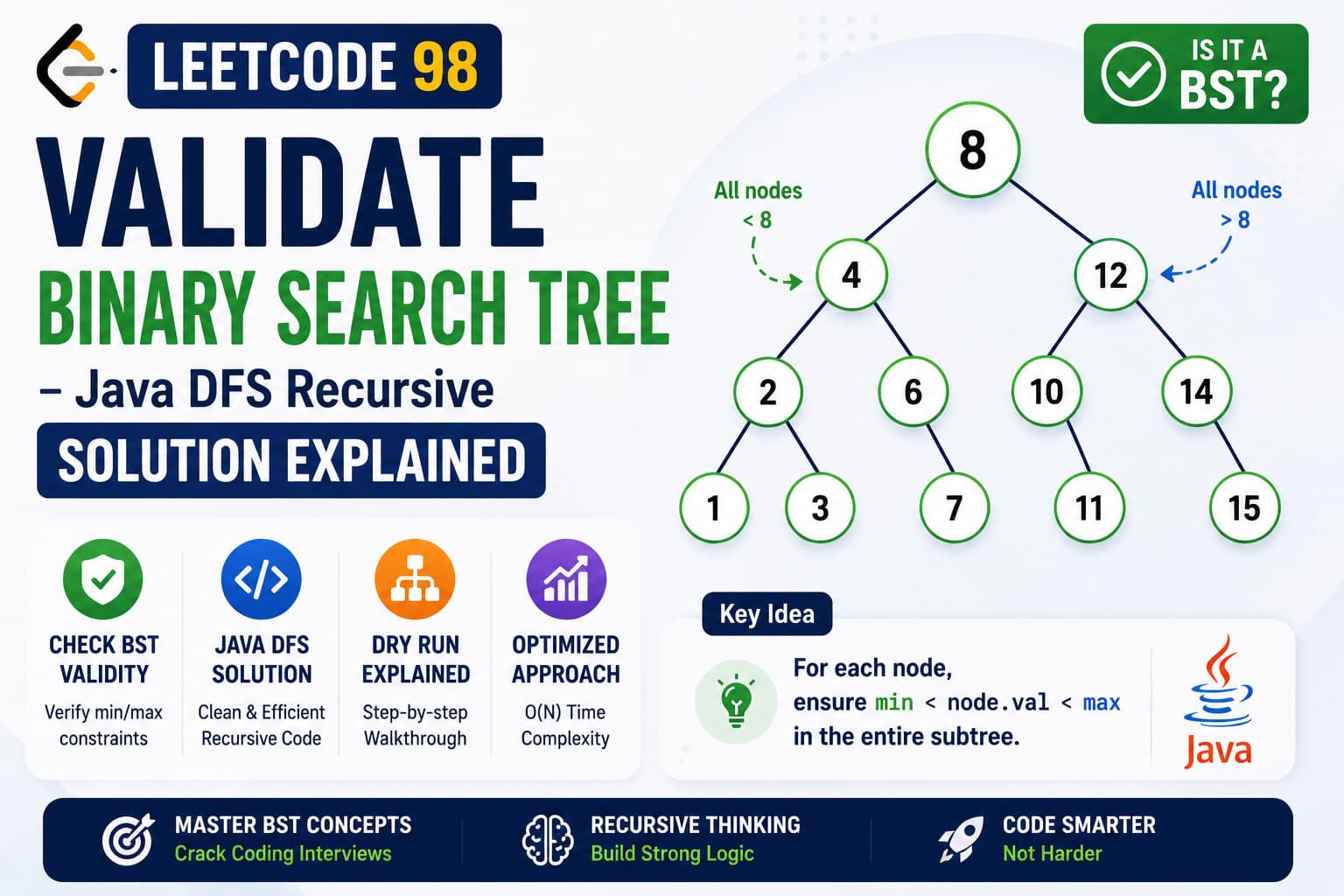
LeetCode 98: Validate Binary Search Tree – Java DFS Recursive Solution Explained

LeetCode 98: Validate Binary Search Tree – Java DFS Recursive Solution Explained

IntroductionLeetCode 98 – Validate Binary Search Tree is one of the most important Binary Search Tree interview problems.This question is extremely popular because it tests:BST propertiesRecursive tree traversalDFS recursionRange validationTree constraints handlingMany beginners make mistakes on this problem because checking only parent-child relationships is not enough.Understanding the correct BST validation logic is very important for interviews.Problem LinkπŸ”— https://leetcode.com/problems/validate-binary-search-tree/Problem StatementGiven the root of a binary tree, determine whether it is a valid Binary Search Tree (BST).A valid BST follows:Left subtree contains only smaller valuesRight subtree contains only greater valuesBoth left and right subtrees must also be BSTsExample 1Inputroot = [2,1,3]OutputtrueExplanation 2 / \ 1 3All BST conditions are satisfied.Example 2Inputroot = [5,1,4,null,null,3,6]OutputfalseWhy False? 5 / \ 1 4 / \ 3 6Although:4 < 6the node:4exists inside the right subtree of:5and should therefore be greater than 5.This violates BST rules.Key InsightThe most important understanding:Every node must satisfy an entire valid range, not just parent comparison.This is where many incorrect solutions fail.Common Wrong ThinkingMany beginners try:if(root.left.val < root.val && root.right.val > root.val)This is incorrect.Because BST validation depends on:ALL ancestor constraintsnot just immediate parent.Correct IntuitionEach node has:Minimum allowed valueMaximum allowed valueFor example:Left subtree -> values smaller than rootRight subtree -> values greater than rootAs recursion goes deeper:constraints become tighterVisual Understanding 10 / \ 5 15 / \ 6 20Node:6is invalid because:6 < 10even though:6 < 15This proves:Parent-only checking is insufficient.Brute Force ApproachIdeaFor every node:Find maximum in left subtreeFind minimum in right subtreeValidate BST conditionsBrute Force ComplexityTime ComplexityO(NΒ²)Because subtree traversal repeats for every node.Space ComplexityO(H)Recursive stack space.Optimized Recursive DFS ApproachThe optimized idea:Pass valid range during recursion.Each node must satisfy:min < node.val < maxJava Solutionclass Solution { public boolean solve(TreeNode root, long min, long max) { if(root == null) return true; if(root.val <= min || root.val >= max) { return false; } return solve(root.left, min, root.val) && solve(root.right, root.val, max); } public boolean isValidBST(TreeNode root) { if(root == null) return true; return solve(root, Long.MIN_VALUE, Long.MAX_VALUE); }}Why Use Long Instead of Int?Constraints allow:-2Β³ΒΉ <= Node.val <= 2Β³ΒΉ - 1Using:Integer.MIN_VALUEInteger.MAX_VALUEcan create edge-case failures.So we safely use:Long.MIN_VALUELong.MAX_VALUEHow This WorksFor every node:Left SubtreeAllowed range:(min, root.val)Right SubtreeAllowed range:(root.val, max)This guarantees global BST validity.Dry RunInputroot = [2,1,3]Step 1Current node:2Allowed range:(-∞, +∞)Valid.Step 2Move left:1Allowed range:(-∞, 2)Valid.Step 3Move right:3Allowed range:(2, +∞)Valid.Final OutputtrueAnother Dry RunInputroot = [5,1,4,null,null,3,6]Step 1Node:5Range:(-∞, +∞)Valid.Step 2Move right to:4Range:(5, +∞)Now:4 <= 5Invalid BST.Final OutputfalseTime Complexity AnalysisTime ComplexityO(N)Every node visited once.Space ComplexityO(H)Where:H = height of treeWorst case:O(N)for skewed tree.Alternative Approach Using Inorder TraversalKey PropertyBST inorder traversal produces:strictly increasing orderInorder Java Solutionclass Solution { TreeNode prev = null; public boolean inorder(TreeNode root) { if(root == null) return true; if(!inorder(root.left)) return false; if(prev != null && root.val <= prev.val) { return false; } prev = root; return inorder(root.right); } public boolean isValidBST(TreeNode root) { return inorder(root); }}Interview ExplanationIn interviews, explain:A valid BST requires every node to satisfy ancestor constraints, not just parent constraints. Therefore, we recursively maintain valid minimum and maximum bounds for each node.This demonstrates:Deep BST understandingRecursive DFS masteryConstraint propagationEdge-case handlingCommon Mistakes1. Comparing Only Parent NodesIncorrect approach:root.left.val < root.valThis misses ancestor violations.2. Forgetting Strict InequalityBST requires:strictly smallerstrictly greaterDuplicates are invalid.3. Using int Instead of longCan fail on edge values.Always use:long minlong max4. Incorrect Range PassingCorrect recursion:left -> (min, root.val)right -> (root.val, max)FAQsQ1. Why does parent comparison fail?Because BST validity depends on all ancestor constraints.Q2. Why use min/max bounds?Bounds propagate BST restrictions correctly.Q3. Can inorder traversal solve this?Yes.BST inorder traversal must be strictly increasing.Q4. Is this asked frequently?Very frequently.It is one of the most important BST interview questions.Related ProblemsPractice these next:Search in BSTInsert into BSTLowest Common Ancestor in BSTKth Smallest Element in BSTConclusionLeetCode 98 is an excellent problem for mastering:BST validationRecursive DFSConstraint propagationTree traversalInterview problem-solvingThe key insight is:Every BST node must satisfy a valid global range, not just local parent conditions.Once this concept becomes intuitive, many advanced BST problems become significantly easier.

LeetCodeBinary Search TreeBSTJavaDFS TraversalBinary TreeRecursionMedium
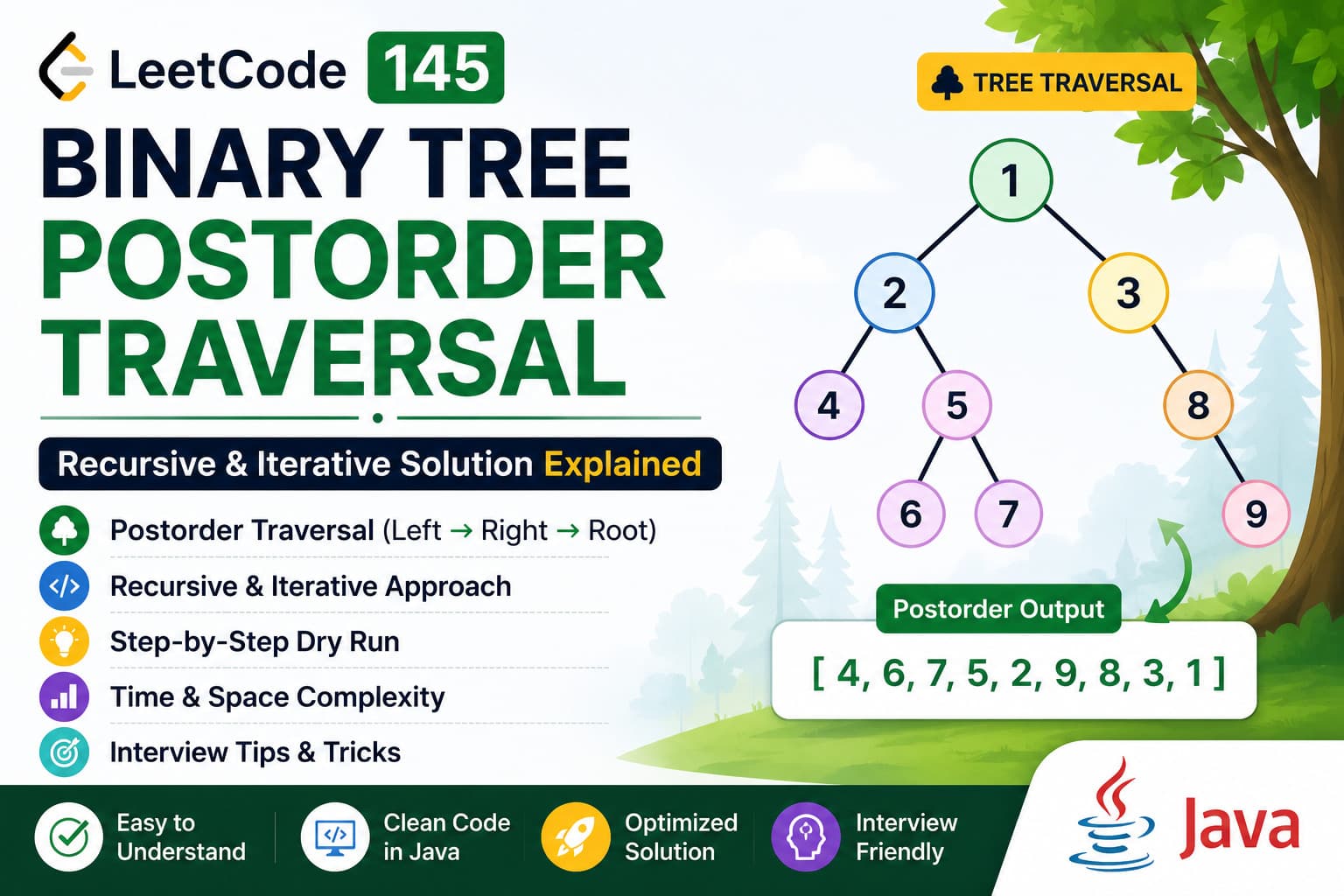
LeetCode 145: Binary Tree Postorder Traversal – Java Recursive & Iterative Solution Explained

LeetCode 145: Binary Tree Postorder Traversal – Java Recursive & Iterative Solution Explained

IntroductionLeetCode 145 – Binary Tree Postorder Traversal is one of the most important tree traversal problems for beginners learning Data Structures and Algorithms.This problem teaches:Binary Tree TraversalDepth First Search (DFS)RecursionStack-based traversalTree traversal patternsPostorder traversal is extremely useful in advanced tree problems such as:Tree deletionExpression tree evaluationBottom-up computationsDynamic programming on treesProblem LinkπŸ”— https://leetcode.com/problems/binary-tree-postorder-traversal/Problem StatementGiven the root of a binary tree, return the postorder traversal of its nodes' values.What is Postorder Traversal?In postorder traversal, nodes are visited in this order:Left β†’ Right β†’ RootUnlike preorder or inorder traversal, the root node is processed at the end.ExampleInputroot = [1,null,2,3]Tree Structure:1\2/3Postorder TraversalTraversal order:3 β†’ 2 β†’ 1Output:[3,2,1]Recursive Approach (Most Common)IntuitionIn postorder traversal:Traverse left subtreeTraverse right subtreeVisit current nodeThis naturally fits recursion because trees themselves are recursive structures.Recursive DFS VisualizationTraversal pattern:Left β†’ Right β†’ RootRecursive function:postorder(node.left)postorder(node.right)visit(node)Java Recursive Solution/*** Definition for a binary tree node.* public class TreeNode {* int val;* TreeNode left;* TreeNode right;* }*/class Solution {public void solve(List<Integer> list, TreeNode root) {if(root == null) return;solve(list, root.left);solve(list, root.right);list.add(root.val);}public List<Integer> postorderTraversal(TreeNode root) {List<Integer> list = new ArrayList<>();solve(list, root);return list;}}Dry Run – Recursive ApproachTree:1\2/3Step 1Start at:1Move left:nullReturn back.Step 2Move right to:2Move left to:3Left and right of 3 are null.Add:3Step 3Return to:2Add:2Step 4Return to:1Add:1Final Answer[3,2,1]Time Complexity – RecursiveTime ComplexityO(N)Every node is visited once.Space ComplexityO(H)Where:H = height of the treeRecursive call stack uses extra spaceWorst case:O(N)for skewed trees.Iterative Approach (Interview Follow-Up)The follow-up asks:Can you solve it iteratively?Yes.We use stacks to simulate recursion.Iterative Postorder IntuitionPostorder traversal order is:Left β†’ Right β†’ RootOne common trick is:Traverse in modified preorder:Root β†’ Right β†’ LeftReverse the result.After reversing, we get:Left β†’ Right β†’ Rootwhich is postorder traversal.Stack-Based Iterative LogicAlgorithmPush root into stack.Pop node.Add node value to answer.Push left child.Push right child.Reverse final answer.Java Iterative Solutionclass Solution {public List<Integer> postorderTraversal(TreeNode root) {LinkedList<Integer> ans = new LinkedList<>();if(root == null) return ans;Stack<TreeNode> stack = new Stack<>();stack.push(root);while(!stack.isEmpty()) {TreeNode node = stack.pop();ans.addFirst(node.val);if(node.left != null) {stack.push(node.left);}if(node.right != null) {stack.push(node.right);}}return ans;}}Dry Run – Iterative ApproachTree:1\2/3Step 1Push:1Step 2Pop:1Add at front:[1]Push right child:2Step 3Pop:2Add at front:[2,1]Push left child:3Step 4Pop:3Add at front:[3,2,1]Final Answer[3,2,1]Comparison of ApproachesApproachAdvantagesDisadvantagesRecursiveEasy to understandUses recursion stackIterativeBetter interview practiceSlightly harder logicInterview ExplanationIn interviews, explain:Postorder traversal processes nodes in Left β†’ Right β†’ Root order. Recursion naturally handles this traversal. Iteratively, we simulate recursion using a stack and reverse traversal order.This demonstrates strong tree traversal understanding.Common Mistakes1. Wrong Traversal OrderIncorrect:Root β†’ Left β†’ RightThat is preorder traversal.Correct postorder:Left β†’ Right β†’ Root2. Forgetting Null Base CaseAlways check:if(root == null) return;3. Incorrect Stack Push OrderFor iterative solution:Push left firstPush right secondbecause we reverse the result later.FAQsQ1. Why is postorder traversal useful?It is used in:Tree deletionExpression tree evaluationBottom-up dynamic programmingCalculating subtree informationQ2. Which approach is preferred in interviews?Recursive is simpler.Iterative is often asked as a follow-up.Q3. Can postorder traversal be done without stack or recursion?Yes.Using Morris Traversal.Q4. What is the difference between preorder, inorder, and postorder?TraversalOrderPreorderRoot β†’ Left β†’ RightInorderLeft β†’ Root β†’ RightPostorderLeft β†’ Right β†’ RootBonus: Morris Postorder TraversalMorris traversal performs tree traversal using:O(1)extra space.This is considered an advanced interview topic.ConclusionLeetCode 145 is an excellent beginner-friendly tree traversal problem.It teaches:DFS traversalRecursionStack simulationBinary tree fundamentalsThe key postorder pattern is:Left β†’ Right β†’ RootMastering this traversal helps in solving many advanced tree problems such as:Tree DPTree deletionExpression evaluationSubtree calculationsAdvanced DFS problems

LeetCodeBinary Tree Postorder TraversalBinary TreeTree TraversalJavaDFSStackRecursionEasy
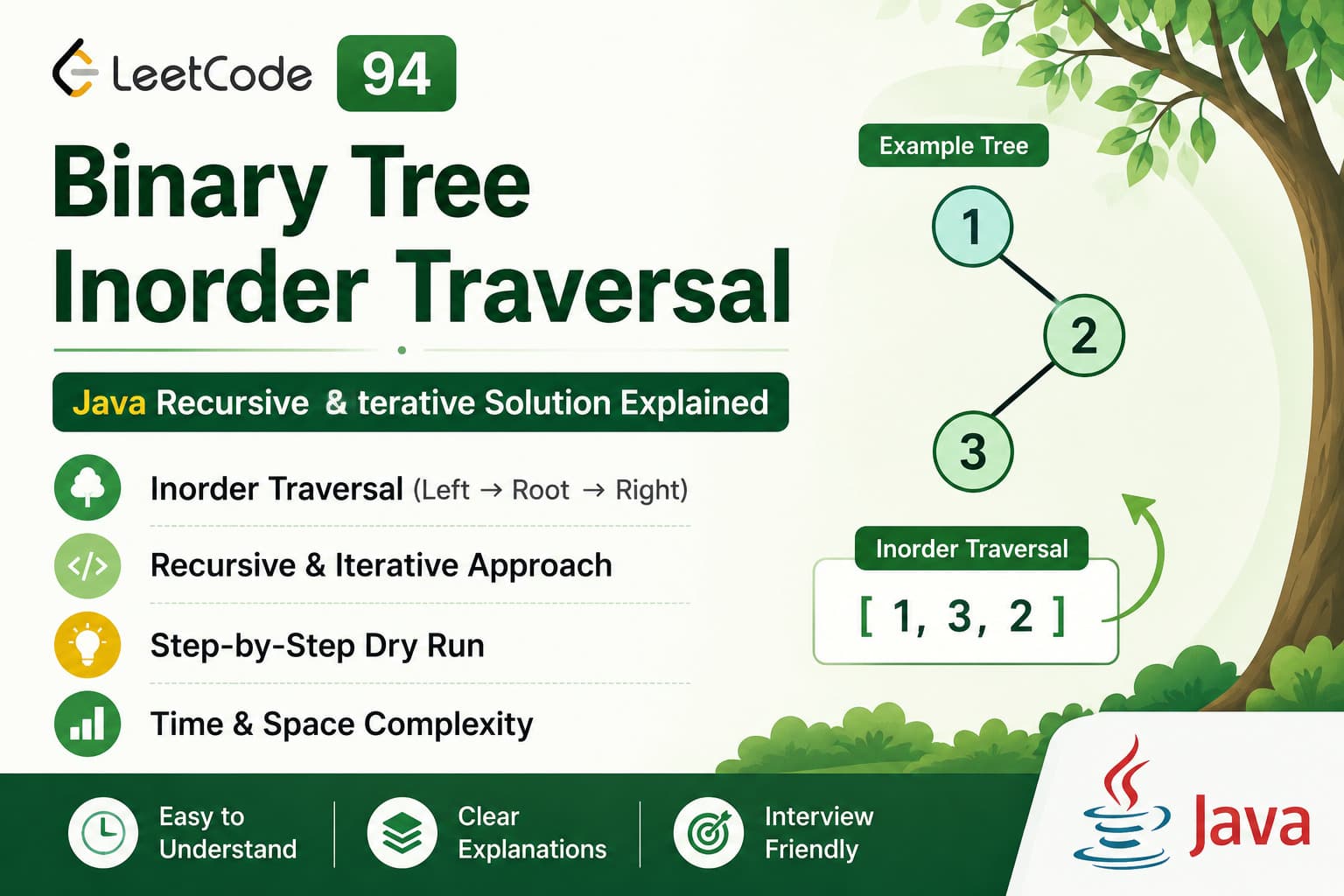
LeetCode 94: Binary Tree Inorder Traversal – Java Recursive & Iterative Solution Explained

LeetCode 94: Binary Tree Inorder Traversal – Java Recursive & Iterative Solution Explained

IntroductionLeetCode 94 – Binary Tree Inorder Traversal is one of the most important beginner-friendly tree problems in Data Structures and Algorithms.This problem helps you understand:Binary tree traversalDepth First Search (DFS)RecursionStack-based traversalTree interview fundamentalsIt is commonly asked in coding interviews because tree traversal forms the foundation of many advanced tree problems.Problem LinkπŸ”— ProblemLeetCode 94: Binary Tree Inorder TraversalOfficial Problem:LeetCode Problem LinkProblem StatementGiven the root of a binary tree, return the inorder traversal of its nodes' values.What is Inorder Traversal?In inorder traversal, we visit nodes in this order:Left β†’ Root β†’ RightExampleInputroot = [1,null,2,3]Tree Structure:1\2/3Inorder TraversalStep-by-step:1 β†’ 3 β†’ 2Output:[1,3,2]Recursive Approach (Most Common)IntuitionIn inorder traversal:Traverse left subtreeVisit current nodeTraverse right subtreeThis naturally fits recursion because trees themselves are recursive structures.Recursive DFS VisualizationTraversal order:Left β†’ Node β†’ RightRecursive function:inorder(node.left)visit(node)inorder(node.right)Java Recursive Solution/*** Definition for a binary tree node.* public class TreeNode {* int val;* TreeNode left;* TreeNode right;* }*/class Solution {public void solve(List<Integer> list, TreeNode root) {if(root == null) return;solve(list, root.left);list.add(root.val);solve(list, root.right);}public List<Integer> inorderTraversal(TreeNode root) {List<Integer> list = new ArrayList<>();solve(list, root);return list;}}Dry Run – Recursive ApproachTree:1\2/3Step 1Start at:1Move left:nullReturn back.Add:1Step 2Move right to:2Move left to:3Add:3Return back.Add:2Final Answer[1,3,2]Time Complexity – RecursiveTime ComplexityO(N)Every node is visited once.Space ComplexityO(H)Where:H = height of treeRecursive call stack uses extra spaceWorst case:O(N)for skewed trees.Iterative Approach (Interview Follow-Up)The follow-up asks:Can you solve it iteratively?Yes.We use a stack to simulate recursion.Iterative Inorder IntuitionThe recursive order is:Left β†’ Node β†’ RightSo iteratively:Keep pushing left nodes into stackProcess current nodeMove to right subtreeStack-Based Traversal LogicAlgorithmWhile current node exists OR stack is not empty:Push all left nodesPop top nodeAdd node valueMove to right subtreeJava Iterative Solutionclass Solution {public List<Integer> inorderTraversal(TreeNode root) {List<Integer> ans = new ArrayList<>();Stack<TreeNode> stack = new Stack<>();TreeNode curr = root;while(curr != null || !stack.isEmpty()) {while(curr != null) {stack.push(curr);curr = curr.left;}curr = stack.pop();ans.add(curr.val);curr = curr.right;}return ans;}}Dry Run – Iterative ApproachTree:1\2/3Step 1Push:1Stack:[1]Step 2Pop:1Add:1Move right to:2Step 3Push:23Stack:[2,3]Step 4Pop:3Add:3Step 5Pop:2Add:2Final Answer[1,3,2]Comparison of ApproachesApproachAdvantagesDisadvantagesRecursiveEasy to write and understandUses recursion stackIterativeBetter interview practiceSlightly harder logicInterview ExplanationIn interviews, explain:In inorder traversal, we process nodes in Left β†’ Root β†’ Right order. Recursion naturally fits this traversal. For iterative traversal, we use a stack to simulate recursive calls.This demonstrates strong tree traversal understanding.Common Mistakes1. Wrong Traversal OrderIncorrect:Root β†’ Left β†’ RightThat is preorder traversal.Correct inorder:Left β†’ Root β†’ Right2. Forgetting Null Base CaseAlways check:if(root == null) return;3. Stack Handling ErrorsIn iterative traversal:Push all left nodes firstThen process nodeThen move rightFAQsQ1. Why is inorder traversal important?It is heavily used in:Binary Search TreesExpression treesTree reconstruction problemsQ2. What is the inorder traversal of a BST?It produces values in sorted order.Q3. Which approach is better for interviews?Recursive is easier.Iterative is preferred for deeper interview rounds.Q4. Can inorder traversal be done without stack or recursion?Yes.Using Morris Traversal with:O(1)space.Bonus: Morris Traversal (Advanced)Morris Traversal performs inorder traversal without recursion or stack.ComplexityTime ComplexityO(N)Space ComplexityO(1)This is an advanced interview optimization.ConclusionLeetCode 94 is one of the most fundamental tree traversal problems.It teaches:DFS traversalRecursionStack simulationBinary tree fundamentalsThe key inorder pattern is:Left β†’ Root β†’ RightMastering this problem builds a strong foundation for advanced tree interview questions like:BST validationTree iteratorsTree reconstructionMorris traversalKth smallest in BST

LeetCodeBinary Tree Inorder TraversalBinary TreeTree TraversalJavaDFSStackRecursionEasy
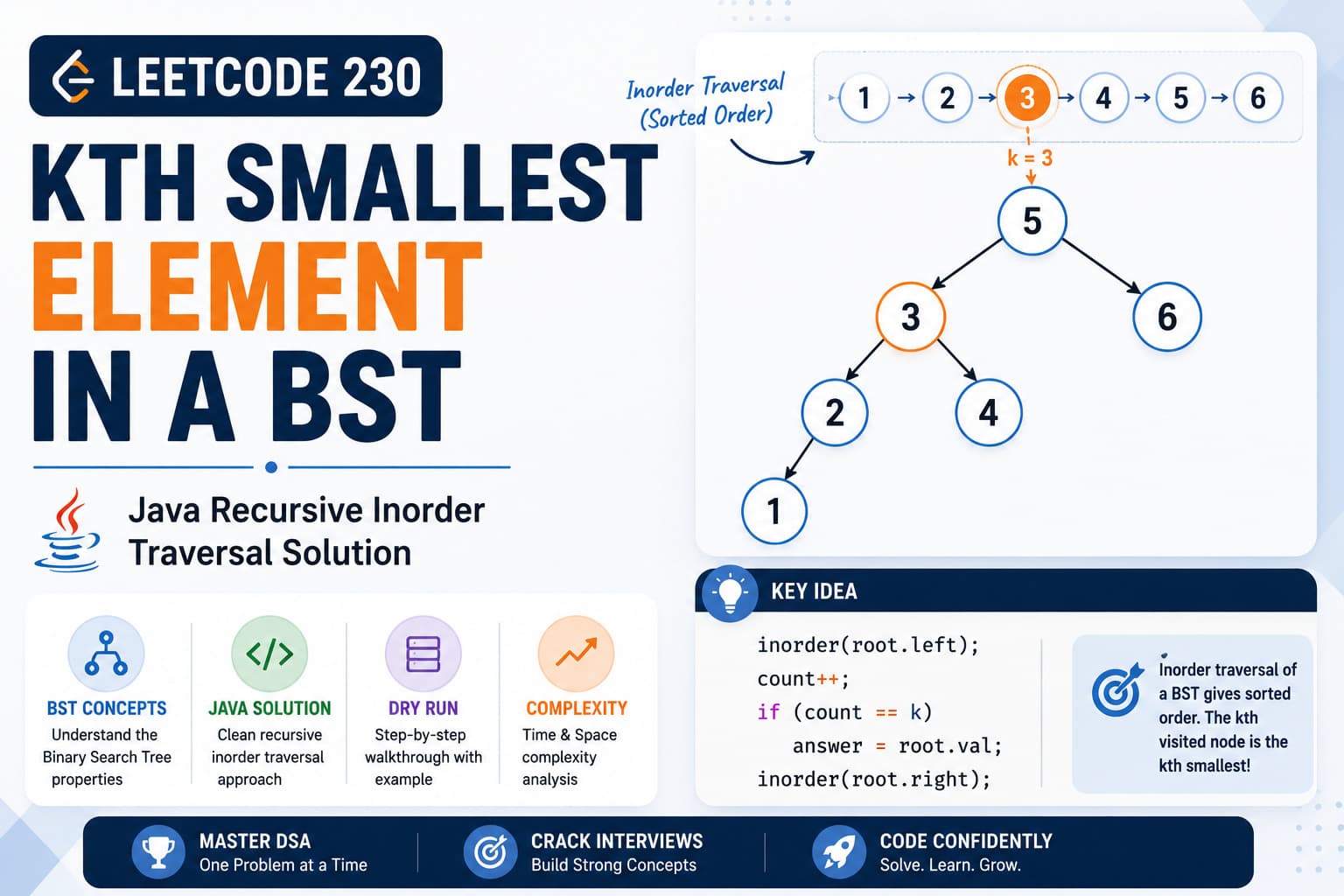
LeetCode 230: Kth Smallest Element in a BST – Java Recursive Inorder Traversal Solution

LeetCode 230: Kth Smallest Element in a BST – Java Recursive Inorder Traversal Solution

IntroductionLeetCode 230 – Kth Smallest Element in a BST is one of the most important Binary Search Tree interview problems.This question is popular because it tests:BST propertiesInorder traversalDFS recursionTree traversal optimizationRecursive state managementUnderstanding this problem properly builds a strong foundation for advanced BST problems.Problem LinkπŸ”— https://leetcode.com/problems/kth-smallest-element-in-a-bst/Problem StatementGiven:Root of a Binary Search TreeInteger kReturn:The kth smallest value in the BSTThe indexing is:1-indexedExample 1Inputroot = [3,1,4,null,2]k = 1Output1ExplanationBST inorder traversal becomes:[1,2,3,4]1st smallest element is:1Example 2Inputroot = [5,3,6,2,4,null,null,1]k = 3Output3Key ObservationThe most important BST property:Inorder Traversal of BST gives sorted orderExample:5/ \3 6/ \2 4/1Inorder traversal:1 β†’ 2 β†’ 3 β†’ 4 β†’ 5 β†’ 6So:kth smallest = kth node in inorder traversalIntuitionWe perform:Left β†’ Root β†’ RightWhile traversing:Keep counting visited nodesWhen count becomes kStore answerNo need to traverse entire tree after finding answer.Brute Force ApproachIdeaStore complete inorder traversal in listReturn:list.get(k - 1)Brute Force Java Solutionclass Solution {public void inorder(TreeNode root, List<Integer> list) {if(root == null) return;inorder(root.left, list);list.add(root.val);inorder(root.right, list);}public int kthSmallest(TreeNode root, int k) {List<Integer> list = new ArrayList<>();inorder(root, list);return list.get(k - 1);}}Complexity of Brute ForceTime ComplexityO(N)Space ComplexityO(N)Extra list storage required.Optimized Recursive ApproachIdeaInstead of storing entire traversal:Maintain counterStop when kth node is reachedThis saves unnecessary storage.Java Solutionclass Solution {int coun = 0;int ans = -1;public void inorder(TreeNode root, int k, List<Integer> lis) {if(root == null) return;inorder(root.left, k, lis);coun++;if(coun == k) {ans = root.val;return;}inorder(root.right, k, lis);}public int kthSmallest(TreeNode root, int k) {List<Integer> lis = new ArrayList<>();inorder(root, k, lis);return ans;}}Cleaner Optimized Versionclass Solution {int count = 0;int answer = -1;public void inorder(TreeNode root, int k) {if(root == null) return;inorder(root.left, k);count++;if(count == k) {answer = root.val;return;}inorder(root.right, k);}public int kthSmallest(TreeNode root, int k) {inorder(root, k);return answer;}}Why This WorksBST inorder traversal always visits nodes in:sorted ascending orderSo:1st visited node = smallest2nd visited node = second smallestkth visited node = kth smallestDry RunInputroot = [5,3,6,2,4,null,null,1]k = 3BST Structure5/ \3 6/ \2 4/1Inorder Traversal1 β†’ 2 β†’ 3 β†’ 4 β†’ 5 β†’ 6Counter ProgressNodeCount112233At count = 3:answer = 3Final Output3Iterative Stack ApproachIdeaUse explicit stack instead of recursion.Iterative Java Solutionclass Solution {public int kthSmallest(TreeNode root, int k) {Stack<TreeNode> stack = new Stack<>();while(true) {while(root != null) {stack.push(root);root = root.left;}root = stack.pop();k--;if(k == 0) {return root.val;}root = root.right;}}}Time Complexity AnalysisOptimized RecursiveTime ComplexityO(H + k)Where:H = tree heightWe visit only required nodesWorst case:O(N)Space ComplexityO(H)Recursive stack space.Iterative ComplexityTime ComplexityO(H + k)Space ComplexityO(H)Stack space.Follow-Up OptimizationProblem Follow-UpWhat if BST changes frequently?Example:Insert operationsDelete operationsFrequent kth smallest queriesAdvanced OptimizationStore:size of subtreeinside every node.This allows:O(log N)kth smallest queries.This concept is used in:Order Statistic TreesAugmented BSTsIndexed TreesInterview ExplanationIn interviews, explain:Inorder traversal of a BST gives nodes in sorted order. Therefore, the kth visited node during inorder traversal is the kth smallest element.This demonstrates:BST understandingDFS recursionTree traversal masteryOptimization thinkingCommon Mistakes1. Forgetting BST PropertyThis solution works because BST inorder traversal is sorted.Not true for normal binary trees.2. Using Extra Array UnnecessarilyOptimized approach avoids storing entire traversal.3. Incorrect Counter PlacementCounter must increase:AFTER left traversalBEFORE right traversal4. Forgetting Early ReturnOnce kth element is found:answer should be stored immediatelyFAQsQ1. Why does inorder traversal work?Because BST inorder traversal produces sorted order.Q2. Can this be solved iteratively?Yes.Using stack-based inorder traversal.Q3. Why is BST important here?Without BST ordering property:kth smallest cannot be determined using inorderQ4. Is this frequently asked?Yes.It is one of the most common BST interview questions.ConclusionLeetCode 230 is an excellent BST problem for mastering:Inorder traversalBST propertiesDFS recursionStack traversalTree optimizationThe core insight is:Inorder traversal of a BST always produces sorted order.Once this concept becomes intuitive, many BST interview problems become much easier.
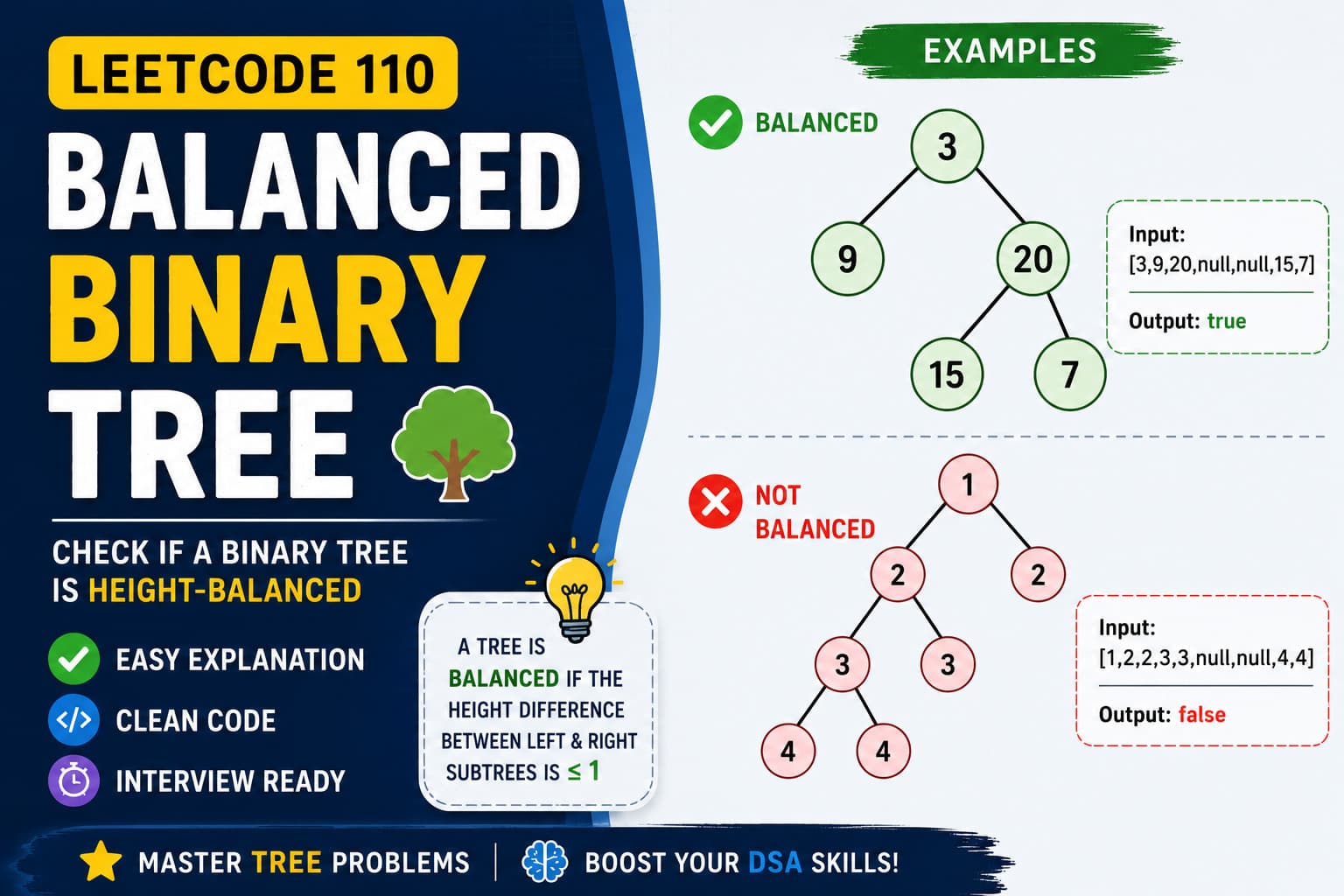
LeetCodeKth Smallest Element in BSTBinary Search TreeJavaInorder TraversalBSTMedium
LeetCode 701: Insert into a Binary Search Tree – Java Recursive Solution with Dry Run

LeetCode 701: Insert into a Binary Search Tree – Java Recursive Solution with Dry Run

IntroductionLeetCode 701 – Insert into a Binary Search Tree is one of the most important Binary Search Tree problems for coding interviews.This problem helps developers understand:BST propertiesRecursive traversalTree modificationNode insertion logicDFS recursionIt is frequently asked because BST insertion is a foundational concept used in:Search operationsTree balancingDatabase indexingOrdered data structuresProblem LinkπŸ”— https://leetcode.com/problems/insert-into-a-binary-search-tree/Problem StatementYou are given:Root of a Binary Search TreeA value to insertReturn:Root of BST after insertionThe inserted value is guaranteed to be unique.What is a Binary Search Tree?A BST follows this rule:Left subtree values < RootRight subtree values > RootExample: 4 / \ 2 7 / \ 1 3If we insert:5It becomes: 4 / \ 2 7 / \ / 1 3 5Key ObservationWhile traversing:If value is smaller β†’ go leftIf value is larger β†’ go rightEventually:We reach a null positionThat is the insertion point.IntuitionBST insertion behaves exactly like BST search.We recursively move:left or rightuntil we find:nullThen create the new node there.Brute Force ThinkingA beginner might think:Store tree in arrayInsert valueSort againRebuild BSTBut rebuilding the tree is unnecessary and inefficient.BST already provides ordered traversal naturally.Optimized Recursive ApproachIdeaAt every node:If value is smaller β†’ insert into left subtreeElse β†’ insert into right subtreeWhen root becomes:nullcreate a new node.Java Solutionclass Solution { public void solve(TreeNode root, TreeNode prevnode, int val) { if(root == null) { if(prevnode.val < val) { prevnode.right = new TreeNode(val); } else { prevnode.left = new TreeNode(val); } return; } if(root.val > val) { solve(root.left, root, val); } else { solve(root.right, root, val); } } public TreeNode insertIntoBST(TreeNode root, int val) { if(root == null) { return new TreeNode(val); } TreeNode originalRoot = root; solve(root, root, val); return originalRoot; }}Cleaner Recursive Versionclass Solution { public TreeNode insertIntoBST(TreeNode root, int val) { if(root == null) { return new TreeNode(val); } if(val < root.val) { root.left = insertIntoBST(root.left, val); } else { root.right = insertIntoBST(root.right, val); } return root; }}Why This WorksBST property guarantees:Smaller values go leftLarger values go rightSo recursion naturally finds the correct insertion position.When recursion reaches:nullwe create the new node.Dry RunInputroot = [4,2,7,1,3]val = 5Step 1Current node:4Since:5 > 4move right.Step 2Current node:7Since:5 < 7move left.Step 3Left child is:nullInsert:5Final Tree 4 / \ 2 7 / \ / 1 3 5Time Complexity AnalysisAverage CaseTime ComplexityO(log N)Balanced BST height remains logarithmic.Space ComplexityO(log N)due to recursion stack.Worst CaseIf BST becomes skewed:1 -> 2 -> 3 -> 4Then:Time ComplexityO(N)Space ComplexityO(N)Recursive vs IterativeApproachTime ComplexitySpace ComplexityRecursiveO(H)O(H)IterativeO(H)O(1)Where:H = height of BSTIterative Java Solutionclass Solution { public TreeNode insertIntoBST(TreeNode root, int val) { if(root == null) { return new TreeNode(val); } TreeNode curr = root; while(true) { if(val < curr.val) { if(curr.left == null) { curr.left = new TreeNode(val); break; } curr = curr.left; } else { if(curr.right == null) { curr.right = new TreeNode(val); break; } curr = curr.right; } } return root; }}Interview ExplanationIn interviews, explain:Binary Search Tree insertion follows BST ordering rules. We recursively traverse left or right depending on the value until we reach a null node, where the new node is inserted.This demonstrates:BST understandingRecursive traversalTree manipulationDFS logicCommon Mistakes1. Forgetting to Return RootAlways return original root after insertion.2. Breaking BST PropertyIncorrect comparisons can violate BST ordering.Correct logic:if(val < root.val)3. Missing Base CaseWithout:if(root == null)recursion never stops.4. Rebuilding Entire TreeInsertion should modify existing BST directly.FAQsQ1. Why use recursion?BST naturally divides into smaller subtrees.Recursion simplifies traversal logic.Q2. Can insertion be iterative?Yes.Using loops avoids recursion stack usage.Q3. Why does BST insertion work efficiently?Because BST reduces search space at every step.Q4. Is this problem important for interviews?Absolutely.BST insertion is one of the most frequently asked tree concepts.ConclusionLeetCode 701 is an excellent BST problem for learning:Recursive tree traversalBST propertiesNode insertion logicDFS recursionThe core insight is:Move left for smaller values and right for larger values until a null position is found.Once this becomes intuitive, most BST operations become much easier to solve.

LeetCodeBSTBinary Search TreeJavaRecursionTreeMedium
Queue Data Structure Complete Guide - Java Explained With All Operations

Queue Data Structure Complete Guide - Java Explained With All Operations

IntroductionIf you have been learning Data Structures and Algorithms, you have probably already spent time with arrays, linked lists, and stacks. Now it is time to meet one of the most important and widely used data structures in computer science β€” the Queue.Queue is not just a theoretical concept. It powers some of the most critical systems you use every day β€” from how your printer handles jobs, to how your CPU schedules tasks, to how Google Maps finds the shortest path between two locations. Understanding Queue deeply means understanding how real systems work.In this complete guide we will cover absolutely everything β€” what a Queue is, how it differs from a Stack, every type of Queue, all operations with code, Java implementations, time and space complexity, common interview questions, and the most important LeetCode problems that use Queue.What Is a Queue?A Queue is a linear data structure that follows the FIFO principle β€” First In First Out. This means the element that was added first is the one that gets removed first.Think of it exactly like a real-world queue (a line of people). The person who joined the line first gets served first. No cutting in line, no serving from the back β€” strict order from front to back.This is the fundamental difference between a Queue and a Stack:Stack β†’ LIFO (Last In First Out) β€” like a stack of plates, you take from the topQueue β†’ FIFO (First In First Out) β€” like a line of people, you serve from the frontReal Life Examples of QueueBefore writing a single line of code, let us understand where queues appear in real life. This will make every technical concept feel natural.Printer Queue β€” when you send multiple documents to print, they print in the order they were sent. The first document sent prints first.CPU Task Scheduling β€” your operating system manages running processes in a queue. Tasks get CPU time in the order they arrive (in basic scheduling).Customer Service Call Center β€” when you call a helpline and are put on hold, you are placed in a queue. The first caller on hold gets connected first.WhatsApp Messages β€” messages are delivered in the order they are sent. The first message sent is the first one received.BFS (Breadth First Search) β€” every time you use Google Maps or any navigation app to find the shortest path, it uses BFS internally which is entirely powered by a Queue.Ticket Booking Systems β€” online booking portals process requests in the order they arrive. First come first served.Queue Terminology β€” Key Terms You Must KnowBefore diving into code, let us get the vocabulary right:Front β€” the end from which elements are removed (dequeued). This is where the "first person in line" stands.Rear (or Back) β€” the end at which elements are added (enqueued). New arrivals join here.Enqueue β€” the operation of adding an element to the rear of the queue. Like joining the back of a line.Dequeue β€” the operation of removing an element from the front of the queue. Like the first person in line being served and leaving.Peek (or Front) β€” looking at the front element without removing it. Like seeing who is first in line without serving them yet.isEmpty β€” checking whether the queue has no elements.isFull β€” relevant for fixed-size queues, checking whether no more elements can be added.Types of QueuesThis is where most beginners get confused. There is not just one type of Queue β€” there are several variations each designed to solve specific problems.1. Simple Queue (Linear Queue)The most basic form. Elements enter from the rear and leave from the front. Strict FIFO, nothing fancy.Enqueue β†’ [ 1 | 2 | 3 | 4 | 5 ] β†’ Dequeue rear frontProblem with Simple Queue: In array-based implementation, once elements are dequeued from the front, those slots cannot be reused even if there is space. This wastes memory. This is why Circular Queue was invented.2. Circular QueueIn a Circular Queue, the rear wraps around to the front when it reaches the end of the array. The last position connects back to the first, forming a circle. This solves the wasted space problem of simple queues. [1] [2] [3] / \ [6] [4] \ / [5] ← rearUsed in: CPU scheduling, memory management, traffic light systems, streaming buffers.3. Double Ended Queue (Deque)A Deque (pronounced "deck") allows insertion and deletion from both ends β€” front and rear. It is the most flexible queue type.Enqueue Front β†’ [ 1 | 2 | 3 | 4 | 5 ] β†’ Dequeue FrontEnqueue Rear β†’ [ 1 | 2 | 3 | 4 | 5 ] β†’ Dequeue RearTwo subtypes:Input Restricted Deque β€” insertion only at rear, deletion from both endsOutput Restricted Deque β€” deletion only at front, insertion at both endsUsed in: browser history (back and forward), undo-redo operations, sliding window problems.4. Priority QueueElements are not served in FIFO order β€” instead each element has a priority and the element with the highest priority is served first regardless of when it was added.Think of an emergency room. A patient with a critical injury jumps ahead of someone with a minor cut even if they arrived later.Two types:Max Priority Queue β€” highest value = highest priorityMin Priority Queue β€” lowest value = highest priorityUsed in: Dijkstra's shortest path, Huffman encoding, A* search algorithm, task scheduling with priorities.5. Blocking QueueA thread-safe queue used in multi-threading. If the queue is empty, a thread trying to dequeue will wait (block) until an element is available. If the queue is full, a thread trying to enqueue will wait until space is available.Used in: Producer-Consumer problems, thread pool implementations, Java's java.util.concurrent package.Queue Operations and Time ComplexityEvery queue operation has a specific time complexity that you must know cold for interviews.OperationDescriptionTime ComplexityEnqueueAdd element to rearO(1)DequeueRemove element from frontO(1)Peek/FrontView front elementO(1)isEmptyCheck if queue is emptyO(1)SizeNumber of elementsO(1)SearchFind a specific elementO(n)Space Complexity: O(n) β€” where n is the number of elements stored.All core queue operations are O(1). This is what makes Queue so powerful β€” no matter how many elements are in the queue, adding and removing always takes constant time.Implementing Queue in Java β€” All WaysJava gives you multiple ways to use a Queue. Let us go through each one.Way 1: Using LinkedList (Most Common)LinkedList implements the Queue interface in Java. This is the most commonly used Queue implementation.import java.util.LinkedList;import java.util.Queue;Queue<Integer> queue = new LinkedList<>();// Enqueue β€” add to rearqueue.offer(10);queue.offer(20);queue.offer(30);// Peek β€” view front without removingSystem.out.println(queue.peek()); // 10// Dequeue β€” remove from frontSystem.out.println(queue.poll()); // 10System.out.println(queue.poll()); // 20// Check emptySystem.out.println(queue.isEmpty()); // false// SizeSystem.out.println(queue.size()); // 1offer() vs add() β€” both add to the queue. add() throws an exception if the queue is full (for bounded queues). offer() returns false instead. Always prefer offer().poll() vs remove() β€” both remove from front. remove() throws an exception if queue is empty. poll() returns null. Always prefer poll().peek() vs element() β€” both view the front. element() throws exception if empty. peek() returns null. Always prefer peek().Way 2: Using ArrayDeque (Fastest)ArrayDeque is faster than LinkedList for Queue operations because it uses a resizable array internally with no node allocation overhead.import java.util.ArrayDeque;import java.util.Queue;Queue<Integer> queue = new ArrayDeque<>();queue.offer(1);queue.offer(2);queue.offer(3);System.out.println(queue.peek()); // 1System.out.println(queue.poll()); // 1System.out.println(queue.size()); // 2When to use ArrayDeque over LinkedList? Use ArrayDeque whenever possible for Queue or Stack operations. It is faster because it avoids the overhead of node objects that LinkedList creates for every element. In competitive programming and interviews, ArrayDeque is the preferred choice.Way 3: Using Deque (Double Ended Queue)import java.util.ArrayDeque;import java.util.Deque;Deque<Integer> deque = new ArrayDeque<>();// Add to frontdeque.offerFirst(10);// Add to reardeque.offerLast(20);deque.offerLast(30);// Remove from frontSystem.out.println(deque.pollFirst()); // 10// Remove from rearSystem.out.println(deque.pollLast()); // 30// Peek front and rearSystem.out.println(deque.peekFirst()); // 20System.out.println(deque.peekLast()); // 20Way 4: Using PriorityQueueimport java.util.PriorityQueue;// Min Heap β€” smallest element has highest priorityPriorityQueue<Integer> minPQ = new PriorityQueue<>();minPQ.offer(30);minPQ.offer(10);minPQ.offer(20);System.out.println(minPQ.poll()); // 10 β€” smallest comes out first// Max Heap β€” largest element has highest priorityPriorityQueue<Integer> maxPQ = new PriorityQueue<>((a, b) -> b - a);maxPQ.offer(30);maxPQ.offer(10);maxPQ.offer(20);System.out.println(maxPQ.poll()); // 30 β€” largest comes out firstWay 5: Implementing Queue From Scratch Using ArrayUnderstanding the underlying implementation helps you in interviews when asked to build one from scratch.class MyQueue { private int[] arr; private int front; private int rear; private int size; private int capacity; public MyQueue(int capacity) { this.capacity = capacity; arr = new int[capacity]; front = 0; rear = -1; size = 0; } public void enqueue(int val) { if (size == capacity) { System.out.println("Queue is full!"); return; } rear = (rear + 1) % capacity; // circular wrapping arr[rear] = val; size++; } public int dequeue() { if (isEmpty()) { System.out.println("Queue is empty!"); return -1; } int val = arr[front]; front = (front + 1) % capacity; // circular wrapping size--; return val; } public int peek() { if (isEmpty()) return -1; return arr[front]; } public boolean isEmpty() { return size == 0; } public int size() { return size; }}Notice the % capacity in enqueue and dequeue β€” that is what makes it a Circular Queue. Without this, once the rear reaches the end of the array, you cannot add more even if front has moved forward and freed up space.Way 6: Implementing Queue Using Two StacksThis is a very popular interview question β€” implement a Queue using two stacks. The idea is to use one stack for enqueue and another for dequeue.class QueueUsingTwoStacks { Stack<Integer> s1 = new Stack<>(); // for enqueue Stack<Integer> s2 = new Stack<>(); // for dequeue public void enqueue(int val) { s1.push(val); // always push to s1 } public int dequeue() { if (s2.isEmpty()) { // transfer all elements from s1 to s2 // this reverses the order, giving FIFO behavior while (!s1.isEmpty()) { s2.push(s1.pop()); } } return s2.pop(); } public int peek() { if (s2.isEmpty()) { while (!s1.isEmpty()) { s2.push(s1.pop()); } } return s2.peek(); } public boolean isEmpty() { return s1.isEmpty() && s2.isEmpty(); }}Why does this work?When you transfer elements from s1 to s2, the order reverses. The element that was added first to s1 ends up on top of s2 β€” which means it gets dequeued first. FIFO achieved using two LIFOs!Amortized time complexity: Each element is pushed and popped at most twice (once in s1, once in s2). So dequeue is O(1) amortized even though individual calls might take O(n).This is LeetCode 232 β€” Implement Queue using Stacks.Queue vs Stack β€” Side by SideFeatureQueueStackPrincipleFIFO β€” First In First OutLIFO β€” Last In First OutInsert atRearTopRemove fromFrontTopReal lifeLine of peopleStack of platesJava classLinkedList, ArrayDequeStack, ArrayDequeMain useBFS, schedulingDFS, backtracking, parsingPeekFront elementTop elementBFS β€” The Most Important Application of QueueBreadth First Search (BFS) is the single most important algorithm that uses a Queue. Understanding BFS is why Queue matters so much in DSA.BFS explores a graph or tree level by level β€” all nodes at distance 1 first, then all at distance 2, and so on. A Queue naturally enforces this level-by-level behavior.public void bfs(int start, List<List<Integer>> graph) { Queue<Integer> queue = new LinkedList<>(); boolean[] visited = new boolean[graph.size()]; queue.offer(start); visited[start] = true; while (!queue.isEmpty()) { int node = queue.poll(); // process front node System.out.print(node + " "); for (int neighbor : graph.get(node)) { if (!visited[neighbor]) { visited[neighbor] = true; queue.offer(neighbor); // add unvisited neighbors to rear } } }}Why Queue and not Stack for BFS? Queue ensures you process all neighbors of a node before going deeper. Stack would take you deep into one path first β€” that is DFS, not BFS. The FIFO property is what guarantees level-by-level exploration.BFS with Queue is used in:Shortest path in unweighted graphsLevel order traversal of treesFinding connected componentsWord ladder problemsRotten oranges, flood fill, and matrix BFS problemsLevel Order Traversal β€” BFS on TreesOne of the most common Queue problems in interviews is Level Order Traversal of a binary tree.public List<List<Integer>> levelOrder(TreeNode root) { List<List<Integer>> result = new ArrayList<>(); if (root == null) return result; Queue<TreeNode> queue = new LinkedList<>(); queue.offer(root); while (!queue.isEmpty()) { int levelSize = queue.size(); // number of nodes at current level List<Integer> level = new ArrayList<>(); for (int i = 0; i < levelSize; i++) { TreeNode node = queue.poll(); level.add(node.val); if (node.left != null) queue.offer(node.left); if (node.right != null) queue.offer(node.right); } result.add(level); } return result;}The key trick here is using queue.size() at the start of each while loop iteration to know exactly how many nodes belong to the current level. Process exactly that many nodes, then move to the next level.This is LeetCode 102 β€” Binary Tree Level Order Traversal.Sliding Window Maximum β€” Monotonic DequeOne of the most impressive Queue applications is the Sliding Window Maximum problem using a Monotonic Deque. This is the queue equivalent of the Monotonic Stack pattern you saw in stack problems.The idea β€” maintain a deque that stores indices of elements in decreasing order. The front always holds the index of the maximum element in the current window.public int[] maxSlidingWindow(int[] nums, int k) { Deque<Integer> deque = new ArrayDeque<>(); // stores indices int[] result = new int[nums.length - k + 1]; int idx = 0; for (int i = 0; i < nums.length; i++) { // remove indices that are out of the current window while (!deque.isEmpty() && deque.peekFirst() < i - k + 1) { deque.pollFirst(); } // remove indices whose values are smaller than current // they can never be the maximum for any future window while (!deque.isEmpty() && nums[deque.peekLast()] < nums[i]) { deque.pollLast(); } deque.offerLast(i); // window is fully formed, record maximum (front of deque) if (i >= k - 1) { result[idx++] = nums[deque.peekFirst()]; } } return result;}This gives O(n) time for what would otherwise be an O(nΓ—k) problem. This is LeetCode 239 β€” Sliding Window Maximum.Java Queue Interface β€” Complete Method ReferenceHere is every method you will ever need from Java's Queue and Deque interfaces:Queue Methods:offer(e) β€” add to rear, returns false if full (preferred over add) poll() β€” remove from front, returns null if empty (preferred over remove) peek() β€” view front without removing, returns null if empty (preferred over element) isEmpty() β€” returns true if no elements size() β€” returns number of elements contains(o) β€” returns true if element existsDeque Additional Methods:offerFirst(e) β€” add to front offerLast(e) β€” add to rear pollFirst() β€” remove from front pollLast() β€” remove from rear peekFirst() β€” view front peekLast() β€” view rearPriorityQueue Specific:offer(e) β€” add with natural ordering or custom comparator poll() β€” remove element with highest priority peek() β€” view highest priority element without removingCommon Interview Questions About QueueThese are the questions interviewers ask to test your understanding of queues conceptually β€” not just coding.Q1. What is the difference between Queue and Stack? Queue is FIFO β€” elements are removed in the order they were added. Stack is LIFO β€” the most recently added element is removed first. Queue removes from the front, Stack removes from the top.Q2. Why is ArrayDeque preferred over LinkedList for Queue in Java? ArrayDeque uses a resizable array internally and has better cache locality and no node allocation overhead. LinkedList creates a new node object for every element added, which means more garbage collection pressure. ArrayDeque is faster in practice for most Queue use cases.Q3. When would you use a PriorityQueue instead of a regular Queue? When the order of processing depends on priority rather than arrival order. For example in a hospital, critical patients are treated before minor cases regardless of when they arrived. Or in Dijkstra's algorithm, always processing the shortest known distance first.Q4. How is Queue used in BFS? BFS uses a Queue to explore nodes level by level. The starting node is enqueued first. Each time a node is dequeued, all its unvisited neighbors are enqueued. Since Queue is FIFO, all neighbors of a node are processed before going deeper β€” guaranteeing level-by-level exploration.Q5. What is the difference between poll() and remove() in Java Queue? Both remove the front element. remove() throws NoSuchElementException if the queue is empty. poll() returns null instead of throwing. Always use poll() for safer code.Q6. Can a Queue have duplicates? Yes. Queue does not have any restriction on duplicate values unlike Sets. The same value can appear multiple times in a Queue.Q7. What is a Blocking Queue and when is it used? A Blocking Queue is a thread-safe Queue used in multi-threaded applications. When a thread tries to dequeue from an empty queue, it blocks (waits) until an element is available. When a thread tries to enqueue into a full queue, it blocks until space is available. Used in Producer-Consumer patterns.Top LeetCode Problems on QueueHere are the most important LeetCode problems that use Queue β€” organized from beginner to advanced:Beginner Level:232. Implement Queue using Stacks β€” implement Queue with two stacks, classic interview question225. Implement Stack using Queues β€” reverse of 232, implement Stack using Queue933. Number of Recent Calls β€” sliding window with QueueIntermediate Level:102. Binary Tree Level Order Traversal β€” BFS on tree, must know107. Binary Tree Level Order Traversal II β€” same but bottom up994. Rotting Oranges β€” multi-source BFS on grid1091. Shortest Path in Binary Matrix β€” BFS shortest path542. 01 Matrix β€” multi-source BFS, distance to nearest 0127. Word Ladder β€” BFS on word graph, classicAdvanced Level:239. Sliding Window Maximum β€” monotonic deque, must know862. Shortest Subarray with Sum at Least K β€” monotonic deque with prefix sums407. Trapping Rain Water II β€” 3D BFS with priority queue787. Cheapest Flights Within K Stops β€” BFS with constraintsQueue Cheat Sheet β€” Everything at a GlanceCreate a Queue:Queue<Integer> q = new LinkedList<>(); // standardQueue<Integer> q = new ArrayDeque<>(); // faster, preferredDeque<Integer> dq = new ArrayDeque<>(); // double endedPriorityQueue<Integer> pq = new PriorityQueue<>(); // min heapPriorityQueue<Integer> pq = new PriorityQueue<>((a,b) -> b-a); // max heapCore Operations:q.offer(x); // enqueueq.poll(); // dequeueq.peek(); // front elementq.isEmpty(); // check emptyq.size(); // number of elementsDeque Operations:dq.offerFirst(x); // add to frontdq.offerLast(x); // add to reardq.pollFirst(); // remove from frontdq.pollLast(); // remove from reardq.peekFirst(); // view frontdq.peekLast(); // view rearBFS Template:Queue<Integer> queue = new LinkedList<>();queue.offer(start);visited[start] = true;while (!queue.isEmpty()) { int node = queue.poll(); for (int neighbor : graph.get(node)) { if (!visited[neighbor]) { visited[neighbor] = true; queue.offer(neighbor); } }}ConclusionQueue is one of those data structures that appears simple on the surface but has incredible depth once you start exploring its variations and applications. From the basic FIFO concept to Circular Queues, Deques, Priority Queues, Monotonic Deques, and BFS β€” each layer adds a new tool to your problem-solving arsenal.Here is the learning path to follow based on everything covered in this guide:Start with understanding FIFO vs LIFO and when each applies. Then get comfortable with Java's Queue interface β€” offer, poll, peek. Practice the BFS template until it feels automatic. Then move to Level Order Traversal problems. Once BFS clicks, tackle multi-source BFS problems like Rotting Oranges. Finally learn the Monotonic Deque pattern for sliding window problems.Master these and you will handle every Queue problem in any coding interview with confidence.

QueueData StructureJavaBFSDequePriority QueueCircular Queue
LeetCode 39: Combination Sum – Java Backtracking Solution with Dry Run & Complexity

LeetCode 39: Combination Sum – Java Backtracking Solution with Dry Run & Complexity

IntroductionIf you are preparing for coding interviews or improving your Data Structures and Algorithms skills, LeetCode 39 Combination Sum is one of the most important backtracking problems to learn. This problem helps you understand how recursion explores multiple possibilities and how combinations are generated efficiently. It is a foundational problem that builds strong problem-solving skills and prepares you for many advanced recursion and backtracking questions.Why Should You Solve This Problem?Combination Sum is not just another coding question β€” it teaches you how to think recursively and break a complex problem into smaller decisions. By solving it, you learn how to manage recursive paths, avoid duplicate combinations, and build interview-level backtracking intuition. Once you understand this pattern, problems like subsets, permutations, N-Queens, and Sudoku Solver become much easier to approach.LeetCode Problem LinkProblem Name: Combination SumProblem Link: Combination SumProblem StatementGiven an array of distinct integers called candidates and a target integer target, you need to return all unique combinations where the chosen numbers sum to the target.Important rules:You can use the same number unlimited times.Only unique combinations should be returned.Order of combinations does not matter.ExampleExample 1Input:candidates = [2,3,6,7]target = 7Output:[[2,2,3],[7]]Explanation2 + 2 + 3 = 77 itself equals targetUnderstanding the Problem in Simple WordsWe are given some numbers.We need to:Pick numbers from the arrayAdd them togetherReach the target sumUse numbers multiple times if neededAvoid duplicate combinationsThis problem belongs to the Backtracking + Recursion category.Real-Life AnalogyImagine you have coins of different values.You want to make an exact payment.You can reuse coins multiple times.You need to find every possible valid coin combination.This is exactly what Combination Sum does.Intuition Behind the SolutionAt every index, we have two choices:Pick the current numberSkip the current numberSince numbers can be reused unlimited times, when we pick a number, we stay at the same index.This creates a recursion tree.We continue until:Target becomes 0 β†’ valid answerTarget becomes negative β†’ invalid pathArray ends β†’ stop recursionWhy Backtracking Works HereBacktracking helps us:Explore all possible combinationsUndo previous decisionsTry another pathIt is useful whenever we need:All combinationsAll subsetsPath explorationRecursive searchingApproach 1: Backtracking Using Pick and SkipCore IdeaAt every element:Either take itOr move to next elementJava Code (Pick and Skip Method)class Solution {List<List<Integer>> result = new ArrayList<>();public void solve(int[] candidates, int index, int target, List<Integer> current) {if (target == 0) {result.add(new ArrayList<>(current));return;}if (index == candidates.length) {return;}if (candidates[index] <= target) {current.add(candidates[index]);solve(candidates, index, target - candidates[index], current);current.remove(current.size() - 1);}solve(candidates, index + 1, target, current);}public List<List<Integer>> combinationSum(int[] candidates, int target) {solve(candidates, 0, target, new ArrayList<>());return result;}}Approach 2: Backtracking Using Loop (Optimized)This is the cleaner and more optimized version.Your code belongs to this category.Java Code (Loop-Based Backtracking)class Solution {List<List<Integer>> result = new ArrayList<>();public void solve(int[] arr, int index, int target, List<Integer> current) {if (target == 0) {result.add(new ArrayList<>(current));return;}if (index == arr.length) {return;}for (int i = index; i < arr.length; i++) {if (arr[i] > target) {continue;}current.add(arr[i]);solve(arr, i, target - arr[i], current);current.remove(current.size() - 1);}}public List<List<Integer>> combinationSum(int[] candidates, int target) {solve(candidates, 0, target, new ArrayList<>());return result;}}Dry Run of the AlgorithmInputcandidates = [2,3,6,7]target = 7Step-by-Step ExecutionStart:solve([2,3,6,7], index=0, target=7, [])Pick 2[2]target = 5Pick 2 again:[2,2]target = 3Pick 2 again:[2,2,2]target = 1No valid choice possible.Backtrack.Try 3[2,2,3]target = 0Valid answer found.Add:[2,2,3]Try 7[7]target = 0Valid answer found.Add:[7]Final Output[[2,2,3],[7]]Recursion Tree Visualization[]/ | | \2 3 6 7/2/2/3Every branch explores a different combination.Time Complexity AnalysisTime ComplexityO(2^Target)More accurately:O(N^(Target/minValue))Where:N = Number of candidatesTarget = Required sumReason:Every number can be picked multiple times.This creates many recursive branches.Space ComplexityO(Target)Reason:Recursion stack stores elements.Maximum recursion depth depends on target.Why We Pass Same Index AgainNotice this line:solve(arr, i, target - arr[i], current);We pass i, not i+1.Why?Because we can reuse the same number unlimited times.If we used i+1, we would move forward and lose repetition.Why Duplicate Combinations Are Not CreatedWe start loop from current index.This guarantees:[2,3]and[3,2]are not both generated.Order remains controlled.Common Mistakes Beginners Make1. Using i+1 Instead of iWrong:solve(arr, i+1, target-arr[i], current)This prevents reuse.2. Forgetting Backtracking StepWrong:current.remove(current.size()-1)Without removing, recursion keeps incorrect values.3. Missing Target == 0 Base CaseThis is where valid answer is stored.Important Interview InsightCombination Sum is a foundational problem.It helps build understanding for:Combination Sum IISubsetsPermutationsN-QueensWord SearchSudoku SolverThis question is frequently asked in coding interviews.Pattern RecognitionUse Backtracking when problem says:Find all combinationsGenerate all subsetsFind all pathsUse recursionExplore possibilitiesOptimized Thinking StrategyWhenever you see:Target sumRepeated selectionMultiple combinationsThink:Backtracking + DFSEdge CasesCase 1candidates = [2]target = 1Output:[]No possible answer.Case 2candidates = [1]target = 3Output:[[1,1,1]]Interview Answer in One Lineβ€œWe use backtracking to recursively try all candidate numbers while reducing the target and backtrack whenever a path becomes invalid.”Final Java Codeclass Solution {List<List<Integer>> result = new ArrayList<>();public void solve(int[] arr, int index, int target, List<Integer> current) {if (target == 0) {result.add(new ArrayList<>(current));return;}for (int i = index; i < arr.length; i++) {if (arr[i] > target) {continue;}current.add(arr[i]);solve(arr, i, target - arr[i], current);current.remove(current.size() - 1);}}public List<List<Integer>> combinationSum(int[] candidates, int target) {solve(candidates, 0, target, new ArrayList<>());return result;}}Key TakeawaysCombination Sum uses Backtracking.Reuse same element by passing same index.Target becomes smaller in recursion.Backtracking removes last element.Very important for interview preparation.Frequently Asked QuestionsIs Combination Sum DP or Backtracking?It is primarily solved using Backtracking.Dynamic Programming can also solve it but recursion is more common.Why is this Medium difficulty?Because:Requires recursion understandingRequires backtracking logicRequires duplicate preventionCan we sort the array?Yes.Sorting can help with pruning.ConclusionLeetCode 39 Combination Sum is one of the best problems to learn recursion and backtracking.Once you understand this pattern, many interview problems become easier.The loop-based recursive solution is clean, optimized, and interview-friendly.If you master this question, you gain strong understanding of recursive decision trees and combination generation.

LeetcodeMediumRecursionBacktrackingJava
LeetCode 3963: Create Grid With Exactly One Path β€” The Simple Java Trick I Almost Overlooked

LeetCode 3963: Create Grid With Exactly One Path β€” The Simple Java Trick I Almost Overlooked

The First Question I Asked Myself: Do We Really Need a Complicated Path?Problem link: LeetCode 3963 β€” Create Grid With Exactly One PathWhen I first looked at this problem, I saw a grid with two types of cells:. means we can move through the cell.# means the cell is blocked.We have to construct a grid in which exactly one valid path exists from the top-left corner to the bottom-right corner.My first instinct was to think about movement. We can move right or down, so I started wondering how to arrange the cells to control these movements.But then I realized something important: the problem doesn't ask us to find a path in a given grid. It asks us to create the grid ourselves.That changes the problem completely.We are not trapped inside a grid someone else has designed. We are the ones deciding which cells are free and which cells are blocked.So instead of asking, "How do I search for exactly one path?", I started asking a simpler question:What is the easiest possible path I can create, and how can I prevent every other path?That question leads to a much simpler solution.Step 1: Stop Thinking That We Must Alternate Right and DownSuppose we have a grid with three rows and four columns.We need to travel from the top-left cell to the bottom-right cell.A valid path can move right or down. But there is no rule saying we must alternate between these movements.We can move right three times and then down twice. We can also move down twice first and then right three times.Both movement patterns are allowed, provided the cells we enter are free.This was the observation that made the problem easier for me.Instead of creating a complicated zigzag path, why not move right along the first row and then down along the last column?For example, with m = 3 and n = 4, we can create this grid:...####.###.Let's trace the intended path:(0,0) β†’ (0,1) β†’ (0,2)↓(1,3)↓(2,3)The first row is free until the final column, and the last column is free all the way to the bottom.Every other cell is blocked.There is only one way to reach the destination: move right across the top row, then move down along the last column.We don't need recursion, DFS, BFS, or dynamic programming. We only need to construct a grid that forces the movement we want.Step 2: Why Does This Grid Have Exactly One Path?Let's look at the structure rather than just the example.Our grid has three important parts:The top row is free, allowing movement to the right.The last column is free, allowing movement downward.Every other cell is blocked.Consider the starting cell (0,0).Since moving down immediately would enter a blocked cell, the only possible move is right.The same reasoning applies as we continue along the top row. Moving down is blocked until we reach the last column.Once we reach the last column, moving right is impossible because we are already at the rightmost boundary. The only available movement is down.We keep moving down until we reach the bottom-right cell.Therefore, every step is forced. There is no point along the path where we can choose between two valid directions.If every step has only one possible next move, there can be only one valid path.This is the central idea behind the construction.Step 3: Translate the Idea Into JavaNow that the pattern is clear, the code becomes straightforward.We create an array of strings, where each string represents one row of the grid.For every cell, we ask two questions:Is this cell in the first row?Is this cell in the last column?If either condition is true, we place a .. Otherwise, we place a #.In other words:if (i == 0 || j == n - 1) {// Free cell} else {// Obstacle}This creates the top-row-and-last-column corridor.Notice that we do not need to calculate all possible paths or count them. The construction itself guarantees that there is exactly one.Java SolutionHere is the complete implementation using the same constructive approach:class Solution {public String[] createGrid(int m, int n) {String[] ans = new String[m];for (int i = 0; i < m; i++) {StringBuilder row = new StringBuilder();for (int j = 0; j < n; j++) {if (i == 0 || j == n - 1) {row.append('.');} else {row.append('#');}}ans[i] = row.toString();}return ans;}}What is different from my original code?My original solution already had the right core idea: create free cells along the first column and the bottom row, blocking the other cells.That approach is also valid. It creates a path that moves down first and then right.The revised implementation uses the alternative pattern discussed above: move right along the top row, then down along the last column.Both constructions work because they create one continuous corridor and block all competing routes.I also used StringBuilder instead of repeatedly concatenating strings with ro += "." or ro += "#". This makes row construction clearer and avoids repeatedly creating intermediate strings.Step 4: Dry RunLet's use the example m = 3, n = 3.Initially, we have three rows and three columns.For each cell, we check whether it belongs to the first row or the last column.Row 0Every cell is in the first row, so every cell becomes free....Row 1The first two cells are neither in the first row nor in the last column, so they become obstacles. The last cell is in the last column, so it remains free.##.Row 2The same rule applies.##.The final grid is:...##.##.The only valid path is:(0,0) β†’ (0,1) β†’ (0,2)↓(1,2)↓(2,2)The answer is a valid grid because the path starts at (0,0), ends at (m - 1, n - 1), and contains no alternative route.Step 5: What About a Grid With Only One Row or One Column?This is where I initially added special cases to my code.For example, if m = 1, the grid contains only one row. We can make every cell free:....There is exactly one path: keep moving right.If n = 1, the grid contains only one column. We can make every cell free vertically:....There is exactly one path: keep moving down.The useful discovery is that our new construction already handles both cases. When m = 1, the first-row condition makes every cell free. When n = 1, the last-column condition makes every cell free.That means we don't need separate if (m == 1) or if (n == 1) blocks.Removing unnecessary special cases makes the code shorter and easier to reason about.Complexity AnalysisLet m be the number of rows and n be the number of columns.Time complexity: O(m Γ— n)We visit every cell exactly once and decide whether it should be a free cell or an obstacle.Space complexity: O(m Γ— n)The returned grid contains m Γ— n characters, so the output itself requires O(m Γ— n) space. The temporary StringBuilder for constructing a row uses O(n) space.What I Learned From This ProblemThe biggest lesson was that I was thinking too much about finding paths instead of designing one.When I saw the words "exactly one valid path," I could easily have started thinking about graph algorithms, counting paths, or checking every possible route.But we control the grid. That means we can make every decision along the route for the person moving through it.The moment I realized that we could move right as many times as needed before moving down, the problem became much simpler. I could create a straight corridor and block everything else.My original solution used the same principle in the opposite direction: move down first, then right. Both ideas are correct.This is a useful lesson for constructive problems in general: before reaching for a complicated algorithm, ask whether you can build an answer whose structure makes the required property inevitable.Final TakeawayLeetCode 3963 is not really about searching a grid. It is about constructing one that forces a unique route.Choose a simple path.Keep the cells along that path free.Block cells that could create alternative routes.Check that the construction still works for a single row or column.Sometimes the best solution isn't to explore every possibility. It's to design the situation so that only one possibility exists.That is the intuition worth carrying into the next constructive algorithm problem.

LeetCodeJavaMatrixEasy
Ai Assistant Kas