Search Blogs

Showing results for "algorithms"

Found 50 results

What Is Dynamic Programming? Origin Story, Real-Life Uses, LeetCode Problems & Complete Beginner Guide

What Is Dynamic Programming? Origin Story, Real-Life Uses, LeetCode Problems & Complete Beginner Guide

Introduction — Why Dynamic Programming Feels Hard (And Why It Isn't)If you've ever stared at a LeetCode problem, read the solution, understood every single line, and still had absolutely no idea how someone arrived at it — welcome. You've just experienced the classic Dynamic Programming (DP) confusion.DP has a reputation. People treat it like some dark art reserved for competitive programmers or Google engineers. The truth? Dynamic Programming is one of the most logical, learnable, and satisfying techniques in all of computer science. Once it clicks, it really clicks.This guide will take you from zero to genuinely confident. We'll cover where DP came from, how it works, what patterns to learn, how to recognize DP problems, real-world places it shows up, LeetCode problems to practice, time complexity analysis, and the mistakes that trip up even experienced developers.Let's go.The Origin Story — Who Invented Dynamic Programming and Why?The term "Dynamic Programming" was coined by Richard Bellman in the early 1950s while working at RAND Corporation. Here's the funny part: the name was deliberately chosen to sound impressive and vague.Bellman was doing mathematical research that his employer — the US Secretary of Defense, Charles Wilson — would have found difficult to fund if described accurately. Wilson had a well-known distaste for the word "research." So Bellman invented a name that sounded suitably grand and mathematical: Dynamic Programming.In his autobiography, Bellman wrote that he picked the word "dynamic" because it had a precise technical meaning and was also impossible to use negatively. "Programming" referred to the mathematical sense — planning and decision-making — not computer programming.The underlying idea? Break a complex problem into overlapping subproblems, solve each subproblem once, and store the result so you never solve it twice.Bellman's foundational contribution was the Bellman Equation, which underpins not just algorithms but also economics, operations research, and modern reinforcement learning.So the next time DP feels frustrating, remember — even its inventor named it specifically to confuse people. You're in good company.What Is Dynamic Programming? (Simple Definition)Dynamic Programming is an algorithmic technique used to solve problems by:Breaking them down into smaller overlapping subproblemsSolving each subproblem only onceStoring the result (memoization or tabulation)Building up the final solution from those stored resultsThe key insight is overlapping subproblems + optimal substructure.Overlapping subproblems means the same smaller problems come up again and again. Instead of solving them every time (like plain recursion does), DP solves them once and caches the answer.Optimal substructure means the optimal solution to the whole problem can be built from optimal solutions to its subproblems.If a problem has both these properties — it's a DP problem.The Two Approaches to Dynamic Programming1. Top-Down with Memoization (Recursive + Cache)You write a recursive solution exactly as you would naturally, but add a cache (usually a dictionary or array) to store results you've already computed.fib(n):if n in cache: return cache[n]if n <= 1: return ncache[n] = fib(n-1) + fib(n-2)return cache[n]This is called memoization — remember what you computed so you don't repeat yourself.Pros: Natural to write, mirrors the recursive thinking, easy to reason about. Cons: Stack overhead from recursion, risk of stack overflow on large inputs.2. Bottom-Up with Tabulation (Iterative)You figure out the order in which subproblems need to be solved, then solve them iteratively from the smallest up, filling a table.fib(n):dp = [0, 1]for i from 2 to n:dp[i] = dp[i-1] + dp[i-2]return dp[n]This is called tabulation — fill a table, cell by cell, bottom to top.Pros: No recursion overhead, usually faster in practice, easier to optimize space. Cons: Requires thinking about the order of computation upfront.🧩 Dynamic Programming Template CodeBefore diving into how to recognize DP problems, here are ready-to-use Java templates for every major DP pattern. Think of these as your reusable blueprints — every DP problem you ever solve will fit into one of these structures. Just define your state, plug in your recurrence relation, and you are good to go.Template 1 — Top-Down (Memoization)import java.util.HashMap;import java.util.Map;public class TopDownDP {Map<Integer, Integer> memo = new HashMap<>();public int solve(int n) {// Base caseif (n <= 1) return n;// Check cacheif (memo.containsKey(n)) return memo.get(n);// Recurrence relation — change this part for your problemint result = solve(n - 1) + solve(n - 2);// Store in cachememo.put(n, result);return result;}}Template 2 — Bottom-Up (Tabulation)public class BottomUpDP {public int solve(int n) {// Create DP tableint[] dp = new int[n + 1];// Base casesdp[0] = 0;dp[1] = 1;// Fill the table bottom-upfor (int i = 2; i <= n; i++) {// Recurrence relation — change this part for your problemdp[i] = dp[i - 1] + dp[i - 2];}return dp[n];}}Template 3 — Bottom-Up with Space Optimizationpublic class SpaceOptimizedDP {public int solve(int n) {// Only keep last two values instead of full tableint prev2 = 0;int prev1 = 1;for (int i = 2; i <= n; i++) {// Recurrence relation — change this part for your problemint curr = prev1 + prev2;prev2 = prev1;prev1 = curr;}return prev1;}}Template 4 — 2D DP (Two Sequences or Grid)public class TwoDimensionalDP {public int solve(String s1, String s2) {int m = s1.length();int n = s2.length();// Create 2D DP tableint[][] dp = new int[m + 1][n + 1];// Base cases — first row and columnfor (int i = 0; i <= m; i++) dp[i][0] = i;for (int j = 0; j <= n; j++) dp[0][j] = j;// Fill table cell by cellfor (int i = 1; i <= m; i++) {for (int j = 1; j <= n; j++) {// Recurrence relation — change this part for your problemif (s1.charAt(i - 1) == s2.charAt(j - 1)) {dp[i][j] = dp[i - 1][j - 1];} else {dp[i][j] = 1 + Math.min(dp[i - 1][j],Math.min(dp[i][j - 1], dp[i - 1][j - 1]));}}}return dp[m][n];}}Template 5 — Knapsack Patternpublic class KnapsackDP {public int solve(int[] weights, int[] values, int capacity) {int n = weights.length;// dp[i][w] = max value using first i items with capacity wint[][] dp = new int[n + 1][capacity + 1];for (int i = 1; i <= n; i++) {for (int w = 0; w <= capacity; w++) {// Don't take item idp[i][w] = dp[i - 1][w];// Take item i if it fitsif (weights[i - 1] <= w) {dp[i][w] = Math.max(dp[i][w],values[i - 1] + dp[i - 1][w - weights[i - 1]]);}}}return dp[n][capacity];}}💡 How to use these templates:Step 1 — Identify which pattern your problem fits into. Step 2 — Define what dp[i] or dp[i][j] means in plain English before writing any code. Step 3 — Write your recurrence relation on paper first. Step 4 — Plug it into the matching template above. Step 5 — Handle your specific base cases carefully.🎥 Visual Learning Resource — Watch This Before Moving ForwardIf you prefer learning by watching before reading, this free full-length course by freeCodeCamp is one of the best Dynamic Programming resources on the internet. Watch it alongside this guide for maximum understanding.Credit: freeCodeCamp — a free, nonprofit coding education platform.How to Recognize a Dynamic Programming ProblemAsk yourself these four questions:1. Can I define the problem in terms of smaller versions of itself? If you can write a recursive formula (recurrence relation), DP might apply.2. Do the subproblems overlap? If a naive recursive solution would recompute the same thing many times, DP is the right tool.3. Is there an optimal substructure? Is the best answer to the big problem made up of best answers to smaller problems?4. Are you looking for a count, minimum, maximum, or yes/no answer? DP problems often ask: "What is the minimum cost?", "How many ways?", "Can we achieve X?"Red flag words in problem statements: minimum, maximum, shortest, longest, count the number of ways, can we reach, is it possible, fewest steps.The Core DP Patterns You Must LearnMastering DP is really about recognizing patterns. Here are the most important ones:Pattern 1 — 1D DP (Linear) Problems where the state depends on previous elements in a single sequence. Examples: Fibonacci, Climbing Stairs, House Robber.Pattern 2 — 2D DP (Grid / Two-sequence) Problems with two dimensions of state, often grids or two strings. Examples: Longest Common Subsequence, Edit Distance, Unique Paths.Pattern 3 — Interval DP You consider all possible intervals or subarrays and build solutions from them. Examples: Matrix Chain Multiplication, Burst Balloons, Palindrome Partitioning.Pattern 4 — Knapsack DP (0/1 and Unbounded) You decide whether to include or exclude items under a capacity constraint. Examples: 0/1 Knapsack, Coin Change, Partition Equal Subset Sum.Pattern 5 — DP on Trees State is defined per node; you combine results from children. Examples: Diameter of Binary Tree, House Robber III, Maximum Path Sum.Pattern 6 — DP on Subsets / Bitmask DP State includes a bitmask representing which elements have been chosen. Examples: Travelling Salesman Problem, Shortest Superstring.Pattern 7 — DP on Strings Matching, editing, or counting arrangements within strings. Examples: Longest Palindromic Subsequence, Regular Expression Matching, Wildcard Matching.Top LeetCode Problems to Practice Dynamic Programming (With Links)Here are the essential problems, organized by difficulty and pattern. Solve them in this order.Beginner — Warm UpProblemPatternLinkClimbing Stairs1D DPhttps://leetcode.com/problems/climbing-stairs/Fibonacci Number1D DPhttps://leetcode.com/problems/fibonacci-number/House Robber1D DPhttps://leetcode.com/problems/house-robber/Min Cost Climbing Stairs1D DPhttps://leetcode.com/problems/min-cost-climbing-stairs/Best Time to Buy and Sell Stock1D DPhttps://leetcode.com/problems/best-time-to-buy-and-sell-stock/Intermediate — Core PatternsProblemPatternLinkCoin ChangeKnapsackhttps://leetcode.com/problems/coin-change/Longest Increasing Subsequence1D DPhttps://leetcode.com/problems/longest-increasing-subsequence/Longest Common Subsequence2D DPhttps://leetcode.com/problems/longest-common-subsequence/0/1 Knapsack (via Subset Sum)Knapsackhttps://leetcode.com/problems/partition-equal-subset-sum/Unique Paths2D Grid DPhttps://leetcode.com/problems/unique-paths/Jump Game1D DP / Greedyhttps://leetcode.com/problems/jump-game/Word BreakString DPhttps://leetcode.com/problems/word-break/Decode Ways1D DPhttps://leetcode.com/problems/decode-ways/Edit Distance2D String DPhttps://leetcode.com/problems/edit-distance/Triangle2D DPhttps://leetcode.com/problems/triangle/Advanced — Interview LevelProblemPatternLinkBurst BalloonsInterval DPhttps://leetcode.com/problems/burst-balloons/Regular Expression MatchingString DPhttps://leetcode.com/problems/regular-expression-matching/Wildcard MatchingString DPhttps://leetcode.com/problems/wildcard-matching/Palindrome Partitioning IIInterval DPhttps://leetcode.com/problems/palindrome-partitioning-ii/Maximum Profit in Job SchedulingDP + Binary Searchhttps://leetcode.com/problems/maximum-profit-in-job-scheduling/Distinct Subsequences2D DPhttps://leetcode.com/problems/distinct-subsequences/Cherry Pickup3D DPhttps://leetcode.com/problems/cherry-pickup/Real-World Use Cases of Dynamic ProgrammingDP is not just for coding interviews. It is deeply embedded in the technology you use every day.1. Google Maps & Navigation (Shortest Path) The routing engines behind GPS apps use DP-based algorithms like Dijkstra and Bellman-Ford to find the shortest or fastest path between two points across millions of nodes.2. Spell Checkers & Autocorrect (Edit Distance) When your phone corrects "teh" to "the," it is computing Edit Distance — a classic DP problem — between what you typed and every word in the dictionary.3. DNA Sequence Alignment (Bioinformatics) Researchers use the Needleman-Wunsch and Smith-Waterman algorithms — both DP — to align DNA and protein sequences and find similarities between species or identify mutations.4. Video Compression (MPEG, H.264) Modern video codecs use DP to determine the most efficient way to encode video frames, deciding which frames to store as full images and which to store as differences from the previous frame.5. Financial Portfolio Optimization Investment algorithms use DP to find the optimal allocation of assets under risk constraints — essentially a variant of the knapsack problem.6. Natural Language Processing (NLP) The Viterbi algorithm — used in speech recognition, part-of-speech tagging, and machine translation — is a DP algorithm. Every time Siri or Google Assistant understands your sentence, DP played a role.7. Game AI (Chess, Checkers) Game trees and minimax algorithms with memoization use DP to evaluate board positions and find the best move without recomputing already-seen positions.8. Compiler Optimization Compilers use DP to decide the optimal order of operations and instruction scheduling to generate the most efficient machine code.9. Text Justification (Word Processors) Microsoft Word and LaTeX use DP to optimally break paragraphs into lines — minimizing raggedness and maximizing visual appeal.10. Resource Scheduling in Cloud Computing AWS, Google Cloud, and Azure use DP-based scheduling to assign computational tasks to servers in the most cost-efficient way possible.Time Complexity Analysis of Common DP ProblemsUnderstanding the time complexity of DP is critical for interviews and for building scalable systems.ProblemTime ComplexitySpace ComplexityNotesFibonacci (naive recursion)O(2ⁿ)O(n)Exponential — terribleFibonacci (DP)O(n)O(1) with optimizationLinear — excellentLongest Common SubsequenceO(m × n)O(m × n)m, n = lengths of two stringsEdit DistanceO(m × n)O(m × n)Can optimize space to O(n)0/1 KnapsackO(n × W)O(n × W)n = items, W = capacityCoin ChangeO(n × amount)O(amount)Classic tabulationLongest Increasing SubsequenceO(n²) or O(n log n)O(n)Binary search version is fasterMatrix Chain MultiplicationO(n³)O(n²)Interval DPTravelling Salesman (bitmask)O(2ⁿ × n²)O(2ⁿ × n)Still exponential but manageable for small nThe general rule: DP trades time for space. You use memory to avoid recomputation. The time complexity equals the number of unique states multiplied by the work done per state.How to Learn and Master Dynamic Programming — Step by StepHere is an honest, structured path to mastery:Step 1 — Get recursion absolutely solid first. DP is memoized recursion at its core. If you cannot write clean recursive solutions confidently, DP will remain confusing. Practice at least 20 pure recursion problems first.Step 2 — Start with the classics. Fibonacci → Climbing Stairs → House Robber → Coin Change. These teach you the core pattern of defining state and transition without overwhelming you.Step 3 — Learn to define state explicitly. Before writing any code, ask: "What does dp[i] represent?" Write it in plain English. "dp[i] = the minimum cost to reach step i." This single habit separates good DP thinkers from struggling ones.Step 4 — Write the recurrence relation before coding. On paper or in a comment. Example: dp[i] = min(dp[i-1] + cost[i-1], dp[i-2] + cost[i-2]). If you can write the recurrence, the code writes itself.Step 5 — Master one pattern at a time. Don't jump between knapsack and interval DP in the same week. Spend a few days on each pattern until it feels intuitive.Step 6 — Solve the same problem both ways. Top-down and bottom-up. This builds deep understanding of what DP is actually doing.Step 7 — Optimize space after getting correctness. Many 2D DP solutions can use a single row instead of a full matrix. Learn this optimization after you understand the full solution.Step 8 — Do timed practice under interview conditions. Give yourself 35 minutes per problem. Review what you got wrong. DP is a muscle — it builds with reps.Common Mistakes in Dynamic Programming (And How to Avoid Them)Mistake 1 — Jumping to code before defining state. The most common DP error. Always define what dp[i] or dp[i][j] means before writing a single line of code.Mistake 2 — Wrong base cases. A single wrong base case corrupts every answer built on top of it. Trace through your base cases manually on a tiny example before running code.Mistake 3 — Off-by-one errors in indexing. Whether your dp array is 0-indexed or 1-indexed must be 100% consistent throughout. This causes more bugs in DP than almost anything else.Mistake 4 — Confusing top-down with bottom-up state order. In bottom-up DP, you must ensure that when you compute dp[i], all values it depends on are already filled. If you compute in the wrong order, you get garbage answers.Mistake 5 — Memoizing in the wrong dimension. In 2D problems, some people cache only one dimension when the state actually requires two. Always identify all variables that affect the outcome.Mistake 6 — Using global mutable state in recursion. If you use a shared array and don't clear it between test cases, you'll get wrong answers on subsequent inputs. Always scope your cache correctly.Mistake 7 — Not considering the full state space. In problems like Knapsack, forgetting that the state is (item index, remaining capacity) — not just item index — leads to fundamentally wrong solutions.Mistake 8 — Giving up after not recognizing the pattern immediately. DP problems don't announce themselves. The skill is learning to ask "is there overlapping subproblems here?" on every problem. This takes time. Don't mistake unfamiliarity for inability.Frequently Asked Questions About Dynamic ProgrammingQ: Is Dynamic Programming the same as recursion? Not exactly. Recursion is a technique for breaking problems into smaller pieces. DP is recursion plus memoization — or iterative tabulation. All DP can be written recursively, but not all recursion is DP.Q: What is the difference between DP and Divide and Conquer? Divide and Conquer (like Merge Sort) breaks problems into non-overlapping subproblems. DP is used when subproblems overlap — meaning the same subproblem is solved multiple times in a naive approach.Q: How do I know when NOT to use DP? If the subproblems don't overlap (no repeated computation), greedy or divide-and-conquer may be better. If the problem has no optimal substructure, DP won't give a correct answer.Q: Do I need to memorize DP solutions for interviews? No. You need to recognize patterns and be able to derive the recurrence relation. Memorizing solutions without understanding them will fail you in interviews. Focus on the thinking process.Q: How long does it take to get good at DP? Most people start to feel genuinely comfortable after solving 40–60 varied DP problems with deliberate practice. The first 10 feel impossible. The next 20 feel hard. After 50, patterns start feeling obvious.Q: What programming language is best for DP? Any language works. Python is often used for learning because its dictionaries make memoization trivial. C++ is preferred in competitive programming for its speed. For interviews, use whatever language you're most comfortable in.Q: What is space optimization in DP? Many DP problems only look back one or two rows to compute the current row. In those cases, you can replace an n×m table with just two arrays (or even one), reducing space complexity from O(n×m) to O(m). This is called space optimization or rolling array technique.Q: Can DP be applied to graph problems? Absolutely. Shortest path algorithms like Bellman-Ford are DP. Longest path in a DAG is DP. DP on trees is a rich subfield. Anywhere you have states and transitions, DP can potentially apply.Q: Is Greedy a type of Dynamic Programming? Greedy is related but distinct. Greedy makes locally optimal choices without reconsidering. DP considers all choices and picks the globally optimal one. Some DP solutions reduce to greedy when the structure allows, but they are different techniques.Q: What resources should I use to learn DP? For structured learning: Neetcode.io (organized problem list), Striver's DP Series on YouTube, and the book "Introduction to Algorithms" (CLRS) for theoretical depth. For practice: LeetCode's Dynamic Programming study plan and Codeforces for competitive DP.Final Thoughts — Dynamic Programming Is a SuperpowerDynamic Programming is genuinely one of the most powerful ideas in computer science. It shows up in your GPS, your autocorrect, your streaming video, your bank's risk models, and the AI assistants you talk to daily.The path to mastering it is not memorization. It is developing the habit of asking: can I break this into smaller problems that overlap? And then learning to define state clearly, write the recurrence, and trust the process.Start with Climbing Stairs. Write dp[i] in plain English before every problem. Solve everything twice — top-down and bottom-up. Do 50 problems with genuine reflection, not just accepted solutions.The click moment will come. And when it does, you'll wonder why it ever felt hard.

Dynamic ProgrammingMemoizationTabulationJavaOrigin StoryRichard Bellman
Merge Sort Algorithm Explained | Java Implementation, Intuition & Complexity

Merge Sort Algorithm Explained | Java Implementation, Intuition & Complexity

IntroductionSorting is one of the most fundamental operations in computer science, and Merge Sort is among the most efficient and widely used sorting algorithms.It follows the Divide and Conquer approach, making it highly scalable and predictable even for large datasets.In this article, we will cover:Intuition behind Merge SortStep-by-step breakdownMultiple approachesJava implementation with commentsTime & space complexity analysis🔗 Problem LinkGeeksforGeeks: Merge SortProblem StatementGiven an array arr[] with starting index l and ending index r, sort the array using the Merge Sort algorithm.ExamplesExample 1Input:arr = [4, 1, 3, 9, 7]Output:[1, 3, 4, 7, 9]Example 2Input:arr = [10, 9, 8, 7, 6, 5, 4, 3, 2, 1]Output:[1, 2, 3, 4, 5, 6, 7, 8, 9, 10]Key InsightMerge Sort works by:Divide → Conquer → CombineDivide the array into two halvesRecursively sort each halfMerge both sorted halvesIntuition (Visual Understanding)For:[4, 1, 3, 9, 7]Step 1: Divide[4, 1, 3] [9, 7][4, 1] [3] [9] [7][4] [1]Step 2: Merge[4] [1] → [1, 4][1, 4] [3] → [1, 3, 4][9] [7] → [7, 9]Step 3: Final Merge[1, 3, 4] + [7, 9] → [1, 3, 4, 7, 9]Approach 1: Recursive Merge Sort (Top-Down)IdeaKeep dividing until single elements remainMerge sorted subarraysJava Codeclass Solution { // Function to merge two sorted halves void merge(int[] arr, int l, int mid, int h) { // Temporary array to store merged result int[] temp = new int[h - l + 1]; int i = l; // pointer for left half int j = mid + 1; // pointer for right half int k = 0; // pointer for temp array // Compare elements from both halves while (i <= mid && j <= h) { if (arr[i] <= arr[j]) { temp[k] = arr[i]; i++; } else { temp[k] = arr[j]; j++; } k++; } // Copy remaining elements from left half while (i <= mid) { temp[k] = arr[i]; i++; k++; } // Copy remaining elements from right half while (j <= h) { temp[k] = arr[j]; j++; k++; } // Copy sorted elements back to original array for (int m = 0; m < temp.length; m++) { arr[l + m] = temp[m]; } } // Recursive merge sort function void mergeSort(int arr[], int l, int h) { // Base case: single element if (l >= h) return; int mid = l + (h - l) / 2; // Sort left half mergeSort(arr, l, mid); // Sort right half mergeSort(arr, mid + 1, h); // Merge both halves merge(arr, l, mid, h); }}Approach 2: Iterative Merge Sort (Bottom-Up)IdeaStart with subarrays of size 1Merge pairsIncrease size graduallyCodeclass Solution { void merge(int[] arr, int l, int mid, int h) { int[] temp = new int[h - l + 1]; int i = l, j = mid + 1, k = 0; while (i <= mid && j <= h) { if (arr[i] <= arr[j]) temp[k++] = arr[i++]; else temp[k++] = arr[j++]; } while (i <= mid) temp[k++] = arr[i++]; while (j <= h) temp[k++] = arr[j++]; for (int m = 0; m < temp.length; m++) { arr[l + m] = temp[m]; } } void mergeSort(int[] arr, int n) { for (int size = 1; size < n; size *= 2) { for (int l = 0; l < n - size; l += 2 * size) { int mid = l + size - 1; int h = Math.min(l + 2 * size - 1, n - 1); merge(arr, l, mid, h); } } }}Approach 3: Using Built-in Sorting (For Comparison)Arrays.sort(arr);👉 Internally uses optimized algorithms (TimSort in Java)Complexity AnalysisTime ComplexityCaseComplexityBestO(n log n)AverageO(n log n)WorstO(n log n)Space ComplexityO(n) (extra array for merging)Why Merge Sort is PowerfulStable sorting algorithmWorks efficiently on large datasetsPredictable performanceUsed in external sorting (large files)❌ Why Not Use Bubble/Selection Sort?AlgorithmTime ComplexityBubble SortO(n²)Selection SortO(n²)Merge SortO(n log n) ✅Key TakeawaysMerge Sort uses divide and conquerRecursion splits problem into smaller partsMerging is the key stepAlways O(n log n), regardless of inputWhen to Use Merge SortLarge datasetsLinked lists (very efficient)Stable sorting requiredExternal sortingConclusionMerge Sort is one of the most reliable and efficient sorting algorithms. Understanding its recursive structure and merging process is essential for mastering advanced algorithms.Once you grasp the divide-and-conquer pattern, it becomes easier to solve many complex problems.Frequently Asked Questions (FAQs)1. Is Merge Sort stable?Yes, it maintains the relative order of equal elements.2. Why is extra space required?Because we use a temporary array during merging.3. Can it be done in-place?Not efficiently; standard merge sort requires extra space.

GeekfOfGeeksMediumSortingMerge SortJava
Search in Rotated Sorted Array II – Binary Search with Duplicates Explained (LeetCode 81)

Search in Rotated Sorted Array II – Binary Search with Duplicates Explained (LeetCode 81)

Try the QuestionBefore reading the explanation, try solving the problem yourself:👉 https://leetcode.com/problems/search-in-rotated-sorted-array-ii/Practicing the problem first helps develop stronger problem-solving intuition, especially for binary search variations.Problem StatementYou are given an integer array nums that is sorted in non-decreasing order.Example of a sorted array:[0,1,2,4,4,4,5,6,6,7]Before being passed to your function, the array may be rotated at some pivot index k.After rotation, the structure becomes:[nums[k], nums[k+1], ..., nums[n-1], nums[0], nums[1], ..., nums[k-1]]Example:Original array[0,1,2,4,4,4,5,6,6,7]Rotated at index 5[4,5,6,6,7,0,1,2,4,4]You are also given an integer target.Your task is to determine:Return true if the target exists in the arrayReturn false if the target does not existThe goal is to minimize the number of operations, which suggests using Binary Search.Example WalkthroughExample 1Inputnums = [2,5,6,0,0,1,2]target = 0OutputtrueExplanation:0 exists in the arrayExample 2Inputnums = [2,5,6,0,0,1,2]target = 3OutputfalseExplanation:3 does not exist in the arrayUnderstanding the Core ChallengeThis problem is very similar to the classic problem:Search in Rotated Sorted Array (LeetCode 33).However, there is an important difference.Difference Between the Two ProblemsProblemArray ValuesRotated Sorted ArrayAll elements are distinctRotated Sorted Array IIArray may contain duplicatesDuplicates introduce ambiguity during binary search.Why Duplicates Make the Problem HarderIn the previous problem, we relied on this rule:If nums[left] <= nums[mid]→ left half is sortedBut duplicates can break this assumption.Example:nums = [1,0,1,1,1]If:left = 0mid = 2right = 4Then:nums[left] = 1nums[mid] = 1nums[right] = 1Here we cannot determine which half is sorted.This is the main complication introduced by duplicates.Key Idea to Handle DuplicatesWhen the values at left, mid, and right are the same, the algorithm cannot decide which half is sorted.To resolve this situation, we shrink the search space:left++right--This gradually removes duplicate values and allows binary search to continue.Modified Binary Search StrategyThe algorithm works as follows:Step 1Calculate the middle index.Step 2If the middle element equals the target:return trueStep 3If duplicates block decision-making:nums[left] == nums[mid] == nums[right]Then move both pointers inward:left++right--Step 4Otherwise, determine which half is sorted and apply normal binary search logic.Java Implementationclass Solution { public boolean search(int[] nums, int target) { int l = 0; int r = nums.length - 1; while (l <= r) { int mid = l + (r - l) / 2; if (nums[mid] == target) return true; // Handle duplicates if (nums[l] == nums[mid] && nums[mid] == nums[r]) { l++; r--; } // Left half sorted else if (nums[l] <= nums[mid]) { if (nums[l] <= target && target < nums[mid]) { r = mid - 1; } else { l = mid + 1; } } // Right half sorted else { if (nums[mid] < target && target <= nums[r]) { l = mid + 1; } else { r = mid - 1; } } } return false; }}Step-by-Step ExampleArray:[2,5,6,0,0,1,2]target = 0Iteration 1mid = 6value = 0Target found immediately.return trueTime ComplexityBest CaseO(log n)When duplicates do not interfere with binary search decisions.Worst CaseO(n)When many duplicate values force the algorithm to shrink the search space one element at a time.Example worst case:[1,1,1,1,1,1,1,1,1]Binary search cannot divide the array effectively.Space ComplexityO(1)The algorithm only uses a few variables and does not require extra memory.Follow-Up: How Do Duplicates Affect Runtime?Without duplicates, binary search always reduces the search space by half.Time Complexity → O(log n)With duplicates, we sometimes cannot determine which half is sorted.In such cases, we shrink the search space linearly:left++right--This may degrade performance to:Worst Case → O(n)However, in most practical cases the algorithm still performs close to logarithmic time.Key Takeaways✔ The array is sorted but rotated✔ Duplicates introduce ambiguity in binary search✔ Special handling is required when nums[left] == nums[mid] == nums[right]✔ The algorithm combines binary search with duplicate handling✔ Worst-case complexity may degrade to O(n)Final ThoughtsThis problem is a natural extension of the rotated sorted array search problem. It tests your ability to adapt binary search to more complex conditions.Understanding this pattern is valuable because similar techniques appear in many interview problems involving:Rotated arraysBinary search edge casesHandling duplicates in sorted data structuresMastering this approach strengthens both algorithmic thinking and interview preparation.

LeetCodeBinary SearchRotated Sorted ArrayJavaMedium
Maximum Absolute Sum of Any Subarray

Maximum Absolute Sum of Any Subarray

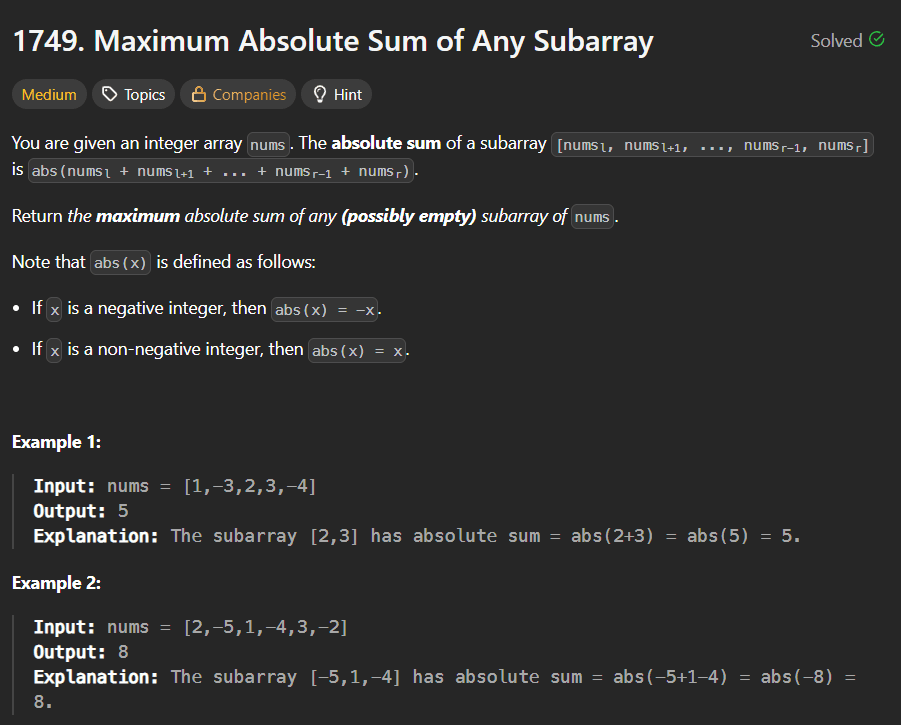
LeetCode Problem 1749Link of the Problem to try -: LinkYou are given an integer array nums. The absolute sum of a subarray [numsl, numsl+1, ..., numsr-1, numsr] is abs(numsl + numsl+1 + ... + numsr-1 + numsr).Return the maximum absolute sum of any (possibly empty) subarray of nums.Note that abs(x) is defined as follows:If x is a negative integer, then abs(x) = -x.If x is a non-negative integer, then abs(x) = x.Example 1:Input: nums = [1,-3,2,3,-4]Output: 5Explanation: The subarray [2,3] has absolute sum = abs(2+3) = abs(5) = 5.Example 2:Input: nums = [2,-5,1,-4,3,-2]Output: 8Explanation: The subarray [-5,1,-4] has absolute sum = abs(-5+1-4) = abs(-8) = 8.Constraints:1 <= nums.length <= 105-104 <= nums[i] <= 104My ThinkingSo, in this question what exactly we have to do what actual logic behind it to solve this question is that like you need to first find out the maximum sum of sub array via kadane's algorithm also find the minimum sum of subarray and then compare both numbers ignore the negative signs of it and then return the maximum number that is what the question want and we have to solve in it.Kadane's AlgorithmThis algorithm is highly efficient, solving the problem in a single pass with a time complexity of O(n), not O(1) constant time, as the algorithm must iterate through all n elements of the input array.The core principle is based on the idea that any negative prefix sum acts as a 'debt' that subsequent positive numbers must overcome. The strategy is to always pursue the maximum sum. If the running sum becomes negative at any point, it is reset to zero, effectively 'discarding' the previous negative sequence, and the search for a new maximum sum begins with the next element.Here is a video for more better understandingSolution:Here is the solution for this quesiton in java by Kadane's Algorithmpublic int maxAbsoluteSum(int[] nums) {int max = Integer.MIN_VALUE;int min = Integer.MAX_VALUE;int maxSum=0;int minSum=0;for(int i =0 ; i< nums.length;i++){maxSum = Math.max(maxSum+nums[i],nums[i]);max = Math.max(max,maxSum);minSum = Math.min(minSum+nums[i],nums[i]);min = Math.min(min,minSum);}return Math.max(max,Math.abs(min));}

leetcodemediumkadane algorithm
Mastering Binary Search – LeetCode 704 Explained

Mastering Binary Search – LeetCode 704 Explained

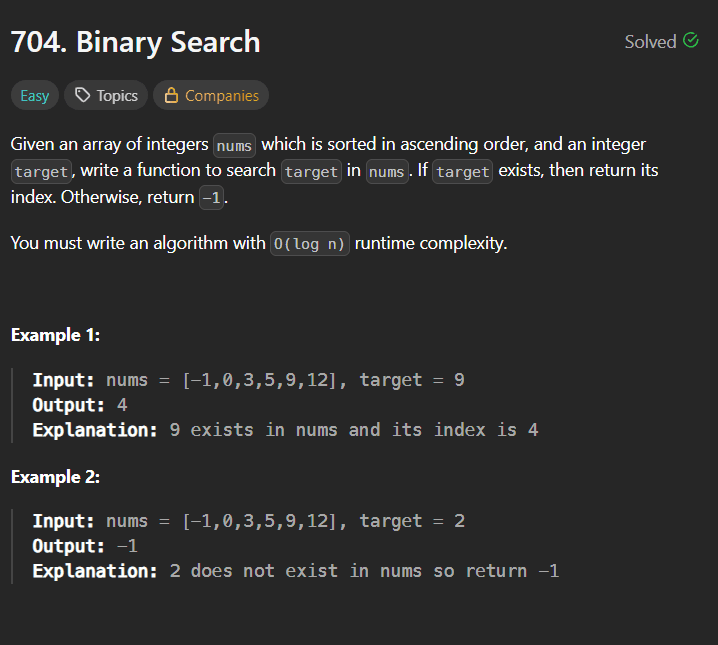
IntroductionBinary Search is one of the most fundamental and powerful algorithms in computer science. If you're preparing for coding interviews, mastering Binary Search is absolutely essential.In this blog, we’ll break down LeetCode 704 – Binary Search, explain the algorithm in detail, walk through your Java implementation, analyze complexity, and recommend additional problems to strengthen your understanding.You can try this problem -: Problem Link📌 Problem OverviewYou are given:A sorted array of integers nums (ascending order)An integer targetYour task is to return the index of target if it exists in the array. Otherwise, return -1.Example 1Input: nums = [-1,0,3,5,9,12], target = 9Output: 4Example 2Input: nums = [-1,0,3,5,9,12], target = 2Output: -1Constraints1 <= nums.length <= 10⁴All integers are uniqueThe array is sorted in ascending orderRequired Time Complexity: O(log n)🚀 Understanding the Binary Search AlgorithmBinary Search works only on sorted arrays.Instead of checking each element one by one (like Linear Search), Binary Search:Finds the middle element.Compares it with the target.Eliminates half of the search space.Repeats until the element is found or the search space is empty.Why is it Efficient?Every iteration cuts the search space in half.If the array size is n, the number of operations becomes:log₂(n)This makes it extremely efficient compared to linear search (O(n)).🧠 Step-by-Step AlgorithmInitialize two pointers:low = 0high = nums.length - 1While low <= high:Calculate middle index:mid = low + (high - low) / 2If nums[mid] == target, return midIf target > nums[mid], search right half → low = mid + 1Else search left half → high = mid - 1If loop ends, return -1💻 Your Java Code ExplainedHere is your implementation:class Solution {public int search(int[] nums, int target) {int high = nums.length-1;int low = 0;while(low <= high){int mid = low+(high-low)/2;if(target == nums[mid] ){return mid;}else if(target > nums[mid]){low = mid+1;}else{high = mid-1;}}return -1;}}🔍 Code Breakdown1️⃣ Initialize Boundariesint high = nums.length - 1;int low = 0;You define the search space from index 0 to n-1.2️⃣ Loop Conditionwhile(low <= high)The loop continues as long as there is a valid search range.3️⃣ Safe Mid Calculationint mid = low + (high - low) / 2;This is preferred over:(low + high) / 2Why?Because (low + high) may cause integer overflow in large arrays.Your approach prevents that.4️⃣ Comparison Logicif(target == nums[mid])If found → return index.else if(target > nums[mid])low = mid + 1;Search in right half.elsehigh = mid - 1;Search in left half.5️⃣ Not Found Casereturn -1;If the loop finishes without finding the target.⏱ Time and Space ComplexityTime Complexity: O(log n)Each iteration halves the search space.Space Complexity: O(1)No extra space used — purely iterative.🔥 Why This Problem Is ImportantLeetCode 704 is:The foundation of all Binary Search problemsA template questionFrequently asked in interviewsRequired to understand advanced problems like:Search in Rotated Sorted ArrayFind First and Last PositionPeak ElementBinary Search on Answer📚 Recommended Binary Search Practice ProblemsAfter solving this, practice these in order:🟢 Easy35. Search Insert Position69. Sqrt(x)278. First Bad Version🟡 Medium34. Find First and Last Position of Element in Sorted Array33. Search in Rotated Sorted Array74. Search a 2D Matrix875. Koko Eating Bananas (Binary Search on Answer)🔴 Advanced Pattern Practice1011. Capacity To Ship Packages Within D Days410. Split Array Largest SumThese will help you master:Lower bound / upper boundBinary search on monotonic functionsSearching in rotated arraysSearching in 2D matricesBinary search on answer pattern🎯 Final ThoughtsBinary Search is not just a single algorithm — it’s a pattern.If you truly understand:How the search space shrinksWhen to move left vs rightHow to calculate mid safelyLoop conditions (low <= high vs low < high)You can solve 50+ interview problems easily.LeetCode 704 is the perfect starting point.Master this template, and you unlock an entire category of problems.

Binary SearchLeetCodeEasy
Quick Sort Algorithm Explained | Java Implementation, Partition Logic & Complexity

Quick Sort Algorithm Explained | Java Implementation, Partition Logic & Complexity

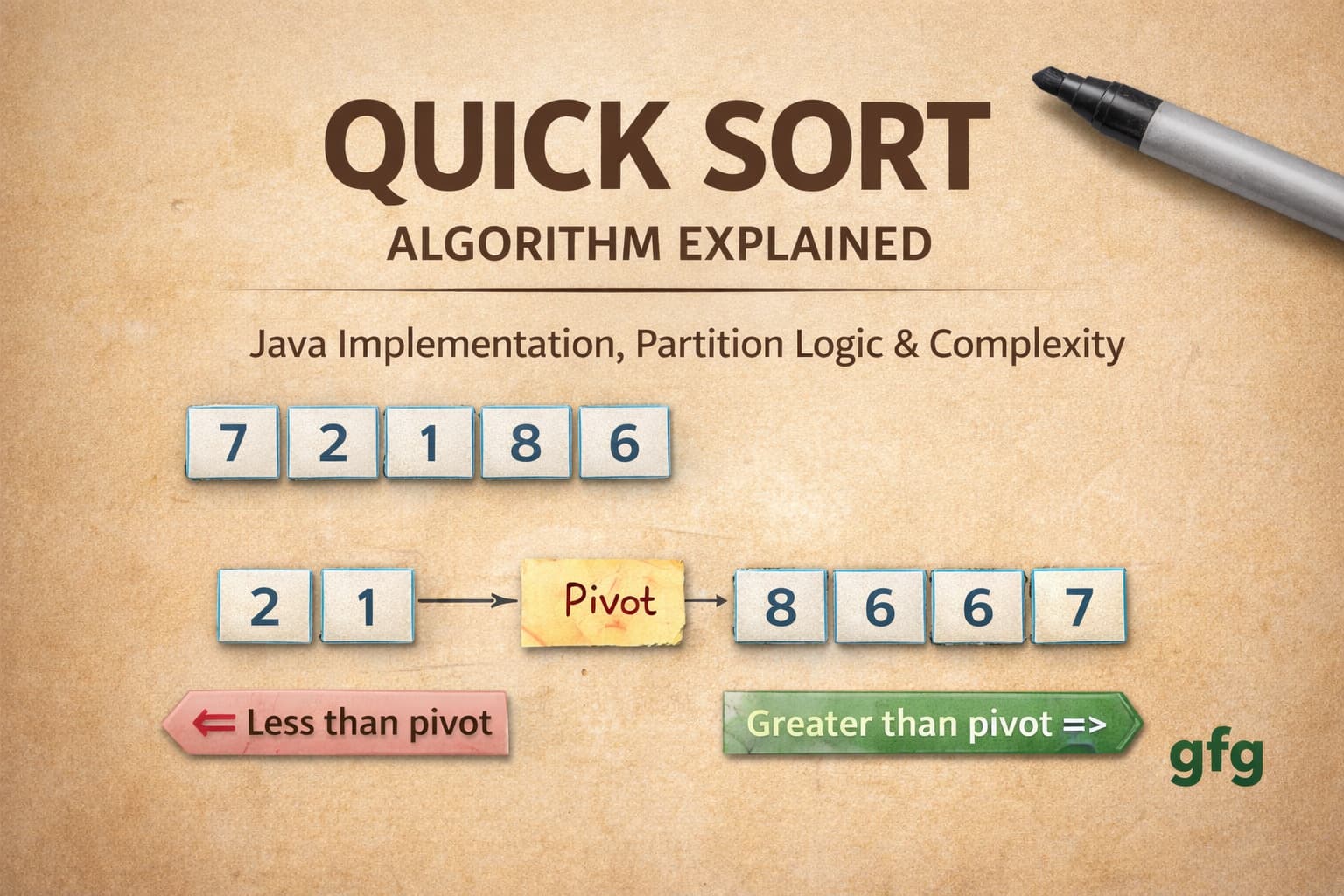
IntroductionQuick Sort is one of the most powerful and widely used sorting algorithms in computer science. It follows the Divide and Conquer approach and is known for its excellent average-case performance.What makes Quick Sort special is:It sorts in-place (no extra array required)It is faster in practice than many O(n log n) algorithms like Merge SortIt is heavily used in real-world systems and librariesIn this article, we’ll go deep into:Intuition behind Quick SortPartition logic (most important part)Step-by-step dry runJava implementation with commentsTime complexity analysisCommon mistakes and optimizations🔗 Problem LinkGeeksforGeeks: Quick SortProblem StatementGiven an array arr[], sort it in ascending order using Quick Sort.Requirements:Use Divide and ConquerChoose pivot elementPlace pivot in correct positionElements smaller → left sideElements greater → right sideExamplesExample 1Input:arr = [4, 1, 3, 9, 7]Output:[1, 3, 4, 7, 9]Example 2Input:arr = [2, 1, 6, 10, 4, 1, 3, 9, 7]Output:[1, 1, 2, 3, 4, 6, 7, 9, 10]Core Idea of Quick SortPick a pivot → Place it correctly → Recursively sort left & right🔥 Key Insight (Partition is Everything)Quick Sort depends entirely on partitioning:👉 After partition:Pivot is at its correct sorted positionLeft side → smaller elementsRight side → larger elementsIntuition (Visual Understanding)Consider:[4, 1, 3, 9, 7]Step 1: Choose PivotLet’s say pivot = 4Step 2: Rearrange Elements[1, 3] 4 [9, 7]Now:Left → smallerRight → largerStep 3: Apply RecursivelyLeft: [1, 3]Right: [9, 7]Final result:[1, 3, 4, 7, 9]Partition Logic (Most Important)Your implementation uses:Pivot = first elementTwo pointers:i → moves forwardj → moves backwardJava Codeclass Solution { public void quickSort(int[] arr, int low, int high) { // Base case: if array has 1 or 0 elements if (low < high) { // Partition array and get pivot index int pivotInd = partition(arr, low, high); // Sort left part quickSort(arr, low, pivotInd - 1); // Sort right part quickSort(arr, pivotInd + 1, high); } } // Function to swap two elements void swap(int[] arr, int i, int j) { int temp = arr[i]; arr[i] = arr[j]; arr[j] = temp; } private int partition(int[] arr, int low, int high) { int pivot = arr[low]; // choosing first element as pivot int i = low + 1; // start from next element int j = high; // start from end while (i <= j) { // Move i forward until element > pivot while (i <= high && arr[i] <= pivot) { i++; } // Move j backward until element <= pivot while (j >= low && arr[j] > pivot) { j--; } // Swap if pointers haven't crossed if (i < j) { swap(arr, i, j); } } // Place pivot at correct position swap(arr, low, j); return j; // return pivot index }}Step-by-Step Dry RunInput:[4, 1, 3, 9, 7]Execution:Pivot = 4i → moves until element > 4j → moves until element ≤ 4Swaps happen → pivot placed correctlyFinal partition:[1, 3, 4, 9, 7]Complexity AnalysisTime ComplexityCaseComplexityBest CaseO(n log n)Average CaseO(n log n)Worst CaseO(n²)Why Worst Case Happens?When array is:Already sortedReverse sortedPivot always becomes smallest/largest.Space ComplexityO(log n) (recursion stack)❌ Common MistakesWrong partition logicInfinite loops in while conditionsIncorrect pivot placementNot handling duplicates properly⚡ Optimizations1. Random PivotAvoid worst-case:int pivotIndex = low + new Random().nextInt(high - low + 1);swap(arr, low, pivotIndex);2. Median of ThreeChoose better pivot:median(arr[low], arr[mid], arr[high])Quick Sort vs Merge SortFeatureQuick SortMerge Sort link to get moreSpaceO(log n)O(n)SpeedFaster (practical)StableWorst CaseO(n²)O(n log n)Why Quick Sort is PreferredCache-friendlyIn-place sortingFaster in real-world scenariosKey TakeawaysPartition is the heart of Quick SortPivot must be placed correctlyRecursion splits problem efficientlyAvoid worst case using random pivotWhen to Use Quick SortLarge arraysMemory constraints (in-place)Performance-critical applicationsConclusionQuick Sort is one of the most efficient and practical sorting algorithms. Mastering its partition logic is crucial for solving advanced problems and performing well in coding interviews.Understanding how pointers move and how pivot is placed will make this algorithm intuitive and powerful.Frequently Asked Questions (FAQs)1. Is Quick Sort stable?No, it is not stable.2. Why is Quick Sort faster than Merge Sort?Because it avoids extra space and is cache-efficient.3. What is the most important part?👉 Partition logic

MediumJavaSortingQuick SortGeeksofGeeks
LeetCode 2126: Destroying Asteroids – Java Greedy Algorithm Solution with Dry Run

LeetCode 2126: Destroying Asteroids – Java Greedy Algorithm Solution with Dry Run

IntroductionLeetCode 2126 – Destroying Asteroids is a classic greedy algorithm problem that tests your ability to:Recognize optimal orderingUse sorting effectivelyApply greedy decision-makingHandle large integer growthUnderstand simulation problemsThis is a very interview-friendly problem because the optimal strategy is not immediately obvious.Problem Link🔗 https://leetcode.com/problems/destroying-asteroids/Problem StatementYou are given:An integer mass representing the planet’s initial massAn array asteroidsRules:If planet mass ≥ asteroid mass → asteroid is destroyedPlanet gains asteroid massOtherwise → planet gets destroyedReturn:true -> if all asteroids can be destroyedfalse -> otherwiseExampleInputmass = 10asteroids = [3,9,19,5,21]OutputtrueKey ObservationThe most important insight:Destroy smaller asteroids first.Why?Because every destroyed asteroid increases planet mass.So destroying smaller asteroids early helps you grow enough to destroy larger ones later.IntuitionSuppose:mass = 5asteroids = [100,1,2]If you attack:100 firstYou instantly lose.But if you destroy:1 → 2Your mass becomes:5 + 1 + 2 = 8Still not enough for 100.So answer remains false.This demonstrates:Ordering matters.Greedy StrategyThe optimal strategy is:Step 1Sort asteroids in ascending order.Step 2Destroy the smallest asteroid possible first.Step 3Keep increasing mass.Why Sorting WorksIf you cannot destroy the smallest remaining asteroid:You definitely cannot destroy larger asteroids either.That is why sorting guarantees the optimal greedy order.Java Solutionclass Solution { public boolean asteroidsDestroyed(int mass, int[] asteroids) { Arrays.sort(asteroids); if(mass >= asteroids[asteroids.length - 1]) { return true; } for(int i = 0; i < asteroids.length; i++) { if(mass >= asteroids[asteroids.length - 1]) { return true; } if(asteroids[i] <= mass) { mass += asteroids[i]; } if(mass < asteroids[i]) { return false; } } return true; }}Cleaner Optimized VersionOne important improvement:Use long instead of int.Why?Because mass can grow very large.Optimized Java Solutionclass Solution { public boolean asteroidsDestroyed(int mass, int[] asteroids) { Arrays.sort(asteroids); long currentMass = mass; for(int asteroid : asteroids) { if(currentMass < asteroid) { return false; } currentMass += asteroid; } return true; }}Why Use Long?Constraints allow:1 <= asteroids.length <= 1000001 <= asteroid[i] <= 100000Mass can exceed:Integer.MAX_VALUEUsing long prevents overflow issues.Dry RunInputmass = 10asteroids = [3,9,19,5,21]Step 1: Sort[3,5,9,19,21]Step 2: Destroy AsteroidsDestroy 310 >= 3mass = 13Destroy 513 >= 5mass = 18Destroy 918 >= 9mass = 27Destroy 1927 >= 19mass = 46Destroy 2146 >= 21mass = 67All asteroids destroyed.Final OutputtrueBrute Force ApproachA brute force approach would try:All possible asteroid ordersThis means:N! permutationsWhich is impossible for:N = 100000So brute force is completely infeasible.Why Greedy Is OptimalGreedy works because:Smaller asteroids are easiest to destroyThey increase massIncreased mass helps destroy bigger asteroidsThis creates a natural optimal progression.Time Complexity AnalysisSortingO(N log N)TraversalO(N)Total Time ComplexityO(N log N)Space ComplexityO(1)Ignoring sorting space.Interview ExplanationIn interviews, explain:Since destroying an asteroid increases our mass, the optimal strategy is to destroy smaller asteroids first. Sorting ensures we always maximize future growth opportunities.This demonstrates:Greedy thinkingSorting optimizationSimulation handlingProof of correctnessCommon Mistakes1. Not SortingWithout sorting:You may attempt larger asteroids too early.2. Using int Instead of longMass can overflow.Always use:long currentMass3. Brute Force PermutationsTrying all orders leads to:O(N!)which is impossible.4. Incorrect Early ReturnYour logic should only fail when:currentMass < asteroidFAQsQ1. Why is sorting necessary?Sorting guarantees we always destroy the smallest possible asteroid first.Q2. Is this a greedy problem?Yes.The optimal local decision:Destroy smallest asteroid firstleads to global optimality.Q3. Why use long?Because mass can grow beyond integer limits.Q4. Is this asked in interviews?Yes.It is a common greedy + sorting interview problem.ConclusionLeetCode 2126 is an excellent greedy problem for mastering:Sorting-based optimizationGreedy decision-makingSimulation problemsOverflow handlingInterview reasoningThe key insight is:Always destroy smaller asteroids first to maximize future mass growth.Once this greedy intuition becomes natural, many scheduling and optimization problems become easier to solve.

LeetCodeGreedy AlgorithmJavaSortingArrayMedium
LeetCode 3963: Create Grid With Exactly One Path — The Simple Java Trick I Almost Overlooked

LeetCode 3963: Create Grid With Exactly One Path — The Simple Java Trick I Almost Overlooked

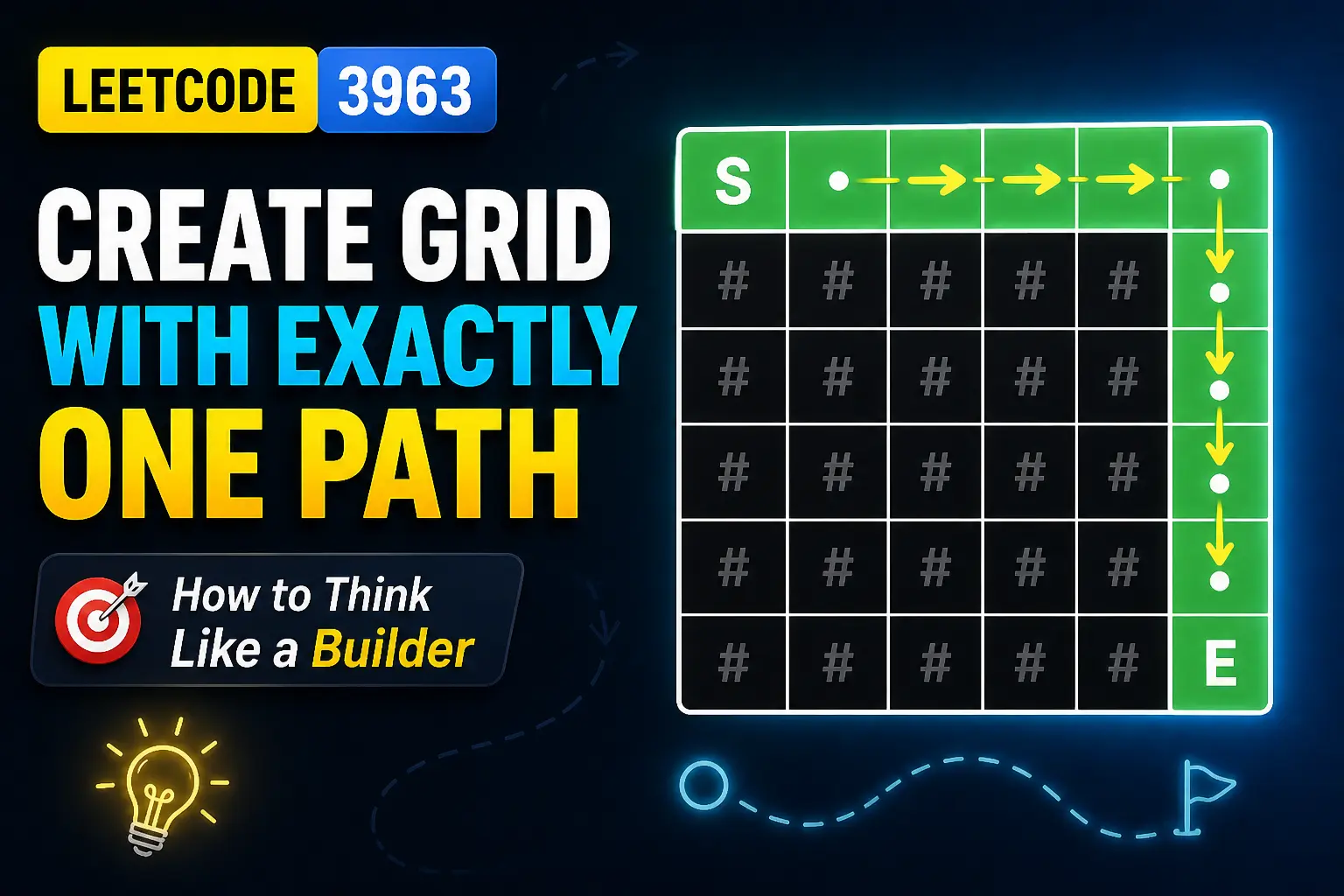
The First Question I Asked Myself: Do We Really Need a Complicated Path?Problem link: LeetCode 3963 — Create Grid With Exactly One PathWhen I first looked at this problem, I saw a grid with two types of cells:. means we can move through the cell.# means the cell is blocked.We have to construct a grid in which exactly one valid path exists from the top-left corner to the bottom-right corner.My first instinct was to think about movement. We can move right or down, so I started wondering how to arrange the cells to control these movements.But then I realized something important: the problem doesn't ask us to find a path in a given grid. It asks us to create the grid ourselves.That changes the problem completely.We are not trapped inside a grid someone else has designed. We are the ones deciding which cells are free and which cells are blocked.So instead of asking, "How do I search for exactly one path?", I started asking a simpler question:What is the easiest possible path I can create, and how can I prevent every other path?That question leads to a much simpler solution.Step 1: Stop Thinking That We Must Alternate Right and DownSuppose we have a grid with three rows and four columns.We need to travel from the top-left cell to the bottom-right cell.A valid path can move right or down. But there is no rule saying we must alternate between these movements.We can move right three times and then down twice. We can also move down twice first and then right three times.Both movement patterns are allowed, provided the cells we enter are free.This was the observation that made the problem easier for me.Instead of creating a complicated zigzag path, why not move right along the first row and then down along the last column?For example, with m = 3 and n = 4, we can create this grid:...####.###.Let's trace the intended path:(0,0) → (0,1) → (0,2)↓(1,3)↓(2,3)The first row is free until the final column, and the last column is free all the way to the bottom.Every other cell is blocked.There is only one way to reach the destination: move right across the top row, then move down along the last column.We don't need recursion, DFS, BFS, or dynamic programming. We only need to construct a grid that forces the movement we want.Step 2: Why Does This Grid Have Exactly One Path?Let's look at the structure rather than just the example.Our grid has three important parts:The top row is free, allowing movement to the right.The last column is free, allowing movement downward.Every other cell is blocked.Consider the starting cell (0,0).Since moving down immediately would enter a blocked cell, the only possible move is right.The same reasoning applies as we continue along the top row. Moving down is blocked until we reach the last column.Once we reach the last column, moving right is impossible because we are already at the rightmost boundary. The only available movement is down.We keep moving down until we reach the bottom-right cell.Therefore, every step is forced. There is no point along the path where we can choose between two valid directions.If every step has only one possible next move, there can be only one valid path.This is the central idea behind the construction.Step 3: Translate the Idea Into JavaNow that the pattern is clear, the code becomes straightforward.We create an array of strings, where each string represents one row of the grid.For every cell, we ask two questions:Is this cell in the first row?Is this cell in the last column?If either condition is true, we place a .. Otherwise, we place a #.In other words:if (i == 0 || j == n - 1) {// Free cell} else {// Obstacle}This creates the top-row-and-last-column corridor.Notice that we do not need to calculate all possible paths or count them. The construction itself guarantees that there is exactly one.Java SolutionHere is the complete implementation using the same constructive approach:class Solution {public String[] createGrid(int m, int n) {String[] ans = new String[m];for (int i = 0; i < m; i++) {StringBuilder row = new StringBuilder();for (int j = 0; j < n; j++) {if (i == 0 || j == n - 1) {row.append('.');} else {row.append('#');}}ans[i] = row.toString();}return ans;}}What is different from my original code?My original solution already had the right core idea: create free cells along the first column and the bottom row, blocking the other cells.That approach is also valid. It creates a path that moves down first and then right.The revised implementation uses the alternative pattern discussed above: move right along the top row, then down along the last column.Both constructions work because they create one continuous corridor and block all competing routes.I also used StringBuilder instead of repeatedly concatenating strings with ro += "." or ro += "#". This makes row construction clearer and avoids repeatedly creating intermediate strings.Step 4: Dry RunLet's use the example m = 3, n = 3.Initially, we have three rows and three columns.For each cell, we check whether it belongs to the first row or the last column.Row 0Every cell is in the first row, so every cell becomes free....Row 1The first two cells are neither in the first row nor in the last column, so they become obstacles. The last cell is in the last column, so it remains free.##.Row 2The same rule applies.##.The final grid is:...##.##.The only valid path is:(0,0) → (0,1) → (0,2)↓(1,2)↓(2,2)The answer is a valid grid because the path starts at (0,0), ends at (m - 1, n - 1), and contains no alternative route.Step 5: What About a Grid With Only One Row or One Column?This is where I initially added special cases to my code.For example, if m = 1, the grid contains only one row. We can make every cell free:....There is exactly one path: keep moving right.If n = 1, the grid contains only one column. We can make every cell free vertically:....There is exactly one path: keep moving down.The useful discovery is that our new construction already handles both cases. When m = 1, the first-row condition makes every cell free. When n = 1, the last-column condition makes every cell free.That means we don't need separate if (m == 1) or if (n == 1) blocks.Removing unnecessary special cases makes the code shorter and easier to reason about.Complexity AnalysisLet m be the number of rows and n be the number of columns.Time complexity: O(m × n)We visit every cell exactly once and decide whether it should be a free cell or an obstacle.Space complexity: O(m × n)The returned grid contains m × n characters, so the output itself requires O(m × n) space. The temporary StringBuilder for constructing a row uses O(n) space.What I Learned From This ProblemThe biggest lesson was that I was thinking too much about finding paths instead of designing one.When I saw the words "exactly one valid path," I could easily have started thinking about graph algorithms, counting paths, or checking every possible route.But we control the grid. That means we can make every decision along the route for the person moving through it.The moment I realized that we could move right as many times as needed before moving down, the problem became much simpler. I could create a straight corridor and block everything else.My original solution used the same principle in the opposite direction: move down first, then right. Both ideas are correct.This is a useful lesson for constructive problems in general: before reaching for a complicated algorithm, ask whether you can build an answer whose structure makes the required property inevitable.Final TakeawayLeetCode 3963 is not really about searching a grid. It is about constructing one that forces a unique route.Choose a simple path.Keep the cells along that path free.Block cells that could create alternative routes.Check that the construction still works for a single row or column.Sometimes the best solution isn't to explore every possibility. It's to design the situation so that only one possibility exists.That is the intuition worth carrying into the next constructive algorithm problem.

LeetCodeJavaMatrixEasy
LeetCode 41: First Missing Positive – O(n) Time and O(1) Space Java Solution

LeetCode 41: First Missing Positive – O(n) Time and O(1) Space Java Solution

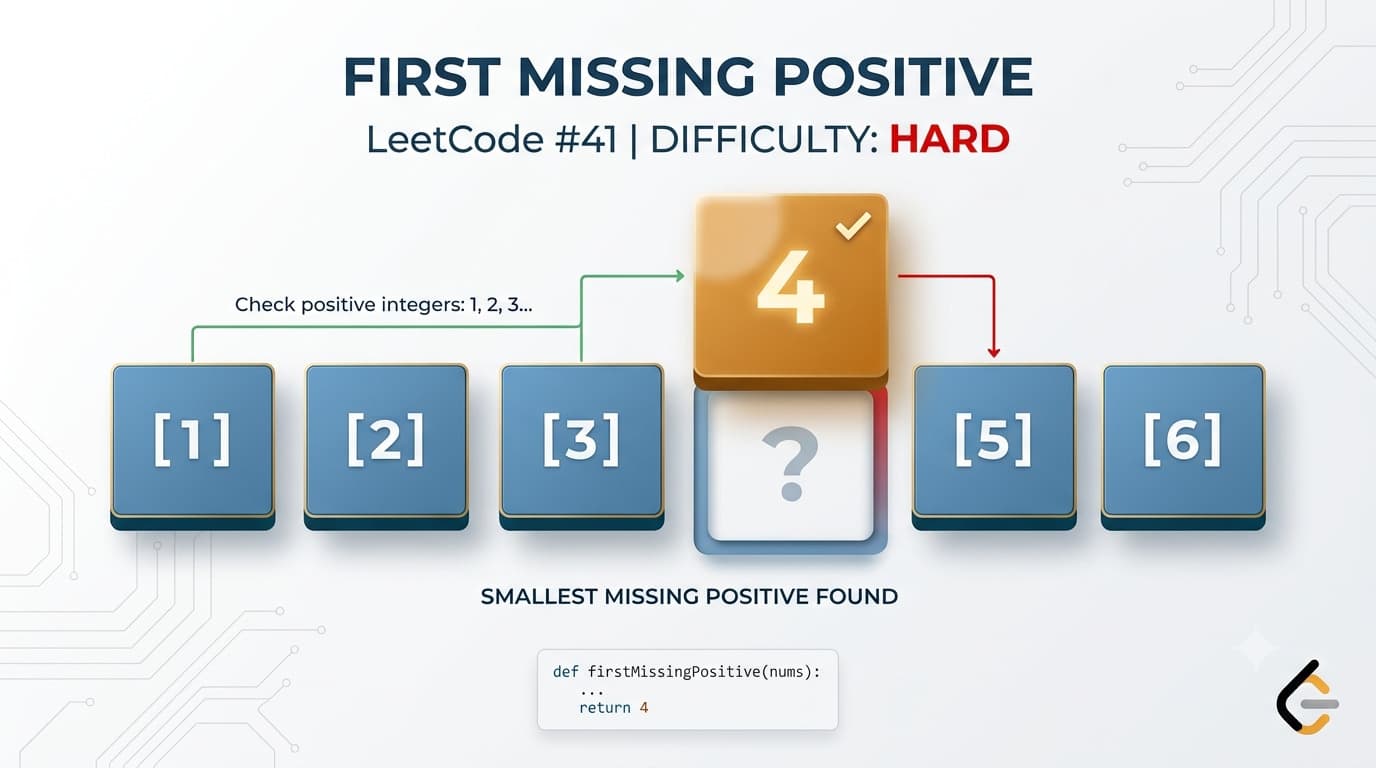
IntroductionFinding the smallest positive integer missing from an unsorted array appears simple at first, but the problem becomes significantly more interesting because of its strict constraints.Problem Link -: First Missing PositiveGiven an unsorted integer array nums, the task is to return the smallest positive integer that does not appear in the array.For example:nums = [1,2,0]The positive integers begin with:1, 2, 3, 4, ...Both 1 and 2 are present, while 3 is missing.Therefore, the answer is:3The challenge is that the solution must run in:O(n) timeO(1) auxiliary spaceThis rules out several common approaches such as sorting and using a HashSet.Problem StatementGiven an unsorted integer array nums, return the smallest positive integer that is not present in the array.ExampleInput: nums = [3,4,-1,1]Output: 2The positive integers are:1, 2, 3, 4, ...1 exists in the array, but 2 does not.Therefore:Answer = 2Another example:Input: nums = [7,8,9,11,12]Output: 1Since 1 itself is missing, the answer is immediately:1Understanding the Important ObservationFor an array of length n, the answer can never be greater than:n + 1Consider:nums = [1,2,3]The first three positive integers are present:1, 2, 3Therefore, the smallest missing positive integer is:4Since n = 3:answer <= n + 1This observation is the key to the optimal solution.Numbers that are:<= 0or> ncannot directly determine the smallest missing positive number.The useful values are only:1 ... nThe Submitted HashSet ApproachA straightforward approach is to store every value in a HashSet and then search for the first missing positive integer.The basic idea is:Store all numbers ↓Check 1 ↓Check 2 ↓Check 3 ↓...The submitted implementation follows this idea:class Solution { public int firstMissingPositive(int[] nums) { int max = Integer.MIN_VALUE; HashSet<Integer> ms = new HashSet<>(); for (int a : nums) { max = Math.max(a, max); ms.add(a); } for (int i = 1; i <= max; i++) { if (!ms.contains(i)) { return i; } } if (max < 0) { return 1; } return max + 1; }}This approach is logically valid for finding the answer, but it does not satisfy the required constraints.Space ComplexityThe HashSet can store up to n elements.Therefore:O(n) auxiliary spaceThe problem requires:O(1) auxiliary spaceSo a different technique is required.Why Sorting Is Also Not EnoughSorting the array might appear to solve the problem easily.For example:[3,4,-1,1]After sorting:[-1,1,3,4]The missing positive integer can then be identified by scanning the array.However, sorting requires:O(n log n)time in the general case.The problem specifically requires:O(n)time.Therefore, sorting does not satisfy the required complexity either.The Core Idea: Put Every Number in Its Correct PositionThe optimal solution uses an in-place cyclic placement technique.The important relationship is:value 1 → index 0value 2 → index 1value 3 → index 2value 4 → index 3...In general:value x → index x - 1Consider:nums = [3,4,-1,1]The desired arrangement for useful values is:index: 0 1 2 3value: 1 2 3 4After placing the valid values into their corresponding positions, the array can become:[1, -1, 3, 4]Index 1 should contain:2but it contains -1.Therefore:answer = index + 1 = 1 + 1 = 2This transforms the problem from:Search for a missing number.into:Place every useful number at the position where it belongs, then find the first incorrect position.Which Numbers Should Be Placed?For an array of length n, only values satisfying:1 <= nums[i] <= nneed to be placed.Why?Suppose:n = 5The answer can only be one of:1,2,3,4,5,6A value such as:-4cannot be the answer.Similarly:10cannot prevent 1...6 from determining the answer.Therefore, values outside the range [1,n] can safely remain where they are.The Cyclic Placement ProcessFor every index i, check the current value:nums[i]If it belongs to the range:1 <= nums[i] <= nits correct index is:nums[i] - 1So the value should be swapped into:nums[nums[i] - 1]The process continues until the current position contains a value that either:is outside the useful range, oris already in its correct position.Why the Duplicate Check Is NecessaryConsider:nums = [1,1]The value 1 belongs at index 0.The first element is already correct.At index 1, the value is again 1.Trying to swap it repeatedly would cause an infinite loop because another 1 already occupies its correct position.Therefore, the swap condition must also ensure:nums[nums[i] - 1] != nums[i]This duplicate check is extremely important.Optimized Java Solutionclass Solution { public int firstMissingPositive(int[] nums) { int n = nums.length; for (int i = 0; i < n; i++) { while ( nums[i] >= 1 && nums[i] <= n && nums[nums[i] - 1] != nums[i] ) { int correctIndex = nums[i] - 1; int temp = nums[i]; nums[i] = nums[correctIndex]; nums[correctIndex] = temp; } } for (int i = 0; i < n; i++) { if (nums[i] != i + 1) { return i + 1; } } return n + 1; }}Dry RunConsider:nums = [3,4,-1,1]Array length:n = 4Initial Array[3, 4, -1, 1]At index 0:nums[0] = 3The correct index for 3 is:3 - 1 = 2Swap:[3, 4, -1, 1] ↓[-1, 4, 3, 1]The value at index 0 is now -1.Since -1 is outside [1,4], no further placement is required for this index.At index 1:nums[1] = 4Correct index:4 - 1 = 3Swap:[-1, 4, 3, 1] ↓[-1, 1, 3, 4]Now:nums[1] = 1The correct index of 1 is 0.Swap:[-1, 1, 3, 4] ↓[1, -1, 3, 4]Now index 1 contains -1, so placement stops.Final Arrangement[1, -1, 3, 4]The expected value at each index is:index 0 → 1 ✓index 1 → 2 ✗index 2 → 3 ✓index 3 → 4 ✓The first incorrect position is:index = 1Therefore:answer = index + 1 = 2Another ExampleConsider:nums = [1,2,0]The values 1 and 2 are already in their correct positions:[1,2,0]Expected arrangement:index 0 → 1 ✓index 1 → 2 ✓index 2 → 3 ✗The first incorrect position is index 2.Therefore:answer = 2 + 1 = 3Edge Case: All Positive Numbers Are PresentConsider:nums = [1,2,3]Every position contains the expected value:index 0 → 1index 1 → 2index 2 → 3No missing value exists between 1 and n.Therefore, the smallest missing positive integer is:n + 1So:answer = 4Edge Case: The Answer Is 1Consider:nums = [7,8,9,11,12]All values are greater than 1.After the placement phase, there is no 1 at index 0.Therefore:answer = 1Complexity AnalysisThe algorithm uses the array itself to store values in their correct positions.Time ComplexityAlthough the algorithm contains a nested while loop, the total number of swaps is bounded by O(n) because every successful swap places a useful value into its correct position.Therefore:Time Complexity: O(n)Space ComplexityNo additional data structure proportional to the input size is used.Only a few variables are required:Space Complexity: O(1)This satisfies the required constraints.Why the Algorithm WorksThe central invariant is:Whenever a value x lies in the range [1,n], the algorithm attempts to place it at index x-1.After the placement phase, every value that can occupy a meaningful position is either:at its correct indexorabsent from the arrayTherefore, scanning from left to right provides a direct answer.If:nums[i] != i + 1then i + 1 is missing.If every position is correct, then all values from:1 ... nexist, making:n + 1the smallest missing positive integer.Interview InsightThis problem is an important example of in-place array positioning.The key pattern is:Value x ↓Correct index = x - 1Whenever an array problem asks for a missing, duplicate, or misplaced number within a known range, it is worth checking whether the values themselves can be mapped directly to indices.This technique appears in several interview problems involving:Missing numbersDuplicate numbersCyclic sortIn-place rearrangementFrequency representation without extra memoryThe biggest clue in this problem is the combination of:Unsorted array+O(n) time+O(1) space+Positive integersThat combination strongly suggests an in-place index/value mapping strategy.ConclusionLeetCode 41, First Missing Positive, is a classic example of turning the array itself into auxiliary storage.A HashSet provides an easy solution but requires O(n) extra space. Sorting simplifies the search but requires O(n log n) time. The optimal solution instead uses the relationship:value x → index x - 1to rearrange useful values directly inside the input array.After this placement, the first index whose value does not match index + 1 identifies the smallest missing positive integer.The final complexity is:O(n) timeO(1) auxiliary spacemaking the approach suitable for the strict constraints and an important pattern to recognize in technical interviews.

LeetCodeJavaArraysCyclic SortHardHashSet
Maximum Subarray

Maximum Subarray

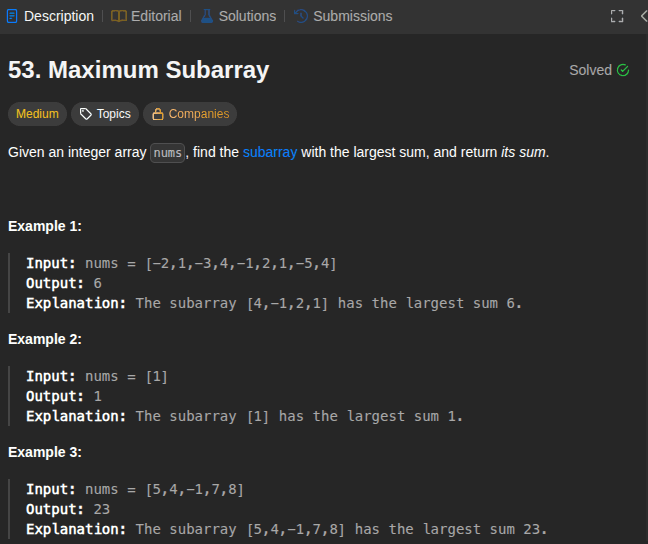
LeetCode Problem 53Link of the Problem to try -: LinkGiven an integer array nums, find the subarray with the largest sum, and return its sum.Example 1:Input: nums = [-2,1,-3,4,-1,2,1,-5,4]Output: 6Explanation: The subarray [4,-1,2,1] has the largest sum 6.Example 2:Input: nums = [1]Output: 1Explanation: The subarray [1] has the largest sum 1.Example 3:Input: nums = [5,4,-1,7,8]Output: 23Explanation: The subarray [5,4,-1,7,8] has the largest sum 23.Constraints:1 <= nums.length <= 105-104 <= nums[i] <= 104Follow up: If you have figured out the O(n) solution, try coding another solution using the divide and conquer approach, which is more subtle.My Approach -: I successfully addressed this problem by implementing nested loops to generate the required subarrays. My approach effectively handles the subarray creation logic as specified. Please find the implementation code below.int ans=0;for(int i=0;i<nums.length;i++){int sum =0;for(int j =i;j<nums.length;j++){sum += nums[j];ans = Math.max(sum,ans);}}return ans;Although this solution passed local tests, it encountered a 'Time Limit Exceeded' (TLE) error on LeetCode due to the constraints of the problem. While the nested loop approach is logically sound, further optimization is required to improve its time complexity for larger test cases.Optimized Algorithm (Kadane's Algorithm)This algorithm is highly efficient, solving the problem in a single pass with a time complexity of O(n), not O(1) constant time, as the algorithm must iterate through all n elements of the input array.The core principle is based on the idea that any negative prefix sum acts as a 'debt' that subsequent positive numbers must overcome. The strategy is to always pursue the maximum sum. If the running sum becomes negative at any point, it is reset to zero, effectively 'discarding' the previous negative sequence, and the search for a new maximum sum begins with the next element.Here is a video for more better understandingMy Understanding Steps to solve this QuestionTo solve this problem efficiently in (O(n)) time, I implemented the following steps:Initialization: Define two integer variables: currentSum (initialized to 0) and maxSum (initialized to Integer.MIN_VALUE). currentSum tracks the running total, while maxSum stores the overall maximum subarray sum found so far.Iteration: Traverse the array using a single for loop.Update Running Sum: At each element, add its value to currentSum.Update Maximum: Compare currentSum with maxSum. If currentSum is greater, update maxSum with this new value.Reset Negative Sums: If currentSum drops below zero, reset it to 0. This effectively "discards" a negative prefix that would otherwise reduce the sum of subsequent subarrays.Return Result: After the loop completes, return maxSum as the final result.Here is the Code:int sum = 0;int max = Integer.MIN_VALUE;for(int i=0;i <nums.length;i++){sum +=nums[i];max =Math.max(sum,max);if(sum < 0){sum =0;}}return max;(Note this same solution can also write in another way as well)Here is another way to write this same solution:int sum = 0;int max = Integer.MIN_VALUE;for(int i=0;i <nums.length;i++){// sum +=nums[i];sum = Math.max(sum+nums[i],nums[i]); // Here we are ensuring that sum will alwaays be grestest in all time so that it will not be negative or smaller ass previously we directly putting value in it.max =Math.max(sum,max);// if(sum < 0){ We don't need this as we already ensure that sum will never be negative and always a positive number// sum =0;// }}return max;

LeetCodeArrayMedium
Search in Rotated Sorted Array – Binary Search Explained with Java Solution (LeetCode 33)

Search in Rotated Sorted Array – Binary Search Explained with Java Solution (LeetCode 33)

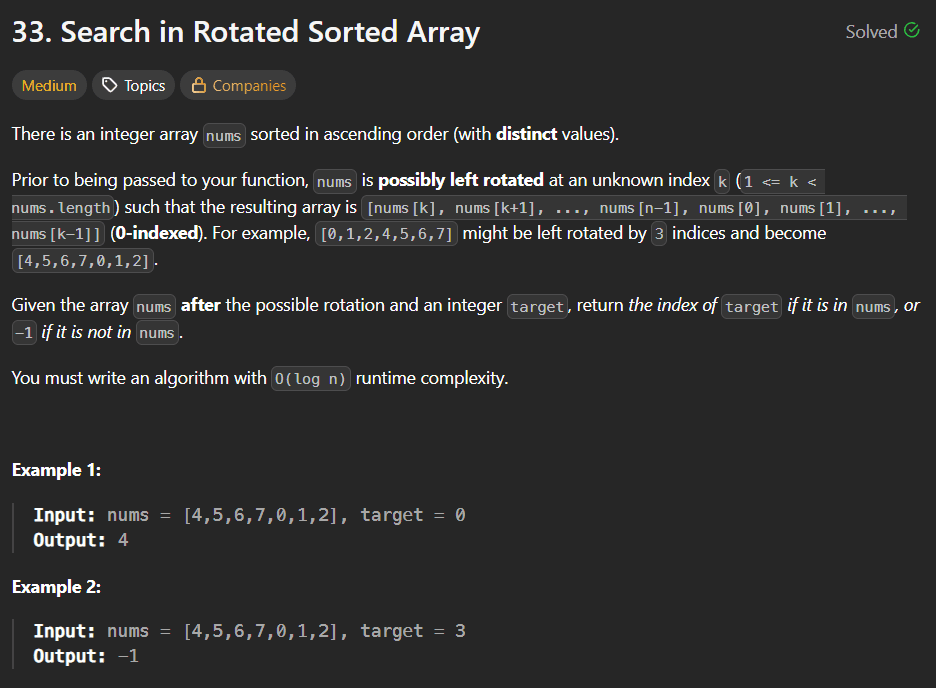
Try the QuestionBefore reading the solution, try solving the problem yourself:👉 https://leetcode.com/problems/search-in-rotated-sorted-array/Attempting the problem first helps build strong algorithmic intuition, which is extremely valuable during coding interviews.Problem StatementYou are given an integer array nums that was originally sorted in ascending order with distinct elements.Example of a sorted array:[0,1,2,4,5,6,7]Before the array is provided to the function, it may have been rotated at some pivot index k.After rotation, the array structure becomes:[nums[k], nums[k+1], ..., nums[n-1], nums[0], nums[1], ..., nums[k-1]]For example:Original Array[0,1,2,4,5,6,7]Rotated by 3 positions[4,5,6,7,0,1,2]You are also given an integer target.The goal is to return the index of the target element in the array.If the element does not exist, return:-1Important ConstraintThe algorithm must run in O(log n) time complexity, which strongly suggests using Binary Search.Example WalkthroughExample 1Inputnums = [4,5,6,7,0,1,2]target = 0Output4Explanation:0 exists at index 4Example 2Inputnums = [4,5,6,7,0,1,2]target = 3Output-1Explanation:3 does not exist in the arrayExample 3Inputnums = [1]target = 0Output-1Understanding the Core ChallengeIf the array were fully sorted, the problem would be straightforward because binary search could directly be applied.Example:[1,2,3,4,5,6,7]However, due to rotation:[4,5,6,7,0,1,2]the array is no longer globally sorted.But an important observation makes the problem solvable.Key ObservationEven after rotation:At least one half of the array is always sorted.For example:[4,5,6,7,0,1,2] Left part → sorted Right part → sortedThis property allows the use of binary search with additional conditions.Approach 1 — Linear Scan (Brute Force)The simplest method is to iterate through the entire array and check each element.AlgorithmTraverse the array from start to end.Compare every element with the target.Return the index if found.Codefor(int i = 0; i < nums.length; i++){ if(nums[i] == target){ return i; }}return -1;Time ComplexityO(n)Space ComplexityO(1)Although simple, this solution does not satisfy the required O(log n) complexity.Approach 2 — Modified Binary SearchA better solution uses binary search with sorted half detection.IdeaAt every step:Calculate the middle index.Determine which half of the array is sorted.Check if the target lies inside that sorted half.Adjust the search range accordingly.Implementationpublic int search(int[] nums, int target) { int l = 0; int r = nums.length - 1; while(l <= r){ int mid = l + (r - l) / 2; if(nums[mid] == target){ return mid; } // left half sorted if(nums[l] <= nums[mid]){ if(nums[l] <= target && target < nums[mid]){ r = mid - 1; }else{ l = mid + 1; } } // right half sorted else{ if(nums[mid] < target && target <= nums[r]){ l = mid + 1; }else{ r = mid - 1; } } } return -1;}Time ComplexityO(log n)Space ComplexityO(1)This is the most common interview solution.Approach 3 — Find Rotation Point Then Apply Binary SearchAnother elegant strategy is to first locate the minimum element in the rotated array, which represents the rotation index (pivot).Once the pivot is known, the array can be logically split into two sorted subarrays.Example:[4,5,6,7,0,1,2] ^ pivotTwo sorted sections exist:[4,5,6,7][0,1,2]After identifying the pivot:Decide which part may contain the target.Apply standard binary search on that portion.Step 1 — Finding the Minimum Element (Rotation Pivot)The smallest element indicates where the rotation happened.Function to Find Minimum Valuepublic int findMinIndex(int[] nums){ int l = 0; int r = nums.length - 1; while(l < r){ int mid = l + (r - l) / 2; if(nums[mid] > nums[r]){ l = mid + 1; }else{ r = mid; } } return l;}Why This WorksIf:nums[mid] > nums[r]the minimum element must be on the right side.Otherwise, it lies on the left side (including mid).Step 2 — Standard Binary SearchAfter determining which half contains the target, a normal binary search is applied.public int binarySearch(int[] nums, int l, int r, int target){ while(l <= r){ int mid = l + (r - l) / 2; if(nums[mid] == target){ return mid; } else if(nums[mid] < target){ l = mid + 1; } else{ r = mid - 1; } } return -1;}Complete Solution (Pivot + Binary Search)class Solution { public int findMinIndex(int[] nums){ int l = 0; int r = nums.length - 1; while(l < r){ int mid = l + (r - l) / 2; if(nums[mid] > nums[r]){ l = mid + 1; }else{ r = mid; } } return l; } public int binarySearch(int[] nums, int l, int r, int target){ while(l <= r){ int mid = l + (r - l) / 2; if(nums[mid] == target){ return mid; } else if(nums[mid] < target){ l = mid + 1; } else{ r = mid - 1; } } return -1; } public int search(int[] nums, int target) { int pivot = findMinIndex(nums); if(nums[pivot] <= target && target <= nums[nums.length - 1]){ return binarySearch(nums, pivot, nums.length - 1, target); } return binarySearch(nums, 0, pivot - 1, target); }}Time ComplexityFinding pivot:O(log n)Binary search:O(log n)Total complexity:O(log n)Space ComplexityO(1)No additional memory is used.Key Takeaways✔ The array is sorted but rotated✔ A rotation creates two sorted sections✔ Binary search can still be applied✔ Either detect the sorted half directly or locate the pivot first✔ Both optimized approaches achieve O(log n) complexityFinal ThoughtsThis problem is a classic binary search variation frequently asked in coding interviews. It evaluates the ability to:Recognize structural patterns in arraysAdapt binary search to non-standard conditionsMaintain optimal algorithmic complexityUnderstanding this pattern also helps solve related problems such as:Find Minimum in Rotated Sorted ArraySearch in Rotated Sorted Array IIFind Rotation Count in ArrayMastering these concepts significantly strengthens binary search problem-solving skills for technical interviews.

Binary SearchJavaRotated Sorted ArrayLeetCodeMedium
LeetCode 3727 Maximum Alternating Sum of Squares – Java Solution & Explanation

LeetCode 3727 Maximum Alternating Sum of Squares – Java Solution & Explanation

IntroductionLeetCode 3727 – Maximum Alternating Sum of Squares is an array problem where the goal is to rearrange the elements to obtain the largest possible alternating score.At first, the formula looks straightforward:score = arr[0]2 - arr[1]2 + arr[2]2 - arr[3]2 + ...However, the challenge is deciding which squared values should occupy the positive positions and which should occupy the negative positions.A useful observation makes the problem easier: the values added to the score should be as large as possible, while the values subtracted should be as small as possible.This solution uses sorting to arrange the squared values, then alternates between taking the largest remaining value for a positive position and the smallest remaining value for a negative position.There is also a small debugging lesson from the submission process: a System.out.println() statement that appears harmless during development can add enough output overhead to contribute to a Time Limit Exceeded (TLE) result.Problem StatementProblem Link-: Maximum Alternating Sum of SquaresGiven an integer array nums, the elements can be rearranged in any order.The alternating score is defined as:score = arr[0]2 - arr[1]2 + arr[2]2 - arr[3]2 + ...Return the maximum possible alternating score after rearranging the array.Example 1Input: nums = [1, 2, 3]Output: 12One valid rearrangement is:[2, 1, 3]Its score is:2^2-1^2+3^2=4-1+9=12Example 2Input: nums = [1, -1, 2, -2, 3, -3]Output: 16One rearrangement that achieves the maximum is:[-3, -1, -2, 1, 3, 2]The score is:9-1+4-1+9-4=16Notice that negative numbers do not remain negative after squaring. For example, ((-3)^2=9), just like (3^2=9).Understanding the Greedy IdeaBefore looking at the code, consider the sign of each position in the alternating sum.PositionContributionIndex 0Add the squareIndex 1Subtract the squareIndex 2Add the squareIndex 3Subtract the squareIndex 4Add the squareThe even indices contribute positively, and the odd indices contribute negatively.To maximize the total, the positive positions should receive large squared values, while the negative positions should receive small squared values.For example, suppose the squared values are:[1, 4, 9]A good arrangement is:[9, 1, 4]The alternating score becomes:9-1+4=12This is better than:1-4+9=6The sorting step makes the largest and smallest remaining values easy to access. Two pointers can then select them in the required order.Java SolutionThe following implementation follows the submitted approach: square the elements, sort them, and build a new array by alternating between the largest and smallest remaining values.class Solution { public long maxAlternatingSum(int[] nums) { for (int i = 0; i < nums.length; i++) { nums[i] = nums[i] * nums[i]; } Arrays.sort(nums); int[] n = new int[nums.length]; int l = 0; int h = nums.length - 1; int v = 0; while (v < nums.length && l < h) { if (v % 2 == 0) { n[v] = nums[h]; h--; v++; } else { n[v] = nums[l]; l++; v++; } } if (h - l != 1) { n[v] = nums[l]; } long sum = 0; for (int i = 0; i < nums.length; i++) { if (i % 2 == 0) { sum += n[i]; } else { sum -= n[i]; } // System.out.println(n[i]); } return sum; }}Step-by-Step Explanation1. Square every elementfor (int i = 0; i < nums.length; i++) { nums[i] = nums[i] * nums[i];}The score uses squares, so each element is converted into its squared value.For example:Original: [1, -1, 2, -2, 3, -3]Squared: [1, 1, 4, 4, 9, 9]This also explains why the original signs no longer affect the ordering after squaring.2. Sort the squared valuesArrays.sort(nums);After sorting:[1, 1, 4, 4, 9, 9]Now the smallest value is at index 0, and the largest is at the last index.3. Use two pointersint l = 0;int h = nums.length - 1;l points to the smallest remaining value.h points to the largest remaining value.v represents the position currently being filled in the new array.At even positions, the code selects the largest remaining value:n[v] = nums[h];h--;At odd positions, it selects the smallest remaining value:n[v] = nums[l];l++;This creates the desired pattern of large positive contributions and small negative contributions.4. Calculate the alternating scoreif (i % 2 == 0) { sum += n[i];} else { sum -= n[i];}The final traversal adds values at even indices and subtracts values at odd indices.The result is stored in a long, which is important because the sum of squared values can exceed the range of a 32-bit integer.Dry RunConsider:nums = [1, 2, 3]After squaring and sorting:[1, 4, 9]Initially:l = 0h = 2v = 0The two pointers select values as follows:StepPositionSelectionValue10Largest remaining921Smallest remaining132Remaining value4The new array becomes:[9, 1, 4]Now calculate the alternating score:IndexValueOperationRunning Sum09+9911-1824+412Therefore:Output: 12The largest squared value contributes positively, while the smallest is subtracted.A Real Debugging Lesson: Why Did Removing System.out.println() Help?While testing a solution, it is common to add a print statement to inspect intermediate values:// System.out.println(n[i]);In this submission, the statement was inside the loop that processes every element.The interesting part is that the solution received a Time Limit Exceeded result while the print statement was active, but was accepted after the statement was commented out.Why can that happen?Console output has a costPrinting is not the same as assigning a value to a variable. A call to System.out.println() involves output handling, and online judges may capture or process that output.When the statement executes repeatedly, the accumulated overhead can become significant.For an array with many elements, a loop such as:for (int i = 0; i < nums.length; i++) { // Process the current element System.out.println(n[i]);}produces up to (n) lines of output.That work is unnecessary when the final submission only needs to return the answer.Why commenting it out can matterRemoving the print statement eliminates the repeated console-output operations. This can make a submission faster, particularly when the execution environment imposes overhead on captured output.However, a TLE is not automatically caused by printing. An inefficient algorithm, repeated string operations, or other unnecessary work can also cause it.The practical lesson: use print statements while debugging, but remove them before submitting unless the problem explicitly requires output through standard output.This is a useful reminder that competitive programming performance depends not only on the algorithm but also on the extra work performed inside its loops.Complexity AnalysisLet (n) be the length of nums.Time complexity: (O(nlog n))Squaring the elements takes (O(n)).Sorting takes (O(n\log n)).Rearranging the values takes (O(n)).Calculating the alternating sum takes (O(n)).Sorting dominates the total time complexity.Auxiliary space: (O(n))The implementation creates a new array of length (n). The sorting implementation may also use additional internal space.An Important Implementation NoteThe submitted solution works through a somewhat complicated final-element condition:if (h - l != 1) { n[v] = nums[l];}This handles the remaining element for certain pointer configurations, but the condition is harder to reason about than necessary.A cleaner implementation can avoid the extra array and special condition by accumulating the score directly while selecting values. It is also important to square into a long if the input constraints might permit values whose squares exceed the int range.For this problem's stated bounds, the square of an individual value fits in an int, but using long for the score protects the accumulated result.The broader lesson is to keep pointer conditions simple and test arrays of length one, odd lengths, and even lengths when implementing two-pointer rearrangements.Interview TakeawayFor array problems involving an alternating sum, identify which positions contribute positively and which contribute negatively before deciding how to sort the data.The key questions are:Which values should be maximized?Which values should be minimized?Can sorting make those values easy to select?Can two pointers build the required arrangement without unnecessary operations?This reasoning connects the problem to a broader set of greedy and sorting questions in which the order of elements determines the final score.ConclusionLeetCode 3727 – Maximum Alternating Sum of Squares combines array manipulation, sorting, two pointers, and greedy reasoning.The central idea is to maximize the values added to the score and minimize the values subtracted from it. Squaring the elements first makes the problem about arranging non-negative values, and sorting allows the largest and smallest remaining values to be selected efficiently.The debugging experience adds one more practical lesson: remove unnecessary console output from performance-sensitive loops before submitting a solution. A small development convenience can create measurable overhead, even when the underlying algorithm is sound.Together, the greedy observation and the debugging lesson make this problem useful both for algorithm practice and for building better submission habits.

LeetCodeJavaArraysSortingMedium
Sort Colors

Sort Colors

LeetCode Problem 75 Link of the Problem to try -: LinkProblem Statement :- Given an array nums with n objects colored red, white, or blue, sort them in-place so that objects of the same color are adjacent, with the colors in the order red, white, and blue.We will use the integers 0, 1, and 2 to represent the color red, white, and blue, respectively.Example 1:Input: nums = [2,0,2,1,1,0]Output: [0,0,1,1,2,2]Example 2:Input: nums = [2,0,1]Output: [0,1,2]You must solve this problem without using the library's sort function.My Approach (1)I have solved this question via my approach by counting frequency of each element like 0,1 and 2 as I avoid to use nested loops but i used for loops multiple times but as loops are used in a constant space of time that's why they did not increases the time complexity that's why my solution time complexity is O(n) even though I need to traverse array multiple time.Here is the Approach:int zeroCounter= 0;int oneCounter = 0;int twoCounter=0;int counter =0;for(int i =0; i< nums.length; i++){if(nums[i] == 0){zeroCounter++;}else if(nums[i] == 1){oneCounter++;}else{twoCounter++;}}for(int i=0; i<zeroCounter;i++){nums[i] = 0;counter++;}for(int i=0; i<oneCounter;i++){nums[counter] = 1;counter++;}for(int i=0; i<twoCounter;i++){nums[counter] = 2;counter++;}My Approach (2)This approach uses a algorithm called DNF (Dutch National Flag) Algorithm in this algorithm we have to focus on two elements out of three and make sure those two element are on the correct place as the last one came automatically to the correct position even though my approach(1) is uses loops multiple time but this approach is also take O(n) time complexity but uses loop one time that's why this approach is far cleaner than approach (1).int low =0;int high= nums.length-1;int curr =0;while(curr <= high){if(nums[curr] == 0){int temp = nums[low];nums[low] = nums[curr];nums[curr] = temp;low++;curr++;}else if( nums[curr] == 1){curr++;}else{int temp = nums[curr];nums[curr] = nums[high];nums[high] = temp;high--;}}

LeetCodeMediumTwo PointerDutchman Flag Algorithm
Queue Data Structure Complete Guide - Java Explained With All Operations

Queue Data Structure Complete Guide - Java Explained With All Operations

IntroductionIf you have been learning Data Structures and Algorithms, you have probably already spent time with arrays, linked lists, and stacks. Now it is time to meet one of the most important and widely used data structures in computer science — the Queue.Queue is not just a theoretical concept. It powers some of the most critical systems you use every day — from how your printer handles jobs, to how your CPU schedules tasks, to how Google Maps finds the shortest path between two locations. Understanding Queue deeply means understanding how real systems work.In this complete guide we will cover absolutely everything — what a Queue is, how it differs from a Stack, every type of Queue, all operations with code, Java implementations, time and space complexity, common interview questions, and the most important LeetCode problems that use Queue.What Is a Queue?A Queue is a linear data structure that follows the FIFO principle — First In First Out. This means the element that was added first is the one that gets removed first.Think of it exactly like a real-world queue (a line of people). The person who joined the line first gets served first. No cutting in line, no serving from the back — strict order from front to back.This is the fundamental difference between a Queue and a Stack:Stack → LIFO (Last In First Out) — like a stack of plates, you take from the topQueue → FIFO (First In First Out) — like a line of people, you serve from the frontReal Life Examples of QueueBefore writing a single line of code, let us understand where queues appear in real life. This will make every technical concept feel natural.Printer Queue — when you send multiple documents to print, they print in the order they were sent. The first document sent prints first.CPU Task Scheduling — your operating system manages running processes in a queue. Tasks get CPU time in the order they arrive (in basic scheduling).Customer Service Call Center — when you call a helpline and are put on hold, you are placed in a queue. The first caller on hold gets connected first.WhatsApp Messages — messages are delivered in the order they are sent. The first message sent is the first one received.BFS (Breadth First Search) — every time you use Google Maps or any navigation app to find the shortest path, it uses BFS internally which is entirely powered by a Queue.Ticket Booking Systems — online booking portals process requests in the order they arrive. First come first served.Queue Terminology — Key Terms You Must KnowBefore diving into code, let us get the vocabulary right:Front — the end from which elements are removed (dequeued). This is where the "first person in line" stands.Rear (or Back) — the end at which elements are added (enqueued). New arrivals join here.Enqueue — the operation of adding an element to the rear of the queue. Like joining the back of a line.Dequeue — the operation of removing an element from the front of the queue. Like the first person in line being served and leaving.Peek (or Front) — looking at the front element without removing it. Like seeing who is first in line without serving them yet.isEmpty — checking whether the queue has no elements.isFull — relevant for fixed-size queues, checking whether no more elements can be added.Types of QueuesThis is where most beginners get confused. There is not just one type of Queue — there are several variations each designed to solve specific problems.1. Simple Queue (Linear Queue)The most basic form. Elements enter from the rear and leave from the front. Strict FIFO, nothing fancy.Enqueue → [ 1 | 2 | 3 | 4 | 5 ] → Dequeue rear frontProblem with Simple Queue: In array-based implementation, once elements are dequeued from the front, those slots cannot be reused even if there is space. This wastes memory. This is why Circular Queue was invented.2. Circular QueueIn a Circular Queue, the rear wraps around to the front when it reaches the end of the array. The last position connects back to the first, forming a circle. This solves the wasted space problem of simple queues. [1] [2] [3] / \ [6] [4] \ / [5] ← rearUsed in: CPU scheduling, memory management, traffic light systems, streaming buffers.3. Double Ended Queue (Deque)A Deque (pronounced "deck") allows insertion and deletion from both ends — front and rear. It is the most flexible queue type.Enqueue Front → [ 1 | 2 | 3 | 4 | 5 ] → Dequeue FrontEnqueue Rear → [ 1 | 2 | 3 | 4 | 5 ] → Dequeue RearTwo subtypes:Input Restricted Deque — insertion only at rear, deletion from both endsOutput Restricted Deque — deletion only at front, insertion at both endsUsed in: browser history (back and forward), undo-redo operations, sliding window problems.4. Priority QueueElements are not served in FIFO order — instead each element has a priority and the element with the highest priority is served first regardless of when it was added.Think of an emergency room. A patient with a critical injury jumps ahead of someone with a minor cut even if they arrived later.Two types:Max Priority Queue — highest value = highest priorityMin Priority Queue — lowest value = highest priorityUsed in: Dijkstra's shortest path, Huffman encoding, A* search algorithm, task scheduling with priorities.5. Blocking QueueA thread-safe queue used in multi-threading. If the queue is empty, a thread trying to dequeue will wait (block) until an element is available. If the queue is full, a thread trying to enqueue will wait until space is available.Used in: Producer-Consumer problems, thread pool implementations, Java's java.util.concurrent package.Queue Operations and Time ComplexityEvery queue operation has a specific time complexity that you must know cold for interviews.OperationDescriptionTime ComplexityEnqueueAdd element to rearO(1)DequeueRemove element from frontO(1)Peek/FrontView front elementO(1)isEmptyCheck if queue is emptyO(1)SizeNumber of elementsO(1)SearchFind a specific elementO(n)Space Complexity: O(n) — where n is the number of elements stored.All core queue operations are O(1). This is what makes Queue so powerful — no matter how many elements are in the queue, adding and removing always takes constant time.Implementing Queue in Java — All WaysJava gives you multiple ways to use a Queue. Let us go through each one.Way 1: Using LinkedList (Most Common)LinkedList implements the Queue interface in Java. This is the most commonly used Queue implementation.import java.util.LinkedList;import java.util.Queue;Queue<Integer> queue = new LinkedList<>();// Enqueue — add to rearqueue.offer(10);queue.offer(20);queue.offer(30);// Peek — view front without removingSystem.out.println(queue.peek()); // 10// Dequeue — remove from frontSystem.out.println(queue.poll()); // 10System.out.println(queue.poll()); // 20// Check emptySystem.out.println(queue.isEmpty()); // false// SizeSystem.out.println(queue.size()); // 1offer() vs add() — both add to the queue. add() throws an exception if the queue is full (for bounded queues). offer() returns false instead. Always prefer offer().poll() vs remove() — both remove from front. remove() throws an exception if queue is empty. poll() returns null. Always prefer poll().peek() vs element() — both view the front. element() throws exception if empty. peek() returns null. Always prefer peek().Way 2: Using ArrayDeque (Fastest)ArrayDeque is faster than LinkedList for Queue operations because it uses a resizable array internally with no node allocation overhead.import java.util.ArrayDeque;import java.util.Queue;Queue<Integer> queue = new ArrayDeque<>();queue.offer(1);queue.offer(2);queue.offer(3);System.out.println(queue.peek()); // 1System.out.println(queue.poll()); // 1System.out.println(queue.size()); // 2When to use ArrayDeque over LinkedList? Use ArrayDeque whenever possible for Queue or Stack operations. It is faster because it avoids the overhead of node objects that LinkedList creates for every element. In competitive programming and interviews, ArrayDeque is the preferred choice.Way 3: Using Deque (Double Ended Queue)import java.util.ArrayDeque;import java.util.Deque;Deque<Integer> deque = new ArrayDeque<>();// Add to frontdeque.offerFirst(10);// Add to reardeque.offerLast(20);deque.offerLast(30);// Remove from frontSystem.out.println(deque.pollFirst()); // 10// Remove from rearSystem.out.println(deque.pollLast()); // 30// Peek front and rearSystem.out.println(deque.peekFirst()); // 20System.out.println(deque.peekLast()); // 20Way 4: Using PriorityQueueimport java.util.PriorityQueue;// Min Heap — smallest element has highest priorityPriorityQueue<Integer> minPQ = new PriorityQueue<>();minPQ.offer(30);minPQ.offer(10);minPQ.offer(20);System.out.println(minPQ.poll()); // 10 — smallest comes out first// Max Heap — largest element has highest priorityPriorityQueue<Integer> maxPQ = new PriorityQueue<>((a, b) -> b - a);maxPQ.offer(30);maxPQ.offer(10);maxPQ.offer(20);System.out.println(maxPQ.poll()); // 30 — largest comes out firstWay 5: Implementing Queue From Scratch Using ArrayUnderstanding the underlying implementation helps you in interviews when asked to build one from scratch.class MyQueue { private int[] arr; private int front; private int rear; private int size; private int capacity; public MyQueue(int capacity) { this.capacity = capacity; arr = new int[capacity]; front = 0; rear = -1; size = 0; } public void enqueue(int val) { if (size == capacity) { System.out.println("Queue is full!"); return; } rear = (rear + 1) % capacity; // circular wrapping arr[rear] = val; size++; } public int dequeue() { if (isEmpty()) { System.out.println("Queue is empty!"); return -1; } int val = arr[front]; front = (front + 1) % capacity; // circular wrapping size--; return val; } public int peek() { if (isEmpty()) return -1; return arr[front]; } public boolean isEmpty() { return size == 0; } public int size() { return size; }}Notice the % capacity in enqueue and dequeue — that is what makes it a Circular Queue. Without this, once the rear reaches the end of the array, you cannot add more even if front has moved forward and freed up space.Way 6: Implementing Queue Using Two StacksThis is a very popular interview question — implement a Queue using two stacks. The idea is to use one stack for enqueue and another for dequeue.class QueueUsingTwoStacks { Stack<Integer> s1 = new Stack<>(); // for enqueue Stack<Integer> s2 = new Stack<>(); // for dequeue public void enqueue(int val) { s1.push(val); // always push to s1 } public int dequeue() { if (s2.isEmpty()) { // transfer all elements from s1 to s2 // this reverses the order, giving FIFO behavior while (!s1.isEmpty()) { s2.push(s1.pop()); } } return s2.pop(); } public int peek() { if (s2.isEmpty()) { while (!s1.isEmpty()) { s2.push(s1.pop()); } } return s2.peek(); } public boolean isEmpty() { return s1.isEmpty() && s2.isEmpty(); }}Why does this work?When you transfer elements from s1 to s2, the order reverses. The element that was added first to s1 ends up on top of s2 — which means it gets dequeued first. FIFO achieved using two LIFOs!Amortized time complexity: Each element is pushed and popped at most twice (once in s1, once in s2). So dequeue is O(1) amortized even though individual calls might take O(n).This is LeetCode 232 — Implement Queue using Stacks.Queue vs Stack — Side by SideFeatureQueueStackPrincipleFIFO — First In First OutLIFO — Last In First OutInsert atRearTopRemove fromFrontTopReal lifeLine of peopleStack of platesJava classLinkedList, ArrayDequeStack, ArrayDequeMain useBFS, schedulingDFS, backtracking, parsingPeekFront elementTop elementBFS — The Most Important Application of QueueBreadth First Search (BFS) is the single most important algorithm that uses a Queue. Understanding BFS is why Queue matters so much in DSA.BFS explores a graph or tree level by level — all nodes at distance 1 first, then all at distance 2, and so on. A Queue naturally enforces this level-by-level behavior.public void bfs(int start, List<List<Integer>> graph) { Queue<Integer> queue = new LinkedList<>(); boolean[] visited = new boolean[graph.size()]; queue.offer(start); visited[start] = true; while (!queue.isEmpty()) { int node = queue.poll(); // process front node System.out.print(node + " "); for (int neighbor : graph.get(node)) { if (!visited[neighbor]) { visited[neighbor] = true; queue.offer(neighbor); // add unvisited neighbors to rear } } }}Why Queue and not Stack for BFS? Queue ensures you process all neighbors of a node before going deeper. Stack would take you deep into one path first — that is DFS, not BFS. The FIFO property is what guarantees level-by-level exploration.BFS with Queue is used in:Shortest path in unweighted graphsLevel order traversal of treesFinding connected componentsWord ladder problemsRotten oranges, flood fill, and matrix BFS problemsLevel Order Traversal — BFS on TreesOne of the most common Queue problems in interviews is Level Order Traversal of a binary tree.public List<List<Integer>> levelOrder(TreeNode root) { List<List<Integer>> result = new ArrayList<>(); if (root == null) return result; Queue<TreeNode> queue = new LinkedList<>(); queue.offer(root); while (!queue.isEmpty()) { int levelSize = queue.size(); // number of nodes at current level List<Integer> level = new ArrayList<>(); for (int i = 0; i < levelSize; i++) { TreeNode node = queue.poll(); level.add(node.val); if (node.left != null) queue.offer(node.left); if (node.right != null) queue.offer(node.right); } result.add(level); } return result;}The key trick here is using queue.size() at the start of each while loop iteration to know exactly how many nodes belong to the current level. Process exactly that many nodes, then move to the next level.This is LeetCode 102 — Binary Tree Level Order Traversal.Sliding Window Maximum — Monotonic DequeOne of the most impressive Queue applications is the Sliding Window Maximum problem using a Monotonic Deque. This is the queue equivalent of the Monotonic Stack pattern you saw in stack problems.The idea — maintain a deque that stores indices of elements in decreasing order. The front always holds the index of the maximum element in the current window.public int[] maxSlidingWindow(int[] nums, int k) { Deque<Integer> deque = new ArrayDeque<>(); // stores indices int[] result = new int[nums.length - k + 1]; int idx = 0; for (int i = 0; i < nums.length; i++) { // remove indices that are out of the current window while (!deque.isEmpty() && deque.peekFirst() < i - k + 1) { deque.pollFirst(); } // remove indices whose values are smaller than current // they can never be the maximum for any future window while (!deque.isEmpty() && nums[deque.peekLast()] < nums[i]) { deque.pollLast(); } deque.offerLast(i); // window is fully formed, record maximum (front of deque) if (i >= k - 1) { result[idx++] = nums[deque.peekFirst()]; } } return result;}This gives O(n) time for what would otherwise be an O(n×k) problem. This is LeetCode 239 — Sliding Window Maximum.Java Queue Interface — Complete Method ReferenceHere is every method you will ever need from Java's Queue and Deque interfaces:Queue Methods:offer(e) — add to rear, returns false if full (preferred over add) poll() — remove from front, returns null if empty (preferred over remove) peek() — view front without removing, returns null if empty (preferred over element) isEmpty() — returns true if no elements size() — returns number of elements contains(o) — returns true if element existsDeque Additional Methods:offerFirst(e) — add to front offerLast(e) — add to rear pollFirst() — remove from front pollLast() — remove from rear peekFirst() — view front peekLast() — view rearPriorityQueue Specific:offer(e) — add with natural ordering or custom comparator poll() — remove element with highest priority peek() — view highest priority element without removingCommon Interview Questions About QueueThese are the questions interviewers ask to test your understanding of queues conceptually — not just coding.Q1. What is the difference between Queue and Stack? Queue is FIFO — elements are removed in the order they were added. Stack is LIFO — the most recently added element is removed first. Queue removes from the front, Stack removes from the top.Q2. Why is ArrayDeque preferred over LinkedList for Queue in Java? ArrayDeque uses a resizable array internally and has better cache locality and no node allocation overhead. LinkedList creates a new node object for every element added, which means more garbage collection pressure. ArrayDeque is faster in practice for most Queue use cases.Q3. When would you use a PriorityQueue instead of a regular Queue? When the order of processing depends on priority rather than arrival order. For example in a hospital, critical patients are treated before minor cases regardless of when they arrived. Or in Dijkstra's algorithm, always processing the shortest known distance first.Q4. How is Queue used in BFS? BFS uses a Queue to explore nodes level by level. The starting node is enqueued first. Each time a node is dequeued, all its unvisited neighbors are enqueued. Since Queue is FIFO, all neighbors of a node are processed before going deeper — guaranteeing level-by-level exploration.Q5. What is the difference between poll() and remove() in Java Queue? Both remove the front element. remove() throws NoSuchElementException if the queue is empty. poll() returns null instead of throwing. Always use poll() for safer code.Q6. Can a Queue have duplicates? Yes. Queue does not have any restriction on duplicate values unlike Sets. The same value can appear multiple times in a Queue.Q7. What is a Blocking Queue and when is it used? A Blocking Queue is a thread-safe Queue used in multi-threaded applications. When a thread tries to dequeue from an empty queue, it blocks (waits) until an element is available. When a thread tries to enqueue into a full queue, it blocks until space is available. Used in Producer-Consumer patterns.Top LeetCode Problems on QueueHere are the most important LeetCode problems that use Queue — organized from beginner to advanced:Beginner Level:232. Implement Queue using Stacks — implement Queue with two stacks, classic interview question225. Implement Stack using Queues — reverse of 232, implement Stack using Queue933. Number of Recent Calls — sliding window with QueueIntermediate Level:102. Binary Tree Level Order Traversal — BFS on tree, must know107. Binary Tree Level Order Traversal II — same but bottom up994. Rotting Oranges — multi-source BFS on grid1091. Shortest Path in Binary Matrix — BFS shortest path542. 01 Matrix — multi-source BFS, distance to nearest 0127. Word Ladder — BFS on word graph, classicAdvanced Level:239. Sliding Window Maximum — monotonic deque, must know862. Shortest Subarray with Sum at Least K — monotonic deque with prefix sums407. Trapping Rain Water II — 3D BFS with priority queue787. Cheapest Flights Within K Stops — BFS with constraintsQueue Cheat Sheet — Everything at a GlanceCreate a Queue:Queue<Integer> q = new LinkedList<>(); // standardQueue<Integer> q = new ArrayDeque<>(); // faster, preferredDeque<Integer> dq = new ArrayDeque<>(); // double endedPriorityQueue<Integer> pq = new PriorityQueue<>(); // min heapPriorityQueue<Integer> pq = new PriorityQueue<>((a,b) -> b-a); // max heapCore Operations:q.offer(x); // enqueueq.poll(); // dequeueq.peek(); // front elementq.isEmpty(); // check emptyq.size(); // number of elementsDeque Operations:dq.offerFirst(x); // add to frontdq.offerLast(x); // add to reardq.pollFirst(); // remove from frontdq.pollLast(); // remove from reardq.peekFirst(); // view frontdq.peekLast(); // view rearBFS Template:Queue<Integer> queue = new LinkedList<>();queue.offer(start);visited[start] = true;while (!queue.isEmpty()) { int node = queue.poll(); for (int neighbor : graph.get(node)) { if (!visited[neighbor]) { visited[neighbor] = true; queue.offer(neighbor); } }}ConclusionQueue is one of those data structures that appears simple on the surface but has incredible depth once you start exploring its variations and applications. From the basic FIFO concept to Circular Queues, Deques, Priority Queues, Monotonic Deques, and BFS — each layer adds a new tool to your problem-solving arsenal.Here is the learning path to follow based on everything covered in this guide:Start with understanding FIFO vs LIFO and when each applies. Then get comfortable with Java's Queue interface — offer, poll, peek. Practice the BFS template until it feels automatic. Then move to Level Order Traversal problems. Once BFS clicks, tackle multi-source BFS problems like Rotting Oranges. Finally learn the Monotonic Deque pattern for sliding window problems.Master these and you will handle every Queue problem in any coding interview with confidence.

QueueData StructureJavaBFSDequePriority QueueCircular Queue
Find Peak Element – Binary Search Explained with Java Solution (LeetCode 162)

Find Peak Element – Binary Search Explained with Java Solution (LeetCode 162)

Try the QuestionBefore reading the explanation, try solving the problem yourself:👉 https://leetcode.com/problems/find-peak-element/Attempting the problem first helps develop algorithmic intuition, especially for binary search problems.Problem StatementYou are given a 0-indexed integer array nums.Your task is to find the index of a peak element.What is a Peak Element?A peak element is an element that is strictly greater than its immediate neighbors.For an element nums[i] to be a peak:nums[i] > nums[i-1]nums[i] > nums[i+1]However, the array boundaries have a special rule.Boundary RuleYou can imagine that:nums[-1] = -∞nums[n] = -∞This means:The first element only needs to be greater than the second element.The last element only needs to be greater than the second last element.Constraints1 <= nums.length <= 1000-2^31 <= nums[i] <= 2^31 - 1nums[i] != nums[i + 1] for all valid iImportant implications:Adjacent elements are never equal.The array always has at least one peak.Understanding the Problem with ExamplesExample 1Inputnums = [1,2,3,1]Visualization1 2 3 1^Here:3 > 23 > 1So 3 is a peak element.Output2(index of value 3)Example 2Inputnums = [1,2,1,3,5,6,4]Visualization1 2 1 3 5 6 4^ ^Possible peaks:26Valid outputs:1 or 5Either peak index is acceptable.Key ObservationsImportant facts about peak elements:Every array must contain at least one peak.If numbers keep increasing, the last element will be a peak.If numbers keep decreasing, the first element will be a peak.If the array has ups and downs, peaks exist in the middle.This guarantees a solution exists.Approach 1 — Linear Scan (Brute Force)The simplest approach is to check each element and see whether it satisfies the peak condition.AlgorithmTraverse the array.Check if the current element is greater than neighbors.Return the index if found.Examplenums = [1,2,3,1]Check:1 < 22 < 33 > 2 and 3 > 1 → PeakImplementationpublic int findPeakElement(int[] nums) {for(int i = 0; i < nums.length; i++){boolean left = (i == 0) || nums[i] > nums[i-1];boolean right = (i == nums.length-1) || nums[i] > nums[i+1];if(left && right){return i;}}return -1;}Time ComplexityO(n)Space ComplexityO(1)Although simple, this solution does not satisfy the required O(log n) complexity.Approach 2 — Binary Search Using Peak ConditionsInstead of scanning the entire array, we can use binary search.Key IdeaIf we are at index mid, compare it with the neighbors.Three situations may occur.Case 1 — Peak Foundnums[mid-1] < nums[mid] > nums[mid+1]Then:mid is the peakCase 2 — Increasing Slopenums[mid] < nums[mid+1]Example:1 3 5 7^This means the peak must exist on the right side.Move search to the right.Case 3 — Decreasing Slopenums[mid] < nums[mid-1]Example:7 5 3 1^Peak exists on the left side.Move search to the left.Implementationint i = 1;int j = nums.length - 2;while(i <= j){int mid = i + (j - i)/2;if(nums[mid-1] < nums[mid] && nums[mid] > nums[mid+1]){return mid;}else if(nums[mid] < nums[mid+1]){i = mid + 1;}else{j = mid - 1;}}Time ComplexityO(log n)Space ComplexityO(1)Approach 3 — Optimized Binary Search (Most Elegant Solution)A simpler and more elegant version of binary search exists.Core IntuitionCompare:nums[mid]nums[mid + 1]Two possibilities exist.Case 1 — Increasing Slopenums[mid] < nums[mid+1]Example:1 2 3 4^The peak must exist on the right side.Move:left = mid + 1Case 2 — Decreasing Slopenums[mid] > nums[mid+1]Example:4 3 2 1^Peak exists on the left side including mid.Move:right = midThis gradually narrows down to the peak.Final Optimized Implementationclass Solution {public int findPeakElement(int[] nums) {int i = 0;int j = nums.length - 1;while(i < j){int mid = i + (j - i) / 2;if(nums[mid] < nums[mid + 1]){i = mid + 1;}else{j = mid;}}return i;}}Step-by-Step ExampleArray[1,2,1,3,5,6,4]Iteration 1mid = 3nums[mid] = 3nums[mid+1] = 5Increasing slope → move right.Iteration 2mid = 5nums[mid] = 6nums[mid+1] = 4Decreasing slope → move left.Eventually:peak index = 5Value:6Why This Binary Search WorksThe array behaves like a mountain landscape.Example visualization:/\/ \/ \__If you stand at mid:If the right side is higher, go right.If the left side is higher, go left.This guarantees that you will eventually reach a peak.Time ComplexityO(log n)Each iteration cuts the search space in half.Space ComplexityO(1)Only a few variables are used.Key Takeaways✔ A peak element is greater than its neighbors✔ The array always contains at least one peak✔ Binary search can be applied using slope comparison✔ The optimized solution only compares nums[mid] and nums[mid+1]✔ The final algorithm runs in O(log n) timeFinal ThoughtsThis problem is an excellent example of applying binary search beyond sorted arrays.Instead of searching for a value, binary search is used here to locate a structural property of the array (a peak).Understanding this pattern is extremely valuable because similar logic appears in many interview problems involving:Mountain arraysBitonic arraysOptimization search problemsMastering this approach will significantly improve your binary search problem-solving skills for technical interviews.

LeetCodeBinary SearchMediumJava
Floor in a Sorted Array – Binary Search Explained with Story & Visuals | GeeksforGeeks

Floor in a Sorted Array – Binary Search Explained with Story & Visuals | GeeksforGeeks

Problem StatementPlatform: GeeksforGeeksYou are given a sorted array arr[] and an integer x. Your task is to find the index of the largest element in the array that is less than or equal to x.Return -1 if no such element exists.If multiple elements equal the floor, return the last occurrence.Example:Input: arr = [1, 2, 8, 10, 10, 12, 19], x = 11Output: 4✅ The largest element ≤ 11 is 10. The last occurrence is at index 4.👉 Try this problem here: GeeksforGeeks – Floor in a Sorted ArrayIntuition: What is “Floor” and Why It MattersImagine climbing stairs:You want to step as high as possible without going past a certain height.That step is your floor – the largest number ≤ x.In arrays:The floor of x is the largest number smaller than or equal to x.Because the array is sorted, we can search efficiently with binary search instead of checking every element.This is faster and helps you handle large arrays with millions of elements.Multiple Approaches1️⃣ Linear Search (Easy but Slow)Check each element from left to right. If it’s ≤ x, update the answer.int ans = -1;for(int i = 0; i < arr.length; i++){if(arr[i] <= x){ans = i; // store last occurrence}}return ans;Time Complexity: O(n) – slow for large arraysSpace Complexity: O(1) – constant memory2️⃣ Binary Search (Fast & Efficient)Binary search cuts the search space in half at every step.int ans = -1;int low = 0, high = arr.length - 1;while(low <= high){int mid = low + (high - low)/2;if(arr[mid] == x){ans = mid; // candidate floorlow = mid + 1; // move right for last occurrence} else if(arr[mid] < x){ans = mid; // candidate floorlow = mid + 1;} else {high = mid - 1; // too large, move left}}return ans;Time Complexity: O(log n) – very fastSpace Complexity: O(1) – no extra spaceDry Run / Step-by-StepInput: arr = [1, 2, 8, 10, 10, 12, 19], x = 11Steplowhighmidarr[mid]ansAction1063103arr[mid] < x → move right2465123arr[mid] > x → move left3444104arr[mid] < x → move right454--4low > high → stop, return 4✅ Finds floor = 10 at index 4.Code Explanation in Simple Wordsans = -1 → stores best candidate for floor.Use low and high as binary search boundaries.mid = low + (high - low)/2 → safe midpoint.If arr[mid] <= x, it can be the floor → move right to find last occurrence.If arr[mid] > x, move left → floor is smaller.Loop ends when low > high, return ans.Edge Cases to Rememberx < arr[0] → return -1 (floor doesn’t exist)x ≥ arr[n-1] → return last index (floor is last element)Duplicates → always return last occurrenceStory-Based Visual Example: “Alice’s Book Shelf Adventure” 📚Scenario:Alice is a librarian.Books are arranged by height on a shelf.She has a new book and wants to place it next to the tallest book shorter than or equal to hers.Instead of checking each book, she uses a binary search approach to find the position quickly."Alice is scanning the bookshelf, which represents a sorted array: [1, 2, 8, 10, 10, 12, 19]. She is thinking where to place her new book labeled 11. This step represents the initial step of the floor algorithm, understanding the array elements.""Alice places the book labeled 11 right after the last 10 on the shelf. This demonstrates finding the floor: the largest number ≤ 11 is 10, and the book is positioned next to it, illustrating the last occurrence logic.""From a top view, Alice is scanning all the books. This shows how binary search would conceptually divide the array: she quickly decides which section the book 11 belongs to without checking every book, demonstrating efficient search.""Alice has successfully placed the book 11 at the correct position. The floor of 11 is 10 (index 4). This visual confirms the algorithm’s result: the new element is positioned immediately after the last element ≤ x, exactly as binary search would determine."Why This Problem is ImportantStrengthens binary search skillsTeaches last occurrence / boundary conditions handlingMakes you think algorithmically, not just about numbersStory-based learning improves retention and understandingConclusionLinear search: easy but slow (O(n))Binary search: fast, elegant (O(log n))Multiple dry run steps make it easy to followStory-based images make abstract concepts concrete and memorable

GeeksforGeeksBinary SearchEasy
LeetCode 1344: Angle Between Hands of a Clock – Java Mathematical Solution Explained

LeetCode 1344: Angle Between Hands of a Clock – Java Mathematical Solution Explained

IntroductionLeetCode 1344, Angle Between Hands of a Clock, is a classic mathematics and geometry problem frequently asked in coding interviews.Unlike many algorithmic problems involving arrays, trees, or dynamic programming, this challenge focuses entirely on understanding how an analog clock works and converting that understanding into a simple mathematical formula.The goal is to determine the smaller angle formed between the hour hand and the minute hand for a given time.This problem is an excellent example of how mathematical observation can transform what appears to be a simulation problem into a constant-time solution.Problem Link - Angle Between Hands of a ClockProblem StatementGiven:An integer hourAn integer minutesReturn the smaller angle formed between:The hour handThe minute handof an analog clock.The answer should be accurate within 10^-5.Example 1Inputhour = 12minutes = 30Output165ExplanationAt 12:30:Minute hand points at 6Hour hand lies halfway between 12 and 1The smaller angle between them is:165°Example 2Inputhour = 3minutes = 30Output75Example 3Inputhour = 3minutes = 15Output7.5Understanding Clock MathematicsTo solve this problem efficiently, we first need to understand how clock hands move.Minute Hand MovementA clock contains:360°and60 minutesTherefore:360 / 60 = 6°The minute hand moves:6° per minuteFormula:Minute Angle = 6 × minutesExample:30 minutes6 × 30 = 180°Hour Hand MovementThe clock has:12 hoursand360°Therefore:360 / 12 = 30°The hour hand moves:30° per hourFormula:Hour Angle = 30 × hourHowever, most beginners miss one important detail.The Hour Hand Never Stays StillAt 3:30, the hour hand is not exactly at 3.It moves continuously as minutes pass.Since:30° per hourand60 minutes per hourthe hour hand moves:30 / 60 = 0.5°per minute.Therefore:Hour Angle =(30 × hour) + (0.5 × minutes)Deriving the Final FormulaMinute hand angle:6 × minutesHour hand angle:30 × hour + 0.5 × minutesDifference:|Hour Angle − Minute Angle|Substituting:|(30 × hour + 0.5 × minutes)− (6 × minutes)|Simplifying:|30 × hour − 5.5 × minutes|This gives one angle.But clocks always form two angles.Choosing the Smaller AngleSuppose:Difference = 250°The other angle would be:360 − 250 = 110°Since the problem asks for the smaller angle:Math.min(diff, 360 - diff)Optimal Java Solutionclass Solution { public double angleClock(int hour, int minutes) { double angle = Math.abs((30 * hour) - (5.5 * minutes)); return angle > 180 ? 360 - angle : angle; }}Dry RunInputhour = 3minutes = 15Hour Hand Angle30 × 3 = 900.5 × 15 = 7.5Total = 97.5°Minute Hand Angle6 × 15 = 90°Difference|97.5 - 90|=7.5°Smaller Angle7.5°Output:7.5Dry Run 2Inputhour = 12minutes = 30Formula|30 × 12 − 5.5 × 30||360 − 165|195°Since:195 > 180Choose:360 − 195=165°Output:165Why This Solution Is OptimalMany beginners attempt to:Simulate clock positionsCreate arraysUse loopsNone of these are required.The entire problem can be solved using a direct mathematical formula.No iteration is needed.No additional data structures are needed.Complexity AnalysisTime ComplexityO(1)Only a few arithmetic operations are performed.Space ComplexityO(1)No extra memory is used.Common Interview MistakesMistake 1Ignoring minute movement of the hour hand.Wrong:Hour Angle = 30 × hourCorrect:Hour Angle =30 × hour + 0.5 × minutesMistake 2Returning the larger angle.The problem asks for:Smaller AngleAlways compare:angleand360 - angleMistake 3Forgetting absolute value.Without:Math.abs()negative angles may occur.Key TakeawaysMinute hand moves 6° every minute.Hour hand moves 30° every hour.Hour hand also moves 0.5° every minute.The formula simplifies to:|30 × hour − 5.5 × minutes|Always return the smaller of the two possible angles.The solution runs in O(1) time and O(1) space.ConclusionLeetCode 1344: Angle Between Hands of a Clock is a beautiful mathematical problem that demonstrates how understanding the underlying mechanics of a clock leads to an elegant constant-time solution.Instead of simulating movement, we directly calculate the positions of both hands using geometry and arithmetic. This results in a clean, interview-friendly solution with optimal performance.Problems like this highlight an important lesson in programming:Sometimes the best algorithm is not an algorithm at all—it is mathematics.

LeetcodeJavaMediumClock AngleMaths
LeetCode 1980: Find Unique Binary String – Multiple Ways to Generate a Missing Binary Combination

LeetCode 1980: Find Unique Binary String – Multiple Ways to Generate a Missing Binary Combination

Try the ProblemYou can solve the problem here:https://leetcode.com/problems/find-unique-binary-string/Problem DescriptionYou are given an array nums containing n unique binary strings, where each string has length n.Your task is to return any binary string of length n that does not appear in the array.Important ConditionsEach string consists only of '0' and '1'.Every string in the array is unique.The output must be a binary string of length n.If multiple valid answers exist, any one of them is acceptable.ExamplesExample 1Inputnums = ["01","10"]Output"11"ExplanationPossible binary strings of length 2:00011011Since "01" and "10" are already present, valid answers could be:00 or 11Example 2Inputnums = ["00","01"]Output"11"Another valid output could be:10Example 3Inputnums = ["111","011","001"]Output101Other valid answers include:000010100110Constraintsn == nums.length1 <= n <= 16nums[i].length == nnums[i] consists only of '0' and '1'All strings in nums are uniqueImportant ObservationThe total number of binary strings of length n is:2^nBut the array contains only:n stringsSince 2^n grows very quickly and n ≤ 16, there are many possible binary strings missing from the array. Our goal is simply to construct one of those missing strings.Thinking About the ProblemBefore jumping into coding, it's useful to think about different strategies that could help us generate a binary string that does not appear in the array.Possible Ways to Think About the ProblemWhen approaching this problem, several ideas may come to mind:Generate all possible binary strings of length n and check which one is missing.Store all strings in a HashSet or HashMap and construct a candidate string to verify whether it exists.Manipulate existing strings by flipping bits to create new combinations.Use a mathematical trick that guarantees the new string is different from every string in the list.Each of these approaches leads to a different solution strategy.In this article, we will walk through these approaches and understand how they work.Approach 1: Brute Force – Generate All Binary StringsIdeaThe simplest idea is to generate every possible binary string of length n and check whether it exists in the given array.Since there are:2^n possible binary stringsWe can generate them one by one and return the first string that does not appear in nums.StepsConvert numbers from 0 to (2^n - 1) into binary strings.Pad the binary string with leading zeros so its length becomes n.Check if that string exists in the array.If not, return it.Time ComplexityO(2^n * n)This works because n is at most 16, but it is still not the most elegant approach.Approach 2: HashMap + Bit Flipping (My Approach)IdeaWhile solving this problem, another idea is to store all given binary strings inside a HashMap for quick lookup.Then we can try to construct a new binary string by flipping bits from the existing strings.The intuition is simple:If the current character is '0', change it to '1'.If the current character is '1', change it to '0'.By flipping bits at different positions, we attempt to build a new binary combination.Once the string is constructed, we check whether it already exists in the map.If the generated string does not exist, we return it as our answer.Java Implementation (My Solution)class Solution { public String findDifferentBinaryString(String[] nums) { int len = nums[0].length(); // HashMap to store all given binary strings HashMap<String, Integer> mp = new HashMap<>(); for(int i = 0; i < nums.length; i++){ mp.put(nums[i], i); } int cou = 0; String ans = ""; for(int i = 0; i < nums.length; i++){ if(cou < len){ // Flip the current bit if(nums[i].charAt(cou) == '0'){ ans += '1'; cou++; } else{ ans += '0'; cou++; } }else{ // If generated string does not exist in map if(!mp.containsKey(ans)){ return ans; } // Reset and try building again ans = ""; cou = 0; } } return ans; }}Time ComplexityO(n²)Because we iterate through the array and perform string operations.Space ComplexityO(n)For storing the strings in the HashMap.Approach 3: Cantor’s Diagonalization (Optimal Solution)IdeaA clever mathematical observation allows us to construct a string that must differ from every string in the array.We build a new string such that:The first character differs from the first string.The second character differs from the second string.The third character differs from the third string.And so on.By ensuring that the generated string differs from each string at least at one position, it is guaranteed not to exist in the array.This technique is known as Cantor’s Diagonalization.Java Implementationclass Solution { public String findDifferentBinaryString(String[] nums) { int n = nums.length; StringBuilder result = new StringBuilder(); for(int i = 0; i < n; i++){ // Flip the diagonal bit if(nums[i].charAt(i) == '0'){ result.append('1'); } else{ result.append('0'); } } return result.toString(); }}Time ComplexityO(n)We only traverse the array once.Space ComplexityO(n)For storing the resulting string.Comparison of ApproachesApproachTime ComplexitySpace ComplexityNotesBrute ForceO(2^n * n)O(n)Simple but inefficientHashMap + Bit FlippingO(n²)O(n)Constructive approachCantor DiagonalizationO(n)O(n)Optimal and elegantKey TakeawaysThis problem highlights an interesting concept in algorithm design:Sometimes the best solution is not searching for the answer but constructing one directly.By understanding the structure of the input, we can generate a result that is guaranteed to be unique.ConclusionThe Find Unique Binary String problem can be solved using multiple strategies, ranging from brute force enumeration to clever mathematical construction.While brute force works due to the small constraint (n ≤ 16), more elegant solutions exist. Using hashing or constructive approaches improves efficiency and demonstrates deeper algorithmic thinking.Among all approaches, the Cantor Diagonalization technique provides the most efficient and mathematically guaranteed solution.Understanding problems like this helps strengthen skills in string manipulation, hashing, and constructive algorithms, which are commonly tested in coding interviews.

Binary StringsHashingCantor DiagonalizationLeetCodeMedium
Understanding HashMap and Hashing Techniques: A Complete Guide

Understanding HashMap and Hashing Techniques: A Complete Guide

What is HashMap?HashMap is a non-linear data structure that lives inside Java's collection framework, alongside other structures like Trees and Graphs (see the generated image above). What makes it special? It uses a clever technique called hashing to store and retrieve data at blazing speeds.Think of hashing as a smart address system. It converts large keys (like long strings or big numbers) into smaller values that work as array indices. This simple trick transforms your data lookup from slow O(n)O(n) or O(log⁡n)O(logn) operations into lightning-fast O(1)O(1) access times!Understanding Hashing MappingsBefore diving deeper, let's understand the four types of hashing mappings:One-to-one mapping — Each key maps to exactly one indexMany-to-one mapping — Multiple keys can map to the same indexOne-to-many mapping — One key maps to multiple indicesMany-to-many mapping — Multiple keys map to multiple indicesHashMap primarily uses one-to-one and many-to-one mapping strategies to achieve its performance goals.The Problem: Why Not Just Use Arrays?Let's say you want to store 7 elements with keys: 1, 5, 23, 57, 234, 678, and 1000.Using direct indexing (where key = array index), you'd need an array of size 1000 just to store 7 items! That leaves 993 empty slots wasting precious memory. Imagine having a parking lot with 1000 spaces for just 7 cars — totally inefficient!This is the exact problem hash functions solve.Hash Functions: The SolutionA hash function takes your key and calculates which array index to use. The beauty? You can now store those same 7 elements in an array of just size 10!The most common hash function uses the modulus operator:hash(key)=keymod array sizehash(key)=keymodarray sizeExample: With array size = 10:Key 57 → Index: 57mod 10=757mod10=7Key 234 → Index: 234mod 10=4234mod10=4Key 1000 → Index: 1000mod 10=01000mod10=0Now you only need an array of size 10 instead of 1000. Problem solved!Three Popular Hash Function TypesModulus MethodThe most widely used technique. Divide the key by array size (or a prime number) and use the remainder as the index.index=keymod sizeindex=keymodsizeMid Square MethodSquare the key value, then extract the middle digits to form your hash value.Example: Key = 57 → 572=3249572=3249 → Extract middle digits "24"Folding HashingDivide the key into equal parts, add them together, then apply modulus.Example: Key = 123456Split into: 12, 34, 56Sum: 12+34+56=10212+34+56=102Apply modulus: 102mod 10=2102mod10=2The Collision ProblemHere's the catch: sometimes two different keys produce the same index. This is called a collision.Example:Key 27 → 27mod 10=727mod10=7Key 57 → 57mod 10=757mod10=7Both keys want index 7! We need smart strategies to handle this.Collision Resolution: Two Main TechniquesTechnique 1: Open Chaining (Separate Chaining)Mapping Type: Many-to-oneWhen a collision happens, create a linked list at that index and store all colliding values in sorted order.Example: Keys 22 and 32 both map to index 2:Index 2: [22] → [32] → nullAdvantage: Simple and works well in practiceDrawback: If too many collisions occur, the linked list becomes long and searching degrades to O(n)O(n). However, Java's collection framework uses highly optimized hash functions that achieve amortized O(1)O(1) time complexity.Technique 2: Closed Addressing (Open Addressing)Mapping Type: One-to-manyInstead of creating a list, find another empty slot in the array. There are three approaches:Linear ProbingWhen collision occurs, check the next index. If it's occupied, keep checking the next one until you find an empty slot.Hash Function:h(x)=xmod sizeh(x)=xmodsizeOn Collision:h(x)=(h(x)+i)mod sizeh(x)=(h(x)+i)modsizewhere i=0,1,2,3,…i=0,1,2,3,…Example: Keys 22 and 32 both map to index 2:Store 22 at index 2Try 32 at index 2 → occupiedCheck index 3 → empty, store 32 thereProblems:Clustering: Keys bunch together in adjacent indices, slowing down searchesDeleted Slot Problem: When you delete a key, it creates an empty slot that breaks the search chainThe Deleted Slot Problem Explained:Keys 22 and 32 are at indices 2 and 3Delete key 22 from index 2Now when searching for key 32, the algorithm reaches index 2 (empty), thinks key 32 doesn't exist, and stops searching!Solution: Mark deleted slots with a special marker (like -1) or perform rehashing after deletions.Quadratic ProbingSame concept as linear probing, but instead of checking consecutive slots, jump in quadratic increments: 1, 4, 9, 16, 25...Hash Function:h(x)=xmod sizeh(x)=xmodsizeOn Collision:h(x)=(h(x)+i2)mod sizeh(x)=(h(x)+i2)modsizewhere i=0,1,2,3,…i=0,1,2,3,…Advantage: Significantly reduces clusteringDrawback: Still suffers from the deleted slot problemDouble HashingThe most sophisticated approach! Uses two different hash functions to create unique probe sequences for each key.First Hash Function:h1(x)=xmod sizeh1(x)=xmodsizeSecond Hash Function:h2(x)=prime−(xmod prime)h2(x)=prime−(xmodprime)On Collision:h(x)=(h1(x)+i×h2(x))mod sizeh(x)=(h1(x)+i×h2(x))modsizewhere i=0,1,2,3,…i=0,1,2,3,…Advantage: Effectively avoids clustering and provides the best performance among probing techniquesLoad Factor: The Performance IndicatorThe load factor tells you how full your hash table is:Load Factor=Number of elementsArray sizeLoad Factor=Array sizeNumber of elementsPerformance GuidelinesLoad Factor ≤ 0.5 → Good performance, fast operations Load Factor > 0.7 → Poor performance, time to rehash ExamplesBad Load Factor:Array size = 10, Elements = 8Load Factor = 8/10=0.88/10=0.8Action: Rehash the array (typically double the size)Good Load Factor:Array size = 200, Elements = 100Load Factor = 100/200=0.5100/200=0.5Action: No changes needed, performing optimallyWhat is Rehashing?When the load factor exceeds the threshold (usually 0.7), the hash table is resized — typically doubled in size. All existing elements are then rehashed and redistributed into the new larger array. This maintains optimal performance as your data grows.Performance SummaryHashMap delivers exceptional average-case performance:Insertion: O(1)O(1)Deletion: O(1)O(1)Search: O(1)O(1)However, in the worst case (many collisions with poor hash functions), operations can degrade to O(n)O(n).The key to maintaining O(1)O(1) performance:Use a good hash functionChoose an appropriate collision resolution strategyMonitor and maintain a healthy load factorRehash when necessaryConclusionHashMap is one of the most powerful and frequently used data structures in programming. By understanding hashing techniques, collision resolution strategies, and load factors, you can write more efficient code and make better design decisions.Whether you're building a cache, implementing a frequency counter, or solving complex algorithm problems, HashMap is your go-to tool for fast data access!

hashmapdata-structureshashingjavaalgorithmscollision-resolutiontime-complexity
LeetCode 1833: Maximum Ice Cream Bars – Java Greedy & Counting Sort Solution Explained

LeetCode 1833: Maximum Ice Cream Bars – Java Greedy & Counting Sort Solution Explained

LeetCode 1833: Maximum Ice Cream Bars – Java Greedy Solution ExplainedBuy the Maximum Number of Ice Cream Bars Using Sorting and Greedy StrategyIntroductionLeetCode 1833, Maximum Ice Cream Bars, is a classic Greedy Algorithm problem that teaches an important optimization principle:When you want to maximize the number of items purchased with a limited budget, always buy the cheapest items first.Although the problem statement specifically mentions solving it using Counting Sort, understanding the Greedy approach first helps build intuition before moving to the optimized counting-sort solution.In this article, we'll cover:Problem intuitionGreedy strategySorting-based solutionCounting Sort optimizationDry run examplesComplexity analysisInterview insightsProblem StatementProblem Link -: Maximum Ice Cream BarsA boy has a fixed number of coins.You are given:costs[i]which represents the price of the ith ice cream bar.The boy can purchase ice cream bars in any order.Your task is to determine the maximum number of ice cream bars that can be bought without exceeding the available coins.Example 1Inputcosts = [1,3,2,4,1]coins = 7Output4ExplanationSort the costs:[1,1,2,3,4]Buy in order:1 → remaining 61 → remaining 52 → remaining 33 → remaining 0Total bars purchased:4Example 2Inputcosts = [10,6,8,7,7,8]coins = 5Output0Even the cheapest ice cream costs more than the available coins.Example 3Inputcosts = [1,6,3,1,2,5]coins = 20Output6The boy can purchase every ice cream bar.Key ObservationSuppose you have:Coins = 10and:Costs = [1,2,8]Buying:8 firstallows only:8 + 1 = 9Total bars:2But buying cheapest first:1 + 2 + 8 = 11Not possible.Try:1 + 2 = 3Still leaves room for more purchases in many cases.To maximize quantity:Always buy the cheapest available ice cream first.This immediately suggests a Greedy strategy.Approach 1: Sorting + GreedyStepsSort the array.Buy ice creams from cheapest to most expensive.Stop when coins run out.Return the count.Java Solutionclass Solution { public int maxIceCream(int[] costs, int coins) { Arrays.sort(costs); int count = 0; for (int cost : costs) { if (coins >= cost) { coins -= cost; count++; } } return count; }}Dry RunInputcosts = [1,3,2,4,1]coins = 7After Sorting[1,1,2,3,4]Purchase ProcessBuy first:coins = 7 - 1 = 6count = 1Buy second:coins = 6 - 1 = 5count = 2Buy third:coins = 5 - 2 = 3count = 3Buy fourth:coins = 3 - 3 = 0count = 4Cannot buy:4Final answer:4Why Greedy WorksThe goal is:Maximize quantitynot:Maximize money spentChoosing a more expensive ice cream earlier can only reduce the number of future purchases.Therefore:Picking the cheapest available option is always optimal.This makes Greedy the correct strategy.Follow-Up: Counting Sort SolutionThe problem explicitly asks:You must solve it using Counting Sort.Why?Because:1 <= costs[i] <= 100000The cost values have a bounded range.Instead of sorting:O(n log n)we can count frequencies.Counting Sort ApproachStep 1Create frequency array.int[] freq = new int[100001];Step 2Count occurrences.for (int cost : costs) { freq[cost]++;}Step 3Process costs from smallest to largest.for (int price = 1; price <= 100000; price++) { while (freq[price] > 0 && coins >= price) { coins -= price; freq[price]--; count++; }}Optimized Counting Sort Solutionclass Solution { public int maxIceCream(int[] costs, int coins) { int[] freq = new int[100001]; for (int cost : costs) { freq[cost]++; } int count = 0; for (int price = 1; price <= 100000; price++) { while (freq[price] > 0 && coins >= price) { coins -= price; freq[price]--; count++; } } return count; }}Complexity AnalysisSorting SolutionTime ComplexityO(n log n)Space ComplexityO(1)(ignoring sorting implementation details)Counting Sort SolutionTime ComplexityO(n + 100000)Effectively linear.Space ComplexityO(100000)for the frequency array.Which Solution Should You Use?ApproachTimeSpaceSorting + GreedyO(n log n)O(1)Counting SortO(n + 100000)O(100000)For interviews:Explain the Greedy idea first.Mention Sorting solution.Then discuss Counting Sort because the problem explicitly requires it.This demonstrates both problem-solving ability and optimization awareness.Common MistakesMistake 1Buying expensive bars first.Reduces total quantity purchased.Mistake 2Stopping after a single unaffordable item in an unsorted array.Always sort or process costs in increasing order.Mistake 3Ignoring the Counting Sort requirement.The online judge may accept sorting, but interviewers may specifically ask for the linear-time optimization.Key TakeawaysThe problem is based on Greedy selection.To maximize purchases, buy the cheapest items first.Sorting provides a simple solution.Counting Sort satisfies the problem's follow-up requirement.Greedy works because every expensive purchase reduces future buying power.Counting Sort improves performance when value ranges are bounded.ConclusionLeetCode 1833: Maximum Ice Cream Bars is an excellent Greedy Algorithm problem that demonstrates how local optimal choices can lead to a globally optimal solution.The sorting-based approach is intuitive and easy to implement, while the counting-sort optimization leverages the bounded range of costs to achieve near-linear performance.Understanding both approaches prepares you not only for coding interviews but also for real-world optimization problems involving budgets, resources, and constrained selections.

LeetCodeMediumJavaSortingGreedy ApproachCounting Sort
LeetCode 1665: Minimum Initial Energy to Finish Tasks – Java Greedy Solution Explained

LeetCode 1665: Minimum Initial Energy to Finish Tasks – Java Greedy Solution Explained

IntroductionLeetCode 1665 – Minimum Initial Energy to Finish Tasks is an important greedy algorithm problem frequently asked in coding interviews.The problem looks difficult initially because tasks can be completed in any order. The real challenge is finding the best order that minimizes the starting energy required.This problem teaches:Greedy strategyCustom sortingOptimization thinkingSimulation techniquesInterview-level problem solvingProblem Link🔗 https://leetcode.com/problems/minimum-initial-energy-to-finish-tasks/Problem StatementYou are given an array:tasks[i] = [actuali, minimumi]Where:actuali = energy spent after completing the taskminimumi = minimum energy required to start the taskYou can complete tasks in any order.Return the minimum initial energy required to finish all tasks.ExampleInput[[1,2],[2,4],[4,8]]Output8Understanding the ProblemSuppose a task is:[4,8]This means:You need at least 8 energy to begin.After completing it, your energy decreases by 4.If your current energy is:10After finishing:10 - 4 = 6Brute Force ApproachIntuitionTry every possible order of tasks and calculate the minimum starting energy needed.Then return the smallest answer.Why Brute Force FailsIf there are N tasks:Total permutations = N!For large constraints up to 10^5, brute force becomes impossible.Brute Force ComplexityTime ComplexityO(N!)Space ComplexityO(N)Greedy IntuitionFor every task:[actual, minimum]The value:minimum - actualrepresents how restrictive the task is.Tasks with larger differences require high starting energy and should be completed earlier.Key Greedy ObservationWe should sort tasks in descending order of:minimum - actualThis minimizes the extra starting energy required later.Why This Greedy WorksSuppose we have:A = [1,10]B = [5,6]Differences:A -> 9B -> 1Task A is more restrictive.If we delay task A, we may lose too much energy before attempting it.So we perform tasks with larger (minimum - actual) first.Optimal Greedy ApproachSteps1. Sort TasksSort tasks by:(minimum - actual) in descending order2. Maintain Current Energycurr = current available energytotal = minimum initial energy required3. Add Energy When NeededIf:minimum > currAdd extra energy.4. Complete the TaskReduce current energy by actual energy spent.Java Greedy Solutionclass Solution { public int minimumEffort(int[][] tasks) { Arrays.sort(tasks, (a, b) -> (b[1] - b[0]) - (a[1] - a[0]) ); int total = 0; int curr = 0; for (int i = 0; i < tasks.length; i++) { if (tasks[i][1] > curr) { int diff = tasks[i][1] - curr; curr += diff; total += diff; } curr -= tasks[i][0]; } return total; }}Dry RunInput[[1,2],[2,4],[4,8]]Step 1: Sort TasksDifferences:TaskDifference[1,2]1[2,4]2[4,8]4Sorted Order:[[4,8],[2,4],[1,2]]Step 2: Process TasksTask [4,8]Need energy:8Current energy:0Add:8After completion:8 - 4 = 4Task [2,4]Already have enough energy.After completion:4 - 2 = 2Task [1,2]After completion:2 - 1 = 1Final Answer8Time Complexity AnalysisTime ComplexityO(N log N)Sorting dominates the complexity.Space ComplexityO(1)Ignoring sorting space.Interview ExplanationIn interviews, explain:Tasks with larger (minimum - actual) are more restrictive because they require high starting energy. Performing them earlier prevents us from needing larger initial energy later.This demonstrates strong greedy reasoning.Common Mistakes1. Sorting by Minimum OnlyIncorrect because actual energy consumption also matters.2. Sorting by Actual OnlyAlso incorrect.The important factor is:minimum - actual3. Forgetting to Increase Current EnergyAlways check:if(tasks[i][1] > curr)before performing the task.FAQsQ1. Why sort by (minimum - actual)?Because it measures how restrictive a task is.Q2. Is this Dynamic Programming?No.This is a Greedy + Sorting problem.Q3. Why is this problem considered hard?The greedy observation is difficult to identify.The implementation itself is straightforward.ConclusionLeetCode 1665 is an excellent greedy problem for mastering:Custom sortingGreedy intuitionTask schedulingOptimization techniquesThe key idea is sorting tasks by:minimum - actualin descending order.Once this intuition clicks, many advanced greedy interview problems become easier to solve.

LeetCodeGreedy AlgorithmJavaSortingHardArray
LeetCode 2161: Partition Array According to Given Pivot – Java Easy Stable Partition Solution

LeetCode 2161: Partition Array According to Given Pivot – Java Easy Stable Partition Solution

IntroductionLeetCode 2161 is a clean and important array manipulation problem that tests:Array traversalStable partitioningOrder preservationTwo-pass and three-pass approachesLogical grouping of elementsThe interesting part of this problem is that we are not only partitioning the array around a pivot, but we also need to preserve the relative order of elements.This makes the problem slightly different from classical partition algorithms like QuickSort partitioning.In this article, we will understand:The intuition behind stable partitioningWhy order preservation mattersStep-by-step explanationDry runTime and space complexityComplete optimized Java solutionProblem StatementTry this probelm here :- Partition ArrayYou are given:An integer array:numsAn integer:pivotYou must rearrange the array such that:All elements smaller than pivot come firstAll elements equal to pivot come nextAll elements greater than pivot come lastRelative ordering must remain preservedReturn the rearranged array.ExampleInputnums = [9,12,5,10,14,3,10]pivot = 10Output[9,5,3,10,10,12,14]ExplanationElements less than 109, 5, 3Elements equal to 1010, 10Elements greater than 1012, 14All relative orderings are preserved.Key ObservationWe do NOT need sorting.We only need grouping while maintaining original order.This is called:Stable PartitioningApproachWe create a new array and fill it in 3 phases:Phase 1Insert all elements:< pivotPhase 2Insert all elements:== pivotPhase 3Insert all elements:> pivotThis naturally preserves relative ordering because we traverse left-to-right every time.Optimized Java Solutionclass Solution { public int[] pivotArray(int[] nums, int pivot) { int[] ans = new int[nums.length]; int index = 0; // Smaller than pivot for(int i = 0; i < nums.length; i++) { if(nums[i] < pivot) { ans[index] = nums[i]; index++; } } // Equal to pivot for(int i = 0; i < nums.length; i++) { if(nums[i] == pivot) { ans[index] = nums[i]; index++; } } // Greater than pivot for(int i = 0; i < nums.length; i++) { if(nums[i] > pivot) { ans[index] = nums[i]; index++; } } return ans; }}Step-by-Step ExplanationStep 1: Create Answer Arrayint[] ans = new int[nums.length];Stores final partitioned result.Step 2: Insert Smaller Elementsif(nums[i] < pivot)All smaller elements go first.Step 3: Insert Equal Elementsif(nums[i] == pivot)Pivot values are placed in the middle.Step 4: Insert Larger Elementsif(nums[i] > pivot)Larger elements go to the end.Dry RunInputnums = [9,12,5,10,14,3,10]pivot = 10Pass 1: Smaller ElementsAdd:9, 5, 3Current array:[9,5,3]Pass 2: Equal ElementsAdd:10, 10Current array:[9,5,3,10,10]Pass 3: Greater ElementsAdd:12, 14Final array:[9,5,3,10,10,12,14]Time ComplexityWe traverse the array 3 times.Time ComplexityO(N)Because:3N → O(N)Space ComplexityWe use an extra array.Space ComplexityO(N)Why This Problem is ImportantThis problem teaches:Stable partitioningArray groupingRelative order preservationMulti-pass array processingClean implementation strategyThese concepts are frequently used in:Sorting systemsData pipelinesStream processingPartition-based algorithmsCommon Mistakes1. Using QuickSort Partition LogicQuickSort partitioning does NOT preserve order.This problem specifically requires stable ordering.2. Forgetting Equal ElementsSome solutions only handle:< pivotand> pivotBut pivot values must remain in the center.3. Overcomplicating with Two PointersA simple three-pass solution is cleaner and easier to understand.Interview ExplanationIn interviews explain:Since relative order must remain preserved, we cannot use traditional in-place partitioning. Instead, we perform stable partitioning by collecting smaller, equal, and larger elements sequentially.This demonstrates:Understanding of stable operationsStrong array fundamentalsClean coding approachAlternative ApproachAnother approach is using:Three separate listsThen merging themExample:small + equal + largeBut using one answer array is more space efficient.ConclusionLeetCode 2161 is a simple yet important stable partition problem.The key insight is:We must preserve relative ordering while grouping elements around the pivot.Using a clean three-pass traversal gives an elegant and efficient O(N) solution.

LeetCodeJavaMediumArrayArray PartitionPivot
LeetCode 3783 Mirror Distance of an Integer | Java Solution Explained

LeetCode 3783 Mirror Distance of an Integer | Java Solution Explained

IntroductionSome problems test complex algorithms, while others focus on fundamental concepts done right.LeetCode 3783 – Mirror Distance of an Integer falls into the second category.This problem is simple yet important because it builds understanding of:Digit manipulationReversing numbersMathematical operationsIn this article, we’ll break down the problem in a clean and intuitive way, along with an optimized Java solution.🔗 Problem LinkLeetCode: Mirror Distance of an IntegerProblem StatementYou are given an integer n.The mirror distance is defined as:| n - reverse(n) |Where:reverse(n) = number formed by reversing digits of n|x| = absolute value👉 Return the mirror distance.ExamplesExample 1Input:n = 25Output:27Explanation:reverse(25) = 52|25 - 52| = 27Example 2Input:n = 10Output:9Explanation:reverse(10) = 1|10 - 1| = 9Example 3Input:n = 7Output:0Key InsightThe problem consists of two simple steps:1. Reverse the number2. Take absolute differenceIntuitionLet’s take an example:n = 120Step 1: Reverse digits120 → 021 → 21👉 Leading zeros are ignored automatically.Step 2: Compute difference|120 - 21| = 99ApproachStep-by-StepExtract digits using % 10Build reversed numberUse Math.abs() for final resultJava Codeclass Solution { // Function to reverse a number public int reverse(int k) { int rev = 0; while (k != 0) { int dig = k % 10; // get last digit k = k / 10; // remove last digit rev = rev * 10 + dig; // build reversed number } return rev; } public int mirrorDistance(int n) { // Calculate mirror distance return Math.abs(n - reverse(n)); }}Dry RunInput:n = 25Execution:Reverse → 52Difference → |25 - 52| = 27Complexity AnalysisTime ComplexityReversing number → O(d)(d = number of digits)👉 Overall: O(log n)Space Complexity👉 O(1) (no extra space used)Why This WorksDigit extraction ensures correct reversalLeading zeros automatically removedAbsolute difference ensures positive resultEdge Cases to ConsiderSingle digit → result = 0Numbers ending with zero (e.g., 10 → 1)Large numbers (up to 10⁹)Key TakeawaysSimple math problems can test core logicDigit manipulation is a must-know skillAlways handle leading zeros carefullyUse built-in functions like Math.abs() effectivelyReal-World RelevanceConcepts used here are helpful in:Number transformationsPalindrome problemsReverse integer problemsMathematical algorithmsConclusionThe Mirror Distance of an Integer problem is a great example of combining basic operations to form a meaningful solution.While simple, it reinforces important programming fundamentals that are widely used in more complex problems.Frequently Asked Questions (FAQs)1. What happens to leading zeros in reverse?They are automatically removed when stored as an integer.2. Can this be solved using strings?Yes, but integer-based approach is more efficient.3. What is the best approach?Using arithmetic operations (% and /) is optimal.

EasyArrayReverse NumberLeetCodeJava
LeetCode 462: Minimum Moves to Equal Array Elements II | Java Solution Explained (Median Approach)

LeetCode 462: Minimum Moves to Equal Array Elements II | Java Solution Explained (Median Approach)

IntroductionLeetCode 462 is a classic mathematical and greedy problem.We are given an integer array where each operation allows us to:Increment an element by 1Decrement an element by 1Our task is to make all numbers equal while using the minimum number of moves.At first glance, this may look like a simple array problem.But the hidden concept behind this question is:Median propertyGreedy optimizationAbsolute difference minimizationThis problem is extremely popular in coding interviews because it tests logical thinking more than coding complexity.# Problem LinkProblem StatementYou are given an integer array nums.In one move:You can increase an element by 1Or decrease an element by 1You must make all array elements equal.Return the minimum number of operations required.Example 1Input:nums = [1,2,3]Output:2Explanation:[1,2,3]→ [2,2,3]→ [2,2,2]Total operations = 2Example 2Input:nums = [1,10,2,9]Output:16Key ObservationWe need to choose one target value such that all numbers move toward it.Question:Which target gives minimum total moves?Answer:MedianMedian minimizes the sum of absolute differences.Why Median Works?Suppose:nums = [1,2,3,10]If target = 2|1-2| + |2-2| + |3-2| + |10-2|= 1 + 0 + 1 + 8= 10If target = 5|1-5| + |2-5| + |3-5| + |10-5|= 4 + 3 + 2 + 5= 14Median gives minimum moves.Approach 1: Brute ForceIn this approach, we try every possible value as target.For each target:Calculate total operations neededStore minimum answerAlgorithmFind minimum and maximum elementTry every value between themCompute total movesReturn minimumJava Code (Brute Force)class Solution {public int minMoves2(int[] nums) {int min = Integer.MAX_VALUE;int max = Integer.MIN_VALUE;for (int num : nums) {min = Math.min(min, num);max = Math.max(max, num);}int result = Integer.MAX_VALUE;for (int target = min; target <= max; target++) {int moves = 0;for (int num : nums) {moves += Math.abs(num - target);}result = Math.min(result, moves);}return result;}}Time ComplexityO(N × Range)Very slow for large values.Approach 2: Sorting + Median (Optimal)This is the best and most commonly used approach.IdeaSort arrayPick median elementCalculate total absolute differenceStepsStep 1: Sort ArraySorting helps us easily find median.Step 2: Pick MedianMedian index = n / 2Step 3: Calculate MovesFor every element:moves += abs(median - value)Optimal Java Solutionclass Solution {public int minMoves2(int[] nums) {Arrays.sort(nums);int mid = nums.length / 2;int ans = 0;for (int i = 0; i < nums.length; i++) {int diff = Math.abs(nums[mid] - nums[i]);ans += diff;}return ans;}}Code ExplanationStep 1: Sort ArrayArrays.sort(nums);Sorting allows median calculation.Step 2: Get Medianint mid = nums.length / 2;Middle element becomes target.Step 3: Compute DifferenceMath.abs(nums[mid] - nums[i])Find distance from median.Step 4: Add All Movesans += diff;Store total moves.Approach 3: Two Pointer OptimizationAfter sorting, we can use two pointers.Instead of calculating absolute difference manually, we can pair smallest and largest values.IdeaAfter sorting:moves += nums[right] - nums[left]Because both numbers will meet toward median.Java Code (Two Pointer)class Solution {public int minMoves2(int[] nums) {Arrays.sort(nums);int left = 0;int right = nums.length - 1;int moves = 0;while (left < right) {moves += nums[right] - nums[left];left++;right--;}return moves;}}Why Two Pointer Works?Because:Median minimizes total distancePairing smallest and largest values gives direct movement cost.Dry RunInput:nums = [1,10,2,9]Sort:[1,2,9,10]Median:9Operations:|1-9| = 8|2-9| = 7|9-9| = 0|10-9| = 1Total:16Time ComplexitySortingO(N log N)TraversingO(N)TotalO(N log N)Space ComplexityO(1)Ignoring sorting stack.Common Mistakes1. Using Average Instead of MedianMany people think average gives minimum.Wrong.Average minimizes squared difference.Median minimizes absolute difference.2. Forgetting SortingMedian requires sorted order.3. Overflow IssueValues can be large.Sometimes use:long ansfor safer calculation.4. Using Wrong Median IndexCorrect:n / 2Edge CasesCase 1Single element array.Answer = 0Case 2All elements already equal.Answer = 0Case 3Negative numbers.Algorithm still works.FAQsQ1. Why median gives minimum moves?Median minimizes total absolute difference.Q2. Can average work?No.Average does not minimize absolute distance.Q3. Is sorting necessary?Yes.Sorting helps us easily find median.Q4. Which approach is best?Sorting + median approach.Interview InsightInterviewers ask this problem to test:Median property understandingGreedy optimizationMathematical thinkingArray manipulationConclusionLeetCode 462 is one of the most important median-based interview questions.The major learning is:Median minimizes total absolute differenceSorting makes finding median easySum of distances gives answerOnce you understand why median works, this question becomes very simple.

MathMedianMediumLeetCodeJavaArrayTwo PointerSorting
Sort a Stack Using Recursion - Java Solution Explained

Sort a Stack Using Recursion - Java Solution Explained

IntroductionSort a Stack is one of those problems that feels impossible at first — you only have access to the top of a stack, you cannot index into it, and the only tools you have are push, pop, and peek. How do you sort something with such limited access?The answer is recursion. And this problem is a perfect example of how recursion can do something elegant that feels like it should require much more complex logic.You can find this problem here — Sort a Stack — GeeksForGeeksThis article explains the complete intuition, both recursive functions in detail, a thorough dry run, all approaches, and complexity analysis.What Is the Problem Really Asking?You have a stack of integers. Sort it so that the smallest element is at the bottom and the largest element is at the top.Input: [41, 3, 32, 2, 11] (11 is at top)Output: [41, 32, 11, 3, 2] (2 is at top, 41 at bottom)Wait — if smallest is at bottom and largest at top, then popping gives you the smallest first. So the stack is sorted in ascending order from top to bottom when you pop.The constraints make this interesting — you can only use stack operations (push, pop, peek, isEmpty). No arrays, no sorting algorithms directly on the data, no random access.Real Life Analogy — Sorting a Stack of BooksImagine a stack of books of different thicknesses on your desk. You want the thinnest book on top and thickest at the bottom. But you can only take from the top.Here is what you do — pick up books one by one from the top and set them aside. Once you have removed enough, place each book back in its correct position. If the book you are placing is thicker than what is currently on top, slide the top books aside temporarily, place the thick book down, then put the others back.That is exactly what the recursive sort does — take elements out one by one, and insert each back into the correct position.The Core Idea — Two Recursive Functions Working TogetherThe solution uses two recursive functions that work hand in hand:sortStack(st) — removes elements one by one until the stack is empty, then inserts each back using insertinsert(st, temp) — inserts a single element into its correct sorted position in an already-sorted stackThink of it like this — sortStack is the manager that empties the stack recursively, and insert is the worker that places each element in the right position on the way back.Function 1: sortStack — The Main Recursive Driverpublic void sortStack(Stack<Integer> st) { // base case — empty or single element is already sorted if (st.empty() || st.size() == 1) return; // Step 1: remove the top element int temp = st.pop(); // Step 2: recursively sort the remaining stack sortStack(st); // Step 3: insert the removed element in correct position insert(st, temp);}How to Think About ThisThe leap of faith here — trust that sortStack correctly sorts whatever is below. After the recursive call, the remaining stack is perfectly sorted. Now your only job is to insert temp (the element you removed) into its correct position in that sorted stack.This is the classic "solve smaller, fix current" recursion pattern. Reduce the problem by one element, trust recursion for the rest, then fix the current element's position.Function 2: insert — Placing an Element in Sorted Positionvoid insert(Stack<Integer> st, int temp) { // base case 1: stack is empty — just push // base case 2: top element is smaller or equal — push on top if (st.empty() || st.peek() <= temp) { st.push(temp); return; } // top element is greater than temp // temp needs to go below the top element int val = st.pop(); // temporarily remove the top insert(st, temp); // try inserting temp deeper st.push(val); // restore the removed element on top}How to Think About ThisYou want to insert temp in sorted order. The stack is already sorted (largest on top). So:If the top is smaller than or equal to temp → temp belongs on top. Push it.If the top is greater than temp → temp needs to go below the top. So pop the top temporarily, try inserting temp deeper, then push the top back.This is the same "pop, recurse deeper, push back" pattern you saw in the Baseball Game problem — when you need to access elements below the top without permanent removal.Complete Solutionclass Solution { // insert temp into its correct position in sorted stack void insert(Stack<Integer> st, int temp) { if (st.empty() || st.peek() <= temp) { st.push(temp); return; } int val = st.pop(); insert(st, temp); st.push(val); } // sort the stack using recursion public void sortStack(Stack<Integer> st) { if (st.empty() || st.size() == 1) return; int temp = st.pop(); // remove top sortStack(st); // sort remaining insert(st, temp); // insert top in correct position }}Detailed Dry Run — st = [3, 2, 1] (1 at top)Let us trace every single call carefully.sortStack calls (going in):sortStack([3, 2, 1]) temp = 1, remaining = [3, 2] call sortStack([3, 2]) temp = 2, remaining = [3] call sortStack([3]) size == 1, return ← base case now insert(st=[3], temp=2) peek=3 > 2, pop val=3 insert(st=[], temp=2) st empty, push 2 ← base case push val=3 back stack is now [2, 3] (3 on top) sortStack([3,2]) done → stack = [2, 3] now insert(st=[2,3], temp=1) peek=3 > 1, pop val=3 insert(st=[2], temp=1) peek=2 > 1, pop val=2 insert(st=[], temp=1) st empty, push 1 ← base case push val=2 back stack = [1, 2] push val=3 back stack = [1, 2, 3] (3 on top)sortStack done → stack = [1, 2, 3]✅ Final stack (3 on top, 1 at bottom): largest at top, smallest at bottom — correctly sorted!Detailed Dry Run — st = [41, 3, 32, 2, 11] (11 at top)Let us trace at a higher level to see the pattern:sortStack calls unwinding (popping phase):sortStack([41, 3, 32, 2, 11]) pop 11, sortStack([41, 3, 32, 2]) pop 2, sortStack([41, 3, 32]) pop 32, sortStack([41, 3]) pop 3, sortStack([41]) base case — return insert([41], 3) → [3, 41] (41 on top) insert([3, 41], 32) → [3, 32, 41] (41 on top) insert([3, 32, 41], 2) → [2, 3, 32, 41] (41 on top) insert([2, 3, 32, 41], 11) → [2, 3, 11, 32, 41] (41 on top)✅ Final: [2, 3, 11, 32, 41] with 41 at top, 2 at bottom — correct!Let us verify the insert([3, 32, 41], 2) step in detail since it involves multiple pops:insert(st=[3, 32, 41], temp=2) peek=41 > 2, pop val=41 insert(st=[3, 32], temp=2) peek=32 > 2, pop val=32 insert(st=[3], temp=2) peek=3 > 2, pop val=3 insert(st=[], temp=2) st empty, push 2 push val=3 back → [2, 3] push val=32 back → [2, 3, 32] push val=41 back → [2, 3, 32, 41]Beautiful chain of pops followed by a chain of pushes — recursion handling what would be very messy iterative logic.Approach 2: Using an Additional Stack (Iterative)If recursion is not allowed or you want an iterative solution, you can use a second stack.public void sortStack(Stack<Integer> st) { Stack<Integer> tempStack = new Stack<>(); while (!st.empty()) { int curr = st.pop(); // move elements from tempStack back to st // until we find the right position for curr while (!tempStack.empty() && tempStack.peek() > curr) { st.push(tempStack.pop()); } tempStack.push(curr); } // move everything back to original stack while (!tempStack.empty()) { st.push(tempStack.pop()); }}How This WorkstempStack is maintained in sorted order (smallest on top). For each element popped from st, we move elements from tempStack back to st until we find the right position, then push. At the end, transfer everything back.Time Complexity: O(n²) — same as recursive approach Space Complexity: O(n) — explicit extra stackApproach 3: Using Collections.sort (Cheat — Not Recommended)public void sortStack(Stack<Integer> st) { List<Integer> list = new ArrayList<>(st); Collections.sort(list); // ascending st.clear(); for (int num : list) { st.push(num); // smallest pushed first = smallest at bottom }}This gives the right answer but completely defeats the purpose of the problem. Never use this in an interview — it shows you do not understand the problem's intent.Time Complexity: O(n log n) Space Complexity: O(n)Approach ComparisonApproachTimeSpaceAllowed in InterviewCode ComplexityRecursive (Two Functions)O(n²)O(n)✅ Best answerMediumIterative (Two Stacks)O(n²)O(n)✅ Good alternativeMediumCollections.sortO(n log n)O(n)❌ Defeats purposeEasyTime and Space Complexity AnalysisRecursive ApproachTime Complexity: O(n²)For each of the n elements popped by sortStack, the insert function may traverse the entire stack to find the correct position — O(n) per insert. Total: O(n) × O(n) = O(n²).This is similar to insertion sort — and in fact, this recursive approach IS essentially insertion sort implemented on a stack using recursion.Space Complexity: O(n)No extra data structure is used. But the call stack holds up to n frames for sortStack and up to n additional frames for insert. In the worst case, total recursion depth is O(n) + O(n) = O(n) space.The Connection to Insertion SortIf you have studied sorting algorithms, this solution will look very familiar. It is Insertion Sort implemented recursively on a stack:sortStack is like the outer loop — take one element at a timeinsert is like the inner loop — find the correct position by comparing and shiftingThe key difference from array-based insertion sort is that "shifting" in an array is done by moving elements right. Here, "shifting" is done by temporarily popping elements off the stack, inserting at the right depth, then pushing back. Recursion handles the "shift" naturally.Common Mistakes to AvoidWrong base case in insert The base case is st.empty() || st.peek() <= temp. Both conditions are needed. Without st.empty(), you call peek() on an empty stack and get an exception. Without st.peek() <= temp, you never stop even when you find the right position.Using < instead of <= in insert Using strictly less than means equal elements get treated as "wrong position" and cause unnecessary recursion. Using <= correctly handles duplicates — equal elements stay in their current relative order.Calling sortStack instead of insert inside insert insert should only call itself recursively. Calling sortStack inside insert re-sorts an already-sorted stack — completely wrong and causes incorrect results.Not pushing val back after the recursive insert call This is the most common bug. After insert(st, temp) places temp in the correct position, you must push val back on top. Forgetting this loses elements from the stack permanently.FAQs — People Also AskQ1. How do you sort a stack without using extra space in Java? Using recursion — the call stack itself serves as temporary storage. sortStack removes elements one by one and insert places each back in its correct sorted position. No explicit extra data structure is needed, but O(n) implicit call stack space is used.Q2. What is the time complexity of sorting a stack using recursion? O(n²) in all cases — for each of the n elements, the insert function traverses up to n elements to find the correct position. This is equivalent to insertion sort applied to a stack.Q3. Can you sort a stack without recursion? Yes — using a second auxiliary stack. Pop elements from the original stack one by one and insert each into the correct position in the second stack by temporarily moving elements back. Transfer everything back to the original stack at the end.Q4. Why does the insert function need to push val back after the recursive call? Because the goal of insert is to place temp in the correct position WITHOUT losing any existing elements. When we pop val temporarily to go deeper, we must restore it after temp has been placed. Not restoring it means permanently losing that element from the stack.Q5. Is sorting a stack asked in coding interviews? Yes, it appears frequently at companies like Amazon, Adobe, and in platforms like GeeksForGeeks and InterviewBit. It tests whether you understand recursion deeply enough to use it as a mechanism for reordering — not just for computation.Similar Problems to Practice NextDelete Middle Element of a Stack — use same recursive pop-recurse-push patternReverse a Stack — very similar recursive approach, great warmup84. Largest Rectangle in Histogram — advanced stack problem946. Validate Stack Sequences — stack simulation150. Evaluate Reverse Polish Notation — stack with operationsConclusionSort a Stack Using Recursion is a beautiful problem that demonstrates the true power of recursion — using the call stack itself as temporary storage to perform operations that would otherwise require extra data structures.The key insight is splitting the problem into two clean responsibilities. sortStack handles one job — peel elements off one by one until the base case, then trigger insert on the way back up. insert handles one job — place a single element into its correct position in an already-sorted stack by temporarily moving larger elements aside.Once you see those two responsibilities clearly, the code almost writes itself. And once this pattern clicks, it directly prepares you for more advanced recursive problems like reversing a stack, deleting the middle element, and even understanding how recursive backtracking works at a deeper level.

StackRecursionJavaGeeksForGeeksMedium
LeetCode 94: Binary Tree Inorder Traversal – Java Recursive & Iterative Solution Explained

LeetCode 94: Binary Tree Inorder Traversal – Java Recursive & Iterative Solution Explained

IntroductionLeetCode 94 – Binary Tree Inorder Traversal is one of the most important beginner-friendly tree problems in Data Structures and Algorithms.This problem helps you understand:Binary tree traversalDepth First Search (DFS)RecursionStack-based traversalTree interview fundamentalsIt is commonly asked in coding interviews because tree traversal forms the foundation of many advanced tree problems.Problem Link🔗 ProblemLeetCode 94: Binary Tree Inorder TraversalOfficial Problem:LeetCode Problem LinkProblem StatementGiven the root of a binary tree, return the inorder traversal of its nodes' values.What is Inorder Traversal?In inorder traversal, we visit nodes in this order:Left → Root → RightExampleInputroot = [1,null,2,3]Tree Structure:1\2/3Inorder TraversalStep-by-step:1 → 3 → 2Output:[1,3,2]Recursive Approach (Most Common)IntuitionIn inorder traversal:Traverse left subtreeVisit current nodeTraverse right subtreeThis naturally fits recursion because trees themselves are recursive structures.Recursive DFS VisualizationTraversal order:Left → Node → RightRecursive function:inorder(node.left)visit(node)inorder(node.right)Java Recursive Solution/*** Definition for a binary tree node.* public class TreeNode {* int val;* TreeNode left;* TreeNode right;* }*/class Solution {public void solve(List<Integer> list, TreeNode root) {if(root == null) return;solve(list, root.left);list.add(root.val);solve(list, root.right);}public List<Integer> inorderTraversal(TreeNode root) {List<Integer> list = new ArrayList<>();solve(list, root);return list;}}Dry Run – Recursive ApproachTree:1\2/3Step 1Start at:1Move left:nullReturn back.Add:1Step 2Move right to:2Move left to:3Add:3Return back.Add:2Final Answer[1,3,2]Time Complexity – RecursiveTime ComplexityO(N)Every node is visited once.Space ComplexityO(H)Where:H = height of treeRecursive call stack uses extra spaceWorst case:O(N)for skewed trees.Iterative Approach (Interview Follow-Up)The follow-up asks:Can you solve it iteratively?Yes.We use a stack to simulate recursion.Iterative Inorder IntuitionThe recursive order is:Left → Node → RightSo iteratively:Keep pushing left nodes into stackProcess current nodeMove to right subtreeStack-Based Traversal LogicAlgorithmWhile current node exists OR stack is not empty:Push all left nodesPop top nodeAdd node valueMove to right subtreeJava Iterative Solutionclass Solution {public List<Integer> inorderTraversal(TreeNode root) {List<Integer> ans = new ArrayList<>();Stack<TreeNode> stack = new Stack<>();TreeNode curr = root;while(curr != null || !stack.isEmpty()) {while(curr != null) {stack.push(curr);curr = curr.left;}curr = stack.pop();ans.add(curr.val);curr = curr.right;}return ans;}}Dry Run – Iterative ApproachTree:1\2/3Step 1Push:1Stack:[1]Step 2Pop:1Add:1Move right to:2Step 3Push:23Stack:[2,3]Step 4Pop:3Add:3Step 5Pop:2Add:2Final Answer[1,3,2]Comparison of ApproachesApproachAdvantagesDisadvantagesRecursiveEasy to write and understandUses recursion stackIterativeBetter interview practiceSlightly harder logicInterview ExplanationIn interviews, explain:In inorder traversal, we process nodes in Left → Root → Right order. Recursion naturally fits this traversal. For iterative traversal, we use a stack to simulate recursive calls.This demonstrates strong tree traversal understanding.Common Mistakes1. Wrong Traversal OrderIncorrect:Root → Left → RightThat is preorder traversal.Correct inorder:Left → Root → Right2. Forgetting Null Base CaseAlways check:if(root == null) return;3. Stack Handling ErrorsIn iterative traversal:Push all left nodes firstThen process nodeThen move rightFAQsQ1. Why is inorder traversal important?It is heavily used in:Binary Search TreesExpression treesTree reconstruction problemsQ2. What is the inorder traversal of a BST?It produces values in sorted order.Q3. Which approach is better for interviews?Recursive is easier.Iterative is preferred for deeper interview rounds.Q4. Can inorder traversal be done without stack or recursion?Yes.Using Morris Traversal with:O(1)space.Bonus: Morris Traversal (Advanced)Morris Traversal performs inorder traversal without recursion or stack.ComplexityTime ComplexityO(N)Space ComplexityO(1)This is an advanced interview optimization.ConclusionLeetCode 94 is one of the most fundamental tree traversal problems.It teaches:DFS traversalRecursionStack simulationBinary tree fundamentalsThe key inorder pattern is:Left → Root → RightMastering this problem builds a strong foundation for advanced tree interview questions like:BST validationTree iteratorsTree reconstructionMorris traversalKth smallest in BST

LeetCodeBinary Tree Inorder TraversalBinary TreeTree TraversalJavaDFSStackRecursionEasy
LeetCode 39: Combination Sum – Java Backtracking Solution with Dry Run & Complexity

LeetCode 39: Combination Sum – Java Backtracking Solution with Dry Run & Complexity

IntroductionIf you are preparing for coding interviews or improving your Data Structures and Algorithms skills, LeetCode 39 Combination Sum is one of the most important backtracking problems to learn. This problem helps you understand how recursion explores multiple possibilities and how combinations are generated efficiently. It is a foundational problem that builds strong problem-solving skills and prepares you for many advanced recursion and backtracking questions.Why Should You Solve This Problem?Combination Sum is not just another coding question — it teaches you how to think recursively and break a complex problem into smaller decisions. By solving it, you learn how to manage recursive paths, avoid duplicate combinations, and build interview-level backtracking intuition. Once you understand this pattern, problems like subsets, permutations, N-Queens, and Sudoku Solver become much easier to approach.LeetCode Problem LinkProblem Name: Combination SumProblem Link: Combination SumProblem StatementGiven an array of distinct integers called candidates and a target integer target, you need to return all unique combinations where the chosen numbers sum to the target.Important rules:You can use the same number unlimited times.Only unique combinations should be returned.Order of combinations does not matter.ExampleExample 1Input:candidates = [2,3,6,7]target = 7Output:[[2,2,3],[7]]Explanation2 + 2 + 3 = 77 itself equals targetUnderstanding the Problem in Simple WordsWe are given some numbers.We need to:Pick numbers from the arrayAdd them togetherReach the target sumUse numbers multiple times if neededAvoid duplicate combinationsThis problem belongs to the Backtracking + Recursion category.Real-Life AnalogyImagine you have coins of different values.You want to make an exact payment.You can reuse coins multiple times.You need to find every possible valid coin combination.This is exactly what Combination Sum does.Intuition Behind the SolutionAt every index, we have two choices:Pick the current numberSkip the current numberSince numbers can be reused unlimited times, when we pick a number, we stay at the same index.This creates a recursion tree.We continue until:Target becomes 0 → valid answerTarget becomes negative → invalid pathArray ends → stop recursionWhy Backtracking Works HereBacktracking helps us:Explore all possible combinationsUndo previous decisionsTry another pathIt is useful whenever we need:All combinationsAll subsetsPath explorationRecursive searchingApproach 1: Backtracking Using Pick and SkipCore IdeaAt every element:Either take itOr move to next elementJava Code (Pick and Skip Method)class Solution {List<List<Integer>> result = new ArrayList<>();public void solve(int[] candidates, int index, int target, List<Integer> current) {if (target == 0) {result.add(new ArrayList<>(current));return;}if (index == candidates.length) {return;}if (candidates[index] <= target) {current.add(candidates[index]);solve(candidates, index, target - candidates[index], current);current.remove(current.size() - 1);}solve(candidates, index + 1, target, current);}public List<List<Integer>> combinationSum(int[] candidates, int target) {solve(candidates, 0, target, new ArrayList<>());return result;}}Approach 2: Backtracking Using Loop (Optimized)This is the cleaner and more optimized version.Your code belongs to this category.Java Code (Loop-Based Backtracking)class Solution {List<List<Integer>> result = new ArrayList<>();public void solve(int[] arr, int index, int target, List<Integer> current) {if (target == 0) {result.add(new ArrayList<>(current));return;}if (index == arr.length) {return;}for (int i = index; i < arr.length; i++) {if (arr[i] > target) {continue;}current.add(arr[i]);solve(arr, i, target - arr[i], current);current.remove(current.size() - 1);}}public List<List<Integer>> combinationSum(int[] candidates, int target) {solve(candidates, 0, target, new ArrayList<>());return result;}}Dry Run of the AlgorithmInputcandidates = [2,3,6,7]target = 7Step-by-Step ExecutionStart:solve([2,3,6,7], index=0, target=7, [])Pick 2[2]target = 5Pick 2 again:[2,2]target = 3Pick 2 again:[2,2,2]target = 1No valid choice possible.Backtrack.Try 3[2,2,3]target = 0Valid answer found.Add:[2,2,3]Try 7[7]target = 0Valid answer found.Add:[7]Final Output[[2,2,3],[7]]Recursion Tree Visualization[]/ | | \2 3 6 7/2/2/3Every branch explores a different combination.Time Complexity AnalysisTime ComplexityO(2^Target)More accurately:O(N^(Target/minValue))Where:N = Number of candidatesTarget = Required sumReason:Every number can be picked multiple times.This creates many recursive branches.Space ComplexityO(Target)Reason:Recursion stack stores elements.Maximum recursion depth depends on target.Why We Pass Same Index AgainNotice this line:solve(arr, i, target - arr[i], current);We pass i, not i+1.Why?Because we can reuse the same number unlimited times.If we used i+1, we would move forward and lose repetition.Why Duplicate Combinations Are Not CreatedWe start loop from current index.This guarantees:[2,3]and[3,2]are not both generated.Order remains controlled.Common Mistakes Beginners Make1. Using i+1 Instead of iWrong:solve(arr, i+1, target-arr[i], current)This prevents reuse.2. Forgetting Backtracking StepWrong:current.remove(current.size()-1)Without removing, recursion keeps incorrect values.3. Missing Target == 0 Base CaseThis is where valid answer is stored.Important Interview InsightCombination Sum is a foundational problem.It helps build understanding for:Combination Sum IISubsetsPermutationsN-QueensWord SearchSudoku SolverThis question is frequently asked in coding interviews.Pattern RecognitionUse Backtracking when problem says:Find all combinationsGenerate all subsetsFind all pathsUse recursionExplore possibilitiesOptimized Thinking StrategyWhenever you see:Target sumRepeated selectionMultiple combinationsThink:Backtracking + DFSEdge CasesCase 1candidates = [2]target = 1Output:[]No possible answer.Case 2candidates = [1]target = 3Output:[[1,1,1]]Interview Answer in One Line“We use backtracking to recursively try all candidate numbers while reducing the target and backtrack whenever a path becomes invalid.”Final Java Codeclass Solution {List<List<Integer>> result = new ArrayList<>();public void solve(int[] arr, int index, int target, List<Integer> current) {if (target == 0) {result.add(new ArrayList<>(current));return;}for (int i = index; i < arr.length; i++) {if (arr[i] > target) {continue;}current.add(arr[i]);solve(arr, i, target - arr[i], current);current.remove(current.size() - 1);}}public List<List<Integer>> combinationSum(int[] candidates, int target) {solve(candidates, 0, target, new ArrayList<>());return result;}}Key TakeawaysCombination Sum uses Backtracking.Reuse same element by passing same index.Target becomes smaller in recursion.Backtracking removes last element.Very important for interview preparation.Frequently Asked QuestionsIs Combination Sum DP or Backtracking?It is primarily solved using Backtracking.Dynamic Programming can also solve it but recursion is more common.Why is this Medium difficulty?Because:Requires recursion understandingRequires backtracking logicRequires duplicate preventionCan we sort the array?Yes.Sorting can help with pruning.ConclusionLeetCode 39 Combination Sum is one of the best problems to learn recursion and backtracking.Once you understand this pattern, many interview problems become easier.The loop-based recursive solution is clean, optimized, and interview-friendly.If you master this question, you gain strong understanding of recursive decision trees and combination generation.

LeetcodeMediumRecursionBacktrackingJava
Roman to Integer – Easy Explanation with Java Solution (LeetCode 13)

Roman to Integer – Easy Explanation with Java Solution (LeetCode 13)

Try the QuestionYou can try solving the problem here before reading the solution:👉 https://leetcode.com/problems/roman-to-integer/Practicing it yourself first helps you understand the logic better.Roman to Integer – Complete GuideRoman numerals are an ancient numbering system used by the Romans. Instead of digits like 1, 2, 3, they used specific characters to represent values.This problem asks us to convert a Roman numeral string into its corresponding integer value.It is a very common interview question and frequently appears in coding platforms like LeetCode, HackerRank, and coding interviews at product-based companies.Roman Numeral SymbolsRoman numerals consist of seven characters, each representing a fixed value.SymbolValueI1V5X10L50C100D500M1000Example conversions:III = 3 → 1 + 1 + 1XII = 12 → 10 + 1 + 1XXVII = 27 → 10 + 10 + 5 + 1 + 1Normally, Roman numerals are written from largest to smallest from left to right.But there is an important exception.The Subtraction RuleIn some cases, Roman numerals use subtraction instead of addition.If a smaller value appears before a larger value, it means we subtract it.Examples:RomanCalculationResultIV5 − 14IX10 − 19XL50 − 1040XC100 − 1090CD500 − 100400CM1000 − 100900These are the only valid subtraction cases.Example WalkthroughExample 1Inputs = "III"ExplanationI + I + I = 1 + 1 + 1 = 3Output3Example 2Inputs = "LVIII"ExplanationL = 50V = 5III = 350 + 5 + 3 = 58Output58Example 3Inputs = "MCMXCIV"ExplanationM = 1000CM = 900XC = 90IV = 4Total = 1994Output1994Intuition Behind the SolutionThe key idea is to compare each Roman numeral with the numeral to its right.Two situations occur:Case 1 — Normal AdditionIf the current value ≥ next valueWe simply add it to the total.ExampleVI5 + 1 = 6Case 2 — Subtraction CaseIf the current value < next valueWe subtract it.ExampleIV5 - 1 = 4Strategy to SolveCreate a HashMap to store Roman numeral values.Start from the rightmost character.Initialize total with the last character's value.Move from right to left.Compare the current numeral with the next numeral.If smaller → subtract.Otherwise → add.Continue until the beginning of the string.This approach works because Roman numerals follow a local comparison rule.Java Implementationclass Solution { public int romanToInt(String s) { HashMap<Character,Integer> mp = new HashMap<>(); mp.put('I',1); mp.put('V',5); mp.put('X',10); mp.put('L',50); mp.put('C',100); mp.put('D',500); mp.put('M',1000); int tot = mp.get(s.charAt(s.length()-1)); char arr[] = s.toCharArray(); int j = s.length()-2; for(int i = arr.length-1; i >= 0; i--){ if(j >= 0){ if(mp.get(arr[j]) < mp.get(arr[i])){ tot -= mp.get(arr[j]); }else if(mp.get(arr[j]) > mp.get(arr[i])){ tot += mp.get(arr[j]); }else{ tot += mp.get(arr[j]); } } j--; } return tot; }}Code ExplanationStep 1 — Store Roman ValuesWe create a HashMap so we can quickly get the numeric value of each Roman character.I → 1V → 5X → 10...This allows O(1) lookup time.Step 2 — Initialize TotalWe start with the last character.int tot = mp.get(s.charAt(s.length()-1));Why?Because the last numeral is always added, never subtracted.Step 3 — Traverse from Right to LeftWe move backward through the string.for(int i = arr.length-1; i >= 0; i--)And compare with the previous character.Step 4 — Apply Roman RulesIf the previous numeral is smaller than the current numeral:tot -= valueExampleIV5 - 1If it is greater or equal:tot += valueExampleVI5 + 1Time ComplexityO(n)Where n = length of the string.We only traverse the string once.Space ComplexityO(1)The HashMap size is constant (only 7 entries).Key Takeaways✔ Roman numerals mostly use addition✔ Subtraction occurs only in six specific cases✔ Comparing current and next value is the simplest approach✔ A single pass solution (O(n)) is enoughThis is why this problem is commonly used to test string processing and logical reasoning in coding interviews.Final ThoughtsThe Roman to Integer problem is a great beginner-friendly problem that teaches:HashMap usageString traversalConditional logicPattern recognitionMastering these simple problems builds a strong foundation for more complex algorithmic questions.If you're preparing for coding interviews, this is definitely a problem you should practice.

LeetCodeJavaString ProblemsEasyRoman Numerals
LeetCode 36: Valid Sudoku Explained – Java Solutions, Intuition & Formula Dry Run

LeetCode 36: Valid Sudoku Explained – Java Solutions, Intuition & Formula Dry Run

IntroductionSudoku is a universally beloved puzzle, but validating a Sudoku boardalgorithmically is a classic technical interview question. In this post, we aregoing to dive deep into LeetCode 36: Valid Sudoku.We won't just look at the code; we will explore the intuition behind the problemso you don't have to memorize anything. We’ll cover an ingenious in-placevalidation approach, break down the complex math formula used to check3 \times 3 sub-boxes, and look at an alternative optimal solution usingHashSets.Let's dive in!Understanding the ProblemThe problem asks us to determine if a partially filled 9 \times 9 Sudoku boardis valid. To be valid, the filled cells must follow three straightforward rules:1. Each row must contain the digits 1-9 without repetition.2. Each column must contain the digits 1-9 without repetition.3. Each of the nine 3 \times 3 sub-boxes must contain the digits 1-9 withoutrepetition.Important Note: A valid board doesn't mean the board is fully solvable! We onlycare about checking the numbers that are currently on the board.Intuition: How to Think About the ProblemBefore writing code, how do we, as humans, check if a Sudoku board is valid? Ifyou place a 5 in a cell, you quickly scan horizontally (its row), vertically(its column), and within its small 3 \times 3 square. If you see another 5, theboard is invalid.To translate this to code, we have two choices:1. The Simulation Approach: Go cell by cell. Pick up the number, hide it, andcheck its row, column, and 3 \times 3 box to see if that number existsanywhere else. (This is the approach we will look at first).2. The Memory Approach: Go cell by cell, but keep a "notebook" (like a HashTable) of everything we have seen so far. If we see a number we've alreadywritten down for a specific row, column, or box, it's invalid.Approach 1: The In-Place Validation (Space-Optimized)Here is a brilliant solution that validates the board without using any extradata structures.The Logic: Iterate through every cell on the board. When we find a number, wetemporarily replace it with a . (empty space). Then, we iterate 9 times to checkits entire row, column, and sub-box. If the number is found, we return false.Otherwise, we put the number back and move to the next cell.The Java Codeclass Solution {public boolean isvalid(char[][] board, int i, int j, char k) {for(int m = 0; m < 9; m++) {// Check rowif(board[i][m] == k) return false;// Check columnif(board[m][j] == k) return false;// Check 3x3 sub-boxif(board[3 * (i / 3) + m / 3][3 * (j / 3) + m % 3] == k) return false;}return true;}public boolean isValidSudoku(char[][] board) {for(int i = 0; i < board.length; i++) {for(int j = 0; j < board[0].length; j++) {if(board[i][j] != '.') {char temp = board[i][j];board[i][j] = '.'; // Temporarily remove the numberif(!isvalid(board, i, j, temp)) {return false;}board[i][j] = temp; // Put the number back}}}return true;}}The Math Breakdown: Demystifying the 3 \times 3 Grid FormulaThe hardest part of this code to understand is this exact line: board[3*(i/3) +m/3][3*(j/3) + m%3]How does a single loop variable m (from 0 to 8) traverse a 3 \times 3 grid?Let’s do a dry run.Step 1: Finding the Starting Point of the BoxThe grid is 9 \times 9, broken into nine 3 \times 3 boxes. If we are at a randomcell, say row i = 4, col j = 5, which box are we in? Because integer division inJava drops the decimal:i / 3 = 4 / 3 = 1j / 3 = 5 / 3 = 1Now multiply by 3 to get the actual starting coordinates (top-left corner) ofthat specific sub-box:3 * 1 = 3 (Row offset)3 * 1 = 3 (Col offset) So, the 3 \times 3 box starts at row 3, col 3.Step 2: Traversing the Box (Dry Run)Now, as m goes from 0 to 8, we use m / 3 for rows and m % 3 for columns:m = 0: row offset 0/3 = 0, col offset 0%3 = 0 \rightarrow Checks (3+0, 3+0) = (3, 3)m = 1: row offset 1/3 = 0, col offset 1%3 = 1 \rightarrow Checks (3+0, 3+1) = (3, 4)m = 2: row offset 2/3 = 0, col offset 2%3 = 2 \rightarrow Checks (3+0, 3+2) = (3, 5)m = 3: row offset 3/3 = 1, col offset 3%3 = 0 \rightarrow Checks (3+1, 3+0) = (4, 3)m = 4: row offset 4/3 = 1, col offset 4%3 = 1 \rightarrow Checks (3+1, 3+1) = (4, 4)...and so on up to m = 8.This brilliant math formula maps a 1D loop (0 to 8) directly onto a 2D3 \times 3 grid perfectly! No nested loops needed inside the isvalid function.Approach 2: The HashSet Solution (Single Pass)While the first approach is highly space-efficient, it does a bit of redundantchecking. An alternative approach that interviewers love is using a HashSet.Instead of checking rows and columns every time we see a number, we generate aunique "string signature" for every number and attempt to add it to a HashSet.If we see a 5 at row 0 and col 1, we create three strings:1. "5 in row 0"2. "5 in col 1"3. "5 in block 0-0"The HashSet.add() method returns false if the item already exists in the set. Ifit returns false, we instantly know the board is invalid!HashSet Java Code:class Solution {public boolean isValidSudoku(char[][] board) {HashSet<String> seen = new HashSet<>();for (int i = 0; i < 9; i++) {for (int j = 0; j < 9; j++) {char number = board[i][j];if (number != '.') {// HashSet.add() returns false if the element already existsif (!seen.add(number + " in row " + i) ||!seen.add(number + " in col " + j) ||!seen.add(number + " in block " + i/3 + "-" + j/3)) {return false;}}}}return true;}}Notice how we use i/3 + "-" + j/3 to identify the blocks. Top-left is block 0-0,bottom-right is block 2-2.Time and Space Complexity BreakdownInterviewers will always ask for your complexity analysis. Because a Sudokuboard is strictly fixed at 9 \times 9, the strict Big-O is actually constant.However, let's look at it conceptually as if the board were N \times N.Approach 1: In-Place Validation (Your Solution)Time Complexity: O(1) (Strictly speaking). We traverse 81 cells, and foreach cell, we do at most 9 iterations. 81 \times 9 = 729 operations. Since729 is a constant, it's O(1). (If the board was N \times N, time complexitywould be O(N^3) because for N^2 cells, we iterate N times).Space Complexity: O(1). We only use primitive variables (i, j, k, m, temp).No extra memory is allocated.Approach 2: HashSet ApproachTime Complexity: O(1). We traverse the 81 cells exactly once. Generatingstrings and adding to a HashSet takes O(1) time. (If the board wasN \times N, time complexity would be O(N^2)).Space Complexity: O(1). The HashSet will store a maximum of81 \times 3 = 243 strings. Since this upper limit is fixed, space isconstant.ConclusionThe Valid Sudoku problem is a fantastic exercise in matrix traversal andcoordinate math.When solving this in an interview:1. Use the first approach if you want to impress the interviewer with O(1)space complexity and your deep understanding of math formulas (the /3 and %3trick).2. Use the second approach (HashSet) if you want to show off your knowledge ofdata structures and write highly readable, clean, and clever code.I hope this breakdown gives you the intuition needed so you never have tomemorize the code for LeetCode 36!Happy Coding! Keep Learning🤟
LeetCodeJavaMatrixHash TableRecursionBacktrackingMedium
LeetCode 835: Image Overlap – Java Matrix Translation Solution

LeetCode 835: Image Overlap – Java Matrix Translation Solution

IntroductionWhat happens when one binary image is shifted over another and the goal is to find the position where the two images overlap the most?That is exactly the idea behind LeetCode 835: Image Overlap.Each image is represented as an n × n binary matrix containing only 0s and 1s. One image can be moved left, right, up, or down, but it cannot be rotated.After every possible translation, the number of positions containing 1 in both images is calculated. The maximum value among all translations is the answer.Since n is at most 30, a direct simulation of every possible translation is practical.Question LinkLeetCode 835 – Image OverlapUnderstanding the ProblemConsider two images:Image 11 1 00 1 00 1 0and:Image 20 0 00 1 10 0 1The first image can be translated.For example, shifting Image 1:Right → 1Down → 1can align several 1s from the two images.The objective is to find the translation that produces the largest number of overlapping 1s.Key ObservationA translation can be represented using two values:row offsetcolumn offsetFor example:row offset = 1column offset = 1means that a cell from Image 2 at:(i, j)is compared with Image 1 at:(i + 1, j + 1)The algorithm tries every possible row and column offset.For an n × n matrix, each offset ranges from:-(n - 1) to (n - 1)This covers every possible way the two images can overlap without requiring rotation.ApproachThe solution is divided into two parts.Generate Every TranslationThe largestOverlap() function generates every possible pair of row and column offsets.for(int i = -n + 1; i < n; i++)handles vertical movement.for(int j = -n + 1; j < n; j++)handles horizontal movement.For every pair:(rowOffset, columnOffset)the helper function ch() calculates the overlap.Count the Overlapping OnesFor every cell in img2, the translated position inside img1 is calculated:int tarrow = i + rowo;int tarcol = j + colo;The position is counted only when:It is still inside img1.img2[i][j] == 1.img1[tarrow][tarcol] == 1.Every such position contributes 1 to the overlap.Java Solutionclass Solution { // Calculates the overlap for one particular translation. public int ch(int[][] im1, int[][] im2, int rowo, int colo) { int max = 0; // Traverse every cell of img2. for (int i = 0; i < im2.length; i++) { for (int j = 0; j < im2.length; j++) { // Apply the row and column translation. int tarrow = i + rowo; int tarcol = j + colo; // Make sure the translated position // is still inside img1. if (tarrow >= 0 && tarcol >= 0 && tarrow < im1.length && tarcol < im1.length && im2[i][j] == 1 && im1[tarrow][tarcol] == 1) { // Both images contain 1 at this position. max++; } } } return max; } public int largestOverlap(int[][] img1, int[][] img2) { int n = img1.length; // Stores the maximum overlap found so far. int an = 0; // Try every possible row translation. for (int i = -n + 1; i < n; i++) { // Try every possible column translation. for (int j = -n + 1; j < n; j++) { // Calculate overlap for this translation. int max = 0; max = ch(img1, img2, i, j); // Keep the best overlap. an = Math.max(max, an); } } return an; }}Visual Dry RunConsider:img1 =1 1 00 1 00 1 0img2 =0 0 00 1 10 0 1One useful translation is:row offset = 1column offset = 1The idea is to move Image 2 relative to Image 1 and compare the positions containing 1.How offset move on matrix?The visual makes the important idea immediately clear: translation changes the positions being compared, while rotation is never performed.How the Translation WorksSuppose:rowo = 1colo = 1For a cell in img2:(i, j)the corresponding position in img1 becomes:(i + 1, j + 1)For example:img2[1][1]is compared with:img1[2][2]If both contain 1, the overlap count increases.The boundary check is important because some translations move cells outside the matrix.For example, a large positive offset could produce:tarrow >= im1.lengthIn that case, the translated cell is outside the image and must not be counted.Dry Run of the Helper FunctionSuppose the translation is:rowo = 1colo = 1For every (i, j) in img2, the code calculates:tarrow = i + rowo;tarcol = j + colo;Then it checks:img2[i][j] == 1and:img1[tarrow][tarcol] == 1Only when both are true does the overlap increase.Conceptually:Image 2 cell ↓Apply translation ↓Corresponding Image 1 cell ↓Are both values 1? ↓Yes → overlap++After checking every cell, ch() returns the overlap for that particular translation.Exploring All Possible TranslationsFor a matrix of size n, the row offset is explored from:-(n - 1)to:n - 1The same is done for the column offset.For example, when:n = 3the possible offsets are:-2, -1, 0, 1, 2Therefore, all combinations are tested:(-2,-2) (-2,-1) (-2,0) ...(-1,-2) (-1,-1) (-1,0) ...( 0,-2) ( 0,-1) ( 0,0) ......Each pair represents one possible translation.The largest overlap among all of them becomes the final answer.Why Boundary Checking Is NecessaryImagine shifting an image to the right.Some cells will move beyond the right edge of the matrix.Those cells effectively disappear.The same happens when moving:leftupdownTherefore, before accessing:im1[tarrow][tarcol]the solution verifies:tarrow >= 0tarcol >= 0tarrow < im1.lengthtarcol < im1.lengthThis prevents an ArrayIndexOutOfBoundsException and correctly handles pixels that move outside the image.Why Rotation Is Not NeededThe problem allows only translation.That means the relative structure of the 1s never changes.For example:1 00 1can move:← →↑ ↓but it cannot become:0 11 0through rotation.This is why simply testing row and column offsets is enough.Complexity AnalysisThere are:(2n - 1)possible row offsets and the same number of column offsets.Therefore, the number of translations is:(2n - 1)²For every translation, the entire n × n matrix is scanned.That takes:O(n²)So the overall complexity is:O((2n - 1)² × n²)which simplifies to:O(n⁴)Space ComplexityThe solution uses only a few variables apart from the input matrices.Therefore, the extra space is:O(1)Why O(n⁴) Is Acceptable HereAt first glance, O(n⁴) may look expensive.However, the constraint is:n ≤ 30This is a relatively small matrix.The number of translations is at most:(2 × 30 - 1)² = 59² = 3481and each translation checks at most:30 × 30 = 900cells.So the total amount of work remains manageable.This is a good example of an important DSA principle:The best algorithm depends not only on the Big-O notation, but also on the actual constraints.Interview TipWhen dealing with two matrices or grids and the problem allows one of them to move, a useful first question is:Can the movement be represented using coordinates or offsets?Here, every possible movement can be represented with:(row offset, column offset)Once that representation is identified, the problem becomes a straightforward simulation.A good mental pattern is:Movement ↓Represent movement as coordinates ↓Try every valid movement ↓Compare overlapping positions ↓Keep the maximumThis pattern can also appear in problems involving:Grid matchingPattern alignment2D simulationsImage processingCoordinate transformationsConclusionLeetCode 835 is a useful matrix simulation problem that demonstrates how a seemingly visual problem can be converted into simple coordinate calculations.The main idea is to represent every possible translation using a row offset and column offset. For each translation, every cell of the second image is mapped to its corresponding position in the first image, and overlapping 1s are counted.Because the matrix size is limited to 30 × 30, the O(n⁴) brute-force simulation is practical and keeps the implementation straightforward.The most important takeaway is the coordinate-based way of thinking: when an object moves on a grid, represent that movement as an offset and systematically test the valid positions.

LeetCodeJavaMatrixArraysSimulation2D ArraysMatrix TraversalMedium
Climbing Stairs Problem (LeetCode 70) – Complete Guide with Optimized Solutions

Climbing Stairs Problem (LeetCode 70) – Complete Guide with Optimized Solutions

IntroductionThe Climbing Stairs problem is one of the most commonly asked coding interview questions for beginners. It is a perfect example to understand recursion, memoization, and dynamic programming (DP).In this article, we will break down the problem step by step and explore multiple approaches—from brute force recursion to an optimized space-efficient solution.Link of Problem: LeetCode – Climbing StairsProblem StatementYou are climbing a staircase that has n steps.Each time, you can either climb 1 step or 2 steps.The goal is to calculate the total number of distinct ways to reach the top.ExampleInput:n = 2Output:2Explanation:1 + 12Input:n = 3Output:3Explanation:1 + 1 + 11 + 22 + 1Key InsightTo reach step n, there are only two possibilities:From step n-1 (taking 1 step)From step n-2 (taking 2 steps)So, the recurrence relation becomes:ways(n) = ways(n-1) + ways(n-2)This is identical to the Fibonacci sequence, making this problem a classic DP question.Approach 1: Recursive Solution (Brute Force)IdeaBreak the problem into smaller subproblems:Count ways to reach n-1Count ways to reach n-2Add both resultsCodeclass Solution { public int climbStairs(int n) { if(n == 0) return 1; if(n < 0) return 0; return climbStairs(n-1) + climbStairs(n-2); }}ComplexityTime Complexity: O(2^n)Space Complexity: O(n)DrawbackThis solution recalculates the same subproblems multiple times, leading to Time Limit Exceeded (TLE) for larger values.Approach 2: Recursion with Memoization (Top-Down DP)IdeaTo optimize recursion, store already computed results using a HashMap.Avoid repeated calculationsConvert exponential time into linear timeCodeimport java.util.HashMap;class Solution { private HashMap<Integer, Integer> memo = new HashMap<>(); public int climbStairs(int n) { if(n == 0) return 1; if(n < 0) return 0; if(memo.containsKey(n)) { return memo.get(n); } int result = climbStairs(n-1) + climbStairs(n-2); memo.put(n, result); return result; }}ComplexityTime Complexity: O(n)Space Complexity: O(n)Why It WorksMemoization ensures each subproblem is solved only once, making recursion efficient and practical.Approach 3: Dynamic Programming (Bottom-Up)IdeaInstead of recursion, build the solution iteratively:Use an array dp[]Store results for each stepBuild from smaller values to larger onesCodeclass Solution { public int climbStairs(int n) { if(n == 1) return n; if(n == 2) return n; if(n == 3) return n; int dp[] = new int[n+1]; dp[0] = 0; dp[1] = 1; dp[2] = 2; for(int i = 3; i <= n; i++) { dp[i] = dp[i-1] + dp[i-2]; } return dp[n]; }}ComplexityTime Complexity: O(n)Space Complexity: O(n)Approach 4: Optimal Solution (Space Optimized)IdeaWe only need the last two values instead of the whole array.Codeclass Solution { public int climbStairs(int n) { if(n <= 2) return n; int prev1 = 1; int prev2 = 2; for(int i = 3; i <= n; i++) { int current = prev1 + prev2; prev1 = prev2; prev2 = current; } return prev2; }}ComplexityTime Complexity: O(n)Space Complexity: O(1)Key TakeawaysThe problem follows a Fibonacci-like patternBrute force recursion is simple but inefficientMemoization converts recursion into an efficient solutionDynamic programming avoids recursion completelySpace optimization reduces memory usage to constant spaceWhen This Problem Is AskedThis question is frequently asked in:Coding interviews (product-based companies)Data Structures & Algorithms examsOnline coding platformsIt evaluates:Problem-solving abilityUnderstanding of recursionOptimization skillsConclusionThe Climbing Stairs problem is a foundational example for learning dynamic programming. Starting with recursion and improving it using memoization and iterative DP demonstrates how to optimize algorithms effectively.Understanding this pattern will help solve many similar problems related to sequences and decision-making.Frequently Asked Questions (FAQs)1. Is this problem related to Fibonacci?Yes, the recurrence relation is exactly the same as the Fibonacci sequence.2. Why does recursion fail for large inputs?Because it recalculates the same values repeatedly, leading to exponential time complexity.3. What is the best approach?The space-optimized approach is the most efficient with O(n) time and O(1) space.

EasyJavaLeetCodeRecursionMemoization
LeetCode 144: Binary Tree Preorder Traversal – Java Recursive & Iterative Solution Explained

LeetCode 144: Binary Tree Preorder Traversal – Java Recursive & Iterative Solution Explained

IntroductionLeetCode 144 – Binary Tree Preorder Traversal is one of the most important beginner-friendly tree traversal problems in Data Structures and Algorithms.This problem helps you understand:Binary Tree TraversalDepth First Search (DFS)RecursionStack-based traversalTree traversal patternsPreorder traversal is widely used in:Tree copyingSerializationExpression treesDFS-based problemsHierarchical data processingIt is also one of the most commonly asked tree problems in coding interviews.Problem Link🔗 ProblemLeetCode 144: Binary Tree Preorder TraversalOfficial Problem:LeetCode Problem LinkProblem StatementGiven the root of a binary tree, return the preorder traversal of its nodes' values.What is Preorder Traversal?In preorder traversal, nodes are visited in this order:Root → Left → RightThe root node is processed first before traversing subtrees.ExampleInputroot = [1,null,2,3]Tree Structure:1\2/3Preorder TraversalTraversal order:1 → 2 → 3Output:[1,2,3]Recursive Approach (Most Common)IntuitionIn preorder traversal:Visit current nodeTraverse left subtreeTraverse right subtreeThis naturally fits recursion because trees themselves are recursive structures.Recursive DFS VisualizationTraversal pattern:Root → Left → RightRecursive function:visit(node)preorder(node.left)preorder(node.right)Java Recursive Solution/*** Definition for a binary tree node.* public class TreeNode {* int val;* TreeNode left;* TreeNode right;* }*/class Solution {public void solve(List<Integer> list, TreeNode root) {if(root == null) return;list.add(root.val);solve(list, root.left);solve(list, root.right);}public List<Integer> preorderTraversal(TreeNode root) {List<Integer> list = new ArrayList<>();solve(list, root);return list;}}Dry Run – Recursive ApproachTree:1\2/3Step 1Start at:1Add:1Move right to:2Step 2Add:2Move left to:3Step 3Add:3Final Answer[1,2,3]Time Complexity – RecursiveTime ComplexityO(N)Every node is visited once.Space ComplexityO(H)Where:H = height of treeRecursive call stack uses extra spaceWorst case:O(N)for skewed trees.Iterative Approach (Interview Follow-Up)The follow-up asks:Can you solve it iteratively?Yes.We use a stack to simulate recursion.Iterative Preorder IntuitionPreorder traversal order is:Root → Left → RightUsing a stack:Process current node immediatelyPush right child firstPush left child secondWhy?Because stacks follow:Last In First Out (LIFO)So left subtree gets processed first.Stack-Based Iterative LogicAlgorithmPush root into stack.Pop node.Add node value.Push right child.Push left child.Repeat until stack becomes empty.Java Iterative Solutionclass Solution {public List<Integer> preorderTraversal(TreeNode root) {List<Integer> ans = new ArrayList<>();if(root == null) return ans;Stack<TreeNode> stack = new Stack<>();stack.push(root);while(!stack.isEmpty()) {TreeNode node = stack.pop();ans.add(node.val);if(node.right != null) {stack.push(node.right);}if(node.left != null) {stack.push(node.left);}}return ans;}}Dry Run – Iterative ApproachTree:1\2/3Step 1Push:1Step 2Pop:1Add:[1]Push right child:2Step 3Pop:2Add:[1,2]Push left child:3Step 4Pop:3Add:[1,2,3]Final Answer[1,2,3]Comparison of ApproachesApproachAdvantagesDisadvantagesRecursiveEasy to understandUses recursion stackIterativeBetter interview practiceSlightly harder logicInterview ExplanationIn interviews, explain:Preorder traversal processes nodes in Root → Left → Right order. Recursion naturally handles this traversal. Iteratively, we use a stack and push the right child before the left child so the left subtree gets processed first.This demonstrates strong DFS and stack understanding.Common Mistakes1. Wrong Traversal OrderIncorrect:Left → Root → RightThat is inorder traversal.Correct preorder:Root → Left → Right2. Forgetting Null Base CaseAlways check:if(root == null) return;3. Wrong Stack Push OrderFor iterative traversal:Push right firstPush left secondOtherwise traversal order becomes incorrect.FAQsQ1. Why is preorder traversal useful?It is heavily used in:Tree cloningSerializationDFS traversalExpression treesQ2. Which approach is preferred in interviews?Recursive is simpler.Iterative is often asked as a follow-up.Q3. Can preorder traversal be done without stack or recursion?Yes.Using Morris Traversal.Q4. What is the difference between preorder, inorder, and postorder?TraversalOrderPreorderRoot → Left → RightInorderLeft → Root → RightPostorderLeft → Right → RootBonus: Morris Preorder TraversalMorris traversal performs preorder traversal using:O(1)extra space.This is considered an advanced interview topic.ConclusionLeetCode 144 is one of the most fundamental binary tree traversal problems.It teaches:DFS traversalRecursionStack simulationBinary tree fundamentalsThe key preorder pattern is:Root → Left → RightMastering this traversal builds a strong foundation for advanced tree problems such as:Tree serializationDFS-based problemsTree reconstructionExpression treesMorris traversal

LeetCodeBinary Tree Preorder TraversalBinary TreeTree TraversalJavaDFSStackRecursionEasy
LeetCode 145: Binary Tree Postorder Traversal – Java Recursive & Iterative Solution Explained

LeetCode 145: Binary Tree Postorder Traversal – Java Recursive & Iterative Solution Explained

IntroductionLeetCode 145 – Binary Tree Postorder Traversal is one of the most important tree traversal problems for beginners learning Data Structures and Algorithms.This problem teaches:Binary Tree TraversalDepth First Search (DFS)RecursionStack-based traversalTree traversal patternsPostorder traversal is extremely useful in advanced tree problems such as:Tree deletionExpression tree evaluationBottom-up computationsDynamic programming on treesProblem Link🔗 https://leetcode.com/problems/binary-tree-postorder-traversal/Problem StatementGiven the root of a binary tree, return the postorder traversal of its nodes' values.What is Postorder Traversal?In postorder traversal, nodes are visited in this order:Left → Right → RootUnlike preorder or inorder traversal, the root node is processed at the end.ExampleInputroot = [1,null,2,3]Tree Structure:1\2/3Postorder TraversalTraversal order:3 → 2 → 1Output:[3,2,1]Recursive Approach (Most Common)IntuitionIn postorder traversal:Traverse left subtreeTraverse right subtreeVisit current nodeThis naturally fits recursion because trees themselves are recursive structures.Recursive DFS VisualizationTraversal pattern:Left → Right → RootRecursive function:postorder(node.left)postorder(node.right)visit(node)Java Recursive Solution/*** Definition for a binary tree node.* public class TreeNode {* int val;* TreeNode left;* TreeNode right;* }*/class Solution {public void solve(List<Integer> list, TreeNode root) {if(root == null) return;solve(list, root.left);solve(list, root.right);list.add(root.val);}public List<Integer> postorderTraversal(TreeNode root) {List<Integer> list = new ArrayList<>();solve(list, root);return list;}}Dry Run – Recursive ApproachTree:1\2/3Step 1Start at:1Move left:nullReturn back.Step 2Move right to:2Move left to:3Left and right of 3 are null.Add:3Step 3Return to:2Add:2Step 4Return to:1Add:1Final Answer[3,2,1]Time Complexity – RecursiveTime ComplexityO(N)Every node is visited once.Space ComplexityO(H)Where:H = height of the treeRecursive call stack uses extra spaceWorst case:O(N)for skewed trees.Iterative Approach (Interview Follow-Up)The follow-up asks:Can you solve it iteratively?Yes.We use stacks to simulate recursion.Iterative Postorder IntuitionPostorder traversal order is:Left → Right → RootOne common trick is:Traverse in modified preorder:Root → Right → LeftReverse the result.After reversing, we get:Left → Right → Rootwhich is postorder traversal.Stack-Based Iterative LogicAlgorithmPush root into stack.Pop node.Add node value to answer.Push left child.Push right child.Reverse final answer.Java Iterative Solutionclass Solution {public List<Integer> postorderTraversal(TreeNode root) {LinkedList<Integer> ans = new LinkedList<>();if(root == null) return ans;Stack<TreeNode> stack = new Stack<>();stack.push(root);while(!stack.isEmpty()) {TreeNode node = stack.pop();ans.addFirst(node.val);if(node.left != null) {stack.push(node.left);}if(node.right != null) {stack.push(node.right);}}return ans;}}Dry Run – Iterative ApproachTree:1\2/3Step 1Push:1Step 2Pop:1Add at front:[1]Push right child:2Step 3Pop:2Add at front:[2,1]Push left child:3Step 4Pop:3Add at front:[3,2,1]Final Answer[3,2,1]Comparison of ApproachesApproachAdvantagesDisadvantagesRecursiveEasy to understandUses recursion stackIterativeBetter interview practiceSlightly harder logicInterview ExplanationIn interviews, explain:Postorder traversal processes nodes in Left → Right → Root order. Recursion naturally handles this traversal. Iteratively, we simulate recursion using a stack and reverse traversal order.This demonstrates strong tree traversal understanding.Common Mistakes1. Wrong Traversal OrderIncorrect:Root → Left → RightThat is preorder traversal.Correct postorder:Left → Right → Root2. Forgetting Null Base CaseAlways check:if(root == null) return;3. Incorrect Stack Push OrderFor iterative solution:Push left firstPush right secondbecause we reverse the result later.FAQsQ1. Why is postorder traversal useful?It is used in:Tree deletionExpression tree evaluationBottom-up dynamic programmingCalculating subtree informationQ2. Which approach is preferred in interviews?Recursive is simpler.Iterative is often asked as a follow-up.Q3. Can postorder traversal be done without stack or recursion?Yes.Using Morris Traversal.Q4. What is the difference between preorder, inorder, and postorder?TraversalOrderPreorderRoot → Left → RightInorderLeft → Root → RightPostorderLeft → Right → RootBonus: Morris Postorder TraversalMorris traversal performs tree traversal using:O(1)extra space.This is considered an advanced interview topic.ConclusionLeetCode 145 is an excellent beginner-friendly tree traversal problem.It teaches:DFS traversalRecursionStack simulationBinary tree fundamentalsThe key postorder pattern is:Left → Right → RootMastering this traversal helps in solving many advanced tree problems such as:Tree DPTree deletionExpression evaluationSubtree calculationsAdvanced DFS problems

LeetCodeBinary Tree Postorder TraversalBinary TreeTree TraversalJavaDFSStackRecursionEasy
LeetCode 2265: Count Nodes Equal to Average of Subtree – Java DFS Solution

LeetCode 2265: Count Nodes Equal to Average of Subtree – Java DFS Solution

IntroductionBinary tree problems often become interesting when the answer for a node depends on everything below that node.This problem is exactly that.For every node, the task is to calculate the average of all values in its subtree and check whether that average is equal to the value of the node itself.At first, this looks like a simple DFS problem. But there is an important optimization opportunity hidden inside it.To calculate the average of a subtree, two things are required:The sum of all nodes in the subtreeThe number of nodes in the subtreeThe first approach calculates these values directly. Then, by looking at the repeated work, the solution can be improved further.Question LinkLeetCode 2265 – Count Nodes Equal to Average of SubtreeUnderstanding the ProblemFor every node:Average = Subtree Sum / Number of NodesThe average is rounded down.If the calculated average is equal to the current node's value, that node is counted.Consider this tree: 4 / \ 8 5 / \ \ 0 1 6For node 5:Subtree = [5, 6]Sum = 5 + 6 = 11Count = 2Average = 11 / 2 = 5Since the average is 5, node 5 contributes to the answer.The same calculation has to be performed for every node.The Core ObservationFor each node, the required information is:Subtree Sum+Subtree Node CountOnce these two values are available, calculating the average is straightforward.The natural question is:How can the sum and count of every subtree be calculated efficiently?A recursive DFS is a natural fit because the information of a subtree can be obtained by processing its children first.Approach 1: Calculate Subtree Sum and Count SeparatelyThe first approach is the most direct way to think about the problem.For every node:Calculate the sum of its entire subtree.Calculate the number of nodes in that subtree.Calculate the average.Compare it with the current node.Repeat for the left and right children.A separate count() function can be used to count the nodes.This approach follows the problem statement very closely, which makes it a good starting point for understanding the solution.CodeHere is the complete approach, including the separate count() idea:class Solution { int co = 0; // Calculates the sum of all nodes in the subtree public int sumdfs(TreeNode roo) { if (roo == null) { return 0; } // Leaf node contributes its value to the sum if (roo.left == null && roo.right == null) { co++; return roo.val; } int left = sumdfs(roo.left); int right = sumdfs(roo.right); // Current node is also part of its subtree co++; return roo.val + left + right; } // Separate function to count the number of nodes // in the subtree. // // This was the initial idea, but it is commented out // because the sumdfs() traversal can already count nodes. // // public int count(TreeNode roo){ // if(roo == null){ // return 0; // } // if(roo.left == null && roo.right == null){ // return 1; // } // int left = count(roo.left); // int right = count(roo.right); // return 1 + left + right; // } int am = 0; public void solve(TreeNode root) { if (root == null) { return; } // Reset count for the current subtree co = 0; // Calculate the sum of the current subtree // and count its nodes at the same time. int tot = sumdfs(root); int cot = co; // The problem requires the average to be rounded down. if (Math.floor(tot / cot) == root.val) { am++; } // Check the left subtree solve(root.left); // Check the right subtree solve(root.right); } public int averageOfSubtree(TreeNode root) { solve(root); return am; }}How This Approach WorksThe interesting part is sumdfs().Initially, a separate count() function can be used:int cot = count(root);At the same time, another traversal calculates the sum.But there is no need to traverse the same subtree again just to count its nodes.The sumdfs() function is already visiting every node, so the counter can be increased during the same traversal.That is why the following idea works:co++;Whenever a node is visited, co increases by one.After sumdfs(root) finishes:int tot = sumdfs(root);int cot = co;Now:tot = sum of subtreecot = number of nodes in subtreeand the average can be calculated.Dry RunConsider: 4 / \ 8 5 / \ \ 0 1 6Start from node 4.Node 0sum = 0count = 1average = 0 / 1 = 0So node 0 is counted.Node 1sum = 1count = 1average = 1 / 1 = 1Node 1 is counted.Node 8Its subtree is: 8 / \ 0 1Therefore:sum = 8 + 0 + 1 = 9count = 3average = 9 / 3 = 3Since:8 != 3node 8 is not counted.Node 6sum = 6count = 1average = 6Node 6 is counted.Node 5Its subtree is: 5 \ 6So:sum = 5 + 6 = 11count = 2average = 11 / 2 = 5Node 5 is counted.Node 4The complete subtree is: 4 / \ 8 5 / \ \ 0 1 6Therefore:sum = 4 + 8 + 5 + 0 + 1 + 6 = 24count = 6average = 24 / 6 = 4Node 4 is counted.The final answer is:5An Important Complexity ObservationThe co variable removes the need for a separate count() traversal.However, there is still a bigger issue.Look at what happens when solve() processes the root.It calls:sumdfs(root);which visits the entire tree.Then solve() moves to the left child and calls:sumdfs(root.left);which visits that subtree again.Then the same thing happens for the right subtree.So the same nodes can be visited many times.For example, in a skewed tree:1 \ 2 \ 3 \ 4 \ 5The first call processes:1 → 2 → 3 → 4 → 5The second processes:2 → 3 → 4 → 5The third:3 → 4 → 5and so on.Therefore, although the co optimization is cleaner than using a separate count() traversal, the overall worst-case complexity can still reach:O(n²)This observation leads directly to the optimal solution.Approach 2: Calculate Everything During One Postorder TraversalInstead of recalculating every subtree, the better idea is:Calculate the subtree information once and return it to the parent.For every node, the DFS can return two values:sumcountSuppose a node has:left subtree → (leftSum, leftCount)right subtree → (rightSum, rightCount)Then the current node can calculate:sum = root.val + leftSum + rightSumand:count = 1 + leftCount + rightCountNow the average is immediately available.After checking the current node, the pair:(sum, count)is returned to its parent.This means every node is processed exactly once.Why Postorder Traversal?The traversal order is:Left → Right → RootThis is called postorder traversal.It fits perfectly because the parent needs information from its children before it can calculate its own subtree information.For example: 4 / \ 8 5The algorithm first calculates information for:85and then combines them at:4This is a very common pattern in tree problems.Optimal Java SolutionA small Pair class can be used to return both the subtree sum and node count together.class Solution { int ans = 0; class Pair { int sum; int count; Pair(int sum, int count) { this.sum = sum; this.count = count; } } public Pair dfs(TreeNode root) { // Empty subtree if (root == null) { return new Pair(0, 0); } // Get sum and count from left subtree Pair left = dfs(root.left); // Get sum and count from right subtree Pair right = dfs(root.right); // Calculate information for current subtree int sum = root.val + left.sum + right.sum; int count = 1 + left.count + right.count; // Calculate subtree average int average = sum / count; // Check if current node equals its subtree average if (average == root.val) { ans++; } // Return current subtree information to parent return new Pair(sum, count); } public int averageOfSubtree(TreeNode root) { dfs(root); return ans; }}Why This Solution Is OptimalConsider node 4.Instead of recalculating its subtree from scratch, the algorithm receives:From 8:sum = 9count = 3and:From 5:sum = 11count = 2Then:sum = 4 + 9 + 11 = 24and:count = 1 + 3 + 2 = 6Therefore:average = 24 / 6 = 4The information is calculated once and passed upward.No subtree needs to be recalculated.Complexity AnalysisApproach 1The sumdfs() traversal can be repeated for every node.Time ComplexityO(n²)in the worst case.Space ComplexityThe recursion stack depends on the height of the tree:O(h)Approach 2: One Postorder DFSEvery node is visited exactly once.At each node, only constant-time operations are performed.Time ComplexityO(n)Space ComplexityO(h)where h is the height of the tree.For a balanced tree:O(log n)For a skewed tree:O(n)A Small Java ImprovementThere is also a small simplification in the original code.The following expression:Math.floor(tot / cot)is unnecessary here.Because tot and cot are integers:tot / cotalready performs integer division.For example:11 / 2 = 5which is exactly the required rounded-down result because all node values are non-negative.Therefore, the comparison can simply be:if (tot / cot == root.val)The optimal solution uses:int average = sum / count;which is cleaner and easier to read.Approach ComparisonApproachMain IdeaTimeSpaceSeparate sum + countCalculate subtree information directlyO(n²) worst caseO(h)Global co counterCount nodes during sum traversalO(n²) worst caseO(h)One postorder DFSReturn sum + count to parentO(n)O(h)The second approach is a useful improvement over the first, but the third approach is the real optimization.What Can Be Learned From This Problem?This problem teaches an important binary-tree pattern:If a parent needs information about its entire subtree, calculate that information from the results returned by its children.Instead of repeatedly asking:"What is the sum of this subtree?""What is the count of this subtree?"the children calculate their information once and return it.The parent simply combines the results.This pattern appears in many tree problems involving:Subtree sumsSubtree sizesTree heightDiameterBalanced tree checkingMaximum path calculationsCounting nodes satisfying a conditionTree dynamic programmingA useful mental template is:Result dfs(Node root) { if (root == null) { return baseResult; } Result left = dfs(root.left); Result right = dfs(root.right); // Combine left + right + current node return result;}Once this pattern becomes familiar, many seemingly complicated tree problems become much easier to approach.Interview TipIf an interviewer asks for the straightforward solution first, it is perfectly reasonable to start with the direct recursive approach.But after getting it working, look for repeated subtree calculations.A strong follow-up thought process is:Am I visiting the same subtree multiple times? ↓Can I calculate its information once? ↓Can I return that information to the parent? ↓Postorder DFSThis is often the difference between an acceptable recursive solution and an optimal tree solution.ConclusionThe straightforward approach is a natural way to solve this problem: for each node, calculate the sum and number of nodes in its subtree, find the average, and check whether it matches the node's value.The first improvement is to notice that the same DFS used for calculating the sum can also maintain the node count using a shared counter instead of running a separate count() traversal.However, the bigger optimization comes from noticing that subtrees are still being recalculated.The optimal solution solves this by using one postorder DFS. Each node receives the sum and count from its children, calculates its own subtree information, checks the average, and passes the result to its parent.This changes the worst-case time complexity from:O(n²)to:O(n)The most valuable takeaway is the pattern behind the solution:When a tree problem asks for information about a subtree, try to calculate that information once and return it upward through postorder DFS.

LeetCodeJavaBinary TreeDFSRecursionPostorder TraversalMedium
Stack Data Structure in Java: The Complete In-Depth Guide

Stack Data Structure in Java: The Complete In-Depth Guide

1. What Is a Stack?A Stack is a linear data structure that stores elements in a sequential order, but with one strict rule — you can only insert or remove elements from one end, called the top.It is one of the simplest yet most powerful data structures in computer science. Its strength comes from its constraint. Because everything happens at one end, the behavior of a stack is completely predictable.The formal definition: A Stack is a linear data structure that follows the Last In, First Out (LIFO) principle — the element inserted last is the first one to be removed.Here is what a stack looks like visually: ┌──────────┐ │ 50 │ ← TOP (last inserted, first removed) ├──────────┤ │ 40 │ ├──────────┤ │ 30 │ ├──────────┤ │ 20 │ ├──────────┤ │ 10 │ ← BOTTOM (first inserted, last removed) └──────────┘When you push 60 onto this stack, it goes on top. When you pop, 60 comes out first. That is LIFO.2. Real-World AnalogiesBefore writing a single line of code, it helps to see stacks in the real world. These analogies will make the concept permanently stick.A Pile of Plates In a cafeteria, clean plates are stacked on top of each other. You always pick the top plate. You always place a new plate on top. You never reach into the middle. This is a stack.Browser Back Button Every time you visit a new webpage, it gets pushed onto a history stack. When you press the Back button, the browser pops the most recent page off the stack and takes you there. The page you visited first is at the bottom — you only reach it after going back through everything else.Undo Feature in Text Editors When you type in a document and press Ctrl+Z, the most recent action is undone first. That is because every action you perform is pushed onto a stack. Undo simply pops from that stack.Call Stack in Programming When a function calls another function, the current function's state is pushed onto the call stack. When the inner function finishes, it is popped off and execution returns to the outer function. This is the literal stack your programs run on.A Stack of Books Put five books on a table, one on top of another. You can only take the top book without knocking the pile over. That is a stack.3. The LIFO Principle ExplainedLIFO stands for Last In, First Out.It means whatever you put in last is the first thing to come out. This is the exact opposite of a Queue (which is FIFO — First In, First Out).Let us trace through an example step by step:Start: Stack is empty → []Push 10 → [10] (10 is at the top)Push 20 → [10, 20] (20 is at the top)Push 30 → [10, 20, 30] (30 is at the top)Pop → returns 30 (30 was last in, first out) Stack: [10, 20]Pop → returns 20 Stack: [10]Peek → returns 10 (just looks, does not remove) Stack: [10]Pop → returns 10 Stack: [] (stack is now empty)Every single operation happens only at the top. The bottom of the stack is never directly accessible.4. Stack Operations & Time ComplexityA stack supports the following core operations:OperationDescriptionTime Complexitypush(x)Insert element x onto the top of the stackO(1)pop()Remove and return the top elementO(1)peek() / top()Return the top element without removing itO(1)isEmpty()Check if the stack has no elementsO(1)isFull()Check if the stack has reached its capacity (Array only)O(1)size()Return the number of elements in the stackO(1)search(x)Find position of element from top (Java built-in only)O(n)All primary stack operations — push, pop, peek, isEmpty — run in O(1) constant time. This is what makes the stack so efficient. It does not matter whether the stack has 10 elements or 10 million — these operations are always instant.Space complexity for a stack holding n elements is O(n).5. Implementation 1 — Using a Static ArrayThis is the most fundamental way to implement a stack. We use a fixed-size array and a variable called top to track where the top of the stack currently is.How it works:top starts at -1 (stack is empty)On push: increment top, then place the element at arr[top]On pop: return arr[top], then decrement topOn peek: return arr[top] without changing it// StackUsingArray.javapublic class StackUsingArray { private int[] arr; private int top; private int capacity; // Constructor — initialize with a fixed capacity public StackUsingArray(int capacity) { this.capacity = capacity; arr = new int[capacity]; top = -1; } // Push: add element to the top public void push(int value) { if (isFull()) { System.out.println("Stack Overflow! Cannot push " + value); return; } arr[++top] = value; System.out.println("Pushed: " + value); } // Pop: remove and return top element public int pop() { if (isEmpty()) { System.out.println("Stack Underflow! Stack is empty."); return -1; } return arr[top--]; } // Peek: view the top element without removing public int peek() { if (isEmpty()) { System.out.println("Stack is empty."); return -1; } return arr[top]; } // Check if stack is empty public boolean isEmpty() { return top == -1; } // Check if stack is full public boolean isFull() { return top == capacity - 1; } // Return current size public int size() { return top + 1; } // Display all elements public void display() { if (isEmpty()) { System.out.println("Stack is empty."); return; } System.out.print("Stack (top → bottom): "); for (int i = top; i >= 0; i--) { System.out.print(arr[i] + " "); } System.out.println(); } // Main method to test public static void main(String[] args) { StackUsingArray stack = new StackUsingArray(5); stack.push(10); stack.push(20); stack.push(30); stack.push(40); stack.push(50); stack.push(60); // This will trigger Stack Overflow stack.display(); System.out.println("Peek: " + stack.peek()); System.out.println("Pop: " + stack.pop()); System.out.println("Pop: " + stack.pop()); stack.display(); System.out.println("Size: " + stack.size()); }}```**Output:**```Pushed: 10Pushed: 20Pushed: 30Pushed: 40Pushed: 50Stack Overflow! Cannot push 60Stack (top → bottom): 50 40 30 20 10Peek: 50Pop: 50Pop: 40Stack (top → bottom): 30 20 10Size: 3Key Points about Array Implementation:Fixed size — you must declare capacity upfrontVery fast — direct array index accessStack Overflow is possible if capacity is exceededMemory is pre-allocated even if stack is not full6. Implementation 2 — Using an ArrayListAn ArrayList-based stack removes the fixed-size limitation. The ArrayList grows dynamically, so you never have to worry about stack overflow due to capacity.How it works:The end of the ArrayList acts as the topadd() is used for pushremove(size - 1) is used for popget(size - 1) is used for peek// StackUsingArrayList.javaimport java.util.ArrayList;public class StackUsingArrayList { private ArrayList<Integer> list; // Constructor public StackUsingArrayList() { list = new ArrayList<>(); } // Push: add to the end (which is our top) public void push(int value) { list.add(value); System.out.println("Pushed: " + value); } // Pop: remove and return the last element public int pop() { if (isEmpty()) { System.out.println("Stack Underflow! Stack is empty."); return -1; } int top = list.get(list.size() - 1); list.remove(list.size() - 1); return top; } // Peek: view the last element public int peek() { if (isEmpty()) { System.out.println("Stack is empty."); return -1; } return list.get(list.size() - 1); } // Check if stack is empty public boolean isEmpty() { return list.isEmpty(); } // Return size public int size() { return list.size(); } // Display elements from top to bottom public void display() { if (isEmpty()) { System.out.println("Stack is empty."); return; } System.out.print("Stack (top → bottom): "); for (int i = list.size() - 1; i >= 0; i--) { System.out.print(list.get(i) + " "); } System.out.println(); } // Main method to test public static void main(String[] args) { StackUsingArrayList stack = new StackUsingArrayList(); stack.push(5); stack.push(15); stack.push(25); stack.push(35); stack.display(); System.out.println("Peek: " + stack.peek()); System.out.println("Pop: " + stack.pop()); System.out.println("Pop: " + stack.pop()); stack.display(); System.out.println("Is Empty: " + stack.isEmpty()); System.out.println("Size: " + stack.size()); }}```**Output:**```Pushed: 5Pushed: 15Pushed: 25Pushed: 35Stack (top → bottom): 35 25 15 5Peek: 35Pop: 35Pop: 25Stack (top → bottom): 15 5Is Empty: falseSize: 2Key Points about ArrayList Implementation:Dynamic size — grows automatically as neededNo overflow riskSlight overhead compared to raw array due to ArrayList internalsExcellent for most practical use cases7. Implementation 3 — Using a LinkedListA LinkedList-based stack is the most memory-efficient approach when you do not know the stack size in advance. Each element (node) holds data and a pointer to the next node. The head of the LinkedList acts as the top of the stack.How it works:Each node stores a value and a reference to the node below itPush creates a new node and makes it the new headPop removes the head node and returns its valuePeek returns the head node's value without removing it// StackUsingLinkedList.javapublic class StackUsingLinkedList { // Inner Node class private static class Node { int data; Node next; Node(int data) { this.data = data; this.next = null; } } private Node top; // Head of the linked list = top of stack private int size; // Constructor public StackUsingLinkedList() { top = null; size = 0; } // Push: create new node and link it to top public void push(int value) { Node newNode = new Node(value); newNode.next = top; // new node points to current top top = newNode; // new node becomes the new top size++; System.out.println("Pushed: " + value); } // Pop: remove and return top node's data public int pop() { if (isEmpty()) { System.out.println("Stack Underflow! Stack is empty."); return -1; } int value = top.data; top = top.next; // move top pointer to next node size--; return value; } // Peek: return top node's data without removing public int peek() { if (isEmpty()) { System.out.println("Stack is empty."); return -1; } return top.data; } // Check if empty public boolean isEmpty() { return top == null; } // Return size public int size() { return size; } // Display elements from top to bottom public void display() { if (isEmpty()) { System.out.println("Stack is empty."); return; } System.out.print("Stack (top → bottom): "); Node current = top; while (current != null) { System.out.print(current.data + " "); current = current.next; } System.out.println(); } // Main method to test public static void main(String[] args) { StackUsingLinkedList stack = new StackUsingLinkedList(); stack.push(100); stack.push(200); stack.push(300); stack.push(400); stack.display(); System.out.println("Peek: " + stack.peek()); System.out.println("Pop: " + stack.pop()); System.out.println("Pop: " + stack.pop()); stack.display(); System.out.println("Size: " + stack.size()); }}```**Output:**```Pushed: 100Pushed: 200Pushed: 300Pushed: 400Stack (top → bottom): 400 300 200 100Peek: 400Pop: 400Pop: 300Stack (top → bottom): 200 100Size: 2Key Points about LinkedList Implementation:Truly dynamic — each node allocated only when neededNo wasted memory from pre-allocationSlightly more memory per element (each node carries a pointer)Ideal for stacks where size is completely unknown8. Java's Built-in Stack ClassJava provides a ready-made Stack class inside java.util. It extends Vector and is thread-safe by default.// JavaBuiltinStack.javaimport java.util.Stack;public class JavaBuiltinStack { public static void main(String[] args) { Stack<Integer> stack = new Stack<>(); // Push elements stack.push(10); stack.push(20); stack.push(30); stack.push(40); System.out.println("Stack: " + stack); // Peek — look at top without removing System.out.println("Peek: " + stack.peek()); // Pop — remove top System.out.println("Pop: " + stack.pop()); System.out.println("After pop: " + stack); // Search — returns 1-based position from top System.out.println("Search 20: position " + stack.search(20)); // isEmpty System.out.println("Is Empty: " + stack.isEmpty()); // Size System.out.println("Size: " + stack.size()); }}```**Output:**```Stack: [10, 20, 30, 40]Peek: 40Pop: 40After pop: [10, 20, 30]Search 20: position 2Is Empty: falseSize: 3Important Note: In modern Java development, it is often recommended to use Deque (specifically ArrayDeque) instead of Stack for better performance, since Stack is synchronized and carries the overhead of Vector.// Using ArrayDeque as a stack (modern preferred approach)import java.util.ArrayDeque;import java.util.Deque;public class ModernStack { public static void main(String[] args) { Deque<Integer> stack = new ArrayDeque<>(); stack.push(10); // pushes to front stack.push(20); stack.push(30); System.out.println("Top: " + stack.peek()); System.out.println("Pop: " + stack.pop()); System.out.println("Stack: " + stack); }}9. Comparison of All ImplementationsFeatureArrayArrayListLinkedListJava StackArrayDequeSizeFixedDynamicDynamicDynamicDynamicStack Overflow RiskYesNoNoNoNoMemory UsagePre-allocatedAuto-growsPer-node overheadAuto-growsAuto-growsPush TimeO(1)O(1) amortizedO(1)O(1)O(1)Pop TimeO(1)O(1)O(1)O(1)O(1)Peek TimeO(1)O(1)O(1)O(1)O(1)Thread SafeNoNoNoYesNoBest ForKnown size, max speedGeneral useUnknown/huge sizeLegacy codeModern Java10. Advantages & DisadvantagesAdvantagesAdvantageExplanationSimple to implementVery few rules and operations to worry aboutO(1) operationsPush, pop, and peek are all constant timeMemory efficientNo extra pointers needed (array-based)Supports recursionThe call stack is itself a stackEasy undo/redoNatural fit for reversible action trackingBacktrackingPerfectly suited for maze, puzzle, and game solvingExpression evaluationPowers compilers and calculatorsDisadvantagesDisadvantageExplanationLimited accessCannot access elements in the middle directlyFixed size (array)Array-based stacks overflow if size is exceededNo random accessYou cannot do stack[2] — only top is accessibleMemory waste (array)Pre-allocated array wastes space if underusedNot suitable for all problemsMany problems need queues, trees, or graphs insteadStack overflow in recursionVery deep recursion can overflow the JVM call stack11. Real-World Use Cases of StackUnderstanding when to use a stack is just as important as knowing how to implement one. Here is where stacks show up in real software:Function Call Management (Call Stack) Every time your Java program calls a method, the JVM pushes that method's frame onto the call stack. When the method returns, the frame is popped. This is why you see "StackOverflowError" when you write infinite recursion.Undo and Redo Operations Text editors, image editors (Photoshop), and IDEs use two stacks — one for undo history and one for redo history. Every action pushes onto the undo stack. Ctrl+Z pops from it and pushes to the redo stack.Browser Navigation Your browser maintains a back-stack and a forward-stack. Visiting a new page pushes to the back-stack. Pressing Back pops from it and pushes to the forward-stack.Expression Evaluation and Conversion Compilers use stacks to evaluate arithmetic expressions and convert between infix, prefix, and postfix notations. For example: 3 + 4 * 2 must be evaluated considering operator precedence — this is done with a stack.Balanced Parentheses Checking Linters, compilers, and IDEs use stacks to check if brackets are balanced: {[()]} is valid, {[(])} is not.Backtracking Algorithms Maze solving, N-Queens, Sudoku solvers, and depth-first search all use stacks (explicitly or via recursion) to backtrack to previous states when a path fails.Syntax Parsing Compilers parse source code using stacks to match opening and closing constructs like if/else, try/catch, { and }.12. Practice Problems with Full SolutionsHere is where things get really interesting. These problems will sharpen your stack intuition and prepare you for coding interviews.Problem 1 — Reverse a String Using a StackDifficulty: EasyProblem: Write a Java program to reverse a string using a Stack.Approach: Push every character of the string onto a stack, then pop them all. Since LIFO reverses the order, the characters come out reversed.// ReverseString.javaimport java.util.Stack;public class ReverseString { public static String reverse(String str) { Stack<Character> stack = new Stack<>(); // Push all characters for (char c : str.toCharArray()) { stack.push(c); } // Pop all characters to build reversed string StringBuilder reversed = new StringBuilder(); while (!stack.isEmpty()) { reversed.append(stack.pop()); } return reversed.toString(); } public static void main(String[] args) { System.out.println(reverse("hello")); // olleh System.out.println(reverse("java")); // avaj System.out.println(reverse("racecar")); // racecar (palindrome) System.out.println(reverse("datastructure")); // erutcurtasatad }}Problem 2 — Check Balanced ParenthesesDifficulty: Easy–MediumProblem: Given a string containing (, ), {, }, [, ], determine if the brackets are balanced.Approach: Push every opening bracket onto the stack. When you see a closing bracket, check if it matches the top of the stack. If it does, pop. If it does not, the string is unbalanced.// BalancedParentheses.javaimport java.util.Stack;public class BalancedParentheses { public static boolean isBalanced(String expr) { Stack<Character> stack = new Stack<>(); for (char c : expr.toCharArray()) { // Push all opening brackets if (c == '(' || c == '{' || c == '[') { stack.push(c); } // For closing brackets, check the top of stack else if (c == ')' || c == '}' || c == ']') { if (stack.isEmpty()) return false; char top = stack.pop(); if (c == ')' && top != '(') return false; if (c == '}' && top != '{') return false; if (c == ']' && top != '[') return false; } } // Stack must be empty at the end for a balanced expression return stack.isEmpty(); } public static void main(String[] args) { System.out.println(isBalanced("{[()]}")); // true System.out.println(isBalanced("{[(])}")); // false System.out.println(isBalanced("((()))")); // true System.out.println(isBalanced("{]")); // false System.out.println(isBalanced("")); // true (empty is balanced) }}Problem 3 — Reverse a Stack (Without Extra Data Structure)Difficulty: Medium–HardProblem: Reverse all elements of a stack using only recursion — no array or extra stack allowed.Approach: This is a classic recursion problem. You need two recursive functions:insertAtBottom(stack, item) — inserts an element at the very bottom of the stackreverseStack(stack) — pops all elements, reverses, and uses insertAtBottom to rebuild// ReverseStack.javaimport java.util.Stack;public class ReverseStack { // Insert an element at the bottom of the stack public static void insertAtBottom(Stack<Integer> stack, int item) { if (stack.isEmpty()) { stack.push(item); return; } int top = stack.pop(); insertAtBottom(stack, item); stack.push(top); } // Reverse the stack using insertAtBottom public static void reverseStack(Stack<Integer> stack) { if (stack.isEmpty()) return; int top = stack.pop(); reverseStack(stack); // reverse the remaining stack insertAtBottom(stack, top); // insert popped element at bottom } public static void main(String[] args) { Stack<Integer> stack = new Stack<>(); stack.push(1); stack.push(2); stack.push(3); stack.push(4); stack.push(5); System.out.println("Before: " + stack); // [1, 2, 3, 4, 5] reverseStack(stack); System.out.println("After: " + stack); // [5, 4, 3, 2, 1] }}Problem 4 — Evaluate a Postfix ExpressionDifficulty: MediumProblem: Evaluate a postfix (Reverse Polish Notation) expression. Example: "2 3 4 * +" should return 14 because it is 2 + (3 * 4).Approach: Scan left to right. If you see a number, push it. If you see an operator, pop two numbers, apply the operator, and push the result.// PostfixEvaluation.javaimport java.util.Stack;public class PostfixEvaluation { public static int evaluate(String expression) { Stack<Integer> stack = new Stack<>(); String[] tokens = expression.split(" "); for (String token : tokens) { // If it's a number, push it if (token.matches("-?\\d+")) { stack.push(Integer.parseInt(token)); } // If it's an operator, pop two and apply else { int b = stack.pop(); // second operand int a = stack.pop(); // first operand switch (token) { case "+": stack.push(a + b); break; case "-": stack.push(a - b); break; case "*": stack.push(a * b); break; case "/": stack.push(a / b); break; } } } return stack.pop(); } public static void main(String[] args) { System.out.println(evaluate("2 3 4 * +")); // 14 → 2 + (3*4) System.out.println(evaluate("5 1 2 + 4 * + 3 -")); // 14 → 5+((1+2)*4)-3 System.out.println(evaluate("3 4 +")); // 7 }}Problem 5 — Next Greater ElementDifficulty: MediumProblem: For each element in an array, find the next greater element to its right. If none exists, output -1.Example: Input: [4, 5, 2, 10, 8] → Output: [5, 10, 10, -1, -1]Approach: Iterate right to left. Maintain a stack of candidates. For each element, pop all stack elements that are smaller than or equal to it — they can never be the answer for any element to the left. The top of the stack (if not empty) is the next greater element.// NextGreaterElement.javaimport java.util.Stack;import java.util.Arrays;public class NextGreaterElement { public static int[] nextGreater(int[] arr) { int n = arr.length; int[] result = new int[n]; Stack<Integer> stack = new Stack<>(); // stores elements, not indices // Traverse from right to left for (int i = n - 1; i >= 0; i--) { // Pop elements smaller than or equal to current while (!stack.isEmpty() && stack.peek() <= arr[i]) { stack.pop(); } // Next greater element result[i] = stack.isEmpty() ? -1 : stack.peek(); // Push current element for future comparisons stack.push(arr[i]); } return result; } public static void main(String[] args) { int[] arr1 = {4, 5, 2, 10, 8}; System.out.println(Arrays.toString(nextGreater(arr1))); // [5, 10, 10, -1, -1] int[] arr2 = {1, 3, 2, 4}; System.out.println(Arrays.toString(nextGreater(arr2))); // [3, 4, 4, -1] int[] arr3 = {5, 4, 3, 2, 1}; System.out.println(Arrays.toString(nextGreater(arr3))); // [-1, -1, -1, -1, -1] }}Problem 6 — Sort a Stack Using RecursionDifficulty: HardProblem: Sort a stack in ascending order (smallest on top) using only recursion — no loops, no extra data structure.// SortStack.javaimport java.util.Stack;public class SortStack { // Insert element in correct sorted position public static void sortedInsert(Stack<Integer> stack, int item) { if (stack.isEmpty() || item > stack.peek()) { stack.push(item); return; } int top = stack.pop(); sortedInsert(stack, item); stack.push(top); } // Sort the stack public static void sortStack(Stack<Integer> stack) { if (stack.isEmpty()) return; int top = stack.pop(); sortStack(stack); // sort remaining sortedInsert(stack, top); // insert top in sorted position } public static void main(String[] args) { Stack<Integer> stack = new Stack<>(); stack.push(34); stack.push(3); stack.push(31); stack.push(98); stack.push(92); stack.push(23); System.out.println("Before sort: " + stack); sortStack(stack); System.out.println("After sort: " + stack); // smallest on top }}13. Summary & Key TakeawaysA stack is a simple, elegant, and powerful data structure. Here is everything in one place:What it is: A linear data structure that follows LIFO — Last In, First Out.Core operations: push (add to top), pop (remove from top), peek (view top), isEmpty — all in O(1) time.Three ways to implement it in Java:Array-based: fast, fixed size, risk of overflowArrayList-based: dynamic, easy, slightly more overheadLinkedList-based: truly dynamic, memory-efficient per-element, best for unknown sizesWhen to use it:Undo/redo systemsBrowser navigationBalancing brackets and parenthesesEvaluating mathematical expressionsBacktracking problemsManaging recursive function callsDepth-first searchWhen NOT to use it:When you need random access to elementsWhen insertion/deletion is needed from both ends (use Deque)When you need to search efficiently (use HashMap or BST)Modern Java recommendation: Prefer ArrayDeque over the legacy Stack class for non-thread-safe scenarios. Use Stack only when you need synchronized access.The stack is one of those data structures that once you truly understand, you start seeing it everywhere — in your browser, in your IDE, in recursive algorithms, and deep within the operating system itself.This article covered everything from the fundamentals of the Stack data structure to multiple Java implementations, time complexity analysis, real-world applications, and six practice problems of increasing difficulty. Bookmark it as a reference and revisit the practice problems regularly — they are the real test of your understanding.

DataStructuresJavaStackDataStructureLIFO
Stack Problems Explained: NGR, NGL, NSR, NSL — The Four-Problem Family You Must Master

Stack Problems Explained: NGR, NGL, NSR, NSL — The Four-Problem Family You Must Master

IntroductionAmong all the problems built around the Stack data structure, four stand out as a family — they appear repeatedly in coding interviews, competitive programming, and real-world software systems. These four are the Next Greater to the Right (NGR), Next Greater to the Left (NGL), Next Smaller to the Right (NSR), and Next Smaller to the Left (NSL).What makes them special is not just their individual solutions — it is the fact that all four are solved by a single elegant technique called the Monotonic Stack. Learn the pattern once, and you have all four in your toolkit permanently.This guide breaks down each problem with a full solution, step-by-step dry run, edge cases, and the exact reasoning behind every decision in the code. Whether you are preparing for a technical interview or simply want to deeply understand this pattern — you are in the right place.The Story That Makes This ClickBefore any code, let us understand this family of problems with one real-world story.Imagine you are standing in a queue at a cricket stadium. Everyone in the queue has a different height. You are standing somewhere in the middle. You look to your right and ask — who is the first person taller than me? That is your Next Greater Element to the Right (NGR).Now you look to your left — who is the first person taller than me on this side? That is your Next Greater to the Left (NGL).Now instead of taller, you ask shorter — who is the first shorter person to my right? That is Next Smaller to the Right (NSR).And shorter to your left? That is Next Smaller to the Left (NSL).Same queue. Same people. Four different questions. Four different answers. This is exactly what these four problems are about — and they all share the same solution pattern.What Is a Monotonic Stack?A monotonic stack is just a regular stack with one rule — elements inside it are always maintained in a specific order, either always increasing or always decreasing from bottom to top.You never enforce this rule explicitly. It happens naturally as you pop elements that violate the order before pushing a new one. This popping step is the key insight — the moment you pop an element, you have found its answer for the current element being processed.This one pattern solves all four problems. Only two small details change between them — the direction of traversal and the comparison condition inside the while loop.The Four Problems — Quick ReferenceProblemDirectionWhat You WantProblem LinksNGRTraverse Right to LeftFirst greater on right"Next Greater Element GFG"NGLTraverse Left to RightFirst greater on left"Previous Greater Element GFG"NSRTraverse Right to LeftFirst smaller on right"Next Smaller Element GFG"NSLTraverse Left to RightFirst smaller on left"Previous Smaller Element GFG"Problem 1 — Next Greater Element to Right (NGR)GFG Problem: Search "Next Greater Element" on GeeksForGeeks Difficulty: Medium | Accuracy: 32.95% | Submissions: 515K+The QuestionFor each element in the array, find the first element to its right that is strictly greater than it. If none exists, return -1.Input: [1, 3, 2, 4] Output: [3, 4, 4, -1]Input: [6, 8, 0, 1, 3] Output: [8, -1, 1, 3, -1]Real World ExampleThink of the stock market. You have daily closing prices: [1, 3, 2, 4]. For each day, you want to know — on which future day will the price first exceed today's price? Day 1 has price 1, first exceeded on Day 2 with price 3. Day 2 has price 3, first exceeded on Day 4 with price 4. Day 3 has price 2, also first exceeded on Day 4 with price 4. Day 4 has no future day, so -1. This is exactly NGR — and it is literally used in financial software to detect price breakout points.The IntuitionThe brute force is obvious — for every element, scan everything to its right and find the first greater one. That works but it is O(n²). For an array of 10⁶ elements that becomes 10¹² operations. It will time out on any large input.The stack insight is this — traverse right to left. As you move left, the stack always holds elements you have already seen on the right side. These are the candidates for being the next greater element. Before pushing the current element, pop all stack elements that are smaller than or equal to it. Why? Because the current element is blocking them — for any future element to the left, the current element will always be encountered first, so those smaller popped elements can never be an answer for anything. Whatever remains on top of the stack after popping is the answer for the current element.Step-by-Step Dry RunArray: [1, 3, 2, 4], traversing right to left.i=3, element is 4. Stack is empty. Answer for index 3 is -1. Push 4. Stack: [4]i=2, element is 2. Top of stack is 4, which is greater than 2. Answer for index 2 is 4. Push 2. Stack: [4, 2]i=1, element is 3. Top of stack is 2, which is not greater than 3. Pop 2. Top is now 4, which is greater than 3. Answer for index 1 is 4. Push 3. Stack: [4, 3]i=0, element is 1. Top of stack is 3, which is greater than 1. Answer for index 0 is 3. Push 1. Stack: [4, 3, 1]Answers collected right to left: [-1, 4, 4, 3] After Collections.reverse(): [3, 4, 4, -1] ✓The Code// NGR — Next Greater Element to Rightclass Solution {public ArrayList<Integer> nextLargerElement(int[] arr) {ArrayList<Integer> result = new ArrayList<>();Stack<Integer> st = new Stack<>();// Traverse from RIGHT to LEFTfor (int i = arr.length - 1; i >= 0; i--) {// Pop all elements smaller than or equal to current// They can never be the answer for any element to the leftwhile (!st.empty() && arr[i] >= st.peek()) {st.pop();}// Whatever is on top now is the next greater elementif (st.empty()) {result.add(-1);} else {result.add(st.peek());}// Push current — it is a candidate for elements to the leftst.push(arr[i]);}// Collected answers right to left, so reverse before returningCollections.reverse(result);return result;}}Edge CasesAll elements decreasing — Input: [5, 4, 3, 2, 1] Output: [-1, -1, -1, -1, -1] Every element has no greater element to its right. Traversing right to left, each new element is larger than everything already in the stack, so the stack gets cleared and the answer is always -1.All elements increasing — Input: [1, 2, 3, 4, 5] Output: [2, 3, 4, 5, -1] Each element's next greater is simply the next element in the array. The last element always gets -1 since nothing exists to its right.All elements equal — Input: [3, 3, 3, 3] Output: [-1, -1, -1, -1] Equal elements do not count as greater. The pop condition uses >= so equals get removed from the stack, ensuring duplicates never answer each other.Single element — Input: [7] Output: [-1] Nothing to the right, always -1.Why only 32.95% accuracy on GFG? Most people either forget to reverse the result at the end, use the wrong comparison in the while loop, or submit a brute force O(n²) solution that times out on large inputs.Problem 2 — Next Greater Element to Left / Previous Greater Element (NGL)GFG Problem: Search "Previous Greater Element" on GeeksForGeeks Difficulty: Medium | Accuracy: 68.93% | Submissions: 7K+The QuestionFor each element in the array, find the first element to its left that is strictly greater than it. If none exists, return -1.Input: [10, 4, 2, 20, 40, 12, 30] Output: [-1, 10, 4, -1, -1, 40, 40]Real World ExampleImagine you are a junior employee at a company. For each person in the office, you want to know — who is the first senior person sitting to their left who earns more? This is NGL. It is used in organizational hierarchy systems, salary band analysis tools, and even in database query optimizers to find the nearest dominant record on the left side.The IntuitionThis is the mirror image of NGR. Instead of traversing right to left, we traverse left to right. The stack holds elements we have already seen from the left side — these are candidates for being the previous greater element. For each new element, pop everything from the stack that is smaller than or equal to it. Whatever remains on top is the first greater element to its left. Then push the current element for future use.No reverse is needed here because we are already going left to right and building the result in order.Step-by-Step Dry RunArray: [10, 4, 2, 20, 40, 12, 30], traversing left to right.i=0, element is 10. Stack is empty. Answer is -1. Push 10. Stack: [10]i=1, element is 4. Top is 10, greater than 4. Answer is 10. Push 4. Stack: [10, 4]i=2, element is 2. Top is 4, greater than 2. Answer is 4. Push 2. Stack: [10, 4, 2]i=3, element is 20. Top is 2, not greater than 20. Pop 2. Top is 4, not greater. Pop 4. Top is 10, not greater. Pop 10. Stack is empty. Answer is -1. Push 20. Stack: [20]i=4, element is 40. Top is 20, not greater. Pop 20. Stack empty. Answer is -1. Push 40. Stack: [40]i=5, element is 12. Top is 40, greater than 12. Answer is 40. Push 12. Stack: [40, 12]i=6, element is 30. Top is 12, not greater than 30. Pop 12. Top is 40, greater than 30. Answer is 40. Push 30. Stack: [40, 30]Result: [-1, 10, 4, -1, -1, 40, 40] ✓ No reverse needed.The Code// NGL — Next Greater Element to Left (Previous Greater Element)class Solution {static ArrayList<Integer> preGreaterEle(int[] arr) {Stack<Integer> st = new Stack<>();ArrayList<Integer> result = new ArrayList<>();// Traverse LEFT to RIGHT — no reverse neededfor (int i = 0; i <= arr.length - 1; i++) {// Pop all elements smaller than or equal to currentwhile (!st.empty() && arr[i] >= st.peek()) {st.pop();}// Top of stack is the previous greater elementif (!st.empty() && st.peek() > arr[i]) {result.add(st.peek());} else {result.add(-1);}// Push current for future elementsst.push(arr[i]);}return result;}}Edge CasesStrictly increasing array — Input: [10, 20, 30, 40] Output: [-1, -1, -1, -1] Each new element is larger than everything before it, so the stack always gets fully cleared. No previous greater exists for any element.First element is always -1 — regardless of its value, the first element has nothing to its left. The stack is empty at i=0, so the answer is always -1 for index 0. This is guaranteed by the logic.Duplicate values — Input: [5, 5, 5] Output: [-1, -1, -1] Equal elements do not qualify as greater. The pop condition uses >= so duplicates get removed from the stack and never answer each other.Problem 3 — Next Smaller Element to Right (NSR)GFG Problem: Search "Next Smaller Element" on GeeksForGeeks Difficulty: Medium | Accuracy: 36.26% | Submissions: 225K+The QuestionFor each element in the array, find the first element to its right that is strictly smaller than it. If none exists, return -1.Input: [4, 8, 5, 2, 25] Output: [2, 5, 2, -1, -1]Input: [13, 7, 6, 12] Output: [7, 6, -1, -1]Real World ExampleYou work at a warehouse. Shelves have items of weights: [4, 8, 5, 2, 25] kg. For each item, the system needs to find the first lighter item sitting to its right on the shelf — this is used to optimize load balancing and shelf arrangement algorithms. Item of 4 kg — first lighter to the right is 2 kg. Item of 8 kg — first lighter is 5 kg. Item of 5 kg — first lighter is 2 kg. Items of 2 kg and 25 kg have no lighter item to their right, so -1.The IntuitionNSR is structurally identical to NGR — we traverse right to left and collect answers, then reverse. The only change is the pop condition. In NGR we popped elements smaller than or equal to current because we wanted greater. Here we want smaller, so we pop elements greater than or equal to current. After popping, whatever remains on top is the first smaller element to the right.Step-by-Step Dry RunArray: [4, 8, 5, 2, 25], traversing right to left.i=4, element is 25. Stack is empty. Answer is -1. Push 25. Stack: [25]i=3, element is 2. Top is 25, which is greater than or equal to 2. Pop 25. Stack is empty. Answer is -1. Push 2. Stack: [2]i=2, element is 5. Top is 2, which is less than 5. Answer is 2. Push 5. Stack: [2, 5]i=1, element is 8. Top is 5, which is less than 8. Answer is 5. Push 8. Stack: [2, 5, 8]i=0, element is 4. Top is 8, which is greater than or equal to 4. Pop 8. Top is 5, which is greater than or equal to 4. Pop 5. Top is 2, which is less than 4. Answer is 2. Push 4. Stack: [2, 4]Answers collected right to left: [-1, -1, 2, 5, 2] After Collections.reverse(): [2, 5, 2, -1, -1] ✓The Code// NSR — Next Smaller Element to Rightclass Solution {static ArrayList<Integer> nextSmallerEle(int[] arr) {Stack<Integer> st = new Stack<>();ArrayList<Integer> result = new ArrayList<>();// Traverse RIGHT to LEFTfor (int i = arr.length - 1; i >= 0; i--) {// Pop elements greater than or equal to current// Opposite of NGR — we want smaller, so clear the bigger oneswhile (!st.empty() && arr[i] <= st.peek()) {st.pop();}// Top is now the next smaller elementif (!st.empty() && st.peek() < arr[i]) {result.add(st.peek());} else {result.add(-1);}st.push(arr[i]);}Collections.reverse(result);return result;}}Edge CasesStrictly decreasing array — Input: [5, 4, 3, 2, 1] Output: [4, 3, 2, 1, -1] Each element's next smaller is simply the next element in the array. Last element is always -1.Strictly increasing array — Input: [1, 2, 3, 4, 5] Output: [-1, -1, -1, -1, -1] No element has a smaller element to its right since the array only grows.Last element is always -1 — nothing exists to its right regardless of its value.Single element — Input: [42] Output: [-1]Why 36.26% accuracy on GFG? The most common mistake is keeping the NGR pop condition (arr[i] >= st.peek()) and only changing the problem description in your head. The pop condition must flip to arr[i] <= st.peek() for NSR. Forgetting this gives completely wrong answers that look plausible, which makes the bug hard to spot.Problem 4 — Next Smaller Element to Left / Previous Smaller Element (NSL)GFG Problem: Search "Previous Smaller Element" on GeeksForGeeksThe QuestionFor each element in the array, find the first element to its left that is strictly smaller than it. If none exists, return -1.Input: [4, 8, 5, 2, 25] Output: [-1, 4, 4, -1, 2]Real World ExampleSame warehouse. Now the system looks left instead of right. For the item weighing 8 kg, the first lighter item to its left is 4 kg. For 25 kg, the first lighter to its left is 2 kg. For 4 kg, nothing lighter exists to its left so -1. For 2 kg, nothing lighter to its left so -1. This kind of lookback query appears in time-series analysis, price history tracking, and sensor data processing.The IntuitionNSL is the mirror of NSR, exactly as NGL was the mirror of NGR. We traverse left to right (no reverse needed). We maintain a stack of candidates from the left. For each element, pop all elements greater than or equal to it — they cannot be the answer since they are not smaller. Whatever remains on top is the first smaller element to the left. Push current and move on.Step-by-Step Dry RunArray: [4, 8, 5, 2, 25], traversing left to right.i=0, element is 4. Stack is empty. Answer is -1. Push 4. Stack: [4]i=1, element is 8. Top is 4, which is less than 8. Answer is 4. Push 8. Stack: [4, 8]i=2, element is 5. Top is 8, which is greater than or equal to 5. Pop 8. Top is 4, which is less than 5. Answer is 4. Push 5. Stack: [4, 5]i=3, element is 2. Top is 5, greater than or equal to 2. Pop 5. Top is 4, greater than or equal to 2. Pop 4. Stack is empty. Answer is -1. Push 2. Stack: [2]i=4, element is 25. Top is 2, which is less than 25. Answer is 2. Push 25. Stack: [2, 25]Result: [-1, 4, 4, -1, 2] ✓ No reverse needed.The Code// NSL — Next Smaller Element to Left (Previous Smaller Element)class Solution {static ArrayList<Integer> prevSmallerEle(int[] arr) {Stack<Integer> st = new Stack<>();ArrayList<Integer> result = new ArrayList<>();// Traverse LEFT to RIGHT — no reverse neededfor (int i = 0; i < arr.length; i++) {// Pop elements greater than or equal to currentwhile (!st.empty() && arr[i] <= st.peek()) {st.pop();}// Top is the previous smaller elementif (!st.empty() && st.peek() < arr[i]) {result.add(st.peek());} else {result.add(-1);}st.push(arr[i]);}return result;}}Edge CasesFirst element is always -1 — nothing exists to its left. Stack is empty at i=0 every time.All same elements — Input: [5, 5, 5, 5] Output: [-1, -1, -1, -1] Equal elements do not qualify as smaller. The condition arr[i] <= st.peek() ensures equals are popped and never answer each other.Single element — Input: [9] Output: [-1]The Master Cheat SheetThis is the one table to save and refer to whenever you encounter any of these four problems.VariantTraverse DirectionPop ConditionReverse Result?NGR — Next Greater RightRight to Leftarr[i] >= st.peek()YesNGL — Next Greater LeftLeft to Rightarr[i] >= st.peek()NoNSR — Next Smaller RightRight to Leftarr[i] <= st.peek()YesNSL — Next Smaller LeftLeft to Rightarr[i] <= st.peek()NoTwo rules to remember forever:Rule 1 — Direction. If you are looking to the right, traverse right to left and reverse at the end. If you are looking to the left, traverse left to right and no reverse is needed.Rule 2 — Pop Condition. If you want a greater element, pop when arr[i] >= st.peek() to clear out smaller useless candidates. If you want a smaller element, pop when arr[i] <= st.peek() to clear out bigger useless candidates.Mix these two rules and you derive all four variants instantly without memorizing anything separately.Common Mistakes to AvoidWrong pop condition — Using > instead of >= in the while loop. This causes duplicate values to wrongly answer each other. Always use >= for greater problems and <= for smaller problems inside the while loop.Forgetting to reverse — For right-to-left traversals (NGR and NSR), you collect answers from right to left. You must call Collections.reverse() before returning. Skipping this is the single most common reason for wrong answers on these problems.Not checking empty stack before peek — Always check !st.empty() before calling st.peek(). An empty stack peek throws EmptyStackException at runtime and will crash your solution.Wrong if-condition after the while loop — After the while loop, the if-condition must use strict comparison. For NGR use st.peek() > arr[i]. For NSR use st.peek() < arr[i]. These must be strict — no equals sign here.Confusing traversal direction with answer direction — You traverse right to left for NGR but the answer array is filled left to right. The reverse at the end handles this. Do not try to index directly into the result array to compensate — just use reverse.Time and Space ComplexityAll four problems run in O(n) time and use O(n) space.Even though there is a while loop nested inside the for loop, each element is pushed into the stack exactly once and popped from the stack at most once. So across the entire traversal, the total number of push and pop operations combined is at most 2n — which gives O(n) overall. This is the beauty of the monotonic stack.Why These Four Problems Matter Beyond GFGThese four patterns are not just textbook exercises. They appear as the hidden sub-problem inside some of the hardest stack questions:-Largest Rectangle in Histogram uses NSR and NSL to find the left and right boundaries of each bar.Trapping Rain Water uses NGR and NGL to determine the water level above each position.Stock Span Problem is literally NGL applied directly to stock prices.Sum of Subarray Minimums uses NSR and NSL together to count contributions of each element.Once you master these four patterns deeply, a whole family of hard problems that previously seemed unapproachable suddenly becomes a matter of recognizing the pattern and applying it.Also on This BlogIf you are building your stack foundation from scratch, check out the complete deep-dive here → Stack Data Structure in Java: The Complete Guide — covering everything from what a stack is, LIFO principle, all three implementations, every operation with code, and six practice problems.

MonotonicStackNextGreaterElementStackProblemsJavaGeeksForGeeksStackPattern
LeetCode 2913: Subarrays Distinct Element Sum of Squares I – Java Solutions & Explanation

LeetCode 2913: Subarrays Distinct Element Sum of Squares I – Java Solutions & Explanation

IntroductionSome array problems ask for the sum of elements, while others require counting unique values inside different portions of an array. LeetCode 2913 combines both ideas: every possible subarray must be considered, its distinct elements counted, and that count squared before being added to the final answer.The interesting part is that two solutions can perform the same calculations in slightly different ways. One approach stores the distinct count of each subarray and calculates the squares in a separate pass. The other calculates each square immediately after updating the set of distinct elements.The second approach avoids storing intermediate counts and makes the implementation more direct.In this article, both approaches are explained using Java, including the role of HashSet, a dry run of the example, complexity analysis, and the difference between the two implementations.Problem StatementIn LeetCode 2913 – Subarrays Distinct Element Sum of Squares I, an integer array nums is given.For every non-empty contiguous subarray, find the number of distinct elements, square that number, and add it to the total.A subarray is a contiguous sequence of elements from the original array.Mathematically, if (d(s)) represents the number of distinct values in a subarray (s), the required answer is:Formula: Sum of (distinct element count × distinct element count) for every non-empty subarrayExample 1Input: nums = [1, 2, 1]Output: 15The six possible subarrays are:SubarrayDistinct elementsDistinct count squared[1]{1}(1^2=1)[2]{2}(1^2=1)[1]{1}(1^2=1)[1, 2]{1, 2}(2^2=4)[2, 1]{1, 2}(2^2=4)[1, 2, 1]{1, 2}(2^2=4)Adding the contributions gives:1+1+1+4+4+4=15Notice that repeated values are counted only once within a subarray. For example, [1, 2, 1] has three elements but only two distinct values.Example 2Input: nums = [1, 1]Output: 3The possible subarrays are [1], [1], and [1, 1].Each has exactly one distinct value, so the answer is:1^2+1^2+1^2=3Approach 1: Store Distinct Counts and Calculate the Squares LaterThe first approach follows the problem statement directly.For every starting index, all subarrays beginning at that index are explored. A HashSet keeps track of the unique values encountered as the ending index moves forward.Whenever a new element is added, the size of the set represents the number of distinct values in the current subarray.Instead of calculating the square immediately, this approach stores each distinct count in a list. After all subarrays have been processed, another loop squares the stored counts and adds them to the answer.Java Codeclass Solution {public int sumCounts(List<Integer> nums) {List<Integer> counts = new ArrayList<>();for (int i = 0; i < nums.size(); i++) {HashSet<Integer> set = new HashSet<>();for (int j = i; j < nums.size(); j++) {set.add(nums.get(j));counts.add(set.size());}}int sum = 0;for (int count : counts) {sum += count * count;}return sum;}}How It WorksChoose a starting index i.Create an empty HashSet for that starting position.Move the ending index j forward, adding each element to the set.Store set.size() for every subarray.After processing all subarrays, square each stored count and add it to sum.This approach is easy to understand because it separates the two operations: finding distinct counts and calculating their squared contributions.However, it stores a value for every subarray, even though each count can be used immediately.Approach 2: Calculate Each Square DirectlyThe second approach simplifies the process by calculating each contribution as soon as the distinct count is known.Instead of storing the counts in another list, the code adds the square directly to the running total.This is the approach used in the submitted solution.Java Codeclass Solution {public int sumCounts(List<Integer> arr) {int sum = arr.size();for (int i = 0; i < arr.size(); i++) {HashSet<Integer> ms = new HashSet<>();ms.add(arr.get(i));for (int j = i + 1; j < arr.size(); j++) {ms.add(arr.get(j));sum += ms.size() * ms.size();}}return sum;}}Why Does sum Start at arr.size()?This line is an important detail:int sum = arr.size();Every individual element forms a subarray of length one.For a single-element subarray such as [5], the number of distinct values is always one, so its contribution is:1^2=1An array of length (n) has exactly (n) single-element subarrays. Their total contribution is therefore (n).That is why the code initializes sum to arr.size().The outer loop then handles the remaining subarrays, which have lengths of at least two.Why Use a HashSet?Consider the array:[1, 2, 1]As the ending index moves forward, the set changes like this:Current subarraySet contentsDistinct count[1, 2]{1, 2}2[1, 2, 1]{1, 2}2Adding the second occurrence of 1 does not increase the set size. A HashSet automatically ignores duplicate values, so ms.size() always provides the correct distinct count.The code then immediately adds:sum += ms.size() * ms.size();This removes the need for a separate list and a final traversal.Dry Run of the Improved ApproachLet's trace the submitted solution with:arr = [1, 2, 1]Initially:sum = 3The initial value accounts for the three single-element subarrays:[1], [2], [1]Each contributes one, giving a total of three.First starting index: i = 0The set begins with the first element:Set = {1}The inner loop starts at j = 1.jCurrent subarraySetDistinct countAdded contribution1[1, 2]{1, 2}2(2^2=4)2[1, 2, 1]{1, 2}2(2^2=4)Running total:3 + 4 + 4 = 11Second starting index: i = 1The set starts again with the element at index one:Set = {2}The inner loop continues from j = 2.jCurrent subarraySetDistinct countAdded contribution2[2, 1]{1, 2}2(2^2=4)Running total:11 + 4 = 15Third starting index: i = 2There are no elements after the starting index, so the inner loop does not execute.The contribution of [1] was already included in the initial value of sum.Final result:Output: 15All six subarrays have been accounted for.Comparing the Two ApproachesBoth approaches enumerate the same set of subarrays and use a HashSet to count distinct elements. The difference is how the contributions are accumulated.FeatureApproach 1Approach 2Counts distinct elementsHashSetHashSetStores counts separatelyYesNoCalculates squaresIn a second loopImmediatelyExtra storage for counts(O(n^2))None beyond the setOverall time complexity(O(n^2)) expected(O(n^2)) expectedImplementationTwo phasesOne accumulation phaseThe second approach is more space-efficient because it does not store a separate count for every subarray.It is important to distinguish this improvement from a change in asymptotic time complexity. Both approaches still examine a quadratic number of subarrays, so the direct-calculation version is not an (O(n)) solution.Complexity AnalysisLet (n) be the length of the input array.Time Complexity: (O(n^2)) expectedThere are (n(n+1)/2) non-empty subarrays.The nested loops enumerate these subarrays, and the HashSet performs insertions in expected constant time under normal hashing assumptions.Therefore, the overall expected time complexity is:O(n^2)Space ComplexityApproach 1: (O(n^2)) auxiliary space for the list of stored distinct counts, plus the set used during enumeration.Approach 2: (O(n)) auxiliary space in the worst case for the HashSet, since it can contain up to (n) distinct values. No separate list of counts is needed.With the given constraint (n\leq100), the straightforward nested-loop approach is suitable.Interview Tip: Avoid Storing Values You Can Use ImmediatelyA useful optimization habit is to ask whether an intermediate result needs to be saved.In the first approach, each distinct count is stored because the squares are calculated later. But the count is already available at the moment the subarray is processed.That makes this operation possible:sum += count * count;The general lesson is not that a separate list is always wrong. It is that intermediate storage should serve a purpose. If a value can be consumed immediately, doing so may simplify the code and reduce memory usage.For this problem, the main algorithm remains the same: enumerate every subarray, maintain its distinct values, and add the square of the current distinct count.ConclusionLeetCode 2913 is a useful exercise in subarray enumeration and distinct-element counting. The HashSet handles duplicate values, while nested loops ensure that every non-empty contiguous subarray is considered.The first approach stores the distinct count of each subarray and calculates the squares afterward. The second approach, used in the submitted solution, adds each squared count immediately.Both approaches have expected (O(n^2)) time complexity, but the second uses less auxiliary space and keeps the calculation in one place.For small constraints like those in this problem, a clear and correct brute-force solution is often the right choice. Understanding why the direct-calculation version is simpler is also a useful step toward writing more concise and memory-conscious Java code.
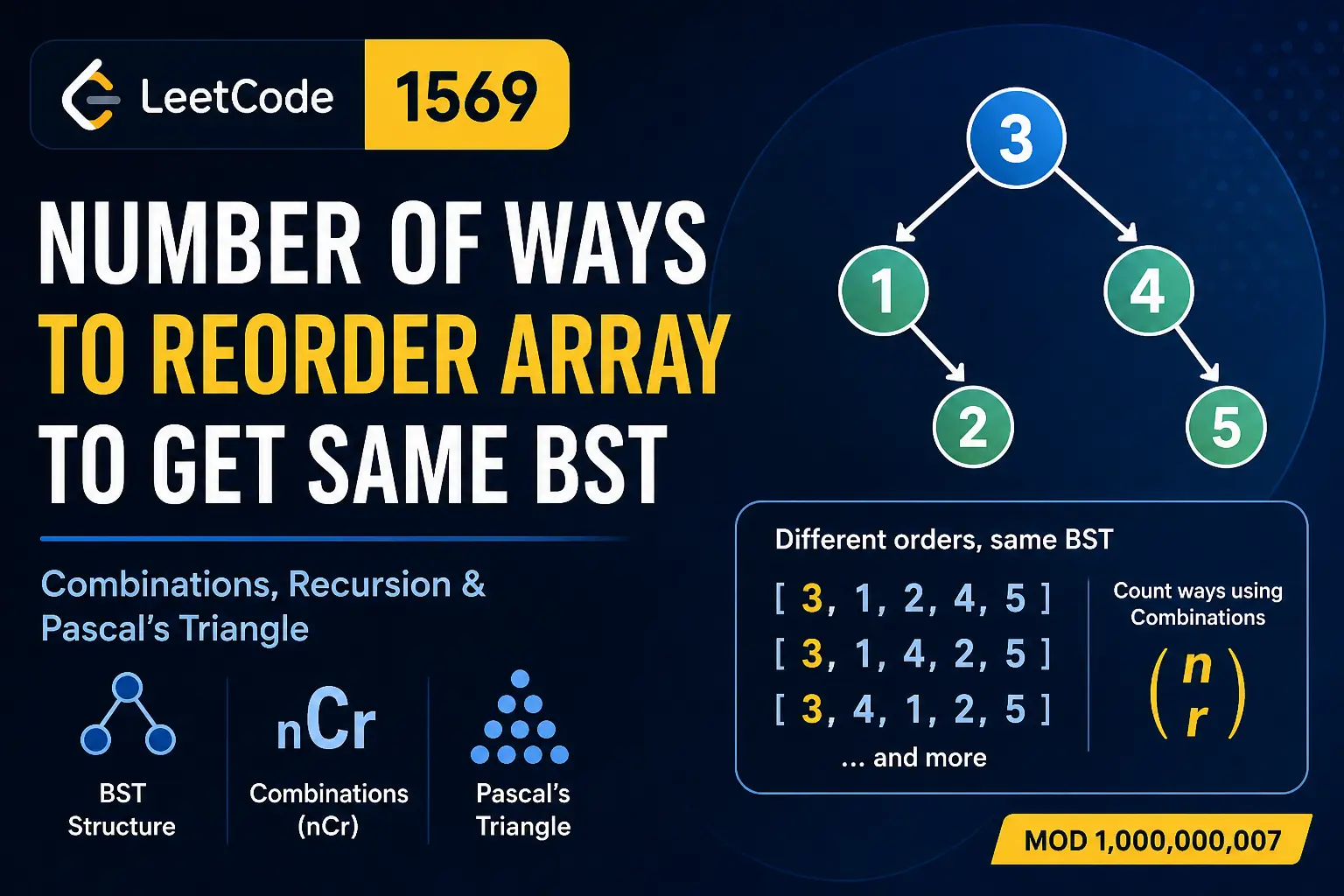
LeetCodeJavaArraysHashSetSubarraysBrute ForceEasy
LeetCode 1569: Number of Ways to Reorder Array to Get Same BST – Java Solution & Explanation

LeetCode 1569: Number of Ways to Reorder Array to Get Same BST – Java Solution & Explanation

IntroductionImagine inserting a sequence of numbers into a Binary Search Tree (BST). The first number becomes the root, smaller values move to the left subtree, and larger values move to the right subtree.Now consider an interesting question: Can the numbers be rearranged into a different order while producing exactly the same BST?The answer is yes.For example, the arrays [2, 1, 3] and [2, 3, 1] produce the same BST. The root remains 2, while 1 belongs to the left subtree and 3 belongs to the right subtree. The insertion order between those two subtrees can change without changing the final tree.This is the central idea behind LeetCode 1569 – Number of Ways to Reorder Array to Get Same BST.The challenge is that the number of possible reorderings can grow rapidly. Generating every permutation would be far too expensive. Instead, we can count valid arrangements mathematically using combinations, then combine those counts recursively for the left and right subtrees.There is one more problem: calculating combinations repeatedly using factorials can lead to unnecessary work and large intermediate numbers. Pascal’s Triangle provides a convenient way to precompute the required combination values.Let's build the solution from the beginning.Problem StatementProblem Link - Number of Ways to Reorder Array to Get Same BSTGiven an array nums containing a permutation of the integers from 1 to n, insert its elements in order into an initially empty BST.Return the number of different reorderings of nums that produce exactly the same BST as the original array.The original ordering itself is included in the total, but the answer must count only the other reorderings, so the original arrangement must be subtracted once.Since the answer may be large, return it modulo:1,000,000,007Example 1Input: nums = [2, 1, 3]Output: 1The original array creates this BST:2/ \1 3The array [2, 3, 1] creates the same tree.There are two valid arrangements in total, including the original one. After excluding the original ordering, the answer is 1.Example 2Input: nums = [3, 4, 5, 1, 2]Output: 5There are six valid arrangements in total, including the original sequence. Subtracting the original arrangement gives 5.Example 3Input: nums = [1, 2, 3]Output: 0The BST is a right-skewed tree. Every value must appear in increasing order to produce that same tree, so no alternative ordering exists.Step 1: The First Element Always Becomes the RootThe first observation comes directly from how a BST is constructed.Consider:nums = [3, 1, 2, 4, 5]The first element, 3, becomes the root.Every remaining value is divided into two groups:Values smaller than 3 go to the left subtree.Values greater than 3 go to the right subtree.The groups are:Left: [1, 2]Right: [4, 5]The resulting BST is:3/ \1 4\ \2 5The root must remain 3 in every valid reordering because the first inserted value determines the root.However, the left and right subtree elements do not necessarily need to appear in one fixed interleaving.For example, these sequences preserve the same relative order within each subtree:[3, 1, 2, 4, 5][3, 1, 4, 2, 5][3, 4, 1, 2, 5]The left-subtree sequence remains 1, 2, and the right-subtree sequence remains 4, 5.The elements from the two groups can be mixed together in different ways, provided that the relative insertion order within each group is preserved.This gives us the first major insight:Count the valid arrangements of the left subtree, count those of the right subtree, and then count the ways to interleave the two groups.Step 2: Why Do We Need Combinations (nCr)?Suppose a node has:L elements in its left subtree.R elements in its right subtree.After choosing the root, there are L + R remaining positions to fill.We need to choose which of those positions will contain the left-subtree elements. Once those positions are selected, the remaining positions automatically belong to the right subtree.The number of ways to choose L positions from L + R positions is: [(L+RL)][ \binom{L+R}{L} ][(LL+R​)] This is the familiar combinations formula, also written as nCr.The recursive count becomes: [ways=(L+RL)×waysLeft×waysRight][ ways = \binom{L+R}{L} \times waysLeft \times waysRight ][ways=(LL+R​)×waysLeft×waysRight] Here:waysLeft counts valid reorderings inside the left subtree.waysRight counts valid reorderings inside the right subtree.The combination term counts the possible interleavings of the two groups.All three factors are necessary.A small exampleConsider the tree formed by:nums = [2, 1, 3]There is one element on the left and one on the right.Therefore: [(21)=2][ \binom{2}{1}=2 ][(12​)=2] The two interleavings are:[1, 3][3, 1]Both produce the same BST when placed after root 2.Since each subtree contains only one element, each has exactly one valid arrangement.Thus: [ways=2×1×1=2][ ways = 2 \times 1 \times 1 = 2 ][ways=2×1×1=2] This count includes the original array. The final answer is: [2−1=1][ 2-1=1 ][2−1=1] The subtraction is performed only once, after the complete recursive count is calculated.Step 3: Calculating nCr EfficientlyNow we know how combinations fit into the solution. But how should the values of nCr be calculated?The mathematical formula is: [(nr)=n!r!(n−r)!][ \binom{n}{r}=\frac{n!}{r!(n-r)!} ][(rn​)=r!(n−r)!n!​] For example: [(42)=4!2!,2!=6][ \binom{4}{2}=\frac{4!}{2!,2!}=6 ][(24​)=2!,2!4!​=6] One approach is to calculate factorials repeatedly. However, the recursive solution needs combination values at many different subtree sizes. Recalculating factorials again and again adds unnecessary work.We can instead precompute all the required combinations using Pascal’s Triangle.The Pascal’s Triangle observationEvery value in Pascal’s Triangle is obtained by adding the two values directly above it: [(n−1r−1)+(n−1r)][\binom{n-1}{r-1} + \binom{n-1}{r} ][(r−1n−1​)+(rn−1​)] The boundary values are always 1: [(n0)=(nn)=1][ \binom{n}{0}=\binom{n}{n}=1 ][(0n​)=(nn​)=1] The first few rows look like this:11 11 2 11 3 3 11 4 6 4 11 5 10 10 5 1For example, the value 6 is calculated as:3 + 3 = 6It represents: [(42)=6][ \binom{4}{2}=6 ][(24​)=6] The same idea can be implemented using a two-dimensional list or array.Instead of calculating factorials whenever the recursive function needs a combination, we build the table once and look up the required value in constant time.How the submitted code builds the tableYour solution uses the list liss to store the rows of Pascal’s Triangle.for (int i = 0; i < nums.length; i++) {List<Integer> lis = new ArrayList<>();for (int j = 0; j < i + 1; j++) {if (i - 1 >= 0 && j - 1 >= 0 && j != i) {long sum = (liss.get(i - 1).get(j)+ liss.get(i - 1).get(j - 1));lis.add((int) (sum % mod));} else {lis.add(1);}}liss.add(new ArrayList<>(lis));}Each iteration builds one row.The first and last values of each row are 1. Every interior value is calculated by adding the two entries from the previous row.For instance, the row representing n = 4 contains:[1, 4, 6, 4, 1]So when the recursive function needs to choose positions for a left subtree of size 2 from a total of 4 elements, it can retrieve the value 6 directly.The table is built once before recursion begins.Step 4: Recursively Count the Left and Right SubtreesWith the combination table ready, the remaining work is recursive.Your sol() method starts by selecting the first element as the root:int root = nums.get(0);It then separates all remaining elements into two lists:List<Integer> left = new ArrayList<>();List<Integer> right = new ArrayList<>();for (int i = 1; i < n; i++) {if (nums.get(i) < root) {left.add(nums.get(i));} else {right.add(nums.get(i));}}Because the input contains distinct values, values smaller than the root belong to the left subtree, while larger values belong to the right subtree.For example:nums = [3, 4, 5, 1, 2]Root: 3Left: [1, 2]Right: [4, 5]Next, the function recursively counts the arrangements for both subtrees:long x = (sol(left)) % mod;long y = (sol(right)) % mod;The base case is:if (nums.size() <= 1) {return 1;}A subtree containing zero or one element has exactly one arrangement. There is nothing to reorder.Finally, the combination table is used to count the interleavings:long z = (liss.get(n - 1).get(left.size())) % mod;Here:n - 1 is the number of elements remaining after choosing the root.left.size() is the number of positions that must be assigned to the left subtree.z is the number of ways to choose those positions.The recursive result is then:return (int) ((((x * y) % mod) * z) % mod);In mathematical form: [ways=waysLeft×waysRight×(n−1leftSize)][ ways = waysLeft \times waysRight \times \binom{n-1}{leftSize} ][ways=waysLeft×waysRight×(leftSizen−1​)] The modulo operation keeps the intermediate result within manageable bounds.Complete Java SolutionThe following is the submitted solution, with formatting and explanatory comments added.class Solution {long mod = 1000000007;List<List<Integer>> liss = new ArrayList<>();public int sol(List<Integer> nums) {if (nums.size() <= 1) {return 1;}int root = nums.get(0);int n = nums.size();List<Integer> left = new ArrayList<>();List<Integer> right = new ArrayList<>();// Divide the remaining values by the current root.for (int i = 1; i < n; i++) {if (nums.get(i) < root) {left.add(nums.get(i));} else {right.add(nums.get(i));}}// Count valid arrangements of both subtrees.long x = sol(left) % mod;long y = sol(right) % mod;// Choose positions for the left-subtree elements.long z = liss.get(n - 1).get(left.size()) % mod;// Combine subtree arrangements and their interleavings.return (int) ((((x * y) % mod) * z) % mod);}public int numOfWays(int[] nums) {int n = nums.length;// Build Pascal's Triangle modulo 1,000,000,007.for (int i = 0; i < n; i++) {List<Integer> lis = new ArrayList<>();for (int j = 0; j <= i; j++) {if (i > 0 && j > 0 && j < i) {long sum = (long) liss.get(i - 1).get(j)+ liss.get(i - 1).get(j - 1);lis.add((int) (sum % mod));} else {lis.add(1);}}liss.add(lis);}List<Integer> num = new ArrayList<>();for (int value : nums) {num.add(value);}// Includes the original ordering.int ans = sol(num);// Exclude the original ordering.return ans - 1;}}Dry Run: How the Pieces Work TogetherConsider:nums = [2, 1, 3]1. Select the rootThe first element is 2.Root = 2Left = [1]Right = [3]2. Count the subtree arrangementsBoth subtrees contain one element.waysLeft = 1waysRight = 1The base case returns 1 for each subtree.3. Find the number of interleavingsThere are two remaining elements, and one belongs to the left subtree.The required combination is: [(21)=2][ \binom{2}{1}=2 ][(12​)=2] Pascal’s Triangle gives this value directly.4. Combine the results [ways=1×1×2=2][ ways = 1 \times 1 \times 2=2 ][ways=1×1×2=2] The two possible arrays are:[2, 1, 3][2, 3, 1]Both generate the same BST.5. Exclude the original orderingThe function initially counts all valid arrangements, including the input array.Therefore:Answer = 2 - 1 = 1The final output is 1, matching the expected result.Complexity AnalysisLet n be the length of nums.Building Pascal’s Triangle:There are (O(n^2)) entries, and each entry is calculated in constant time.Time: (O(n^2))Space: (O(n^2))Recursive BST counting:At each recursive call, the elements are divided into left and right lists. Across each level of the recursion, the elements processed total at most (n). In a highly unbalanced BST, the recursion can reach depth (n), and repeatedly scanning and copying the sublists can result in (O(n^2)) total work.Worst-case time: (O(n^2))Additional recursive and sublist space: up to (O(n^2)) across an unbalanced recursion, excluding the combination table.Therefore, the overall worst-case time complexity of this implementation is:O(n²)The Pascal’s Triangle table itself requires:O(n²) spaceThese bounds are suitable for the problem constraint of n <= 1000.Important Detail: Why Do We Subtract One?The recursive function counts all sequences that generate the same BST, including the original input sequence.However, the problem asks for the number of different reorderings, excluding the original ordering.That is why the final line is:return ans - 1;This subtraction should happen only once, after the full recursive count has been calculated. Subtracting one inside each recursive call would incorrectly exclude arrangements from individual subtrees.Interview TakeawayThis problem combines three ideas that are useful in more advanced algorithm questions:Recursive decomposition: The left and right subtrees can be solved independently.Combinatorics: The elements of the two subtrees can be interleaved in (\binom{L+R}{L}) ways.Dynamic programming: Pascal’s Triangle precomputes combination values so they can be reused instead of recalculated.The most important insight is that the left and right subtree sequences must each preserve their own relative order. Only their positions relative to one another can change.Once that restriction is understood, the counting formula follows naturally.ConclusionLeetCode 1569 looks difficult because it asks for the number of valid reorderings of an array, and the number of possible permutations grows extremely quickly.The solution becomes manageable when the problem is viewed through the structure of the BST. The first element fixes the root, smaller and larger elements form the left and right subtrees, and the two groups can be interleaved without changing the resulting tree.Recursion counts the valid arrangements inside each subtree, while combinations count the possible interleavings. Pascal’s Triangle makes those combination values available efficiently, and modular arithmetic keeps the calculations within the required range.The central formula to remember is:Ways =Left subtree ways× Right subtree ways× Ways to interleave both subtreesThis is the key to turning a seemingly enormous permutation problem into a structured recursive calculation.
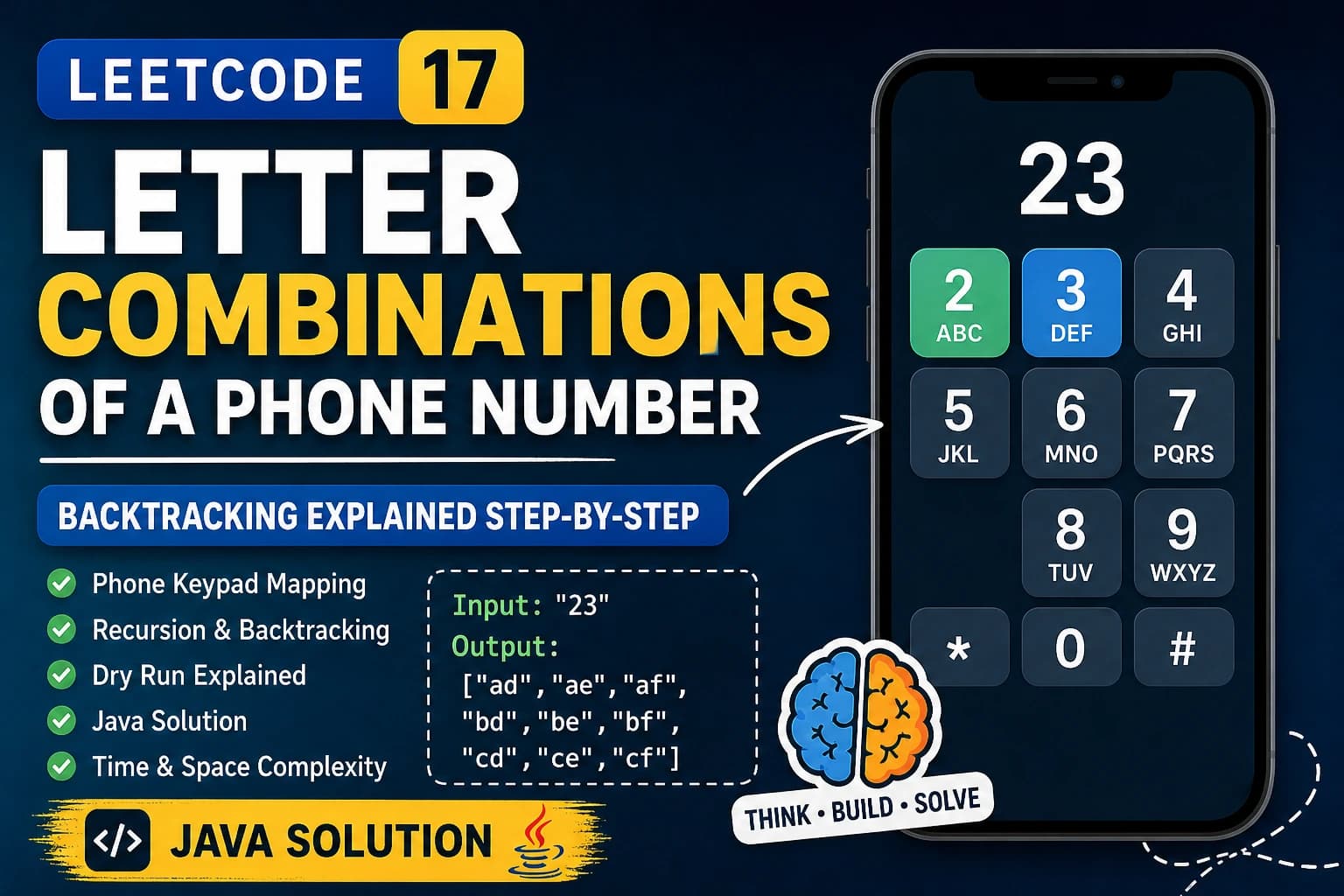
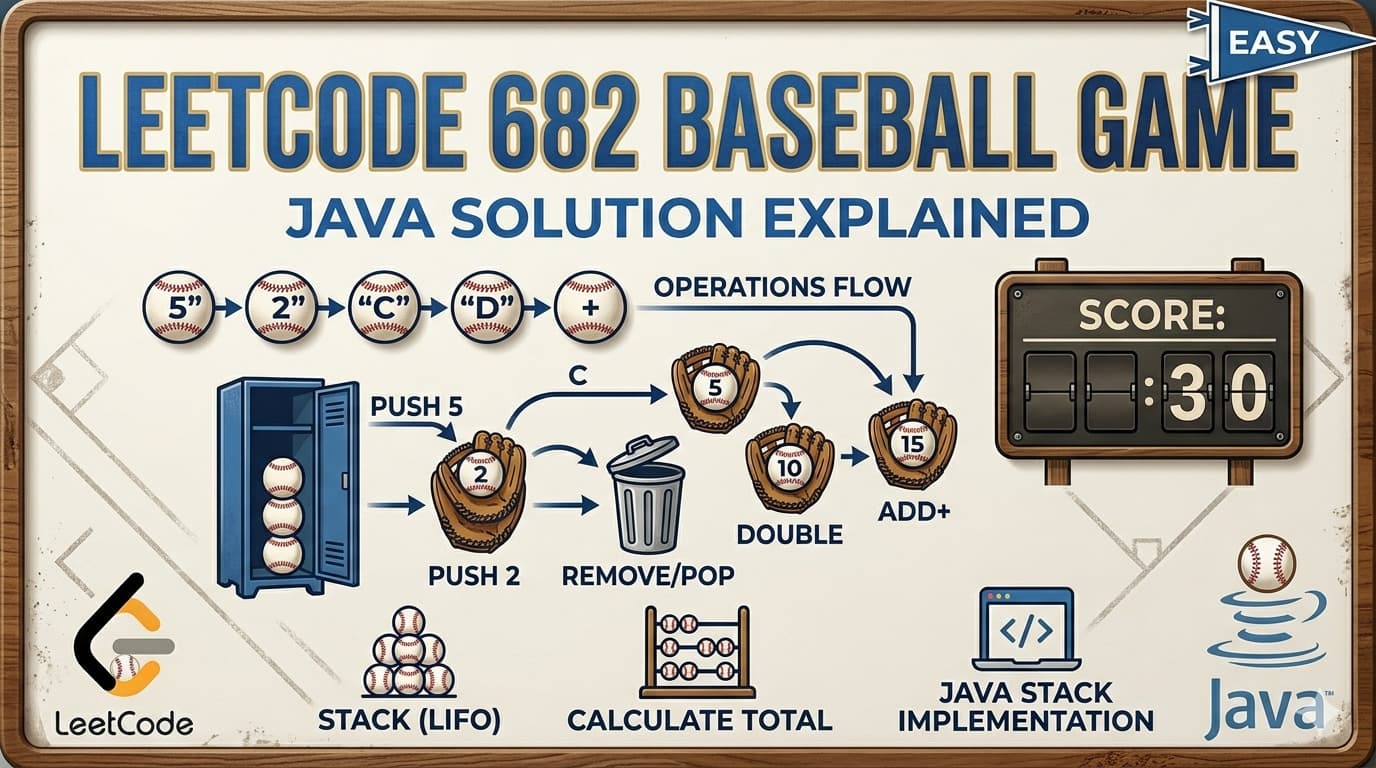
LeetCodeJavaBinary Search TreeBSTRecursionCombinatoricsPascal TriangleDynamic ProgrammingDSAHard
LeetCode 17: Letter Combinations of a Phone Number — Java Solution and Backtracking Explained

LeetCode 17: Letter Combinations of a Phone Number — Java Solution and Backtracking Explained

IntroductionHave you ever wondered how a phone number can represent multiple possible words? On a traditional telephone keypad, each digit from 2 to 9 is associated with three or four letters. For example, 2 represents a, b, and c, while 3 represents d, e, and f.Now imagine entering the digits "23". For every letter represented by 2, we can combine it with every letter represented by 3. This produces nine possible combinations, including "ad", "ae", "af", "bd", and "cf".This is the central idea behind LeetCode 17: Letter Combinations of a Phone Number. The challenge is to generate every possible combination without missing any valid result.In this article, we will explore a recursive Java solution, understand how the keypad mapping is built, and trace how the recursive calls generate the final list.Problem link: LeetCode 17 — Letter Combinations of a Phone NumberUnderstanding the ProblemYou are given a string digits containing numbers from 2 to 9. Each digit corresponds to a group of letters on a telephone keypad.Your task is to return all possible strings that can be formed by choosing exactly one letter for each digit.For example, if the input is "23":Digit 2 can contribute a, b, or c.Digit 3 can contribute d, e, or f.Each letter selected from the first group must be paired with every letter in the second group.The resulting combinations are:["ad", "ae", "af", "bd", "be", "bf", "cd", "ce", "cf"]The order of the returned combinations does not matter.One important detail is that the digits 0 and 1 are not included in the input constraints because they do not map to letters in this problem.Approach: Recursion with Phone Keypad MappingThe key observation is that each digit represents a choice, and recursion explores every available choice at the current position.For example, when processing "23", we first select a letter from digit 2. After that, we move to digit 3 and try all its letters. Once we have selected one letter for each digit, we have completed a valid combination.Our solution uses three main components.1. Build the digit-to-letter mappingWe create a list of character lists called arr.Each position represents a digit, and the corresponding list contains its letters. For instance:arr.get(2) contains a, b, c.arr.get(3) contains d, e, f.arr.get(7) contains p, q, r, s.arr.get(9) contains w, x, y, z.We begin with two empty lists at indices 0 and 1, so the mapping for a digit can be accessed directly using its numeric value.The variable charnum starts at 97, the ASCII value of lowercase a. We convert consecutive numeric values into characters and advance the counter by three or four letters, depending on the digit.This lets us construct the entire keypad mapping programmatically rather than writing each group manually.2. Recursively build each combinationThe helper method sol() receives four parameters:arr: the phone keypad mapping.ind: the current position in the input string.dig: the original digit string.sb: the combination constructed so far, represented as a string.At each recursive call, we examine the current digit and iterate over its available letters.For every letter, we make another recursive call with that letter appended to the current combination. This continues until every digit has contributed one letter.3. Stop when a complete combination is formedThe base condition is:if (sb.length() == dig.length())When the constructed string has the same length as the input digit string, we have selected one letter for every digit. We add that combination to the result list and return from the current call.The recursive process then continues exploring the remaining choices.This is the essential stopping condition that prevents the recursion from continuing beyond the number of input digits.Java SolutionHere is the recursive solution, preserving your approach while making two small improvements:Use a StringBuilder when adding a letter instead of repeatedly creating intermediate strings.Handle an empty input and keep the result list local to the method, so repeated calls do not accidentally reuse results from a previous invocation.import java.util.ArrayList;import java.util.List;class Solution {public void sol(List<List<Character>> arr,int ind,String digits,StringBuilder sb,List<String> lis) {if (ind == digits.length()) {lis.add(sb.toString());return;}int digit = digits.charAt(ind) - '0';for (char ch : arr.get(digit)) {sb.append(ch);sol(arr, ind + 1, digits, sb, lis);sb.deleteCharAt(sb.length() - 1);}}public List<String> letterCombinations(String digits) {List<String> lis = new ArrayList<>();if (digits.isEmpty()) {return lis;}List<List<Character>> arr = new ArrayList<>();arr.add(new ArrayList<>());arr.add(new ArrayList<>());int charnum = 97;for (int i = 0; i < 8; i++) {List<Character> li = new ArrayList<>();int count = (i == 5 || i == 7) ? 4 : 3;for (int j = 0; j < count; j++) {li.add((char) (charnum + j));}arr.add(li);charnum += count;}sol(arr, 0, digits, new StringBuilder(), lis);return lis;}}Why use StringBuilder and remove the last character?Your original code uses sb + arr.get(...).get(i) to create a new string for each recursive call. This is valid Java, but repeated string concatenation creates additional string objects.The improved version modifies a single StringBuilder:append(ch) adds the chosen letter.The recursive call explores the combinations that begin with that letter.deleteCharAt(sb.length() - 1) removes the letter after returning, allowing the next letter to be tried.This pattern is called backtracking. We make a choice, explore its consequences, and undo the choice before exploring another branch.It is especially useful when generating permutations, combinations, subsets, and other possible arrangements.Dry Run: digits = "23"Let's trace the recursion to see exactly how the combinations are generated.Initially, the current string is empty, and the current index is 0.Current choiceNext digit choiceCombination producedadadaeaeafafbdbdbebebfbfcdcdcececfcfThe process follows this sequence:Select a from digit 2.Explore all choices from digit 3, producing ad, ae, and af.Return to the first digit and replace a with b.Explore digit 3 again, producing bd, be, and bf.Repeat with c, producing cd, ce, and cf.The final result contains nine combinations.Why nine? The first digit has three choices, and the second digit also has three choices. Therefore, the total number of combinations is 3 × 3 = 9.Complexity AnalysisLet n be the length of the input string, and let R be the total number of generated combinations.Every digit has either three or four possible letters. The maximum number of combinations is therefore 4^n.Time complexity: O(n × R)There are R complete combinations, each containing n characters. Constructing and storing all these strings requires O(n × R) total time. Since R can be as large as 4^n, the worst-case time complexity is O(n × 4^n).Auxiliary space complexity: O(n)The recursion depth is at most n, and the StringBuilder holds at most n characters. The keypad mapping contains a fixed number of letters, so its space usage is constant with respect to the input length.Output space: O(n × R)The result list stores R strings, each of length n. This output memory is separate from the auxiliary space used by the algorithm.Because the constraints limit the input to at most four digits, the number of generated combinations remains small.Common Mistakes to Avoid1. Forgetting to advance to the next digitEvery recursive call must process the next position. If the index is not incremented, recursion will keep processing the same digit.2. Using an incorrect base conditionThe recursion should stop after processing all digits. Checking whether the current string has the same length as the input works, but checking ind == digits.length() directly makes the relationship between the index and the stopping condition clearer.3. Forgetting to undo a choiceWhen using a shared StringBuilder, remember to remove the character after the recursive call. Otherwise, letters from one branch may incorrectly carry over into another.4. Reusing a result list across separate callsIn your original implementation, lis is a class-level field. If the same Solution instance is used for multiple calls, previous results can remain in the list. Creating the result list inside letterCombinations() avoids this issue.5. Ignoring empty inputThe provided constraints guarantee at least one digit, but returning an empty list for an empty input is a useful defensive behavior. It also avoids accidentally treating the empty string as a valid result.Interview Tip: Recognize the Backtracking PatternWhenever a problem asks you to generate every possible arrangement from several groups of choices, consider recursion or backtracking.A useful way to design the solution is to ask:What choices are available at the current position?What state should be passed to the next recursive call?When is a complete answer formed?What needs to be undone before exploring the next choice?For this problem, the choices are the letters associated with the current digit, the state is the current combination and digit index, and a complete answer is reached after processing all digits.The same reasoning can help with problems such as generating subsets, permutations, combination sums, and other recursive search problems.ConclusionLeetCode 17, Letter Combinations of a Phone Number, is a useful introduction to recursive backtracking in Java. The phone keypad gives us a set of choices for every digit, and recursion explores every possible sequence of those choices.The most important part is not the keypad mapping itself. It is learning how to explore one choice completely, return to the previous state, and then try the next choice without mixing results between branches.Once this pattern becomes familiar, many combination-generation problems become easier to approach and explain in coding interviews.Key takeaway: Build the keypad mapping, choose one letter per digit, stop when every digit has been processed, and backtrack to explore the remaining possibilities.

LeetCodeJavaBacktrackingRecursionStringArrayListDSAMediumCombination
LeetCode 682 Baseball Game - Java Solution Explained

LeetCode 682 Baseball Game - Java Solution Explained

IntroductionLeetCode 682 Baseball Game is one of the cleanest and most beginner-friendly stack simulation problems on LeetCode. It does not require any fancy algorithm or deep insight — it purely tests whether you can carefully read the rules and simulate them faithfully using the right data structure.But do not let "Easy" fool you. This problem is a great place to practice thinking about which data structure fits best and why. We will solve it three different ways — Stack, ArrayList, and Deque — so you can see the tradeoffs and pick the one that makes most sense to you.You can find the problem here — LeetCode 682 Baseball Game.What Is the Problem Really Asking?You are keeping score for a baseball game with four special rules. You process a list of operations one by one and maintain a record of scores. At the end, return the total sum of all scores in the record.The four operations are:A number (like "5" or "-2") — just add that number as a new score to the record."C" — the last score was invalid, remove it from the record."D" — add a new score that is double the most recent score."+" — add a new score that is the sum of the two most recent scores.That is it. Four rules, simulate them in order, sum up what is left.Real Life Analogy — A Scoreboard With CorrectionsImagine a scoreboard operator at a sports event. They write scores on a whiteboard as the game progresses:A player scores 5 points → write 5Another player scores 2 → write 2Referee says last score was invalid → erase the last number (C)Special bonus rule kicks in → double the last valid score (D)Two scores combine → add the last two scores as one entry (+)At the end, add up everything on the whiteboard. The stack is your whiteboard — you write on top and erase from the top.Why Stack Is the Natural FitAll four operations only ever look at or modify the most recently added scores. C removes the last one. D doubles the last one. + uses the last two. This "most recent first" access pattern is the definition of LIFO — Last In First Out — which is exactly what a Stack provides.Any time a problem says "the previous score" or "the last two scores," your brain should immediately think Stack.Approach 1: Stack (Your Solution) ✅The IdeaUse a Stack of integers. For each operation:Number → parse and pushC → pop the topD → peek the top, push doubled value+ → pop top two, push both back, push their sumpublic int calPoints(String[] operations) { Stack<Integer> st = new Stack<>(); for (int i = 0; i < operations.length; i++) { String op = operations[i]; if (op.equals("C")) { st.pop(); // remove last score } else if (op.equals("D")) { st.push(st.peek() * 2); // double of last score } else if (op.equals("+")) { int prev1 = st.pop(); // most recent score int prev2 = st.pop(); // second most recent score int sum = prev1 + prev2; st.push(prev2); // put them back st.push(prev1); st.push(sum); // push the new score } else { st.push(Integer.parseInt(op)); // regular number } } // sum all remaining scores int total = 0; while (!st.empty()) { total += st.pop(); } return total;}One small improvement over your original solution — using op.equals("C") instead of op.charAt(0) == 'C'. This is cleaner and handles edge cases better since negative numbers like "-2" also start with - not a digit, so charAt(0) comparisons can get tricky. Using equals is always safer for string operations.Why the + Operation Needs Pop-Push-PopThe trickiest part is the + operation. You need the two most recent scores. Stack only lets you see the top. So you pop the first, then the second, compute the sum, then push both back before pushing the sum. This restores the record correctly — the previous two scores stay, and the new sum score is added on top.Detailed Dry Run — ops = ["5","2","C","D","+"]Let us trace every step carefully:"5" → number, parse and push Stack: [5]"2" → number, parse and push Stack: [5, 2]"C" → remove last score, pop Stack: [5]"D" → double last score, peek=5, push 10 Stack: [5, 10]"+" → sum of last two:pop prev1 = 10pop prev2 = 5sum = 15push prev2=5, push prev1=10, push sum=15 Stack: [5, 10, 15]Sum all: 5 + 10 + 15 = 30 ✅Detailed Dry Run — ops = ["5","-2","4","C","D","9","+","+"]"5" → push 5. Stack: [5]"-2" → push -2. Stack: [5, -2]"4" → push 4. Stack: [5, -2, 4]"C" → pop 4. Stack: [5, -2]"D" → peek=-2, push -4. Stack: [5, -2, -4]"9" → push 9. Stack: [5, -2, -4, 9]"+" → prev1=9, prev2=-4, sum=5. Push -4, 9, 5. Stack: [5, -2, -4, 9, 5]"+" → prev1=5, prev2=9, sum=14. Push 9, 5, 14. Stack: [5, -2, -4, 9, 5, 14]Sum: 5 + (-2) + (-4) + 9 + 5 + 14 = 27 ✅Approach 2: ArrayList (Most Readable)The IdeaArrayList gives you index-based access which makes the + operation much cleaner — no need to pop and push back. Just access the last two elements directly using size()-1 and size()-2.public int calPoints(String[] operations) { ArrayList<Integer> record = new ArrayList<>(); for (String op : operations) { int n = record.size(); if (op.equals("C")) { record.remove(n - 1); // remove last element } else if (op.equals("D")) { record.add(record.get(n - 1) * 2); // double last } else if (op.equals("+")) { // sum of last two — no need to remove and re-add! record.add(record.get(n - 1) + record.get(n - 2)); } else { record.add(Integer.parseInt(op)); } } int total = 0; for (int score : record) { total += score; } return total;}See how the + operation becomes a single line with ArrayList? record.get(n-1) + record.get(n-2) directly accesses the last two elements without any pop-push gymnastics.Dry Run — ops = ["5","2","C","D","+"]"5" → add 5. List: [5]"2" → add 2. List: [5, 2]"C" → remove last. List: [5]"D" → 5×2=10, add 10. List: [5, 10]"+" → get(0)+get(1) = 5+10=15, add 15. List: [5, 10, 15]Sum: 30 ✅Time Complexity: O(n) — single pass through operations Space Complexity: O(n) — ArrayList stores at most n scoresThe one tradeoff — remove(n-1) on an ArrayList is O(1) for the last element (no shifting needed). And get() is O(1). So this is fully O(n) overall and arguably the cleanest solution to read and understand.Approach 3: Deque (ArrayDeque — Fastest in Java)The IdeaArrayDeque is faster than Stack in Java because Stack is synchronized (thread-safe overhead) and ArrayDeque is not. For single-threaded LeetCode problems, ArrayDeque is always the better choice over Stack.public int calPoints(String[] operations) { Deque<Integer> deque = new ArrayDeque<>(); for (String op : operations) { if (op.equals("C")) { deque.pollLast(); // remove last } else if (op.equals("D")) { deque.offerLast(deque.peekLast() * 2); // double last } else if (op.equals("+")) { int prev1 = deque.pollLast(); int prev2 = deque.pollLast(); int sum = prev1 + prev2; deque.offerLast(prev2); // restore deque.offerLast(prev1); // restore deque.offerLast(sum); // new score } else { deque.offerLast(Integer.parseInt(op)); } } int total = 0; for (int score : deque) { total += score; } return total;}The logic is identical to the Stack approach. The only difference is the method names — offerLast instead of push, pollLast instead of pop, peekLast instead of peek.Time Complexity: O(n) Space Complexity: O(n)For iterating a Deque to sum, you can use a for-each loop directly — no need to pop everything out like with Stack.Approach ComparisonApproachTimeSpaceBest ForStackO(n)O(n)Classic interview answer, clear LIFO intentArrayListO(n)O(n)Cleanest code, easiest to readArrayDequeO(n)O(n)Best performance, preferred in productionAll three approaches have identical time and space complexity. The difference is purely in code style and readability. In an interview, any of these is perfectly acceptable. Mention that ArrayDeque is preferred over Stack in Java for performance if you want to impress.Why op.equals() Is Better Than op.charAt(0)Your original solution uses operations[i].charAt(0) == 'C' to check operations. This works but has a subtle risk — the + character check with charAt(0) is fine, but imagine if a future test had a number starting with C or D (it will not in this problem but defensive coding is a good habit). More importantly, "-2".charAt(0) is '-' which is fine, but using equals is semantically clearer — you are comparing the whole string, not just the first character. This shows cleaner coding habits in interviews.Edge Cases to KnowNegative numbers like "-2" Integer.parseInt("-2") handles negatives perfectly. The D operation on -2 gives -4. The + operation works correctly with negatives too. No special handling needed."C" after a "+" that added a score The problem guarantees C always has at least one score to remove. So after + adds a score, a C removes just that one new score — the previous two scores that + used remain intact. This is correct behavior and our solution handles it automatically.All scores removed If all operations are numbers followed by C operations removing every score, the stack ends up empty and the sum is 0. Our while loop handles this correctly — it simply never executes and returns 0.Only one operation A single number like ["5"] → push 5, sum is 5. Works fine.Common Mistakes to AvoidIn the + operation, forgetting to push both numbers back When you pop prev1 and prev2 to compute the sum, you must push them back onto the stack before pushing the sum. If you only push the sum without restoring prev1 and prev2, those scores disappear from the record permanently — which is wrong. The + operation only adds a new score, it does not remove the previous ones.Using charAt(0) comparison for detecting numbers Negative numbers start with -, not a digit. If you check charAt(0) >= '0' && charAt(0) <= '9' to detect numbers, you will miss negatives. The safest approach is to check for C, D, and + explicitly using equals, and fall through to the else for everything else (which covers both positive and negative numbers).Calling st.peek() or st.pop() without checking empty The problem guarantees valid operations — C always has something to remove, + always has two previous scores, D always has one. But in real code and defensive interview solutions, adding empty checks shows good habits even when the constraints guarantee safety.FAQs — People Also AskQ1. Why is Stack a good choice for LeetCode 682 Baseball Game? Because all four operations only access the most recently added scores — the last score for C and D, the last two for +. This "most recent first" access pattern is exactly what LIFO (Last In First Out) provides. Stack's push, pop, and peek all run in O(1) making it perfectly efficient.Q2. What is the time complexity of LeetCode 682? O(n) time where n is the number of operations. Each operation performs a constant number of stack operations (at most 3 pushes/pops for the + case). Space complexity is O(n) for storing scores.Q3. Why does the + operation need to pop and push back in the Stack approach? Stack only gives direct access to the top element. To get the second most recent score, you must pop the first one, peek/pop the second, then push the first one back. The ArrayList approach avoids this by using index-based access directly.Q4. What is the difference between Stack and ArrayDeque in Java for this problem? Both work correctly. ArrayDeque is faster because Stack is a legacy class that extends Vector and is synchronized (thread-safe), adding unnecessary overhead for single-threaded use. ArrayDeque has no synchronization overhead. For LeetCode and interviews, either is acceptable but ArrayDeque is technically better.Q5. Is LeetCode 682 asked in coding interviews? It appears occasionally as a warmup or screening problem. Its main value is testing whether you can carefully simulate rules without making logical errors — a skill that matters in systems programming, game development, and any domain with complex state management.Similar LeetCode Problems to Practice Next71. Simplify Path — Medium — stack simulation with path operations1047. Remove All Adjacent Duplicates In String — Easy — stack simulation735. Asteroid Collision — Medium — stack simulation with conditions150. Evaluate Reverse Polish Notation — Medium — stack with arithmetic operations, very similar pattern227. Basic Calculator II — Medium — stack with operator precedenceConclusionLeetCode 682 Baseball Game is a perfect problem to build confidence with stack simulation. The four operations are clearly defined, the rules are unambiguous, and the stack maps naturally to every operation. Once you understand why pop-push-back is needed for + in the stack approach and how ArrayList simplifies that with index access, you have genuinely understood the tradeoffs between these data structures.If you are newer to stacks, start with the ArrayList solution for clarity. Once that clicks, rewrite it with Stack to understand the LIFO mechanics. Then try ArrayDeque to understand why it is preferred in modern Java code.

LeetCodeJavaStackArrayListDequeEasy
Check if Binary String Has at Most One Segment of Ones – Java Solution (LeetCode 1784)

Check if Binary String Has at Most One Segment of Ones – Java Solution (LeetCode 1784)

Try the QuestionBefore reading the solution, try solving the problem yourself:👉 https://leetcode.com/problems/check-if-binary-string-has-at-most-one-segment-of-ones/Attempting the problem first helps build your problem-solving intuition, which is essential for coding interviews.Problem DescriptionYou are given a binary string s, which means the string contains only two characters:'0' and '1'The string does not contain leading zeros, meaning the first character is always 1.Your task is to determine whether the string contains at most one contiguous segment of 1s.If the string has only one continuous group of 1s, return:trueIf the string contains multiple separated groups of 1s, return:falseUnderstanding the Problem ClearlyThe key phrase in the problem is:"at most one contiguous segment of ones"A segment means a continuous block of characters without interruption.For example:111This is one segment of ones.But if 1s are separated by 0s and appear again later, then there are multiple segments.Example WalkthroughExample 1Inputs = "1001"Structure1 0 0 1Here we have:Segment 1 → "1"Segment 2 → "1"There are two separate segments of ones, which violates the condition.OutputfalseExample 2Inputs = "110"Structure1 1 0There is only one continuous block of ones.OutputtrueVisual IntuitionThe string is valid only if it follows this pattern:111111000000Meaning:[One block of 1s] + [any number of 0s]But the string becomes invalid if we see something like:111001011Because here:1s → stop → 0 → start again → 1Which means two segments of ones exist.Key ObservationSince the string starts with 1, the valid structure must look like:111...111000...000Once we encounter the first 0, we should never see 1 again.If we ever see:0 → followed by → 1then a new segment of ones has started, which means the answer is false.Intuition Behind the SolutionThe logic becomes very simple:Traverse the string from left to right.Keep track of the previous character.If we ever see the pattern:0 followed by 1then it means a new segment of ones has started, so return false.If we finish scanning the string without seeing this pattern, the string is valid.Java Implementationclass Solution { public boolean checkOnesSegment(String s) { if(s.length() == 1) return true; if(s.length() == 2 && s.charAt(1) == '1'){ return true; } if(s.length() == 2 && s.charAt(1) == '0'){ return true; } char prev = '0'; for(int i = 0; i < s.length() - 1; i++){ prev = s.charAt(i); if(s.charAt(i+1) == '1' && prev == '0'){ return false; } } return true; }}Step-by-Step Code Explanation1. Handle Small Edge CasesIf the string length is 1:"1"There is obviously only one segment, so we return:trueIf the string length is 2, both cases are valid:"11""10"Because neither creates multiple segments of ones.2. Traverse the StringWe loop through the string:for(int i = 0; i < s.length() - 1; i++)At every step, we compare:current characternext character3. Detect the Invalid PatternWe check this condition:if(s.charAt(i+1) == '1' && prev == '0')This means we found:0 → 1Which indicates a new segment of ones has started, so we return:false4. If No Violation is FoundIf we finish the loop without encountering the pattern:0 → 1then the string contains only one contiguous segment of ones, so we return:trueTime ComplexityO(n)Where:n = length of the stringWe traverse the string only once.Space ComplexityO(1)No extra space is used except a few variables.A Simpler Observation (Bonus Insight)A simpler trick for this problem is checking if the string contains:"01"Why?Because:111000 → validBut:1110011contains:01 → followed by another 1Which means a second segment of ones exists.Key Takeaways✔ Binary strings contain only 0 and 1✔ A segment means a continuous block✔ Valid strings contain only one block of ones✔ The invalid pattern is 0 followed by 1✔ The solution works with one linear scanFinal ThoughtsAlthough this problem is categorized as easy, it tests an important concept:Pattern detection while traversing strings.Problems like this are common in interviews because they evaluate:Logical reasoningEdge case handlingString traversal techniquesMastering such problems helps build a strong foundation for more complex string and pattern-matching algorithms.

LeetCodeJavaString ProblemsBinary StringsEasy
LeetCode 1254: Number of Closed Islands — Finding the Idea Before Writing the Code (Java)

LeetCode 1254: Number of Closed Islands — Finding the Idea Before Writing the Code (Java)

The Honest Beginning: I Understood the Question, but I Didn't Know How to Solve ItProblem: LeetCode 1254 — Number of Closed IslandsWhen I first read this question, I understood the basic meaning of the input. We have a grid containing 0s and 1s. Zero represents land, and one represents water.But understanding the input and knowing how to solve the problem are two completely different things.The question asks us to count closed islands. What exactly is an island here? How do we decide whether several zeroes belong to the same island? And how can we tell whether an island is closed?I didn't immediately think of DFS, recursion, or connected components. Honestly, I didn't even know which direction to take.So instead of jumping straight into a solution, let's start with something familiar and build the intuition from there.Step 1: Imagine Looking for Land on a MapImagine that you are looking at a small map made up of land and water.0 means land.1 means water.Suppose several pieces of land are touching each other horizontally or vertically. Even if that land occupies many grid cells, we consider it one connected island.For example, look at this grid:1 1 1 1 11 0 0 1 11 1 0 1 11 1 1 1 1There are three land cells, but they are not three separate islands.The two zeroes in the second row are connected. The zero directly below the second zero is also connected to them.Therefore, all three cells form one island.This gives us our first important observation:We should not count every zero individually. We need to discover groups of zeroes connected in four directions: up, down, left, and right.Notice that diagonal contact does not count. Two land cells touching only at their corners are not connected under this problem's rules.But we still haven't answered the most important question: how do we discover an entire group?Step 2: How Do We Explore All the Connected Land?Suppose we find a zero at position (1, 1).What should we do next?We can inspect its four neighboring cells:Left: (1, 0)Right: (1, 2)Up: (0, 1)Down: (2, 1)If a neighboring cell contains land, we should explore that cell too. Then we should inspect its neighbors, and continue until there is no more unvisited land connected to our starting point.Think about exploring a maze. You enter a room, check the available paths, enter another room, and continue exploring. Whenever you reach a dead end or a path you have already visited, you return and try another direction.That is very close to what recursion does.We can write a function that explores a cell and calls itself for the four neighboring cells. This technique is commonly called Depth-First Search (DFS).I initially found the recursive calls confusing because it felt as if the function would keep calling itself forever. The missing piece is that we need a way to remember which cells have already been explored.In this problem, we can use the grid itself.Whenever we visit a land cell, we change its value from 0 to 1. Since we have finished treating that cell as unvisited land, we won't explore it again.This prevents us from repeatedly visiting the same cells and getting stuck in an infinite recursive loop.Step 3: Exploring an Island Is Not Enough — Is It Closed?At this point, we can discover an island. But the problem doesn't ask us to count every island. It asks us to count only closed islands.Imagine two pieces of land.In the first case, land is surrounded by water on every side. It is completely enclosed.In the second case, some land reaches the edge of the map. This island is open because it is not completely surrounded by water.The important distinction is that an island touching the boundary of the grid cannot be closed.For example:1 1 1 1 11 0 0 1 11 1 0 1 11 1 1 1 1The island is surrounded by water, so it is closed.Now consider:0 0 1 1 11 0 0 1 11 1 1 1 1The land group touches the top edge of the grid. It is not closed, even though some of its cells have water around them.This gives us the second important observation:An island is closed only if none of its connected land cells touches the boundary of the grid.We now have the complete plan:Find an unvisited land cell.Explore every land cell connected to it.Determine whether that entire island touches the boundary.Count it only if it is closed.Continue looking for other unvisited islands.The remaining challenge is implementing this logic without losing information about whether the island is open or closed.Step 4: Translating the Idea into RecursionLet's design a recursive function called sol().It receives the grid and the current row and column. It returns a boolean:true means the explored land group is closed.false means the group touches the grid boundary and is not closed.The function needs to handle three situations.Case 1: We reach waterIf the current cell contains 1, we have reached water. This direction does not lead to additional land outside the island.We return true because this particular direction does not make the island open.Case 2: We reach the grid boundaryIf the current cell is land and lies on the outermost row or column, the island touches the boundary.That means the island is not closed, so this exploration must eventually return false.However, there is a subtle implementation detail here: we must still mark and explore the boundary-connected land correctly. If we stop immediately at the first boundary cell without exploring the rest of that connected group, some of the island's cells may remain unvisited. A later scan could then mistake part of that same open island for a separate closed island.We will address this in the final implementation.Case 3: We reach unvisited interior landThis is where recursion does the real work.We mark the current cell as visited by changing it to 1. Then we explore all four directions.The island is closed only if every direction confirms that it does not connect to the outside boundary.In boolean terms, the results must be combined using logical AND (&&).If even one path reaches boundary-connected land, the whole island is open.Step 5: Connecting the Recursive Function to the Main LoopWe need a way to start exploring islands.The simplest approach is to scan the grid using two nested loops.The outer loop moves through the rows, and the inner loop moves through the columns. Whenever we find an unvisited land cell, we call our recursive function.If the function confirms that the island is closed, we increment our answer.Why can we modify the grid instead of creating a separate visited matrix?Because the original problem only requires us to return the count. We don't need to preserve the original grid, so changing visited land into water is a convenient way to remember our progress.We also need to avoid counting the same island twice. Once an entire connected island has been explored and marked, its cells will no longer trigger another DFS call from the main loop.Java SolutionHere is the complete implementation. It follows the recursive DFS approach described above and handles boundary-connected islands correctly.class Solution {public boolean sol(int[][] grid, int row, int col) {// Reaching outside the grid means this island is open.if (row < 0 || row >= grid.length ||col < 0 || col >= grid[0].length) {return false;}// Water does not make the island open.if (grid[row][col] == 1) {return true;}// Mark this land cell as visited.grid[row][col] = 1;// Explore all four directions.boolean left = sol(grid, row, col - 1);boolean right = sol(grid, row, col + 1);boolean top = sol(grid, row - 1, col);boolean bottom = sol(grid, row + 1, col);return left && right && top && bottom;}public int closedIsland(int[][] grid) {int rows = grid.length;int cols = grid[0].length;int ans = 0;for (int i = 0; i < rows; i++) {for (int j = 0; j < cols; j++) {if (grid[i][j] == 0) {if (sol(grid, i, j)) {ans++;}}}}return ans;}}What changed from my first attempt?My original code checked whether the current cell was water before checking whether it was on the boundary. It also returned immediately when isperim() detected a boundary land cell.That creates a subtle problem: the boundary cell remains unvisited, and the DFS does not continue through it to explore the rest of the connected island. Consequently, land connected through the boundary can be left behind and potentially counted incorrectly later.The revised code uses a different strategy:It checks whether the coordinates are outside the grid before accessing grid[row][col].It treats water as a successful direction.It marks every visited land cell, including boundary land.It explores all four directions before combining their results.This ensures that the whole connected island is visited, even when it is open.One more detail matters: we store the results of all four recursive calls in separate variables. This is intentional. Writing a short-circuit expression that skips later calls after the first false could leave some cells unexplored.Step 6: Dry RunConsider this grid:1 1 1 1 11 0 0 1 11 1 0 1 11 1 1 1 1The main loop scans the grid until it finds the first zero at (1, 1).First, we start DFS at (1, 1).The cell is land, so we mark it as visited. The function explores its left, right, top, and bottom neighbors.The right neighbor (1, 2) is also land. The DFS visits it and explores its neighbors.The cell (2, 2) is land as well, so the exploration continues there.Eventually, every connected land cell has been visited.Next, we check the four directions.All paths eventually reach water or the outside of the grid through no unvisited land. Because no connected land cell reaches the boundary, the recursive result is true.We increment the answer:ans = 1The main loop continues scanning. Since the three land cells have already been changed to 1, they are not counted again.There are no other land cells, so the final answer is:1This small example demonstrates the entire mechanism: one DFS call discovers the complete island, marks it visited, and returns whether it is closed.A More Important Edge Case: One Island Touching the BoundaryConsider this grid:0 0 1 1 11 0 0 1 11 1 1 1 1The connected land group touches the top boundary.When DFS starts from one of its land cells, it will eventually reach a coordinate outside the grid. That recursive call returns false.The false result propagates through the recursive calls, so the complete island is classified as open and is not counted.Because the DFS still explores all four directions and marks every land cell, the main loop cannot later count another portion of this same island as a closed island.The answer is 0.This is why visiting the complete connected group matters just as much as deciding whether it is closed.Complexity AnalysisLet m be the number of rows and n be the number of columns.Time complexity: O(m × n)Each cell is visited at most once because every visited land cell is changed from 0 to 1. The grid scan also examines every cell. Therefore, the total time complexity is O(m × n).Auxiliary space complexity: O(m × n) in the worst case.The recursive DFS can reach a depth proportional to the number of cells if a large island is connected throughout the grid. The recursion call stack can therefore use O(m × n) space in the worst case.The algorithm modifies the input grid directly and does not require a separate visited matrix.What I Learned from This ProblemThe biggest lesson was that I didn't need to know the term “connected component” before starting. I needed to understand what the problem was asking me to discover.First, I noticed that individual zeroes were not the answer; groups of connected zeroes were. That led to the idea of exploring neighbors.Then I realized that exploring one neighbor should lead to exploring its neighbors too. Recursion gave me a way to express that repeated process.Finally, I understood that a closed island was not just a group of land cells. It was a group that never reached the boundary.The difficult part was not writing four recursive calls. It was making sure the function explored the entire island and correctly communicated whether any part of it touched the boundary.That distinction is worth remembering in future DFS problems: discovering a connected group and evaluating a property of that group are two related, but separate, tasks.Final TakeawayLeetCode 1254 becomes easier to reason about once we stop thinking of it as a mysterious graph problem and start thinking of it as exploring connected land on a map.Use DFS to explore the entire island.Mark visited land so it cannot be counted twice.Treat a path that reaches outside the grid as evidence that the island is open.Count an island only when every explored direction confirms that it is closed.If you struggled to find this approach on your first attempt, that is a normal part of learning DSA. The goal is not to recognize every pattern immediately. It is to learn how to turn an unfamiliar problem into a sequence of smaller, understandable decisions.

LeetCodeJavaRecursionBacktrackingMatrixDFSMedium
Single Number III

Single Number III

LeetCode Problem 260Link of the Problem to try -: LinkGiven an integer array nums, in which exactly two elements appear only once and all the other elements appear exactly twice. Find the two elements that appear only once. You can return the answer in any order.You must write an algorithm that runs in linear runtime complexity and uses only constant extra space. Example 1:Input: nums = [1,2,1,3,2,5]Output: [3,5]Explanation: [5, 3] is also a valid answer.Example 2:Input: nums = [-1,0]Output: [-1,0]Example 3:Input: nums = [0,1]Output: [1,0] Constraints:2 <= nums.length <= 3 * 104-231 <= nums[i] <= 231 - 1Each integer in nums will appear twice, only two integers will appear once.Solution:It is a very easy question if we only know about HashMap because it is clearly telling us about to create frequency and to return that number whose frequency is exactly 1 so that's why in this question not a very different or bug thing is there that we have to think about very much.Code: HashMap<Integer,Integer> mp = new HashMap<>(); int ans[] =new int[2]; for(int i=0;i<nums.length;i++){ mp.put(nums[i],mp.getOrDefault(nums[i],0)+1); } int co =0; for(int a:mp.keySet()){ if(mp.get(a) == 1){ ans[co] = a; co++; } } return ans;

LeetCodeMediumHashMapArray
The Voltage Regulator Problem: Find The Longest Stable Subarray With One Change – Java Solution

The Voltage Regulator Problem: Find The Longest Stable Subarray With One Change – Java Solution

The Problem: Keeping Our Servers StableImagine that you are a software engineer at KodeSword, responsible for a row of servers. Each server operates at a particular voltage, represented by an integer array called voltages.For safety, a group of neighboring servers is considered stable if the difference between its highest and lowest voltages is at most K.In simple terms:maximum voltage - minimum voltage <= KBut there is a twist. You have one voltage regulator that can change the voltage of any one server to any integer value you choose.Your task is to find the maximum length of a contiguous group of servers that can be made stable using the regulator at most once.You cannot rearrange the servers or select servers from different parts of the array. The group must remain contiguous.Example 1: Can We Save the Entire Group?Input:voltages = [2, 15, 6, 3]K = 4Output: 4Without changing anything, the maximum voltage is 15, and the minimum is 2.The difference is 15 - 2 = 13, which exceeds K = 4. Therefore, the entire group is initially unstable.But we have a regulator. What if we change the voltage 15 to 4?Before: [2, 15, 6, 3]After: [2, 4, 6, 3]Now the minimum is 2, and the maximum is 6.6 - 2 = 4The group is stable, and its length is 4. Since the array has only four elements, we cannot obtain a longer group.Answer: 4At first glance, this looks like a simple example. But how do we know which server to change when the array contains thousands of values? And how do we find the longest valid group without checking every possible subarray?That's where the actual problem-solving begins.Try It YourselfBefore reading the solution, take a moment to think about the problem.Can you find a way to determine whether a group can be made stable without trying every possible replacement voltage?Try to design an algorithm that works for an array of up to 100,000 elements.Start Challenge -: Let's Solve ItStep 1: What Does the Regulator Actually Change?At first, we might think we need to try many possible replacement values for every server.For example, if we choose the server with voltage 15, should we change it to 4, 5, 6, or something else?The key observation is that we do not need to try every possible replacement value.Suppose we temporarily ignore the server we want to change. If the remaining voltages have a maximum-minus-minimum difference of at most K, we can set the changed server's voltage to a value between their minimum and maximum.For our example:Original group: [2, 15, 6, 3]Ignore 15: [2, 6, 3]The remaining minimum is 2, and the maximum is 6.Their difference is 6 - 2 = 4, so replacing 15 with any integer between 2 and 6 makes the group stable.We are not actually deleting a server from the final answer. We are only ignoring its original voltage while checking whether a replacement can work.This transforms the problem into a simpler question:What is the longest contiguous subarray whose voltage range becomes at most K after ignoring at most one element?Step 2: Which Element Should We Change?Consider this group:[2, 6, 15, 18]Its range is 18 - 2 = 16.If K = 4, the group is unstable.Which element should we change?Changing a middle value such as 6 will not help because the minimum and maximum remain 2 and 18.Therefore, if the range exceeds K, we only need to consider two possibilities:Change the minimum voltage.Change the maximum voltage.If neither the minimum nor the maximum is changed, the range stays exactly the same.For [2, 6, 15, 18]:Change the minimum: the remaining range is 18 - 6 = 12.Change the maximum: the remaining range is 15 - 2 = 13.Neither is at most 4, so the group cannot be fixed with one adjustment.This observation helps us avoid testing every element in the group.Step 3: What If an Extreme Value Appears Multiple Times?Consider:[2, 2, 6, 15]If we change one occurrence of 2, another 2 remains. The minimum does not change.Similarly, changing one occurrence of a repeated maximum leaves the other occurrence in the group.Therefore, when the range exceeds K, changing the minimum can help only if the minimum occurs exactly once. The same rule applies to the maximum.We also need to know the next distinct minimum or maximum after changing a unique extreme.For example:[2, 6, 15, 18]If we ignore 2, the next minimum is 6. If we ignore 18, the next maximum is 15.This is why tracking only the current minimum and maximum is not enough. We also need their frequencies and access to the next distinct values.Step 4: Use a Sliding WindowWe want the longest valid contiguous group, so let's maintain a window with a left boundary and a right boundary.Start with an empty window. Move the right boundary forward one element at a time, adding each new voltage.After adding a value, check whether the current window can be made stable.If it can, keep expanding.If it cannot, move the left boundary forward until the window becomes valid again.For the original example:voltages = [2, 15, 6, 3]K = 4The window grows as follows:[2] is valid without any adjustment.[2, 15] can be fixed by changing one of its values.[2, 15, 6] can be fixed by changing 15.[2, 15, 6, 3] can also be fixed by changing 15 to 4.The final window has length 4.An important property makes this approach work: if a window is valid, every smaller contiguous window inside it is also valid. We can always keep the same replacement if the changed element remains in the smaller window, or leave the smaller window unchanged if it does not.This allows us to shrink invalid windows instead of starting over.Step 5: Maintain the Window With a TreeMapWe need to efficiently track:The minimum voltage.The maximum voltage.The frequency of each extreme.The next distinct minimum and maximum.Java's TreeMap stores keys in sorted order and keeps a count for each voltage.For example, the window [2, 6, 6, 15] can be represented as:Voltage: 2 6 15Count: 1 2 1The first key is the minimum, and the last key is the maximum.The higherKey() method retrieves the next distinct key above a given value. The lowerKey() method retrieves the previous distinct key below a given value.Whenever a voltage enters or leaves the window, we update its count. If its count becomes zero, we remove that key from the map.This gives us the information required to check whether the window is valid.Java Solutionimport java.util.TreeMap;class Solution {private boolean isValid(TreeMap<Integer, Integer> map, int k) {int min = map.firstKey();int max = map.lastKey();// Already stable.if ((long) max - min <= k) {return true;}// Try changing the unique minimum.if (map.get(min) == 1) {int secondMin = map.higherKey(min);if ((long) max - secondMin <= k) {return true;}}// Try changing the unique maximum.if (map.get(max) == 1) {int secondMax = map.lowerKey(max);if ((long) secondMax - min <= k) {return true;}}return false;}public int maxStableGroup(int[] voltages, int k) {TreeMap<Integer, Integer> map = new TreeMap<>();int left = 0;int ans = 0;for (int right = 0; right < voltages.length; right++) {int value = voltages[right];map.put(value, map.getOrDefault(value, 0) + 1);while (!isValid(map, k)) {int removed = voltages[left];map.put(removed, map.get(removed) - 1);if (map.get(removed) == 0) {map.remove(removed);}left++;}ans = Math.max(ans, right - left + 1);}return ans;}}The method name maxStableGroup is specific to this custom problem. If you use the solution on a platform that requires a particular method signature, adjust the name and parameters accordingly.Additional Test Cases: Can You Predict the Output?Try these examples before reading their explanations. They cover a single extreme value, decreasing values, an already-stable array, and repeated spikes.Test Case 2: One Extreme Voltage SurgeInput:voltages = [10, 12, 100, 11, 13]K = 3Output: 5The value 100 creates a range that is too large. But we can change that single value to 12:[10, 12, 12, 11, 13]The maximum is 13, and the minimum is 10.13 - 10 = 3The entire array is stable, so the answer is 5.Think about it: What makes this case easier than the next one? There is only one extreme value that needs to be corrected.Test Case 3: Decreasing VoltagesInput:voltages = [50, 40, 30, 20, 10]K = 15Output: 3Consider the first three elements:[50, 40, 30]Their range is 50 - 30 = 20, which exceeds 15.We can change 50 to 35, giving:[35, 40, 30]Now the range is 40 - 30 = 10, which is valid. The group has length 3.We can also select [40, 30, 20] or [30, 20, 10], each of which has a range of 20. Changing one extreme can make either group valid.No group of length 4 can be made stable with just one adjustment, so the answer is 3.Think about it: The values are already ordered. Does that mean we can skip checking whether the group is valid? No. We still need to consider the range and the single permitted adjustment.Test Case 4: No Regulator NeededInput:voltages = [5, 7, 6, 8, 5, 7]K = 5Output: 6The entire array has a minimum of 5 and a maximum of 8.8 - 5 = 3Since 3 <= 5, the entire array is already stable. We don't need to use the regulator.The answer is 6, the full array length.Think about it: The regulator is available, but does that mean we must use it? No. The problem allows us to use it at most once.Test Case 5: Alternating Voltage SpikesInput:voltages = [1, 20, 2, 20, 3, 20]K = 2Output: 3Consider the first three elements:[1, 20, 2]We can change 20 to 2, giving:[1, 2, 2]The range is 2 - 1 = 1, which is valid. Therefore, a group of length 3 is possible.Now consider a window of length 4:[1, 20, 2, 20]There are two occurrences of 20. Changing only one of them leaves the other 20 in the group, and the range remains too large.No length-four window in this array can be made stable with one adjustment. Therefore, the maximum length is 3.Think about it: Why does the regulator fail here even though the array contains a fixable three-element group? Because one adjustment cannot eliminate two extreme spikes.Complexity AnalysisLet N be the length of the array.Time complexity: O(N log N)Each element enters the sliding window once and leaves it at most once. Updating the TreeMap takes O(log N) time, and checking the window's validity also takes O(log N) time.Therefore, the overall time complexity is O(N log N).Auxiliary space complexity: O(N)In the worst case, the TreeMap can store up to N distinct voltage values.Final TakeawayThe most important part of this problem is understanding what the regulator can actually fix.If the range is already within K, we keep the window. Otherwise, changing a middle value cannot reduce the range. We need to check whether changing the unique minimum or maximum makes the remaining range valid.A TreeMap helps us track those extreme values, while a sliding window lets us find the longest valid contiguous group efficiently.The broader lesson is simple: when a problem allows one modification, first ask which part of the condition that modification can affect. A good observation can eliminate a huge number of unnecessary possibilities.

JavaSliding WindowArraysTreeMapDSA
Find First and Last Position in Sorted Array – From Brute Force to Binary Search (LeetCode 34)

Find First and Last Position in Sorted Array – From Brute Force to Binary Search (LeetCode 34)

Problem LinkLeetCode 34 – Find First and Last Position of Element in Sorted Array 👉 https://leetcode.com/problems/find-first-and-last-position-of-element-in-sorted-array/📌 Problem OverviewYou are given a sorted array (non-decreasing order) and a target value.Your task:Return the starting and ending index of the target.If target does not exist → return [-1, -1]Required Time Complexity: O(log n)Example 1Input: nums = [5,7,7,8,8,10], target = 8 Output: [3,4]Example 2Input: nums = [5,7,7,8,8,10], target = 6 Output: [-1,-1]🧠 My First Intuition – Brute Force (O(n))When I first saw this problem, my thinking was simple:"Since the array is sorted, I just need to find the first occurrence and the last occurrence."So I used two loops:One loop from left → to find first occurrenceOne loop from right → to find last occurrenceHere is my submitted solution:class Solution { public int[] searchRange(int[] nums, int t) { int arr[] = new int[2]; arr[0] = -1; arr[1] = -1; for(int i = nums.length-1;i >=0 ;i--){ if(nums[i] == t){ arr[1] = i; break; } } for(int i = 0;i <nums.length ;i++){ if(nums[i] == t){ arr[0] = i; break; } } return arr; }}✅ Why This WorksSince the array is sorted, occurrences of the same number are grouped together.First loop (reverse) finds last occurrence.Second loop (forward) finds first occurrence.❌ Problem with This ApproachTime Complexity = O(n)Worst case:Target is not presentWe scan entire array twiceBut the problem clearly states:You must write an algorithm with O(log n) runtime complexity.That means: We must use Binary Search.🚀 Optimized Approach – Binary Search (O(log n))💡 Key IntuitionIf the array is sorted:We can use Binary Search to find the first occurrenceWe can use Binary Search again to find the last occurrenceInstead of stopping when we find the target:For first occurrence → continue searching leftFor last occurrence → continue searching right🧠 Idea Breakdown1️⃣ Find First OccurrenceWhen we find target at mid:Store indexMove left → high = mid - 1Because there might be another occurrence before it2️⃣ Find Last OccurrenceWhen we find target at mid:Store indexMove right → low = mid + 1Because there might be another occurrence after it💻 Optimized Code (Binary Search Approach)class Solution { public int[] searchRange(int[] nums, int target) { int[] result = new int[2]; result[0] = findFirst(nums, target); result[1] = findLast(nums, target); return result; } private int findFirst(int[] nums, int target) { int low = 0, high = nums.length - 1; int index = -1; while (low <= high) { int mid = low + (high - low) / 2; if (nums[mid] == target) { index = mid; high = mid - 1; // move left } else if (nums[mid] < target) { low = mid + 1; } else { high = mid - 1; } } return index; } private int findLast(int[] nums, int target) { int low = 0, high = nums.length - 1; int index = -1; while (low <= high) { int mid = low + (high - low) / 2; if (nums[mid] == target) { index = mid; low = mid + 1; // move right } else if (nums[mid] < target) { low = mid + 1; } else { high = mid - 1; } } return index; }}🔍 Why This WorksBinary Search normally stops when target is found.Here, we modify it slightly:Keep searching even after finding target.Narrow the search space toward the boundary we want.This guarantees:First occurrence → leftmost indexLast occurrence → rightmost index⏱ Complexity AnalysisBrute Force ApproachTime: O(n)Space: O(1)Binary Search ApproachTime: O(log n)Space: O(1)This satisfies the problem constraint.🎯 Key Learning from This ProblemThis problem teaches an important pattern:When array is sorted and you need boundaries → Think Binary Search.It is not just about finding the element.It is about finding:First occurrence (Lower Bound)Last occurrence (Upper Bound)This pattern appears in many interview problems.📚 Similar Problems to Practicehttps://leetcode.com/problems/binary-search/https://leetcode.com/problems/search-insert-position/https://leetcode.com/problems/search-in-rotated-sorted-array/https://leetcode.com/problems/find-minimum-in-rotated-sorted-array/https://leetcode.com/problems/sqrtx/🏁 Final ThoughtsMy journey solving this problem:First thought → Use two loops (works but O(n))Then realized constraint → Must be O(log n)Optimized using two Binary SearchesThis is how problem solving improves:Start with correct solution.Then optimize.Then recognize patterns.LeetCode 34 is one of the most important Binary Search boundary problems.If you master this, you unlock an entire category of advanced Binary Search questions.

Binary SearchLeetCodeMedium
Left and Right Sum Differences

Left and Right Sum Differences

LeetCode 2574: Left and Right Sum Differences (Java)The Left and Right Sum Difference problem is a classic array manipulation challenge. It tests your ability to efficiently calculate prefix and suffix values—a skill essential for more advanced algorithms like "Product of Array Except Self."🔗 ResourcesProblem Link: LeetCode 2574 - Left and Right Sum Differences📝 Problem StatementYou are given a 0-indexed integer array nums. You need to return an array answer of the same length where:answer[i] = |leftSum[i] - rightSum[i]|leftSum[i] is the sum of elements to the left of index i.rightSum[i] is the sum of elements to the right of index i.💡 Approach 1: The Three-Array Method (Beginner Friendly)This approach is highly intuitive. We pre-calculate all left sums and all right sums in separate arrays before computing the final difference.The LogicPrefix Array: Fill pref[] by adding the previous element to the cumulative sum.Suffix Array: Fill suff[] by iterating backward from the end of the array.Result: Loop one last time to calculate Math.abs(pref[i] - suff[i]).Java Implementationpublic int[] leftRightDifference(int[] nums) {int n = nums.length;int[] pref = new int[n];int[] suff = new int[n];int[] ans = new int[n];// Calculate Left Sums (Prefix)for (int i = 1; i < n; i++) {pref[i] = pref[i - 1] + nums[i - 1];}// Calculate Right Sums (Suffix)for (int i = n - 2; i >= 0; i--) {suff[i] = suff[i + 1] + nums[i + 1];}// Combine resultsfor (int i = 0; i < n; i++) {ans[i] = Math.abs(pref[i] - suff[i]);}return ans;}Time Complexity: O(n)Space Complexity: O(n) (Uses extra space for pref and suff arrays).🚀 Approach 2: The Running Sum Method (Space Optimized)In technical interviews, you should aim for O(1) extra space. Instead of storing every suffix sum, we calculate the Total Sum first and derive the right sum using logic.The LogicWe use the mathematical property:Right Sum = Total Sum - Left Sum - Current ElementBy maintaining a single variable leftSum that updates as we iterate, we can calculate the result using only the output array.Java Implementationpublic int[] leftRightDifference(int[] nums) {int n = nums.length;int[] ans = new int[n];int totalSum = 0;int leftSum = 0;// 1. Get the total sum of all elementsfor (int num : nums) {totalSum += num;}// 2. Calculate rightSum and difference on the flyfor (int i = 0; i < n; i++) {int rightSum = totalSum - leftSum - nums[i];ans[i] = Math.abs(leftSum - rightSum);// Update leftSum for the next indexleftSum += nums[i];}return ans;}Time Complexity: O(n)Space Complexity: O(1) (Excluding the output array).📊 Summary ComparisonFeatureApproach 1Approach 2Space ComplexityO(n) (Higher)O(1) (Optimal)Logic TypeStorage-basedMathematicalUse CaseBeginnersInterviewsKey TakeawayWhile Approach 1 is easier to visualize, Approach 2 is more professional. It shows you can handle data efficiently without unnecessary memory allocation, which is critical when dealing with large-scale systems.

LeetCodePrefixSuffix
LeetCode 2390: Removing Stars From a String — Java Solution With All Approaches Explained

LeetCode 2390: Removing Stars From a String — Java Solution With All Approaches Explained

Introduction: What Is LeetCode 2390 Removing Stars From a String?If you are preparing for coding interviews at companies like Google, Amazon, or Microsoft, LeetCode 2390 Removing Stars From a String is a must-solve problem. It tests your understanding of the stack data structure and string manipulation — two of the most frequently tested topics in technical interviews.In this article, we will cover:What the problem is asking in plain English3 different Java approaches (Brute Force, Stack, StringBuilder)Step-by-step dry run with examplesTime and space complexity for each approachCommon mistakes to avoidFAQs that appear in Google's People Also AskLet's dive in!Problem Statement SummaryYou are given a string s containing lowercase letters and stars *. In one operation:Choose any * in the stringRemove the * itself AND the closest non-star character to its leftRepeat until all stars are removed and return the final string.Example:Input: s = "leet**cod*e"Output: "lecoe"Real Life Analogy — Think of It as a Backspace KeyImagine you are typing on a keyboard. Every * acts as your backspace key — it deletes itself and the character just before it.You type "leet" and press backspace twice:Backspace 1 → deletes t → "lee"Backspace 2 → deletes e → "le"That is exactly what this problem simulates! Once you see it this way, the solution becomes very obvious.Approach 1: Brute Force Simulation (Beginner Friendly)IdeaDirectly simulate the process the problem describes:Scan the string from left to rightFind the first *Remove it and the character just before itRepeat until no stars remainJava Codepublic String removeStars(String s) {StringBuilder sb = new StringBuilder(s);int i = 0;while (i < sb.length()) {if (sb.charAt(i) == '*') {sb.deleteCharAt(i); // remove the starif (i > 0) {sb.deleteCharAt(i - 1); // remove closest left characteri--;}} else {i++;}}return sb.toString();}Time and Space ComplexityComplexityValueReasonTimeO(n²)Each deletion shifts all remaining charactersSpaceO(n)StringBuilder storage⚠️ Important WarningThis problem has n up to 100,000. Brute force will get Time Limit Exceeded (TLE) on LeetCode. Use this only to understand the concept, never in production or interviews.Approach 2: Stack Based Solution (Interview Favorite)IdeaA stack is the perfect data structure here because:We always remove the most recently added letter when a * appearsThat is the definition of Last In First Out (LIFO) — exactly what a stack doesAlgorithm:Letter → push onto stack* → pop from stack (removes closest left character)At the end, build result from stack contentsJava Codepublic String removeStars(String s) {Stack<Character> st = new Stack<>();for (int i = 0; i < s.length(); i++) {char c = s.charAt(i);if (c == '*') {if (!st.empty()) {st.pop();}} else {st.push(c);}}StringBuilder sb = new StringBuilder();while (!st.empty()) {sb.append(st.pop());}return sb.reverse().toString();}Step-by-Step Dry Run — "leet**cod*e"StepCharacterActionStack State1lpush[l]2epush[l,e]3epush[l,e,e]4tpush[l,e,e,t]5*pop t[l,e,e]6*pop e[l,e]7cpush[l,e,c]8opush[l,e,c,o]9dpush[l,e,c,o,d]10*pop d[l,e,c,o]11epush[l,e,c,o,e]✅ Final Answer: "lecoe"Time and Space ComplexityComplexityValueReasonTimeO(n)Single pass through the stringSpaceO(n)Stack holds up to n charactersApproach 3: StringBuilder as Stack (Optimal Solution) ✅IdeaThis is the best and most optimized approach. A StringBuilder can act as a stack:append(c) → works like pushdeleteCharAt(sb.length() - 1) → works like popNo reverse needed at the end unlike the Stack approachJava Codepublic String removeStars(String s) {StringBuilder sb = new StringBuilder();for (int i = 0; i < s.length(); i++) {char c = s.charAt(i);if (c == '*') {if (sb.length() > 0) {sb.deleteCharAt(sb.length() - 1);}} else {sb.append(c);}}return sb.toString();}Step-by-Step Dry Run — "erase*****"StepCharacterActionStringBuilder1eappend"e"2rappend"er"3aappend"era"4sappend"eras"5eappend"erase"6*delete last"eras"7*delete last"era"8*delete last"er"9*delete last"e"10*delete last""✅ Final Answer: ""Why StringBuilder Beats Stack in JavaFactorStack<Character>StringBuilderMemoryBoxes char → Character objectWorks on primitives directlyReverse neededYesNoCode lengthMore verboseCleaner and shorterPerformanceSlightly slowerFasterTime and Space ComplexityComplexityValueReasonTimeO(n)One pass, each character processed onceSpaceO(n)StringBuilder storageAll Approaches Comparison TableApproachTimeSpacePasses LeetCode?Best ForBrute ForceO(n²)O(n)❌ TLEUnderstanding conceptStackO(n)O(n)✅ YesInterview explanationStringBuilderO(n)O(n)✅ YesBest solutionHow This Relates to LeetCode 3174 Clear DigitsIf you have already solved LeetCode 3174 Clear Digits, you will notice this problem is nearly identical:Feature3174 Clear Digits2390 Removing StarsTriggerDigit 0-9Star *RemovesClosest left non-digitClosest left non-starDifficultyEasyMediumBest approachStringBuilderStringBuilderThe exact same solution pattern works for both. This is why learning patterns matters more than memorizing individual solutions!Common Mistakes to Avoid1. Not checking sb.length() > 0 before deleting Even though the problem guarantees valid input, always add this guard. It shows clean, defensive coding in interviews.2. Forgetting to reverse when using Stack Stack gives you characters in reverse order. If you forget .reverse(), your answer will be backwards.3. Using Brute Force for large inputs With n up to 100,000, O(n²) will time out. Always use the O(n) approach.FAQs — People Also AskQ1. What data structure is best for LeetCode 2390? A Stack or StringBuilder used as a stack is the best data structure. Both give O(n) time complexity. StringBuilder is slightly more optimal in Java because it avoids object boxing overhead.Q2. Why does a star remove the closest left character? Because the problem defines it that way — think of * as a backspace key on a keyboard. It always deletes the character immediately before the cursor position.Q3. What is the time complexity of LeetCode 2390? The optimal solution runs in O(n) time and O(n) space, where n is the length of the input string.Q4. Is LeetCode 2390 asked in Google interviews? Yes, this type of stack simulation problem is commonly asked at Google, Amazon, Microsoft, and Meta interviews as it tests understanding of LIFO operations and string manipulation.Q5. What is the difference between LeetCode 2390 and LeetCode 844? Both use the same backspace simulation pattern. In 844 Backspace String Compare, # is the backspace character and you compare two strings. In 2390, * is the backspace and you return the final string.Similar LeetCode Problems to Practice NextProblemDifficultyPattern844. Backspace String CompareEasyStack simulation1047. Remove All Adjacent Duplicates In StringEasyStack simulation3174. Clear DigitsEasyStack simulation20. Valid ParenthesesEasyClassic stack735. Asteroid CollisionMediumStack simulationConclusionLeetCode 2390 Removing Stars From a String is a classic stack simulation problem that every developer preparing for coding interviews should master. The key insight is recognizing that * behaves exactly like a backspace key, which makes a stack or StringBuilder the perfect tool.Quick Recap:Brute force works conceptually but TLEs on large inputsStack solution is clean and great for explaining in interviewsStringBuilder solution is the most optimal in Java — no boxing, no reversal

StringStackMediumLeetCode
LeetCode 55: Jump Game – Java Greedy Solution with Explanation and Dry Run

LeetCode 55: Jump Game – Java Greedy Solution with Explanation and Dry Run

Problem StatementYou are given an integer array nums, where nums[i] represents the maximum number of steps you can jump forward from index i.You start at the first index of the array.Your task is to determine whether you can reach the last index.Return true if the last index is reachable; otherwise, return false.Problem Link -: Jump GameExample 1Input: nums = [2,3,1,1,4]Output: trueOne possible sequence is:Index 0 → Index 1 → Index 4From index 0, we can jump up to 2 positions.From index 1, we can jump up to 3 positions, which allows us to reach the last index.Example 2Input: nums = [3,2,1,0,4]Output: falseWe can reach index 3, but:nums[3] = 0Therefore, we cannot move any further and the last index cannot be reached.Understanding the ProblemThe important thing to understand is that we do not need to find the exact sequence of jumps.We only need to answer:"How far can I reach from all the positions I have been able to reach so far?"For example:nums = [2,3,1,1,4]index: 0 1 2 3 4value: 2 3 1 1 4Initially, we are at index 0.Since:nums[0] = 2we can reach:index 0, 1, 2So our current farthest reachable index is:2When we reach index 1, it allows us to jump 3 positions.Therefore:1 + 3 = 4Now we can reach index 4, which is the last index.The key idea is therefore to continuously maintain the farthest index we can reach.Greedy ApproachWe maintain a variable:jwhich represents the farthest index that we can currently reach.Initially:j = nums[0];At every index i, we first check:Can we even reach index i?If:i > jthen index i is unreachable.That means the answer must be:falseOtherwise, index i is reachable, so we can use its jump length to potentially extend our reachable range.The new farthest position becomes:max(current farthest, i + nums[i])In Java:j = Math.max(j, i + nums[i]);If this reaches the last index, we can immediately return true.Java Solutionclass Solution {public boolean canJump(int[] nums) {if (nums.length == 1) {return true;}int j = nums[0];for (int i = 1; i < nums.length; i++) {// Current index cannot be reachedif (i > j) {return false;}// Update the farthest reachable indexj = Math.max(j, i + nums[i]);// Last index is reachableif (j >= nums.length - 1) {return true;}}return false;}}Step-by-Step ExplanationLet's break the important part of the algorithm down.1. Start with the first reachable positionint j = nums[0];If:nums[0] = 2then from index 0, we can initially reach index 2.So:j = 22. Iterate through the arrayfor (int i = 1; i < nums.length; i++)We examine every index that we potentially can reach.3. Check whether the current index is reachableif (i > j) {return false;}Suppose:i = 4j = 3This means:4 > 3We can only reach up to index 3, so index 4 is unreachable.There is no way to continue.Therefore:return false;4. Extend the reachable rangeIf the current index is reachable, we calculate how far we can jump from it:i + nums[i]But this might not necessarily be better than our existing reachable position.Therefore we take the maximum:j = Math.max(j, i + nums[i]);This is the core greedy step.Dry RunConsider:nums = [2,3,1,1,4]Initially:j = nums[0]j = 2Now iterate.i = 1Current reachable range:j = 2Can we reach index 1?1 <= 2Yes.From index 1:1 + nums[1]= 1 + 3= 4Update:j = max(2, 4)j = 4Since:j >= last index4 >= 4we can reach the last index.Therefore:trueAnother Dry Run: Impossible CaseConsider:nums = [3,2,1,0,4]Initially:j = 3i = 11 <= 3Reachable.From index 1:1 + 2 = 3So:j = max(3,3)j = 3i = 22 <= 3Reachable.2 + 1 = 3So:j = 3i = 33 <= 3Reachable.But:3 + nums[3]= 3 + 0= 3We are still stuck at:j = 3i = 4Now:4 > 3Index 4 cannot be reached.Therefore:falseWhy Does the Greedy Approach Work?The important observation is that we don't care which particular jump we take.We care only about the farthest position that can be reached from the positions already available to us.Suppose we can reach index i.From there, we can reach:i + nums[i]If this is farther than our previous maximum, we update our reachable boundary.Therefore, at every step:farthest reachable positioncontains all the information we need.We don't need to remember every possible path.This is what makes the solution greedy rather than recursive or dynamic programming based.Why Not Try Every Possible Jump?A straightforward recursive approach might try:index 0├── jump 1│ ├── jump 1│ └── jump 2│└── jump 2├── jump 1└── jump 2The number of possible paths can grow very quickly.We don't actually need to explore these paths.For example, if we can reach:0 → 1and:0 → 2we don't need to separately remember both paths.What matters is simply:Farthest reachable index = 2That removes a huge amount of unnecessary work.A Slightly Cleaner VersionThe same greedy logic can be written using a more descriptive variable name:class Solution {public boolean canJump(int[] nums) {int farthest = 0;for (int i = 0; i < nums.length; i++) {if (i > farthest) {return false;}farthest = Math.max(farthest, i + nums[i]);if (farthest >= nums.length - 1) {return true;}}return true;}}Here:farthestmakes the purpose of the variable clearer than j.The logic is exactly the same.Complexity AnalysisLet n be the length of the array.Time ComplexityWe traverse the array only once:O(n)Space ComplexityWe use only a few variables:O(1)So the final complexity is:Time: O(n)Space: O(1)Important Edge Cases1. Array contains only one elementnums = [0]We are already at the last index.Answer:true2. First position cannot movenums = [0,1]We cannot reach index 1.Answer:false3. Last index is directly reachablenums = [5,0,0,0,0]The first position can jump directly to the end.Answer:true4. Zeros in the middleZeros are not necessarily a problem.For example:[2,0,2]We can jump from index 0 directly to index 2.So the answer is:trueA zero only becomes a problem when it prevents our reachable boundary from extending far enough.Key TakeawayThe most important idea behind Jump Game is:Don't try to decide which jump to make. Track how far you can reach.At every index:Check whether the index is reachable.Calculate how far this index can take us.Update the farthest reachable position.If the last index becomes reachable, return true.If we encounter an index beyond the reachable boundary, return false.The pattern can be summarized as:Reachable?↓Calculate new reach↓Update farthest↓Can we reach the end?This is a classic example of a Greedy Array Traversal problem and is an important pattern to recognize in coding interviews.Final ComplexityApproachTimeSpaceBrute Force / RecursionPotentially exponentialO(n) recursionGreedyO(n)O(1)The greedy solution is optimal because we only need to maintain the farthest position reachable at each point rather than exploring every possible jump sequence.

JavaLeetcodeArrayGreedy ApproachMedium
LeetCode 1047: Remove All Adjacent Duplicates In String — Java Solution With All Approaches Explained

LeetCode 1047: Remove All Adjacent Duplicates In String — Java Solution With All Approaches Explained

Introduction: What Is LeetCode 1047 Remove All Adjacent Duplicates In String?If you are grinding LeetCode for coding interviews at companies like Google, Amazon, or Microsoft, LeetCode 1047 Remove All Adjacent Duplicates In String is a problem you cannot skip. It is one of the most elegant examples of the stack simulation pattern and appears frequently as a warmup or follow-up question in technical rounds.In this article we will cover everything you need — plain English explanation, real life analogy, 3 Java approaches with dry runs, complexity analysis, common mistakes, FAQs, and similar problems to practice next.Here is the problem link-: Leetcode 1047 What Is the Problem Really Asking?You are given a string. Keep scanning it and whenever you find two same letters sitting next to each other, remove both of them. After removing, the letters around them might now become adjacent and form a new pair — so you keep doing this until no more adjacent duplicates exist.Example walkthrough for "abbaca":"abbaca" → bb are adjacent duplicates → remove → "aaca""aaca" → aa are adjacent duplicates → remove → "ca""ca" → no adjacent duplicates → done!✅ Output: "ca"Real Life Analogy — Think of Popping BubblesImagine a row of colored bubbles. Whenever two bubbles of the same color are next to each other, they pop and disappear. After they pop, the bubbles on either side might now touch each other — and if they are the same color, they pop too! You keep going until no two same-colored bubbles are touching.That chain reaction is exactly what this problem simulates. And the best tool to handle that chain reaction? A stack.Approach 1: Brute Force (Beginner Friendly)The IdeaScan the string repeatedly. Every time you find two adjacent equal characters, remove them. Keep doing this until a full pass finds nothing to remove.public String removeDuplicates(String s) { StringBuilder sb = new StringBuilder(s); boolean found = true; while (found) { found = false; for (int i = 0; i < sb.length() - 1; i++) { if (sb.charAt(i) == sb.charAt(i + 1)) { sb.deleteCharAt(i); sb.deleteCharAt(i); found = true; break; } } } return sb.toString();}This is easy to understand but very slow. For each pair found, you restart the entire scan. With n up to 100,000, this will get Time Limit Exceeded on LeetCode. Use it only to build intuition.Time Complexity: O(n²) — repeated passes over the string Space Complexity: O(n) — StringBuilder storageApproach 2: Stack Based Solution (Classic Interview Approach)The IdeaA stack is perfect here because of one key observation — when you remove a pair, the character that was before the pair is now adjacent to the character after the pair. That is a Last In First Out situation, which is exactly what a stack handles naturally.Algorithm:If the current character matches the top of the stack → pop (they cancel each other)Otherwise → push the current character onto the stackAt the end, the stack contains your final answerpublic String removeDuplicates(String s) { Stack<Character> st = new Stack<>(); StringBuilder sb = new StringBuilder(); for (int i = 0; i < s.length(); i++) { char c = s.charAt(i); if (!st.empty() && c == st.peek()) { st.pop(); // adjacent duplicate found, cancel both } else { st.push(c); } } while (!st.empty()) { sb.append(st.pop()); } return sb.reverse().toString();}Dry Run — "abbaca"We go character by character and check against the top of the stack:a → stack empty, push → stack: [a]b → top is a, not equal, push → stack: [a, b]b → top is b, equal! pop → stack: [a]a → top is a, equal! pop → stack: []c → stack empty, push → stack: [c]a → top is c, not equal, push → stack: [c, a]Stack remaining: [c, a] → reverse → ✅ "ca"Notice how after removing bb, the two as automatically become adjacent and get caught — the stack handles this chain reaction naturally without any extra logic!Time Complexity: O(n) — single pass through the string Space Complexity: O(n) — stack holds up to n charactersApproach 3: StringBuilder as Stack (Optimal Solution) ✅The IdeaThis is your own solution and the best one! Instead of using a separate Stack<Character>, we use StringBuilder itself as a stack:sb.append(c) acts as pushsb.deleteCharAt(sb.length() - 1) acts as popsb.charAt(sb.length() - 1) acts as peekNo extra data structure, no boxing of char into Character objects, and no reversal needed at the end. Clean, fast, and minimal.public String removeDuplicates(String s) { StringBuilder sb = new StringBuilder(); for (int i = 0; i < s.length(); i++) { char c = s.charAt(i); if (sb.length() != 0 && c == sb.charAt(sb.length() - 1)) { sb.deleteCharAt(sb.length() - 1); // adjacent duplicate, remove both } else { sb.append(c); } } return sb.toString();}Dry Run — "azxxzy"a → sb empty, append → "a"z → last char is a, not equal, append → "az"x → last char is z, not equal, append → "azx"x → last char is x, equal! delete → "az"z → last char is z, equal! delete → "a"y → last char is a, not equal, append → "ay"✅ Final Answer: "ay"Again, notice the chain reaction — after xx was removed, z and z became adjacent and got removed too. The StringBuilder handles this perfectly in a single pass!Time Complexity: O(n) — one pass, every character processed exactly once Space Complexity: O(n) — StringBuilder storageWhy StringBuilder Beats Stack in JavaWhen you use Stack<Character> in Java, every char primitive gets auto-boxed into a Character object. That means extra memory allocation for every single character. With StringBuilder, you work directly on the underlying char array — faster and leaner. Plus you skip the reversal step entirely.For an interview, the Stack approach is great for explaining your thought process clearly. But for the final submitted solution, StringBuilder is the way to go.Common Mistakes to AvoidNot checking sb.length() != 0 before peeking If the StringBuilder is empty and you call sb.charAt(sb.length() - 1), you will get a StringIndexOutOfBoundsException. Always guard this check — even if the problem guarantees valid input, it shows clean coding habits.Thinking you need multiple passes Many beginners think you need to scan the string multiple times because of chain reactions. The stack handles chain reactions automatically in a single pass. Trust the process!Forgetting to reverse when using Stack Since a stack gives you characters in reverse order when you pop them, you must call .reverse() at the end. With StringBuilder you do not need this.How This Fits Into the Stack Simulation PatternBy now you might be noticing a theme across multiple problems:LeetCode 3174 Clear Digits — digit acts as backspace, deletes closest left non-digit LeetCode 2390 Removing Stars — star acts as backspace, deletes closest left non-star LeetCode 1047 Remove Adjacent Duplicates — character cancels itself if it matches the top of stackAll three use the exact same StringBuilder-as-stack pattern. The only difference is the condition that triggers a deletion. This is why pattern recognition is the real skill — once you internalize this pattern, you can solve a whole family of problems in minutes.FAQs — People Also AskQ1. What is the best approach for LeetCode 1047 in Java? The StringBuilder approach is the best. It runs in O(n) time, uses O(n) space, requires no extra data structure, and avoids the reversal step needed with a Stack.Q2. Why does a stack work for removing adjacent duplicates? Because whenever you remove a pair, the characters around them become the new neighbors. A stack naturally keeps track of the most recently seen character, so it catches these chain reactions without any extra logic.Q3. What is the time complexity of LeetCode 1047? The optimal solution runs in O(n) time and O(n) space, where n is the length of the input string.Q4. Is LeetCode 1047 asked in coding interviews? Yes, it is commonly asked as a warmup problem or follow-up at companies like Google, Amazon, and Adobe. It tests your understanding of stack-based string manipulation.Q5. What is the difference between LeetCode 1047 and LeetCode 1209? LeetCode 1047 removes pairs of adjacent duplicates. LeetCode 1209 is the harder version — it removes groups of k adjacent duplicates, requiring you to store counts alongside characters in the stack.Similar LeetCode Problems to Practice Next2390. Removing Stars From a String — Medium — star as backspace3174. Clear Digits — Easy — digit as backspace844. Backspace String Compare — Easy — compare two strings after backspaces1209. Remove All Adjacent Duplicates in String II — Medium — harder version with k duplicates735. Asteroid Collision — Medium — stack simulation with collision logicConclusionLeetCode 1047 Remove All Adjacent Duplicates In String is a beautiful problem that teaches you one of the most powerful and reusable patterns in DSA — stack simulation. The moment you spot that a removal can cause a chain reaction of more removals, you know a stack is your best friend.The StringBuilder solution is clean, optimal, and interview-ready. Master it, understand why it works, and you will be able to tackle the entire family of stack simulation problems with confidence.Found this helpful? Share it with friends preparing for coding interviews

LeetCodeJavaStackStringEasy
LeetCode 2095. Delete the Middle Node of a Linked List – Fast and Slow Pointer Approach

LeetCode 2095. Delete the Middle Node of a Linked List – Fast and Slow Pointer Approach

🔗 Try This Problemhttps://leetcode.com/problems/delete-the-middle-node-of-a-linked-list/🎥 Video ExplanationProblem ExplanationYou are given the head of a singly linked list. The task is to remove the middle node and return the updated list.The middle node is defined using 0-based indexing:Middle Index = ⌊n / 2⌋Where n is the total number of nodes.ExampleInput: [1, 3, 4, 7, 1, 2, 6]Index: 0 1 2 3 4 5 6n = 7Middle index = 3Node to remove = 7Output: [1, 3, 4, 1, 2, 6]Approach 1: Brute Force (Two Traversals)IdeaTraverse the list to count total nodesCompute middle indexTraverse again to delete that nodeComplexityTime Complexity: O(n)Space Complexity: O(1)LimitationThis approach requires two passes, which is not optimal when a single traversal solution exists.Approach 2: Fast and Slow Pointer (Optimal)IntuitionUse two pointers:Slow pointer moves one step at a timeFast pointer moves two steps at a timeWhen the fast pointer reaches the end of the list:Slow pointer will be at the middle nodeImportant DetailTo remove the middle node, access to the previous node is required.Therefore, maintain an additional pointer:prev → tracks node before slowAlgorithm StepsInitialize:slow = headfast = headprev = nullTraverse:Move fast by 2 stepsMove slow by 1 stepUpdate prev = slow (before moving slow)When loop ends:slow points to middle nodeprev points to node before middleDelete node:prev.next = slow.nextDetailed Dry RunInput1 → 3 → 4 → 7 → 1 → 2 → 6Initial Stateslow = 1fast = 1prev = nullIteration 1fast → 4slow → 3prev → 1Iteration 2fast → 1slow → 4prev → 3Iteration 3fast → nullslow → 7prev → 4After Loopslow = 7 (middle node)prev = 4Deletionprev.next = slow.nextResult:1 → 3 → 4 → 1 → 2 → 6Optimized Code (Java)class Solution {public ListNode deleteMiddle(ListNode head) {// Edge case: single nodeif(head == null) return head;if(head.next == null) return null;ListNode slow = head;ListNode fast = head;ListNode prev = null;// Traverse using fast and slow pointerwhile(fast != null && fast.next != null){fast = fast.next.next;prev = slow;slow = slow.next;}// Remove middle nodeprev.next = slow.next;return head;}}Complexity AnalysisTime Complexity: O(n)Space Complexity: O(1)Only one traversal of the linked listNo extra data structures usedEdge CasesSingle NodeInput: [1]Output: []Two NodesInput: [2, 1]Output: [2]Even Length ListInput: [1, 2, 3, 4]n = 4Middle index = 2Node removed = 3Key TakeawaysFast and slow pointer reduces two-pass solution to one-passTracking the previous node is necessary for deletionWorks efficiently for large linked listsA fundamental pattern used in multiple linked list problemsConclusionThe fast and slow pointer technique provides an elegant and efficient way to identify and remove the middle node in a linked list. By leveraging different traversal speeds, the problem can be solved in a single pass with constant space, making it optimal for both interviews and practical implementations.

LeetCodeMediumLinked ListFast and Slow Pointer
Ai Assistant Kas